
Elihu Vedder
Elihu Vedder (26 February 183629 January 1923) was an American symbolist painter, book illustrator and poet from New York City. He is best known for his fifty-five illustrations for Edward FitzGerald's translation of The Rubaiyat of Omar Khayyam (deluxe edition, published by Houghton Mifflin).
Elihu Vedder
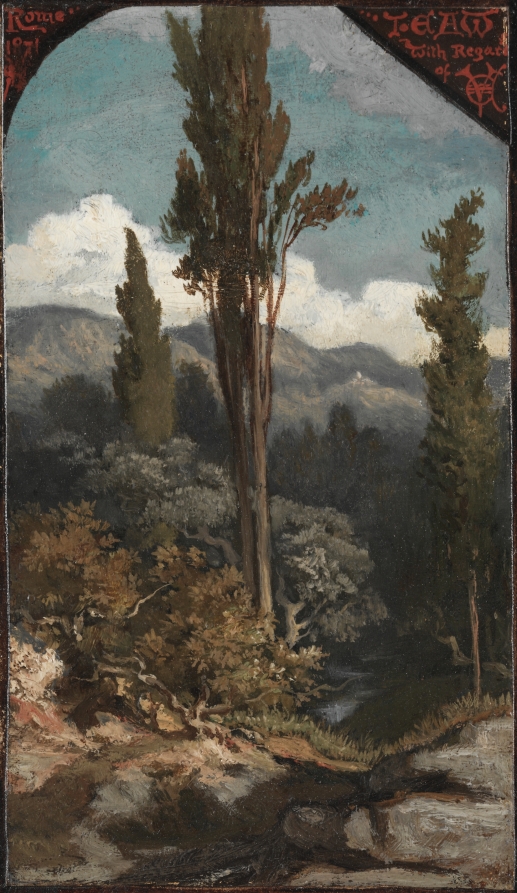
Elihu Vedder · The Cleveland Museum of Art · Gift of Mrs. John C. Newington · CC0
- Name
- Elihu Vedder
- Born
- 26 February 1836
- Birthplace
- New York City, U.S.
- Died
- 29 January 1923
- Place of death
- Rome, Kingdom of Italy
- Field
- Drawing Oil painting Mural painting
- Movement
- Symbolism Orientalism
- Nationality
- United States.
- Occupation
- painter and poet.
- Fields
- drawing.
- Movements
- realism and Symbolism.
- Languages
- English.
VALÉORINE Encyclopedia
VALÉORINE documentary reading
Documentary summary
Elihu Vedder (26 February 183629 January 1923) was an American symbolist painter, book illustrator and poet from New York City. He is best known for his fifty-five illustrations for Edward FitzGerald's translation of The Rubaiyat of Omar Khayyam (deluxe edition, published by Houghton Mifflin).
Admitted source layer · organised and presented by VALÉORINE
Reference Check
Propose documentary evidence for Elihu Vedder. A contribution is never written directly as fact: identity, source, rights and evidence gates still decide.
Sign in to contribute
World of VALÉORINE
Documentary connections
Only confirmed graph relationships appear here. Images are shown only when their identity and reuse rights both pass the documentary gate.
Documentary evidence
Documentary basis
Authority files
wikidata · Q389726 · wikipedia · Elihu Vedder
In this article
Biography
Biography
The recorded working language is English. The field of work recorded is drawing. Work by Elihu Vedder is recorded in the collections of Minneapolis Institute of Art, Art Institute of Chicago, Metropolitan Museum of Art, Fine Arts Museums of San Francisco and Smithsonian American Art Museum.
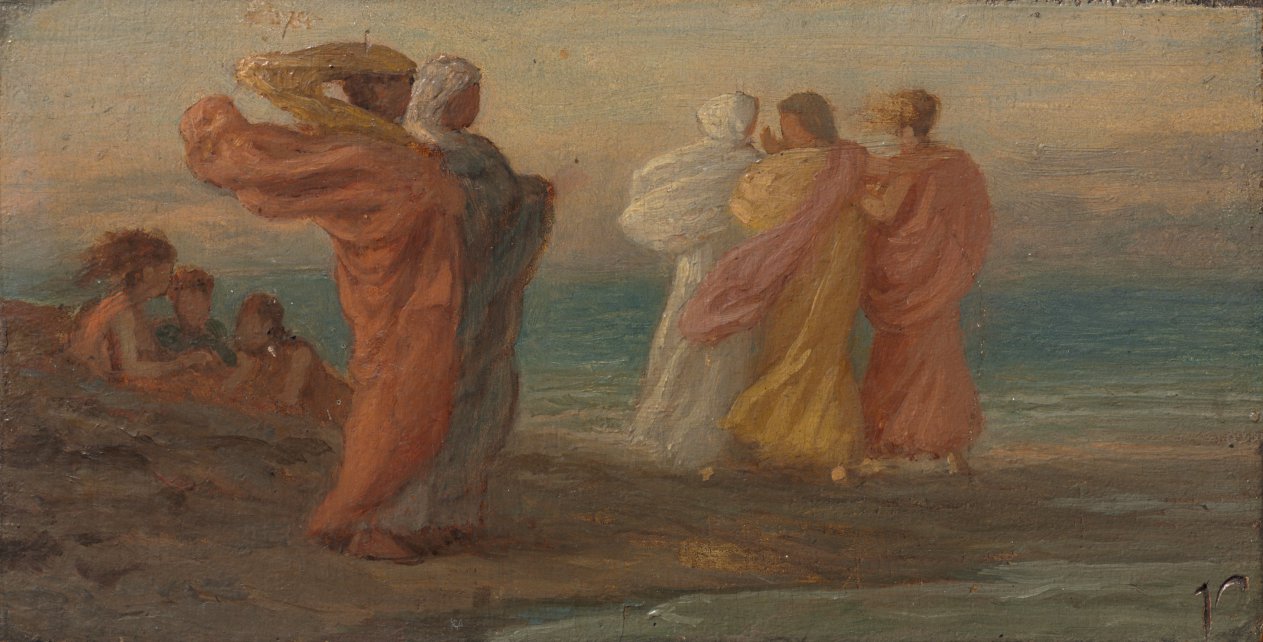
The Music Party, c. 1875, by Elihu Vedder
Elihu Vedder · The Cleveland Museum of Art · Gift of Betty Dunbar Brien in memory of her grandmother, Nancy McLeish Dunbar
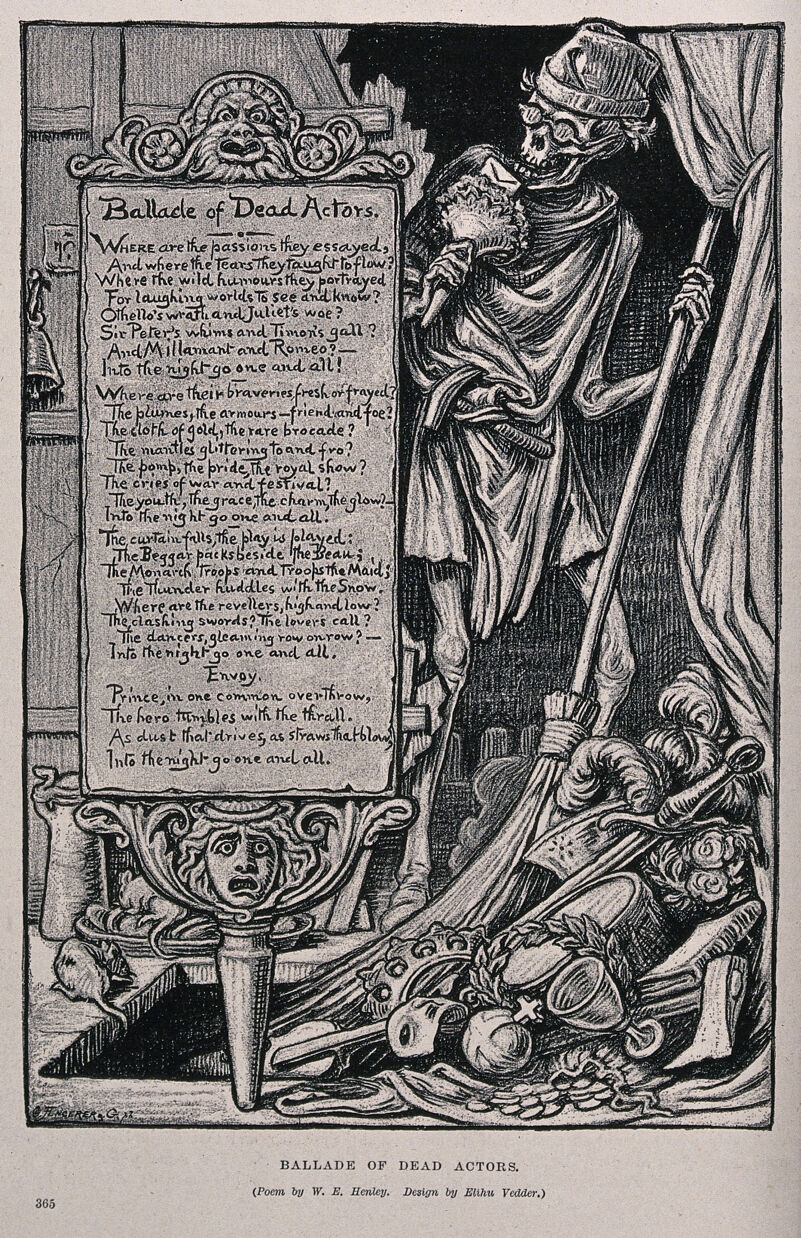
Death as an actor behind stage. Reproduction of a lithograph by Elihu Vedder, 1885., 1885, by Elihu Vedder
Elihu Vedder · Wellcome Collection, London · Wellcome Collection
Key facts
Key facts
• Name — Elihu Vedder • Born — 26 February 1836 • Birthplace — New York City, U.S. • Died — 29 January 1923 • Place of death — Rome, Kingdom of Italy • Field — Drawing Oil painting Mural painting • Movement — Symbolism Orientalism • Children — 4
Biography
Biography
• Illustration — Daguerreotype of Vedder as a schoolboy in 1847 Elihu Vedder was born on 26 February 1836 in New York City, the son of Elihu Vedder Sr. and Elizabeth Vedder. His parents were cousins. His father, a dentist, decided to try his luck in Cuba, and this had a profound impact on Elihu Jr.'s childhood. The remainder of his childhood was spent between his maternal grandfather Alexander Vedder's house in Schenectady and a boarding school. His mother supported his goals to be an artist while his father reluctantly assented, convinced that his son should try a different occupation. His brother, Alexander Madison Vedder, was a Navy surgeon who witnessed the transformation of Japan into a modern culture while he was stationed there. Vedder trained in New York City with Tompkins H. Matteson, then in Paris with François-Édouard Picot. Finally, he completed his studies in Italy - where he was strongly influenced not only by Italian Renaissance work but also by the modern Macchiaioli painters and the living Italian landscape. He first visited Italy from 1858 until 1860, becoming deeply emotionally attached to fellow painter Giovanni Costa. Their idyllic trips through the Italian countryside were cut short because Vedder's father cut off his financial allowance. • Illustration — Dancing Girl, oil on canvas, 1871. Reynolds House Museum of American Art Penniless, Vedder returned to the United States during the American Civil War and made a small living undertaking commercial illustrations. He was involved in the bohemian 'Pfaff's' coffee house group and painted some of his most memorable paintings notable for their visionary nature, romantic imagery and often Oriental influences. Paintings of this time include The Roc's Egg, The Fisherman and the Genii, and one of his most famous works, Lair of the Sea Serpent. In the United States, Vedder sought out and befriended Walt Whitman, Herman Melville and William Morris Hunt. Vedder became a member of the American Academy of Arts and Letters in 1865. At the end of the Civil War, Vedder left America to live in Italy. He married Caroline Rosekrans on 13 July 1869 in Glen Falls, New York. Elihu Vedder and his wife had four children, only two of whom survived. His daughter Anita Herriman Vedder played a vital role in handling the business of her father, who was notorious for his general aloofness towards details. Elihu's son Enoch Rosekrans Vedder was a promising architect who married jewelry designer Angela Reston. Enoch died while visiting his parents in Italy on 2 April 1916. Elihu had a home in Rome and - after the financial success of his 1884 Rubaiyat work - on the Isle of Capri, then a haven for male aesthetes. Vedder visited England many times, and was influenced by the Pre-Raphaelites, and was a friend of Simeon Solomon. He was also influenced by the work of English and Irish mystics such as William Blake and William Butler Yeats. In 1890 Vedder helped establish the In Arte Libertas group in Italy. Tiffany commissioned him to design glassware, mosaics and statuettes for the company. He decorated the hallway of the Reading Room of the Washington Library of Congress, and his mural paintings can still be seen there. Vedder occasionally returned to the United States, but lived only in Italy from 1906 until his death on 29 January 1923. He is buried in the Protestant Cemetery, Rome. There are no known living descendants of Elihu Vedder as both surviving children died without issue.
Exhibitions
Exhibitions
In 2008, the Smithsonian American Art Museum organized an exhibition of Vedder's Rubaiyat illustrations that toured several museums, including the Phoenix Art Museum.
Gallery
Gallery
• Illustration — Soul in Bondage, 1891–92. Brooklyn Museum • Illustration — The Questioner of the Sphinx (1863) • Illustration — Lair of the Sea Serpent, 1864, MFA Boston • Illustration — 9th study for The miller, his son and the donkey (1867/8) • Illustration — Peasant Girl Spinning (1867) • Illustration — The Sun God (1882) • Illustration — The Pleiades (1885) • Illustration — Mural, Lobby to Main Reading Room, Library of Congress Thomas Jefferson Building, Washington, D.C. Main figure is seated atop a pedestal saying "CORRUPT LEGISLATION". • Illustration — "Good Administration" mural by Elihu Vedder, Jefferson Building, Library of Congress LCCN2005675761 • Illustration — Government. Mural, Lobby to Main Reading Room, Library of Congress Thomas Jefferson Building, Washington, D.C. Main figure is seated atop a pedestal ("GOVERNMENT") holding a tablet with "A GOVERNMENT / OF THE PEOPLE / BY THE PEOPLE / FOR THE PEOPLE". • Illustration — Peace and Prosperity (1896) • Illustration — Minerva, 1896 (preparatory study) • Illustration — Minerva, 1896 (mosaic at the Library of Congress) with Nil invita Minerva, quae monumentum aere perennius exegit from Horace's Ars Poetica • Illustration — Lair of the Sea Serpent, 1899, The Met
Life and career
Dated record
Life and career
The full dated record · 2 entries
1836
Elihu Vedder born at New York City.
1923
Elihu Vedder died at Rome.
Places
Named by the record
Places
Only places the record itself states, plotted where the house gazetteer settles their coordinates. Nothing is inferred from a name or a nationality.
New York City.
Birth place
Rome.
Death place
Primary material
Documents and archives
scholarly publication
- Vedder, Elihu (1836-1923), artist, American National Biography Online, 2000
Scholarly · Crossref registry · 2000
Institutional database
- Wikidata, structured authority record Q389726: Elihu Vedder
Scholarly · Wikimedia Foundation
reference work
- “Elihu Vedder”, English Wikipedia, consulted as further reading
Reputable secondary · Wikipedia
Notes from the source article
Cited by Wikipedia
Notes from the source article
These works are cited by the source article, in its own numbering. They are recorded as its citations, not as sources VALÉORINE has verified.
- 1.Vedder, Elihu. Who's Who. 59. 1796–1797. 1907.
- 2.27. 964–965.
- 3.Stevens, Revalee R. & Robert Kim: North American Records: The Protestant Cemetery of Rome. Oracle Press, 1981
- 4.Phoenix Art Museum - Experience Art and Culture in Arizona. www.phxart.org.
Bibliography printed in the source article · 9
- Soria, Regina. Elihu Vedder: American Visionary Artist in Rome. Fairleigh Dickinson University Press. 1970. 0-8386-6906-9.
- Taylor, Joshua C. Perceptions and Evocations: The Art of Elihu Vedder. Smithsonian Books. 1979. 0-87474-902-6.
- Vedder, Elihu. The Digressions of V. Houghton Mifflin. 1910.
- Vedder, Elihu. Reminiscences Of An American Painter I: Art Education Fifty Years Ago. The World's Work: A History of Our Time. XIX. 12459–12470. January 1910.
- Vedder, Elihu. Reminiscences Of An American Painter II: Florentine Years In Retrospect. The World's Work: A History of Our Time. XIX. 12559–12570. February 1910.
- Vedder, Elihu. Reminiscences Of An American Painter III: New York In War Time. The World's Work: A History of Our Time. XIX. 12684–12694. March 1910.
- Vedder, Elihu. Reminiscences Of An American Painter Last Article: Paris and Rome. The World's Work: A History of Our Time. XIX. 12815–12824. April 1910.
- Vedder, Elihu. Miscellaneous Moods in Verse: One Hundred and One Poems with Illustrations. Porter E. Sargent. 1914.
- Vedder, Elihu. Doubt and Other Things. Porter E. Sargent. 1922.
References
Citations
References
Each reference names the institution holding it, so a reader may go to the document itself.
scholarly publication
Institutional witnessInstitutional database
Wikidata, structured authority record Q389726: Elihu VedderWikimedia Foundation
Institutional witnessreference work
Secondary witness
Further particulars
Held on the record
Further particulars
Open the remaining particulars
Elihu Vedder worked in drawing. His work is associated with realism and Symbolism. He belonged to American Academy of Arts and Letters.
Career and activity
Recognition and collections
Work by Elihu Vedder is
Minneapolis Institute of Art, Art Institute of Chicago, Metropolitan Museum of Art and Fine Arts Museums of San Francisco
The Encyclopedia exists whether or not anything is for sale. Corrections are recorded rather than overwritten, and every version of this record is kept. Published 14 August 2026.
Elsewhere in Books
39,451 published records in this field, each with its sources named.
- Eliezer YudkowskyAuthor
- Elif ŞafakAuthor
- Elihan Tore SaghuniAuthor
- Elihu B. WashburneAuthor
- Elijah ben Menahem HaZakenAuthor
- Elim MeshcherskyAuthor
- Elin PelinAuthor
- Elin WägnerAuthor
Best supported in this field
For owners
Own a work by Elihu Vedder?
A specialist will read what you send and tell you what the house can establish, what it cannot, and whether the object is suited to sale. There is no charge and no obligation. The object stays with you throughout; nothing is shipped to us unless it is arranged in writing beforehand.