
Domenico Campagnola
Domenico Campagnola (c. 1500–1564) was an Italian painter and printmaker in engraving and woodcut of the Venetian Renaissance, but whose most influential works were his drawings of landscapes.
Also recorded as Campagnola Domenico · Domenicus Campagnola · Dominique Campagnol · le Campagnole
Domenico Campagnola
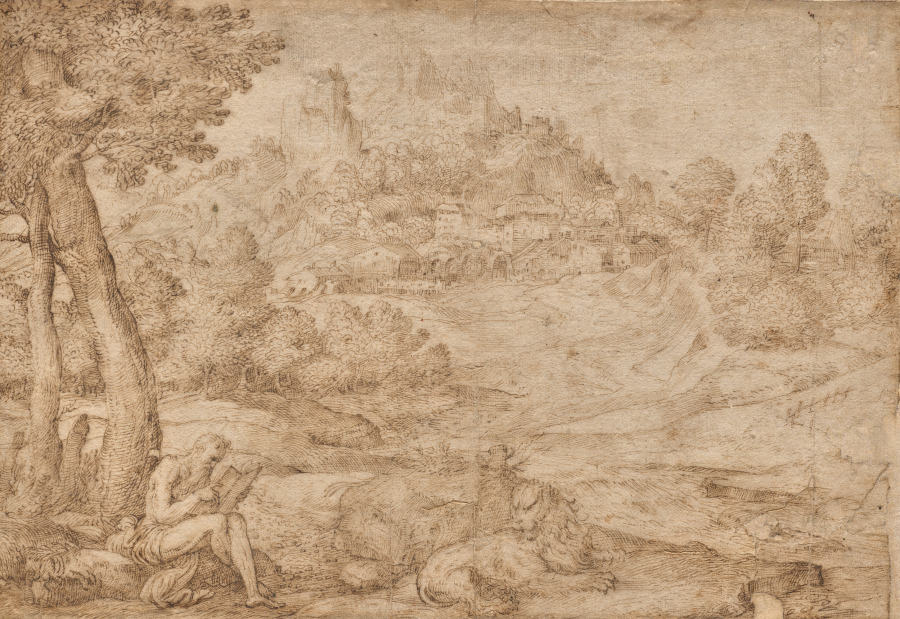
Domenico Campagnola · The Cleveland Museum of Art · The Charles W. Harkness Endowment Fund · CC0
- Born
- 1500.
- Died
- 1564.
- Nationality
- Republic of Venice.
- Occupation
- painter and printmaker.
VALÉORINE Encyclopedia
VALÉORINE documentary reading
Documentary summary
Domenico Campagnola (c. 1500–1564) was an Italian painter and printmaker in engraving and woodcut of the Venetian Renaissance, but whose most influential works were his drawings of landscapes.
Admitted source layer · organised and presented by VALÉORINE
Reference Check
Propose documentary evidence for Domenico Campagnola. A contribution is never written directly as fact: identity, source, rights and evidence gates still decide.
Sign in to contribute
Documentary evidence
Documentary basis
Authority files
wikidata · Q1237088 · wikipedia · Domenico Campagnola
In this article
Life and work
Life and work
Born probably in Venice, he was the pupil of his father, the leading engraver and painter Giulio Campagnola. He appears to have been adopted by his father as a young boy. His grandfather, Girolamo Campagnola was a famous humanist and painter in Padua (end of the 15th century). He was presumably trained initially by his father, and may also have been a pupil of Titian, with whose workshop he was clearly associated. Much of his early painting may be of landscape backgrounds in Titians. He is mainly remembered for his prints and his drawings, especially of landscapes. In his lifetime he was a successful painter, mostly in Padua (Giulio's home town), where he was mainly based from the early 1520s onwards, until his death there in 1564. Mostly he painted on walls, including decorative schemes, but portraits and landscapes are also attributed to him. His works as a painter are not highly regarded by modern art historians though some landscapes are of high quality. His engravings, fourteen of which are known, were produced in a short burst in 1517-18, when he was still in his teens; most are dated 1517. On some his name appears in full, on others, abbreviated "Do.Cap" or "Do.Camp." (for "Domenico Campagnola"). He appears to have cut his own blocks for his woodcuts, using a very different style from the professional cutters most artists employed. Like his father he was a versatile and experimental artist. His landscape drawings were produced as finished products for sale; he was one of the first artists to do this. He may have included etching on some plates, including the Old soldier and shepherd. His most successful prints include his Old soldier and shepherd [1], his Battle of naked men, and his Assumption. One engraving appears to have been begun by his father and completed by Domenico, perhaps after his father died. He fell out seriously with Titian, perhaps as a result of the sharp practice which Peter Dreyer has discovered in recent years; it is thought to be Domenico who took very faint counter-proof impressions of some Titian woodcuts, which were then worked over in ink and passed off as Titian's preliminary drawings. This may well have played a part in bringing to an end Titian's first period of serious interest in making prints based on his work; it was to be some decades before he began collaborating with Cornelius Cort in producing engravings. None of Campagnola's engravings are direct renderings of paintings by Titian, but many are similar in composition, though very different in handling, even allowing for the difference in medium. Many drawings long considered by Titian are now thought to be by Domenico, and attribution of many is still disputed, as some earlier drawings are disputed between his father Giulio, Titian, and Giorgione. Drawings have also been reattributed from Domenico to Giulio Campagnola. He began by closely following the style of his father and Titian in producing landscapes with figures, but produced larger numbers, and made them directly for sale, so that it is largely through him that this influential typology became widely known. According to James Byam Shaw:"In later drawings, Campagnola debased this style of landscape into a kind of facile mannerism; nevertheless he furnished inspiration for Italian draughtsmen for generations to come, including... Agostino and Annibale Carracci, and Domenichino and Grimaldi later still."
Life and career
Dated record
Life and career
The full dated record · 2 entries
1500
Domenico Campagnola was born in 1500.
1564
Domenico Campagnola died at Padua.
Surviving paintings
Most of his paintings have been destroyed. Fresco paintings are to be seen in the Scuola del Santo at Padua and in Venice, marked by fresh animated colour and easy brilliant technique. These are sometimes also attributed to his father. A fine panel picture by him representing Adam and Eve is in the Pitti Palace, Florence.
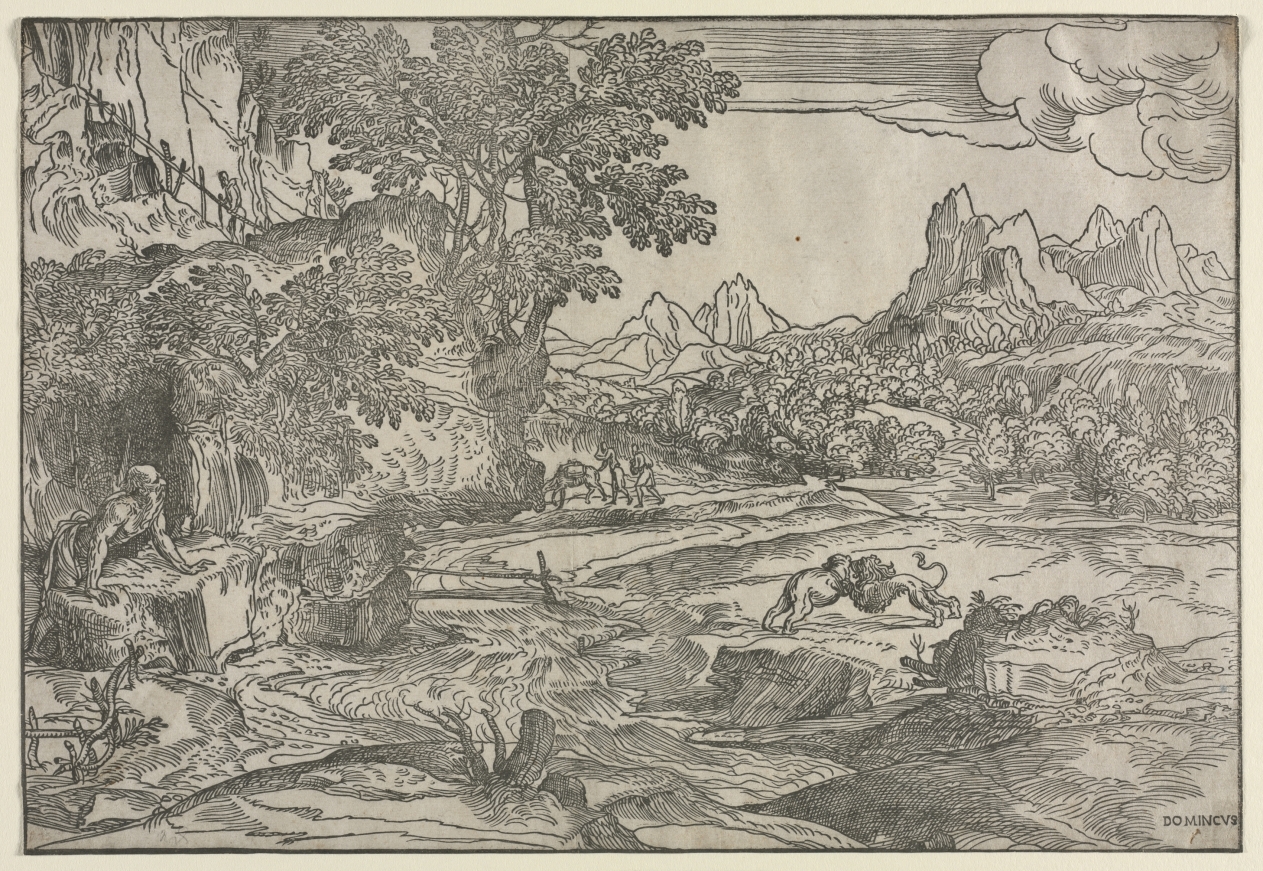
Landscape with Saint Jerome and Two Lions, c. 1530–35, by Domenico Campagnola
Domenico Campagnola · The Cleveland Museum of Art · Dudley P. Allen Fund
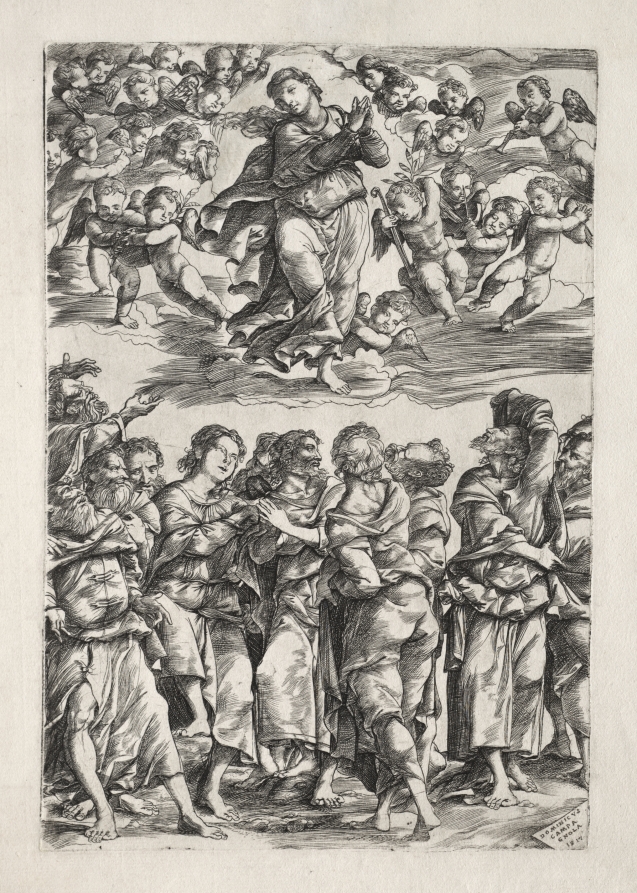
The Assumption of the Virgin, 1517, by Domenico Campagnola
Domenico Campagnola · The Cleveland Museum of Art · Dudley P. Allen Fund
Notes from the source article
Cited by Wikipedia
Notes from the source article
These works are cited by the source article, in its own numbering. They are recorded as its citations, not as sources VALÉORINE has verified.
- 1.Jay A. Levinson (ed.) Early Italian Engravings from the National Gallery of Art, pp 410-436 National Gallery of Art, Washington (Catalogue), 1973, LOC 7379624
- 2.Farquhar, Maria. Biographical catalogue of the principal Italian painters. Woodfall & Kinder. 36. 1855.
- 3.ULAN
- 4.David Landau in Jane Martineau (ed), The Genius of Venice, 1500-1600, p. 305, 1983, Royal Academy of Arts, London.
- 5.See for example no. D9 on p.251 of The Genius of Venice op cit (Three Philosophers in a Landscape, Lugt Collection, Paris)
- 6.The Genius of Venice op cit, p 243.
- 7.Williamson, George Charles. 3.
References
Citations
References
Each reference names the institution holding it, so a reader may go to the document itself.
reference work
Wikidata, structured authority record Q1237088: Domenico CampagnolaWikimedia Foundation
Secondary witnessreference work
Secondary witness
The Encyclopedia exists whether or not anything is for sale. Corrections are recorded rather than overwritten, and every version of this record is kept. Published 14 August 2026.
Elsewhere in Prints
4,138 published records in this field, each with its sources named.
- Dmitri PlavinskyEngraver
- Do Ho SuhEngraver
- Doel ReedEngraver
- Domenico BeccafumiEngraver
- Domenico CunegoEngraver
- Domenico del BarbiereEngraver
- Domenico FalciniEngraver
- Domenico MaggiottoEngraver
Best supported in this field
For owners
Own a work by Domenico Campagnola?
A specialist will read what you send and tell you what the house can establish, what it cannot, and whether the object is suited to sale. There is no charge and no obligation. The object stays with you throughout; nothing is shipped to us unless it is arranged in writing beforehand.