
Dirck Barendsz.
Dirck Barendsz or Theodor Barendszoon (1534–1592) was a Dutch Renaissance painter from Amsterdam who traveled to Italy in his youth to learn from the Italian masters, most notably Titian.
Also recorded as Theodor Barendszoon · T. Bernardus · Theodore Berenstein · Theodorus Bernardus Amsterodamus Barendsz.
Dirck Barendsz.
Dirck Barendsz. · Wellcome Collection, London · Wellcome Collection · Public Domain Mark
- Born
- 1534. · Amsterdam.
- Died
- 1592. · Amsterdam.
- Nationality
- Dutch Republic.
- Occupation
- painter and artist.
- Known for
- Portrait of William I. Prince of Orange, called William the Silent, Meal of the Amsterdam militia and Meal of 14 militia guardsmen.
VALÉORINE Encyclopedia
VALÉORINE documentary reading
Documentary summary
Dirck Barendsz or Theodor Barendszoon (1534–1592) was a Dutch Renaissance painter from Amsterdam who traveled to Italy in his youth to learn from the Italian masters, most notably Titian.
Admitted source layer · organised and presented by VALÉORINE
Note VALÉORINE
No house-authored Note is published until its assertions and sources pass the VALÉORINE evidence contract. The documentary article remains available in full while that enrichment is being consolidated.
Documentary enrichment in progress · no unsupported statement published
Reference Check
Propose documentary evidence for Dirck Barendsz.. A contribution is never written directly as fact: identity, source, rights and evidence gates still decide.
Sign in to contribute
World of VALÉORINE
Documentary connections
Only confirmed graph relationships appear here. Images are shown only when their identity and reuse rights both pass the documentary gate.
Documentary evidence
Evidence Panel
wikipedia incomplete · checked 25 September 2026
- Identity
- resolved
- Independent source families
- 0
- Admitted assertions
- 0
- Open conflicts
- 0
Authority files
wikidata · Q2183916
In this article
Biography
Places of work recorded in the authority are Amsterdam, Rome and Venice. Works named in the authority record are Portrait of William I. Prince of Orange, called William the Silent, Meal of the Amsterdam militia and Meal of 14 militia guardsmen. Work by Dirck Barendsz. Is recorded in the collections of Museum Boijmans Van Beuningen, Auckland Art Gallery, National Gallery of Canada, Groeningemuseum and Royal Library of Belgium.
He was trained by his father, a painter known as Barend Dircksz, or deaf Barent, and in 1555, at the age of twenty-one, Barendsz travelled to Italy. During his seven-year stay there, Karel van Mander tells us that he was "nursed at the great Titian's bosem." He was a great friend of Philip Van Marnix, whom he met in Rome, and Dominicus Lampsonius, with whom he corresponded in Latin. He was a good musician and his most notable work, among various other pieces Van Mander describes that he painted in Amsterdam, was a Judith. Among pieces worthy of mention in Leiden that Van Mander liked was a Venus that at the time he was writing in 1604 was in the possession of Sybrandt Buyck (son of the last Catholic mayor of Amsterdam, Joost Sijbrantsz Buyck). Van Mander further lists several Tafels (altarpieces), including a "Christmas piece" in the possession of the Fraterhouse in Gouda, and a copy of a tronie by Titian, in the possession of Pieter Isaacsz (1569–1625), an Amsterdam painter and art dealer. The "Christmas piece" is still in Gouda and is the only complete surviving altarpiece by him. His chapel piece for the Amsterdam militia, called a Fall of Lucifer by Mander, was destroyed in the Beeldenstorm, but his militia portrait for the same group that hung in their meeting hall survived. He died in Amsterdam.
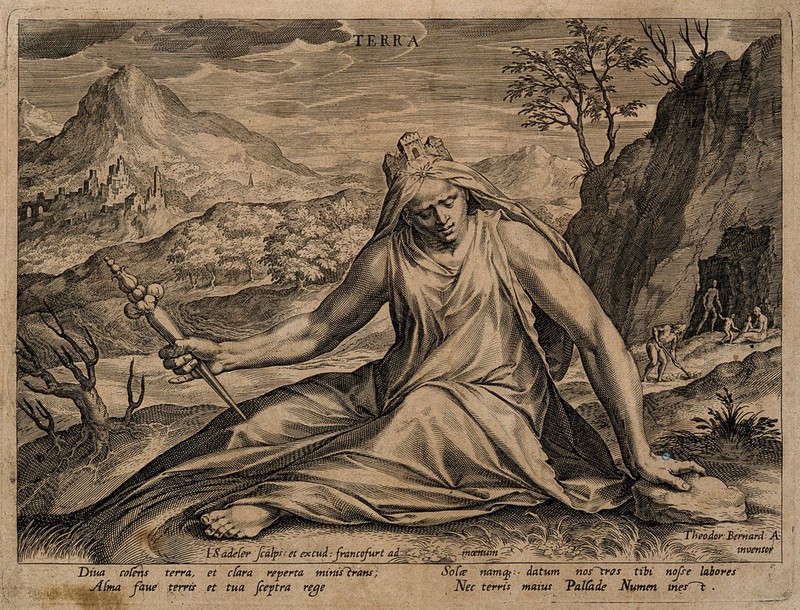
Cybele wearing a turreted crown and holding a sceptre; in the background men work on the land; representing Earth, one of the four elements. Engraving by J. Sadeler, 1587, after D. Barendsz., 1587, by Dirck Barendsz.
Dirck Barendsz. · Wellcome Collection, London · Wellcome Collection
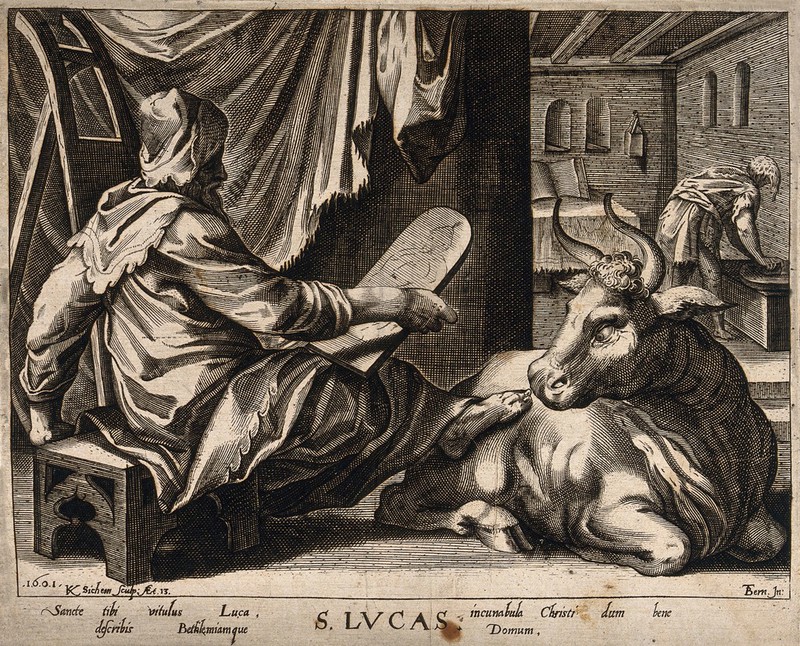
Saint Luke. Engraving by K. van Sichem, 1601, after D. Barendz., 1601, by Dirck Barendsz.
Dirck Barendsz. · Wellcome Collection, London · Wellcome Collection
Notes from the source article
Cited by Wikipedia
Notes from the source article
These works are cited by the source article, in its own numbering. They are recorded as its citations, not as sources VALÉORINE has verified.
- 1.Dirck Barentsen biography in Karel van Mander's Schilderboeck, 1604, courtesy of the Digital library for Dutch literature
- 2.Dbnl.org. Dirck Barentsen, die Schilder geboren wesende, noch daerenboven des grooten Titiaens boesem heeft ghenoten.
- 3.Marcel Roethlisberger, Review of Dirck Barendsz. 1534-1592 by J. Richard Judson and Jan Asselijn by Anne Charlotte Steland-Stief, The Art Bulletin, vol. 54 (Dec., 1972), pp. 553-555.
- 4.Article about Dirck Barentsen, including an illustrated discussion of this triptych, by Jay Richard Judson, Bulletin KMSK, 1962
Bibliography printed in the source article · 1
- Barentsen or Barents, Thierry. 3. 173.
References
Citations
References
Each reference names the institution holding it, so a reader may go to the document itself.
authority record
Unverified
The Encyclopedia exists whether or not anything is for sale. Corrections are recorded rather than overwritten, and every version of this record is kept. Published 14 August 2026.
Elsewhere in Paintings
18,623 published records in this field, each with its sources named.
- Dionys van NijmegenArtist
- Dionysius of FournaArtist
- Dióscoro PueblaArtist
- Dipo DohertyArtist
- Dirck BlekerArtist
- Dirck Dalens the ElderArtist
- Dirck FerrerisArtist
- Dirck HalsArtist
Best supported in this field
For owners
Own a work by Dirck Barendsz.?
A specialist will read what you send and tell you what the house can establish, what it cannot, and whether the object is suited to sale. There is no charge and no obligation. The object stays with you throughout; nothing is shipped to us unless it is arranged in writing beforehand.