
dilrupa
The dilruba (also spelled dilrupa) is a bowed musical instrument originating in India. It is a type of bowed sitar that's slightly larger than an esraj and has a larger, square resonance box like a sarangi. The dilruba holds particular importance in Sikh history.
dilrupa

J Singh · DSCN0809 Uploaded by Hekerui · CC BY-SA 2.0
- Name
- Dilruba
- Field
- necked bowl lute played with a bow
- Region
- India
Reference Check
Propose documentary evidence for dilrupa. A contribution is never written directly as fact: identity, source, rights and evidence gates still decide.
Sign in to contribute
World of VALÉORINE
Documentary connections
Only confirmed graph relationships appear here. Images are shown only when their identity and reuse rights both pass the documentary gate.
Documentary evidence
Documentary basis
Authority files
wikidata · Q5277044
In this article
Overview
Overview
It became more widely known outside India in the 1960s through use in songs by Western artists, such as the Beatles during their psychedelic phase (most notably in the song "Within You Without You").
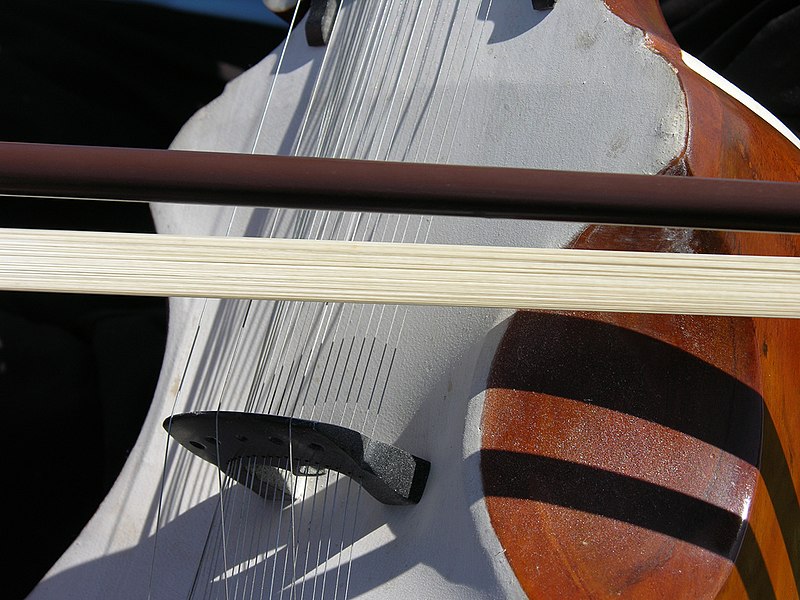
Dilruba detail.
gurmatsangeetorg · Dilruba Uploaded by Hekerui

Ustad Baljit Singh awarded by Delhi Government.
AmanDhally
Key facts
Key facts
• Name — Dilruba • Names — Dilrupa • Background — string • Classification — Bowed string instrument • Developed — India
Etymology
Etymology
The name of the instrument derives from the Persian دلربا/दिलरुबा (dilrubā), literally meaning "that which ravishes or steals the heart."
History
History
Although versions of the dilruba have existed as far back as the third and fourth centuries, the version played by Sikhs is believed to have been remastered around 300 years ago by the 10th Sikh Guru, Guru Gobind Singh, who based it on the much older and much heavier taus. His innovations made it more convenient for the Sikh army (the khalsa) to carry the instrument on horseback. There is some doubt in the research community about the truth of the traditional origin story described above. Some traditional kirtan bearers, such as Bhai Avtar Singh Raagi, have clarified the history of the dilruba's creation being tied to the patronage of Maharaja Bhupinder Singh and created by Mahant Gajja Singh. After the introduction of the harmonium to the Indian Subcontinent by the British Raj, the dilruba fell out of use due to its comparatively steeper learning curve. In more recent times, it has had a resurgence, accompanying ragis in the Harmandir Sahib (Golden Temple) since 2006, and becoming more commonly taught within India and around the world.
Construction
Construction
The construction of a dilruba is very similar to the sitar with some components of the sarangi. Like the sitar, it has a long neck with about 20 moveable metal frets. It has 4 metal main strings and more than 20 sympathetic strings. Of the main strings, only the leftmost string is played with the bow. The resonator of the instrument, at the bottom, is a hollowed out gourd or carved wood covered with a stretched piece of goatskin, in the style of the sarangi. Some dilrubas may have a gourd attached to the top of the neck for balance or tone adjustment. To play a dilruba, the musician sits and rests the bottom of the instrument in front of them or in their lap, with the neck resting on the musician's left shoulder. The left hand uses the frets as a guide to modify the pitch of the leftmost string. The bow is held in the right hand. To produce the portamento or meend that is characteristic of Indian music, the musician moves the left hand up and down the string, rather than stretching the string across the fret like a sitar.
Places
Named by the record
Places
Only places the record itself states, plotted where the house gazetteer settles their coordinates. Nothing is inferred from a name or a nationality.
- India
Text attribution
Licensing
Text attribution
Part of the biographical narrative on this page reuses licensed material. Its origin, revision and licence are recorded here.
The biographical narrative on this page is based on the Wikipedia article Dilruba, revision 1374166376 (EN edition), by its contributors. VALÉORINE has edited that text and built its own documentary record around it. The reused material is available under CC BY-SA 4.0, and this page's reuse of it is offered under the same licence. Everything else on this page — the chronology, the holdings, the evidence, the plates and the connections — is VALÉORINE's own record. Sources and licences.
Notes from the source article
Cited by Wikipedia
Notes from the source article
These works are cited by the source article, in its own numbering. They are recorded as its citations, not as sources VALÉORINE has verified.
- 1.Dutta, Madhumita. Let's Know Music and Musical Instruments of India. Star Publications. 22–23. 2008. 978-1-905863-29-7.
- 2.Khalsa, Sukhmandir. Dilruba: Ravisher of the Heart. Learning Religions. 4 June 2017.
- 3.Dharam Singh. Perspectives on Sikhism. Publication Bureau, Punjabi University. 158. 2001. 978-8-1738-0736-7.
- 4.Rarely played Indian instruments. Radioandmusic.com. 2018-03-29.
- 5.Kaur Khalsa, Nirinjan. The Renaissance of Sikh Devotional Music Memory, Identity, Orthopraxy. 2014.
- 6.Clearing misconceptions on the history of the Dilruba - Bhai Avtar Singh Ji Ragi. YouTube.
- 7.Dutta, Madhumita. Let's Know Music and Musical Instruments of India. Star Publications. 22. 2008. 978-1-905863-29-7.
- 8.Krishnaswami, S. Musical Instruments of India. Publications Division of the Ministry of Information and Broadcasting, Govt of India. 36. 1971.
- 9.Dilruba. Discover Sikhism. 2020-03-08.
- 10.Tribhuwan, Robin. Rudra Veena: An Ancient String Musical Instrument. Discovery Publishing House. 21. 2001. 81-7141-581-4.
References
Citations
References
Each reference names the institution holding it, so a reader may go to the document itself.
reference work
Secondary witness
Connections
Knowledge graph
Connections
Each connection was recorded deliberately, with the basis for it kept on the internal record.
Place
1- IndiaPlace
Established from a fact already recorded on a verified source.
The Encyclopedia exists whether or not anything is for sale. Corrections are recorded rather than overwritten, and every version of this record is kept. Published 16 August 2026.
Elsewhere in Collectables
20,755 published records in this field, each with its sources named.
- dildoTerminology
- dili tuidukTerminology
- Dillon's Dead-Heat BreakersWork
- Dillon's Rolling WesternWork
- DimahooWork
- Dimension XWork
- Diner DashWork
- DingfelderOrganisation
Best supported in this field
For owners
Own an object connected with dilrupa?
A specialist will read what you send and tell you what the house can establish, what it cannot, and whether the object is suited to sale. There is no charge and no obligation. The object stays with you throughout; nothing is shipped to us unless it is arranged in writing beforehand.