
Debora Vaarandi
Debora Vaarandi (born Debora Trull; 1 October 1916 – 28 April 2007) was an Estonian writer, considered to be a leading literary figure in post–World War II Estonia. Many of her poems were set to music. Vaarandi was a recipient of the first Juhan Liiv Poetry Award, and was recognized with the Cultural Award of the Republic of Estonia for outstanding lifetime achievement.
Debora Vaarandi
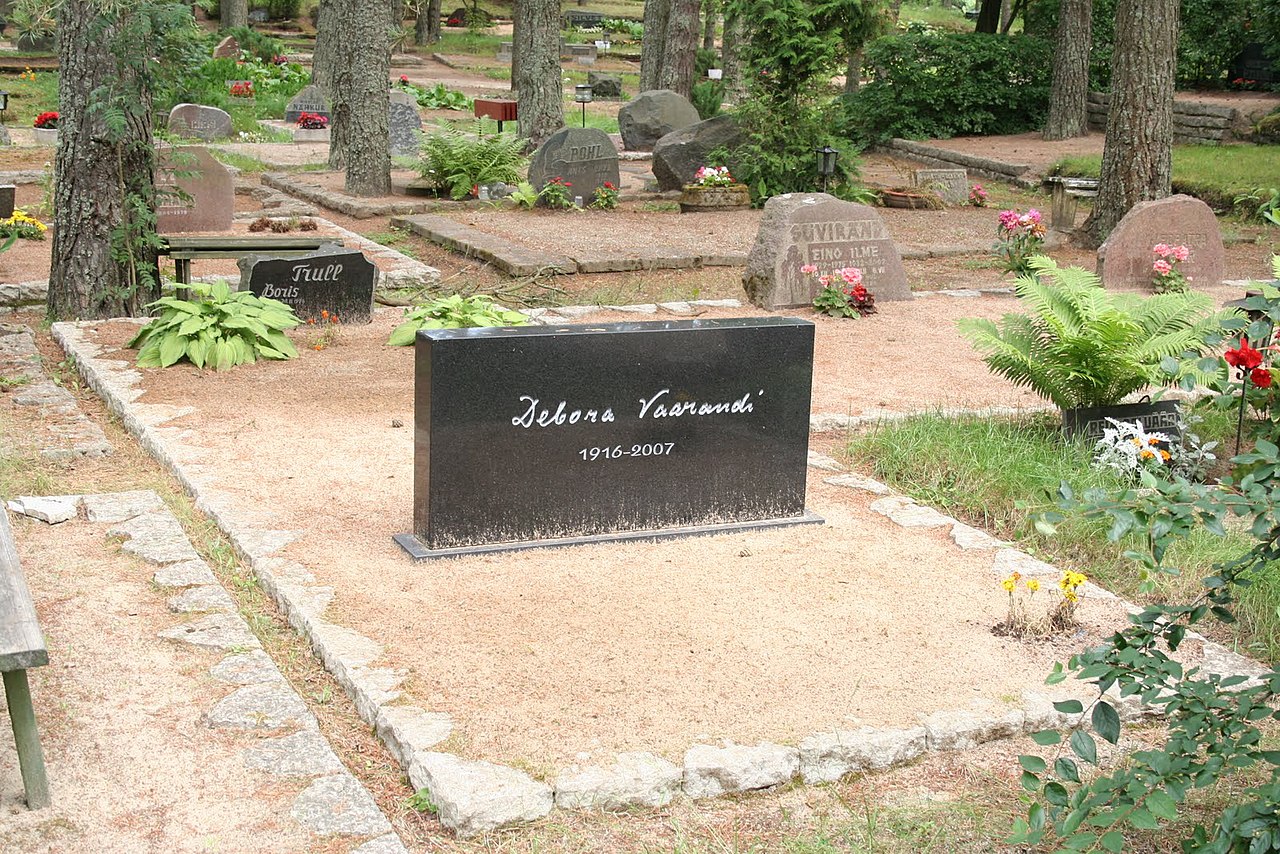
Jaak Urmet · CC BY-SA 3.0
- Name
- Debora Vaarandi
- Birth Name
- Debora Trull
- Born
- 1 October 1916
- Birthplace
- Võru, Russian Empire
- Died
- 28 April 2007
- Place of death
- Tallinn, Estonia
- Occupation
- Writer
- Education
- University of Tartu
- Spouse
- Aadu Hint, Juhan Smuul
- Awards
- Order of the White Rose of Finland
- Nationality
- Estonia
- Fields
- poetry
VALÉORINE Encyclopedia
VALÉORINE documentary reading
Documentary summary
Debora Vaarandi (born Debora Trull; 1 October 1916 – 28 April 2007) was an Estonian writer, considered to be a leading literary figure in post–World War II Estonia. Many of her poems were set to music. Vaarandi was a recipient of the first Juhan Liiv Poetry Award, and was recognized with the Cultural Award of the Republic of Estonia for outstanding lifetime achievement.
Admitted source layer · organised and presented by VALÉORINE
Note VALÉORINE
Debora Vaarandi (1916–2007) was a journalist, poet and translator, among other activities, of Estonian nationality. The journalist was born in Võru and died in Tallinn.
Debora Vaarandi was educated at University of Tartu. Activity centred on poetry.
Languages used include Estonian. Honours include Honored Writer of the Estonian SSR, Juhan Liiv Poetry Award and Order of the October Revolution, among others.
Composed from admitted, traceable facts · 26 September 2026
VALÉORINE
Reference Check
Propose documentary evidence for Debora Vaarandi. A contribution is never written directly as fact: identity, source, rights and evidence gates still decide.
Sign in to contribute
World of VALÉORINE
Documentary connections
Only confirmed graph relationships appear here. Images are shown only when their identity and reuse rights both pass the documentary gate.
Documentary evidence
Documentary basis
Authority files
wikidata · Q543862 · wikipedia · Debora Vaarandi
In this article
Biography
Biography
Debora Vaarandi studied at University of Tartu. The recorded working language is Estonian. The field of work recorded is poetry. Distinctions recorded are Honored Writer of the Estonian SSR, People's Writer of the Estonian SSR, Order of the White Star, 3rd Class and Juhan Liiv Poetry Award.

Debora Vaarandi portree, Kaarel Liimand, TKM TR 1714 M 353
Kaarel Liimand · TKM TR 1714 M 353
Key facts
Key facts
• Name — Debora Vaarandi • Birth Name — Debora Trull • Born — 1 October 1916 • Birthplace — Võru, Russian Empire • Died — 28 April 2007 • Place of death — Tallinn, Estonia • Occupation — Writer • Education — University of Tartu • Notable Works — Põleva laotuse all • Spouse — Aadu Hint, Juhan Smuul • Awards — Order of the White Rose of Finland • Illustration — Vaarandi's grave in Pärnamäe Cemetery
Biography
Biography
Debora Vaarandi was born in Võru on 1 October 1916 to Julianus and Tamara Trull (née Ella). She grew up on the island of Saaremaa. Vaarandi studied language and literature at the University of Tartu. In 1936, she married Aadu Hint; the couple later divorced. She joined the Communist Party of Estonia in 1940. When the Germans invaded Estonia, she escaped to Russia, returning to Estonia in 1944. Although not trained as a journalist, she worked as editor in chief of the communist newspaper Sirp ja Vasar. She was forced to resign from that post after contracting tuberculosis. In 1946, her first collection of poetry Põleva laotuse all ("Under a Blazing Sky") was published. Her work celebrates values such as the love of nature, the importance of family and the beauty of small things. Many of her poems have been set to music. In 1952, she married the writer Juhan Smuul. After 1977, she focused on translating works by Anna Akhmatova, Georg Trakl, and Edith Södergran into Estonian. She was awarded the Order of the White Rose of Finland for translating Finnish poetry into Estonian.
Selected works
Selected works
• Unistaja aknal ("The Dreamer at the Window") (1959) • Tuule valgel ("In the Light of the Wind") (1977)
Places
Named by the record
Places
Only places the record itself states, plotted where the house gazetteer settles their coordinates. Nothing is inferred from a name or a nationality.
Võru.
Birth place
Tallinn.
Death place
Primary material
Documents and archives
reference work
- “Debora Vaarandi”, English Wikipedia, consulted as further reading
Reputable secondary · Wikipedia
authority record
- Wikidata, structured authority record Q543862: Debora Vaarandi
General reference · Wikidata
Awards and honors
• 1965, she received the first Juhan Liiv Poetry Award • 2005, she was recognized with the Cultural Award of the Republic of Estonia for outstanding lifetime achievement.
Notes from the source article
Cited by Wikipedia
Notes from the source article
These works are cited by the source article, in its own numbering. They are recorded as its citations, not as sources VALÉORINE has verified.
References
Citations
References
Each reference names the institution holding it, so a reader may go to the document itself.
reference work
Secondary witnessauthority record
General reference
The Encyclopedia exists whether or not anything is for sale. Corrections are recorded rather than overwritten, and every version of this record is kept. Published 16 August 2026.
Elsewhere in Books
38,960 published records in this field, each with its sources named.
- Debbie FordAuthor
- Debiprasad ChattopadhyayAuthor
- Debito ArudouAuthor
- Debora GregerAuthor
- Debora VogelAuthor
- Deborah A. MirandaAuthor
- Deborah AgerAuthor
- Deborah DiggesAuthor
Best supported in this field
For owners
Own a work by Debora Vaarandi?
A specialist will read what you send and tell you what the house can establish, what it cannot, and whether the object is suited to sale. There is no charge and no obligation. The object stays with you throughout; nothing is shipped to us unless it is arranged in writing beforehand.