
David Young Cameron
Sir David Young Cameron (28 June 1865 – 16 September 1945) was a Scottish painter and, with greater success, etcher, mostly of townscapes and landscapes in both cases. He was a leading figure in the final decades of the Etching Revival.
Also recorded as D. Y. Cameron · Sir Cameron · David Cameron · Sir D. Y. Cameron
David Young Cameron
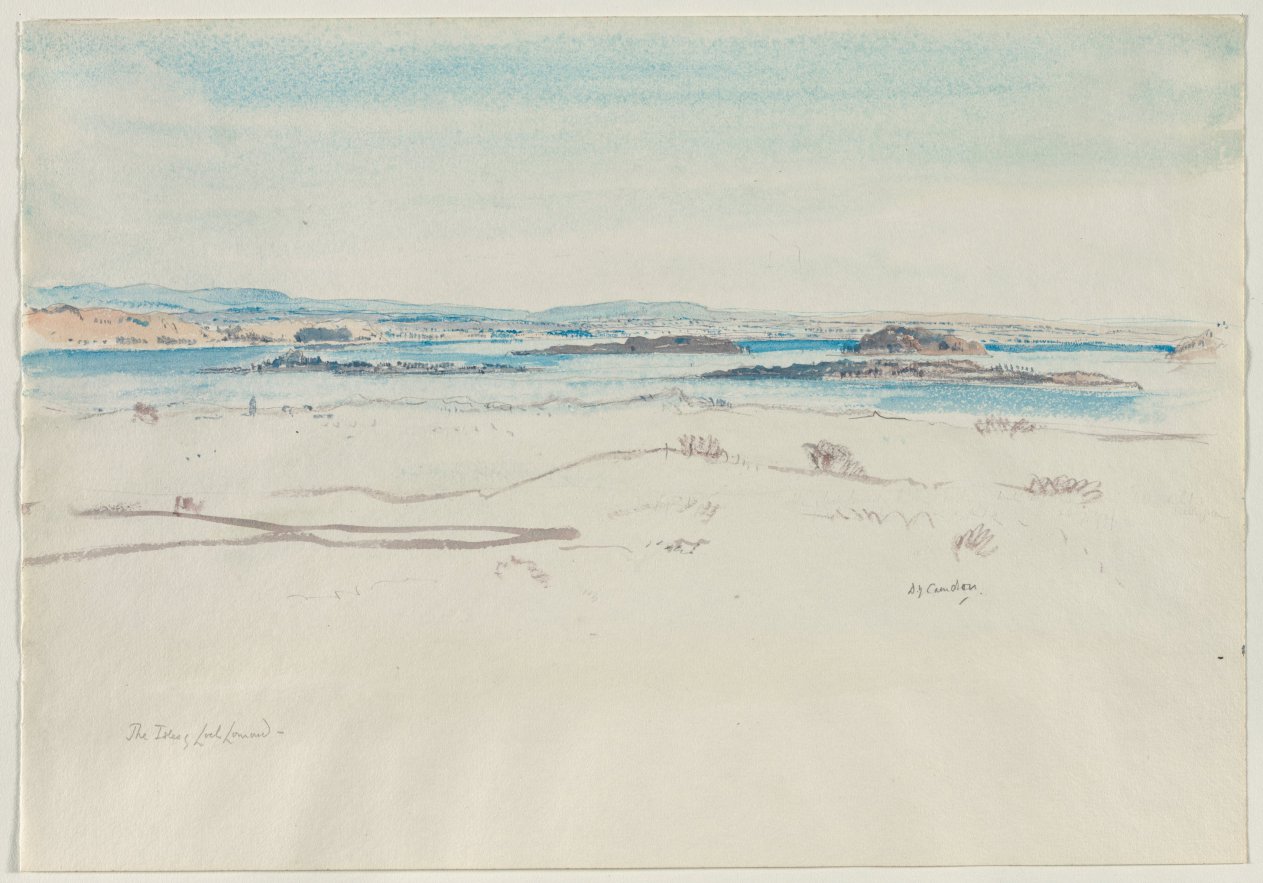
David Young Cameron · The Cleveland Museum of Art · Bequest of Mrs. Henry A. Everett for the Dorothy Burnham Everett Memorial Collection · CC0
- Born
- 1865. · Glasgow.
- Died
- 1945. · Perth.
- Nationality
- United Kingdom.
- Occupation
- painter, printmaker, artist, exlibrist and etcher.
- Fields
- visual arts, painting and graphics.
- Education
- Edinburgh College of Art, Glasgow School of Art and The Glasgow Academy.
- Languages
- English.
VALÉORINE Encyclopedia
VALÉORINE documentary reading
Documentary summary
Sir David Young Cameron (28 June 1865 – 16 September 1945) was a Scottish painter and, with greater success, etcher, mostly of townscapes and landscapes in both cases. He was a leading figure in the final decades of the Etching Revival.
Admitted source layer · organised and presented by VALÉORINE
Note VALÉORINE
No house-authored Note is published until its assertions and sources pass the VALÉORINE evidence contract. The documentary article remains available in full while that enrichment is being consolidated.
Documentary enrichment in progress · no unsupported statement published
Reference Check
Propose documentary evidence for David Young Cameron. A contribution is never written directly as fact: identity, source, rights and evidence gates still decide.
Sign in to contribute
World of VALÉORINE
Documentary connections
Only confirmed graph relationships appear here. Images are shown only when their identity and reuse rights both pass the documentary gate.
Documentary evidence
Evidence Panel
wikipedia incomplete · checked 25 September 2026
- Identity
- resolved
- Independent source families
- 0
- Admitted assertions
- 0
- Open conflicts
- 0
Authority files
wikidata · Q3703382 · wikipedia · David Young Cameron
In this article
Biography
Biography
David Young Cameron studied at Edinburgh College of Art, Glasgow School of Art and The Glasgow Academy. The recorded working language is English. The field of work recorded is visual arts, painting and graphics. Work by David Young Cameron is recorded in the collections of Nationalmuseum, Minneapolis Institute of Art, The Nelson-Atkins Museum of Art, Auckland Art Gallery and Finnish National Gallery.
Cameron was the son of the Rev. Robert Cameron of the United Presbyterian Church, and his wife Margaret Robertson, and was born in Glasgow, Scotland. One of five children, his sister Katharine (Kate) Cameron (1874–1965) was also an artist and sometimes included in the "Glasgow Girls".(David was educated at The Glasgow Academy. From around 1881 he studied at the Glasgow School of Art and in 1885 enrolled at the Edinburgh School of Art. Cameron became a skilled etcher and gained international recognition by the 1890s. He was elected associate of the Royal Society of Painter-Etchers (RE) in 1889. In 1895 he was elected Fellow of the RE. He exhibited regularly from 1889 to 1902, before resigning his membership in 1903. Cameron's subjects included architectural studies, of which he produced a number of popular 'sets' and landscapes. He received various medals and awards for his etchings. He published a number of sets of etchings, including "The Clyde Set", "The North Holland Set" and "The North Italian Set". In general his prints feature areas of great darkness, offset by highlights. Cameron would later become known for his church interiors and barren landscapes of Scotland done in drypoint. The feathery lightness of these drypoints was in visual contrast with the rock and water of the subjects. He became highly sought after by collectors, until the Great Crash of 1929 brought a collapse in prices for prints in general. He exploited his popularity by producing an unprecedented number of states of his prints, and is believed to hold the record at twenty-eight states in one case. As well as becoming well known as an etcher, Cameron also produced a great many oil paintings and watercolour sketches of landscapes and architectural subjects. His earliest known oil painting dates to 1883. His work was influenced by the Glasgow Boys and the Hague School. His first exhibition of 14 paintings received mixed reviews. Amongst the many good reviews others described his work as lacking in subtlety and substance with too much concentration on decoration. This was due in part to his romanticising of his subjects. From 1900 he stopped exhibiting portraits and figure studies, concentrating solely on landscapes and architectural subjects in both his painting and etching. In 1899 Cameron and his wife moved to Kippen in the Scottish Highlands. This was near to Stirling with views of Ben Lomond and across to Stirling Castle. They lived in the village for rest of their lives, as well as keeping a house in London. They also made regular trips abroad including visits throughout Italy and France. Italy provided the inspiration for a number of etchings of architectural subjects, with church interiors proving successful. His etchings, which examined light and shade, again show the influence of the Hague School as well as Whistler and Rembrandt. In 1901 Cameron became a member of the anti-Royal Academy society the International Society of Sculptors, Painters and Gravers, (later The International) that had been founded by Whistler in 1898. He exhibited with the society from 1898 and later served on its council. Following his resignation from the RE, Cameron and 11 other artists formed The Society of Twelve in 1904 with the objective to promote the original print. He became a member of the Royal Society of Painters in Watercolours in 1906. He was elected Associate of the Royal Scottish Academy (RsA) in 1904 (on his 6th attempt) and became RsA in 1918. Having previously been elected Associate of the Royal Academy (ARA) in the engraver class in 1911, in 1916 he was also elected ARA for his painting. He was elected a full Royal Academician (RA) in 1920. During these years Cameron's work was also exhibited at the Royal Society of Oil Painters, the Royal Glasgow Institute, the Walker Art Gallery, Liverpool, as well as showing in overseas exhibitions. After 1907 Cameron's work showed a greater focus on Scottish landscape subjects and from 1908 to 1917 he moved from etching to painting. Around this time he largely stopped including figures in his compositions, apart from in his architectural studies. By this time his works were receiving wide critical acclaim and he was well known both in the UK and abroad. Around 1908 his work began to lighten in colour, prior to this Cameron's work had been criticised for being too dark with a heavy use of brown tones. Visits to France and Italy in the 1920s seemed to have a further influence on his works and brought about a much brighter palette. His painting can be characterised by an interest in tone and design over colour and detail. At the same time there was a shift in influence away from the Glasgow Boys and their decorative style and he became known for his atmospheric highland landscapes. Cameron was well known and liked in the art world and held a great many appointments to societies and boards. On the retirement of RsA president Sir James Guthrie in 1919, it was suggested that Cameron stand for the presidency. Cameron declined however, citing too many existing responsibilities in London. In 1917–18 Cameron was commissioned by the Canadian Government to paint the war in France. Cameron was knighted in 1924 and was a Trustee of the Tate Gallery from 1921 to 1927 and the Scottish National Gallery, and was the King's Painter and Limner in Scotland from 1933. In 1914 he was sculpted by Percy Portsmouth ARSA. Cameron died in Perth, Scotland on 16 September 1945.
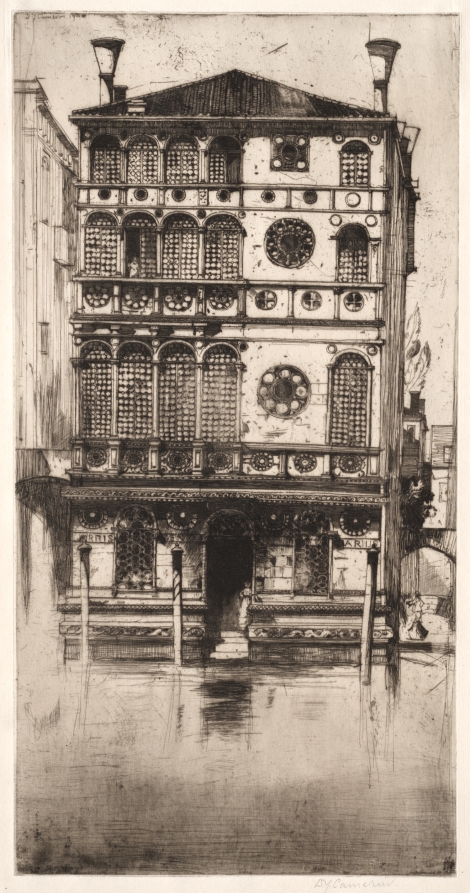
Palazzo Dario, Venice, 1900, by David Young Cameron
David Young Cameron · The Cleveland Museum of Art · Gift of the Estate of Anna M. Schweinfurth
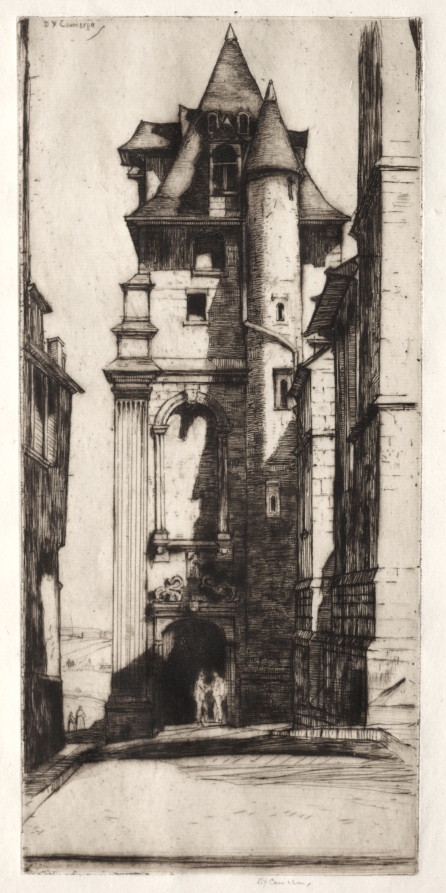
St. Aignan, Chartres, 1916, by David Young Cameron
David Young Cameron · The Cleveland Museum of Art · Gift of Edward G. Kennedy, through The Print Club of Cleveland
Places
Named by the record
Places
Only places the record itself states, plotted where the house gazetteer settles their coordinates. Nothing is inferred from a name or a nationality.
Glasgow.
Birth place
Perth.
Death place
Notes from the source article
Cited by Wikipedia
Notes from the source article
These works are cited by the source article, in its own numbering. They are recorded as its citations, not as sources VALÉORINE has verified.
- 1.Greek Secrets Revealed by Ian McHaffie ISBN 978-0-9525026-8-5
- 2.Gowing, Lawrence. The Edwardians and After: The Royal Academy, 1900-1950. Royal Academy of Arts. 71. 1988. 978-0-297-79509-4.
- 3.Smith, Bill. D.Y. Cameron: the visions of the hills. Atelier. 1992.
- 4.Percy Portsmouth (1873-1953), sculptor, a biography.
References
Citations
References
Each reference names the institution holding it, so a reader may go to the document itself.
reference work
Partially resolvedreference work
Partially resolved
The Encyclopedia exists whether or not anything is for sale. Corrections are recorded rather than overwritten, and every version of this record is kept. Published 14 August 2026.
Elsewhere in Paintings
18,623 published records in this field, each with its sources named.
- David von KrafftArtist
- David WallinArtist
- David WidhopffArtist
- David WilkieArtist
- Davide GhirlandaioArtist
- Davud KazımovArtist
- Davyd CherkaskyiArtist
- Dawn OkoroArtist
Best supported in this field
For owners
Own a work by David Young Cameron?
A specialist will read what you send and tell you what the house can establish, what it cannot, and whether the object is suited to sale. There is no charge and no obligation. The object stays with you throughout; nothing is shipped to us unless it is arranged in writing beforehand.