
cromorne
Crumhorn • Illustration — Cromorne (the longest instrument in this illustration) Cromorne is a French woodwind reed instrument of uncertain identity, used in the early Baroque period in French court music. The name is sometimes confused with the similar-sounding name crumhorn, a musical woodwind instrument probably of different design, called "tournebout" by French theorists in the 17th century.
cromorne
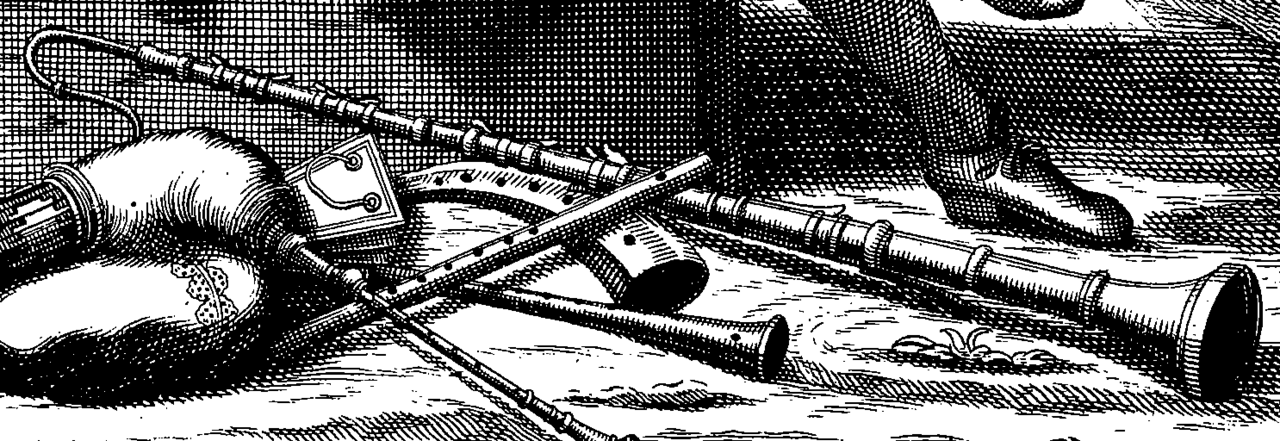
Charles-Emmanuel Borjon de Scellery (1633-1691) · Traité de la musette avec une nouvelle méthode (1672), IMSLP #261620 p. 2. · CC0
- Field
- double reed instrument
VALÉORINE Encyclopedia
VALÉORINE documentary reading
Documentary summary
Crumhorn • Illustration — Cromorne (the longest instrument in this illustration) Cromorne is a French woodwind reed instrument of uncertain identity, used in the early Baroque period in French court music. The name is sometimes confused with the similar-sounding name crumhorn, a musical woodwind instrument probably of different design, called "tournebout" by French theorists in the 17th century.
Admitted source layer · organised and presented by VALÉORINE
Reference Check
Propose documentary evidence for cromorne. A contribution is never written directly as fact: identity, source, rights and evidence gates still decide.
Sign in to contribute
Documentary evidence
Documentary basis
Authority files
wikidata · Q11434792 · wikipedia · Cromorne
In this article
Crumhorn
By contrast, the crumhorn (also known by names including crum horn, crumm horn, Krummhorn, Krummpfeife, Kumbhorn, cornamuto torto, and piva torto) is a capped double-reed instrument usually shaped like a letter "J" and possessing a rather small melodic range spanning a ninth (i.e. just over an octave) unless extended downward by keys or by the technique of underblowing, which increases the range by a perfect fifth. However, this instrument was apparently little used in England—despite listings in the inventories of Henry VIII and the earls of Arundel at Nonsuch House, and mention in a poem by Sir William Leighton, they are conspicuously absent from inventories and other documents of English town waits—or France and was called a "tournebout" by French theorists including Mersenne (1636), Pierre Trichet (ca 1640), and even as late as Diderot (1767).
Notes from the source article
Cited by Wikipedia
Notes from the source article
These works are cited by the source article, in its own numbering. They are recorded as its citations, not as sources VALÉORINE has verified.
Bibliography printed in the source article · 1
- Cite book
References
Citations
References
Each reference names the institution holding it, so a reader may go to the document itself.
reference work
Secondary witnessreference work
Secondary witness
The Encyclopedia exists whether or not anything is for sale. Corrections are recorded rather than overwritten, and every version of this record is kept. Published 16 August 2026.
Elsewhere in Collectables
20,755 published records in this field, each with its sources named.
- CrobotsWork
- Croc 2Work
- Crocker MotorcyclesOrganisation
- Croix SonoreTerminology
- Crookes radiometerTerminology
- CrosleyOrganisation
- cross and circle gameTerminology
- Cross BlitzWork
Best supported in this field
For owners
Own an object connected with cromorne?
A specialist will read what you send and tell you what the house can establish, what it cannot, and whether the object is suited to sale. There is no charge and no obligation. The object stays with you throughout; nothing is shipped to us unless it is arranged in writing beforehand.