
Colen Campbell
Colen Campbell (15 June 1676 – 13 September 1729) was a Scottish architect and writer best known for Vitruvius Britannicus, three volumes of high-quality engravings showing the great houses of the time.
Also recorded as [Colen Campbell]
Colen Campbell
![New College [Hackney House],](https://iiif.wellcomecollection.org/image/V0013424/full/1280,/0/default.jpg)
Colen Campbell · Wellcome Collection, London · Wellcome Collection · Public Domain Mark
- Name
- Colen Campbell
- Born
- 15 June 1676
- Birthplace
- Brodie, Scotland
- Died
- 13 September 1729
- Place of death
- London, England
- Nationality
- Kingdom of Scotland.
- Occupation
- architect and writer.
- Education
- University of Edinburgh.
- Known for
- Mereworth Castle.
- Languages
- English.
VALÉORINE Encyclopedia
VALÉORINE documentary reading
Documentary summary
Colen Campbell (15 June 1676 – 13 September 1729) was a Scottish architect and writer best known for Vitruvius Britannicus, three volumes of high-quality engravings showing the great houses of the time.
Admitted source layer · organised and presented by VALÉORINE
Note VALÉORINE
No house-authored Note is published until its assertions and sources pass the VALÉORINE evidence contract. The documentary article remains available in full while that enrichment is being consolidated.
Documentary enrichment in progress · no unsupported statement published
Reference Check
Propose documentary evidence for Colen Campbell. A contribution is never written directly as fact: identity, source, rights and evidence gates still decide.
Sign in to contribute
World of VALÉORINE
Documentary connections
Only confirmed graph relationships appear here. Images are shown only when their identity and reuse rights both pass the documentary gate.


Documentary evidence
Evidence Panel
not yet certified
- Identity
- resolved
- Independent source families
- 0
- Admitted assertions
- 0
- Open conflicts
- 0
Authority files
wikidata · Q254245 · wikipedia · Colen Campbell
In this article
Biography
Biography
Colen Campbell studied at University of Edinburgh. The recorded working language is English. Places of work recorded in the authority are Edinburgh and London. Works named in the authority record are Mereworth Castle. Work by Colen Campbell is recorded in the collections of Yale Center for British Art.
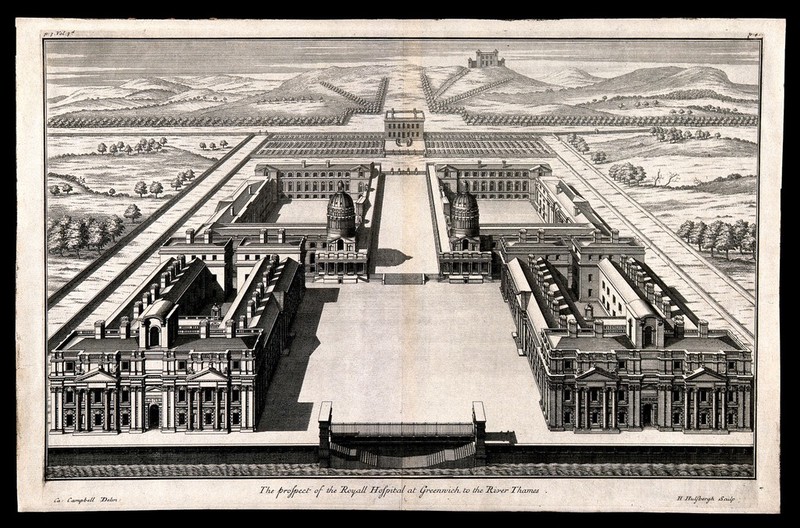
Royal Naval Hospital, Greenwich. Engraving by H. Hulsbergh after C. Campbell, 1715., 1715, by Colen Campbell
Colen Campbell · Wellcome Collection, London · Wellcome Collection
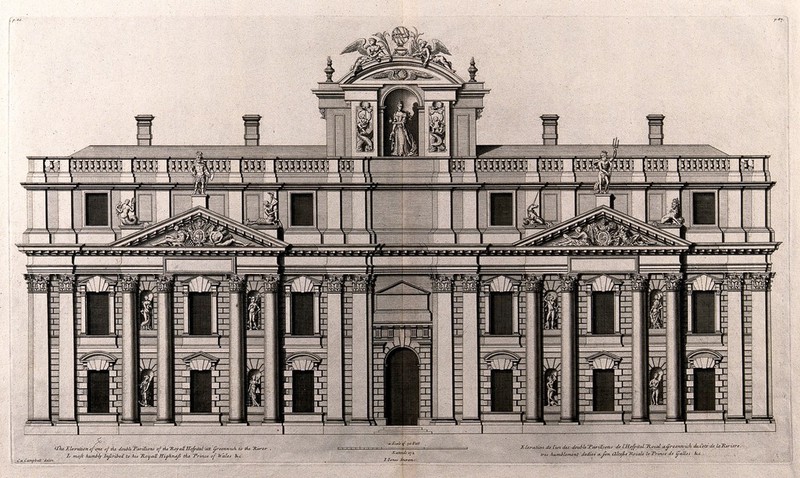
Royal Naval Hospital, Greenwich, part of the King Charles block, with a scale. Engraving by H. Hulsburgh after C. Campbell, 1715., 1715, by Colen Campbell
Colen Campbell · Wellcome Collection, London · Wellcome Collection
Key facts
Key facts
• Name — Colen Campbell • Born — 15 June 1676 • Birthplace — Brodie, Scotland • Died — 13 September 1729 • Place of death — London, England • Resting Place — Westminster Abbey • Significant Buildings — Mereworth Castle Stourhead Houghton Hall Burlington House Wanstead House • Illustration — Palladian revival: Stourhead House, south facade, designed by Campbell and completed in 1720; a print from Vitruvius Britannicus
Early life
Early life
A descendant of the Campbells of Cawdor Castle, he is believed to be the Colinus Campbell who graduated from the University of Edinburgh in July 1695. He initially trained as a lawyer, being admitted to the Faculty of Advocates on 29 July 1702. He travelled in Italy between 1695 and 1702, and is believed to be the Colinus Campbell who signed the visitor's book at the University of Padua in 1697. He is believed to have trained in and studied architecture under James Smith, a belief strengthened by Campbell owning several drawings of buildings designed by Smith.
Volumes by Campbell
Volumes by Campbell
• Illustration — Title page of Campbell's Vitruvius Britannicus; or, The British architect, 1715–1725 Campbell's major published work, Vitruvius Britannicus, or the British Architect... appeared in three volumes between 1715 and 1725. This was the first architectural work to originate in England since John Shute's Elizabethan First Groundes. In the empirical vein, it was not a treatise but basically a catalogue of design, containing engravings of English buildings by Inigo Jones and Sir Christopher Wren, as well as by Campbell and other prominent architects of the era. In the introduction that he appended and in the brief descriptions, Campbell emphasised the "excesses" of Baroque style and declared British independence from foreigners, while he dedicated the volume to the Hanoverian George I. The third volume (1725) has several grand layouts of gardens and parks, with straight allées, for courts and patterned parterres and radiating rides through wooded plantations, in a Baroque manner that was rapidly becoming old-fashioned. Buildings were shown in plan, section and elevation, and some in a bird's-eye perspective. The drawings and designs contained in the book were under way before Campbell was drawn into the speculative scheme. The success of the volumes was instrumental in popularising neo-Palladian architecture in Great Britain and America during the 18th century. For example, Plate 16 of Vitruvius Britannicus, a rendering of Somerset House in London, was an inspiration for the American architect Peter Harrison when he designed the Brick Market in Newport, Rhode Island, in 1761. Campbell was influenced as a young man by James Smith (c. 1645–1731), the pre-eminent Scots architect of his day, and an early neo-Palladian whom Campbell called "the most experienced architect" of Scotland (Vitruvius Britannicus, ii). The somewhat promotional volume, with its excellently rendered engravings, came at a propitious moment at the beginning of a boom in country house and villa building among the Whig oligarchy. Campbell was quickly taken up by Lord Burlington, who replaced James Gibbs with Campbell at Burlington House in London and set out to place himself at the centre of English neo-Palladian architecture. In 1718, Campbell was appointed deputy to the amateur gentleman who had replaced Wren as Surveyor General of the Royal Board of Works, an appointment that Burlington is certain to have pressed, but a short-lived one. When Benson, the new Surveyor was turned out of office, Campbell went with him.
Later volumes by other authors
Major commissions
Major commissions
• Wanstead House, Essex, c. 1713/4–20 (illustrated left). In the first volume of Vitruvius Britannicus, the most influential designs were two alternatives for a palatial Wanstead House, Essex, for the merchant-banker Sir Richard Child, of which the second design was already under way when the volume was published. (Campbell claimed that Wanstead House had Great Britain's first classical portico, but this accolade probably belongs to The Vyne, Hampshire.) • Burlington House, London, 1717. Remodelled the front and provided an entrance gateway for Richard Boyle, 3rd Earl of Burlington (Remodelled in 1868 and the gateway demolished.) • Stourhead, Wiltshire, 1721–24, as a seat for the London-based banker Henry Hoare. Wings were added in the later 18th century, and Campbell's portico was not executed (though to his design) until 1841. The famous landscape garden round a lake, somewhat apart from the house, was developed after Campbell's death, by Henry Flitcroft. • Pembroke House, Whitehall, London, for Henry Herbert, 9th Earl of Pembroke, 1723, a London house in a prominent location for the heir of Jones' Wilton House. It was rebuilt in 1757 and demolished in 1913. Lord Herbert (as he then was) was inspired by it to design the similar Marble Hill House at Twickenham for Henrietta Howard, Countess of Suffolk, the mistress of the future George II. (Marble Hill was a 5-bay palladian villa with central pediment, raised on a high basement, with clumped screens of trees and formal turfed terraces descending to the Thames, illustrated right, that manifest the earliest stages of the English landscape garden.) • Houghton Hall, Norfolk, begun 1722, for Sir Robert Walpole, the Whig prime minister. Here Campbell was replaced by Gibbs, who capped the end pavilions with octagonal domes, and by William Kent, who designed the interiors. • Mereworth Castle, Kent, 1722–25. Campbell's most overtly palladian design, based on Villa La Rotonda, capped with a dome with no drum, through which 24 chimney flues pass to the lantern. • Waverley Abbey House, Surrey, c. 1723–25, for John Aislabie (largely altered). • Nos 76 and 78 Brook Street, London W1, 1725–26. No. 76, which survives, was Campbell's own house, the designs for its interiors published in his Five Orders of architecture, (1729). It carries a blue plaque commemorating him. • Compton Place, Eastbourne, Sussex, 1726 onwards, south front and extensive internal rebuilding for Sir Spencer Compton • Plumptre House, Nottingham, 1724–30. Remodelled for John Plumptre MP. • Illustration — Wanstead House, as built, illustrated in Nathaniel Spencer, The Complete English traveller, London 1771 • Illustration — Marble Hill House, Twickenham • Illustration — Blue plaque on 76 Brook Street, London W1
List of architectural works
List of architectural works
Campbell's architectural works include: • Shawfield Mansion, Glasgow (1712) demolished 1792 • Wanstead House, Essex (1714–15) demolished 1822 • Hedworth House, Chester-le-Street (1726) • Hotham House, Beverley (1716–17) demolished c.1766 • Burlington House, London, south front, and west wing (1717) subsequently extended and several occasions • Burlington (Ten Acre Close) Estate, London, layout (1717–18) • Burlington House, Great Gate and Street Wall (1718) • Rolls House, Chancery Lane, London (1718), demolished 1895–96 • Ebberston Hall, Ebberston, Yorkshire, including cascade (1718) • 34 Great Burlington Street, London (1718–19) • 33 Great Burlington Street, London (1719–20) • 32 Great Burlington Street, London (c.1720); this was Campbell's own house • 31 Great Burlington Street, London (1719–24) rebuilt • Burlington Girls' Charity School, Boyle Street, London (1719–21) • Wimbledon Manor House, Surrey, for Sir Theodore Janssen (1720); completion uncertain • Newby Park, (now Baldersby Park), near Topcliffe, Yorkshire (1720–21) • Houghton Hall, Norfolk; one of several architects to work on the building (1721–22) • Stourhead, Wiltshire; the portico part of Campbell's design was only added in 1840 (1721–24); interiors destroyed by fire 1902 • Mereworth Castle, Kent (1722–23) • Pembroke Lodge, Whitehall, London; executed Henry Herbert, 9th Earl of Pembroke's design (c.1724), demolished 1756 • Plumptre House, Nottingham, (1724) • Hall Barn, Buckinghamshire, garden buildings: Great Room (only partially survives), Temple of Venus, Obelisk & Doric Pavilion (1724) • Waverley Abbey House, Surrey (c.1725), extended 1770, damaged by fire and rebuilt 1833 • Greenwich Hospital, Greenwich, London; additions to Queen Mary block and Queen Anne block (1726–29) • Compton Place, Eastbourne, remodelled house (1726–29) • 76 Brook Street, London, internal alterations (c.1726); became Campbell's new home • Hackney House, Hackney, London (c.1727), demolished before 1842 • Althorp, Northamptonshire, new stables, loggia gate (c.1729–33) • Studley Royal Park, Yorkshire, the stables (c.1729) built after his death by Roger Morris • Illustration — Design for Stourhead in Wiltshire, Vitruvius Britannicus vol. 3, 1725 • Illustration — Houghton Hall in Norfolk; James Gibbs added the domes to Campbell's design • Illustration — Mereworth Castle in Kent, Vitruvius Britannicus vol 2, 1720 • Illustration — Cross-section, Mereworth Castle, Vitruvius Britannicus vol 2, 1720 • Illustration — Gate, Burlington House, London, Vitruvius Britannicus vol 2, 1720 (demolished) • Illustration — Wanstead House in Essex (demolished) • Illustration — alt=The Elevation of General Wade, his house in great Burlington Street, Vitruvius Britannicus, vol. 3, 1723 The Elevation of General Wade, his house in great Burlington Street, London, Vitruvius Britannicus, vol. 3, 1723. Engraving by Henry Hulsbergh
Life and career
Dated record
Life and career
The full dated record · 2 entries
1676
Colen Campbell born at Brodie Castle.
1729
Colen Campbell died at London.
Places
Named by the record
Places
Only places the record itself states, plotted where the house gazetteer settles their coordinates. Nothing is inferred from a name or a nationality.
Brodie Castle.
Birth place
London.
Death place
References
Citations
References
Each reference names the institution holding it, so a reader may go to the document itself.
reference work
Partially resolvedreference work
Partially resolved
Further particulars
Held on the record
Further particulars
Open the remaining particulars
Colen Campbell is connected to 2 other published records in the VALÉORINE Encyclopedia.
Within the Encyclopedia
The Encyclopedia exists whether or not anything is for sale. Corrections are recorded rather than overwritten, and every version of this record is kept. Published 14 August 2026.
Elsewhere in Books
38,960 published records in this field, each with its sources named.
- Cokie RobertsAuthor
- Cola DebrotAuthor
- Colcu mac ConnacanAuthor
- Cole SwensenAuthor
- ColetteAuthor
- Colette BryceAuthor
- Colette InezAuthor
- Colette Nic AodhaAuthor
Best supported in this field
For owners
Own a work by Colen Campbell?
A specialist will read what you send and tell you what the house can establish, what it cannot, and whether the object is suited to sale. There is no charge and no obligation. The object stays with you throughout; nothing is shipped to us unless it is arranged in writing beforehand.