
Charles Lock Eastlake
Sir Charles Lock Eastlake (17 November 1793 – 24 December 1865) was a British painter, gallery director, collector and writer of the 19th century. After a period as keeper, he was the first director of the National Gallery. From 1850 to 1865 he served as President of the Royal Academy, succeeding Martin Archer Shee in the role.
Also recorded as Sir Charles Lock Eastlake · Sir Charles Lock Eastlake RA · Charles Lock Eastlake RA · Sir Charles Eastlake
Charles Lock Eastlake

John Charles Watkins · This file was donated to Wikimedia Commons as part of a project by the Metropolitan Museum of Art. See the Image and Data Resources Open Access Policy · CC0
- Name
- Charles Lock Eastlake
- Birthplace
- Plymouth, Devon, England
- Died
- 24 December 1865
- Place of death
- Pisa, Italy
- Born
- 1793
- Nationality
- Kingdom of Great Britain · United Kingdom of Great Britain and Ireland
- Occupation
- linguist · art historian · painter · translator · photographer · writer
VALÉORINE Encyclopedia
VALÉORINE documentary reading
Documentary summary
Sir Charles Lock Eastlake (17 November 1793 – 24 December 1865) was a British painter, gallery director, collector and writer of the 19th century. After a period as keeper, he was the first director of the National Gallery. From 1850 to 1865 he served as President of the Royal Academy, succeeding Martin Archer Shee in the role.
Admitted source layer · organised and presented by VALÉORINE
Reference Check
Propose documentary evidence for Charles Lock Eastlake. A contribution is never written directly as fact: identity, source, rights and evidence gates still decide.
Sign in to contribute
Documentary evidence
Documentary basis
Authority files
wikidata · Q1065352 · wikipedia · Charles Lock Eastlake
In this article
Key facts
Key facts
• Name — Charles Lock Eastlake • Birthplace — Plymouth, Devon, England • Died — 24 December 1865 • Place of death — Pisa, Italy
Life
Life
• Illustration — Charles Eastlake in a pencil sketch by John Partridge, 1825 Eastlake was born in Plymouth, Devon, the fourth son of an Admiralty lawyer. He was educated at local grammar schools in Plymouth, including Plymouth Grammar School, and, briefly, at Charterhouse (then still in London). He was committed to becoming a painter, and in 1809 he became the first pupil of Benjamin Haydon and a student at the Royal Academy schools in London—where he later exhibited. However, his first exhibited work was shown at the British Institution in 1815, a year in which he also visited Paris and studied works in the Louvre (then known as the Musée Napoléon). His first notable success was a painting of Napoleon on the Bellerophon (1815; National Maritime Museum, London). Like many other people at the time, Eastlake had hired a boat to take him to the ship on which Napoleon was held in Plymouth harbour. He sketched him from the boat. In 1816, he travelled to Rome where he painted members of the British elite staying in Italy including fellow artists Sir Thomas Lawrence and J. M. W. Turner. He also travelled to Naples and Athens. Despite being based predominantly in mainland Europe, Eastlake regularly sent works back to London to be exhibited, and in 1827 he was elected a member of the Royal Academy. Three years later, he returned to England permanently where he continued to paint historical and biblical paintings set in Mediterranean landscapes. While he had been abroad his 1827 painting Lord Byron's Dream was exhibited at the 1829 Royal Academy summer exhibition. • Illustration — Funerary monument, Kensal Green Cemetery, London As an art historian, he translated Goethe's Zur Farbenlehre (Theory of Colours, 1840). He edited with extensive and valuable notes the 'Handbuch der Geschichte der Malerei (Handbook of the History of Painting) by Franz Kugler, which in its first English version was translated by 'A Lady', Mrs. Margaret Hutton. These publications and Eastlake's reputation as an artist led to his nomination in 1841 to become secretary of the Fine Arts Commission, the body in charge of government art patronage. He set up home in Fitzroy Square. In his On Vision and Colours, § 14, Schopenhauer praised Eastlake's translation of Goethe. Eastlake, the painter and gallery inspector, furnished his countrymen, in 1840, with such an excellent translation of Goethe's theory of color that it is a perfect reproduction of the original and reads more easily; in fact, it is understood more easily than the original. Having already advised the National Gallery, London on acquisitions, he was appointed the Gallery's second Keeper in 1843, a post he later resigned "in consequence of an unfortunate purchase that roused much animadversion, a portrait erroneously ascribed to Holbein". In 1855 he returned as the first director, "with more extended powers". In 1849, he married Elizabeth Rigby, an art historian and translator of German art histories. Together they formed a formidable art history writing partnership. In 1845, he was elected into the National Academy of Design as an Honorary Academician. From 1850 to 1865, he was the second president of the Birmingham Society of Artists. Elected president of the Royal Academy and knighted in 1850, he became a notable figure in the British art establishment. He was appointed the first president of the Photographic Society in 1853 and the first director of the National Gallery in 1855. In 1864, the University of Cambridge awarded him an honorary degree.
Popular culture
Popular culture
In the film Effie Gray (2014), he is portrayed by James Fox.
Gallery
Gallery
• Illustration — Brutus Exhorting the Romans to Revenge the Death of Lucretia, 1814 • Illustration — Napoleon on the Bellerophon, 1815 • Illustration — A View of the Erechtheum on the Acropolis, Athens, 1818 • Illustration — The Erechtheum, Athens, 1821 • Illustration — A View of Trajan's Forum, Rome, 1821 • Illustration — The Colosseum from the Esquiline, 1822 • Illustration — The Colosseum from the Campo Vaccino, 1822 • Illustration — The Celian Hill from the Palatine, 1823 • Illustration — An Italian Contadina and Her Children, 1823 • Illustration — The Champion, 1824 • Illustration — Lord Byron's Dream, 1827 • Illustration — Pilgrims Arriving in Sight of Rome, 1827 • Illustration — Hagar and Ishmael, 1830 • Illustration — Christ Blessing Little Children, 1839 • Illustration — Hagar Offering Water to Her Son Ishmael in the Desert, 1842 • Illustration — Zia Theresa: The Visit to the Nun, 1844 • Illustration — The Sisters, 1844 • Illustration — Christ Lamenting over Jerusalem, 1846, one of Eastlake's most popular biblical paintings. • Illustration — The Good Samaritan, 1850
Identity and origins
Identity and origins
The authorities additionally record the headings Sir Charles Lock Eastlake, Sir Charles Lock Eastlake RA, Charles Lock Eastlake RA, Sir Charles Eastlake and Charles Locke Eastlake. His recorded language was English. He was the child of George Eastlake and Mary Pierce. He married Elizabeth Eastlake.
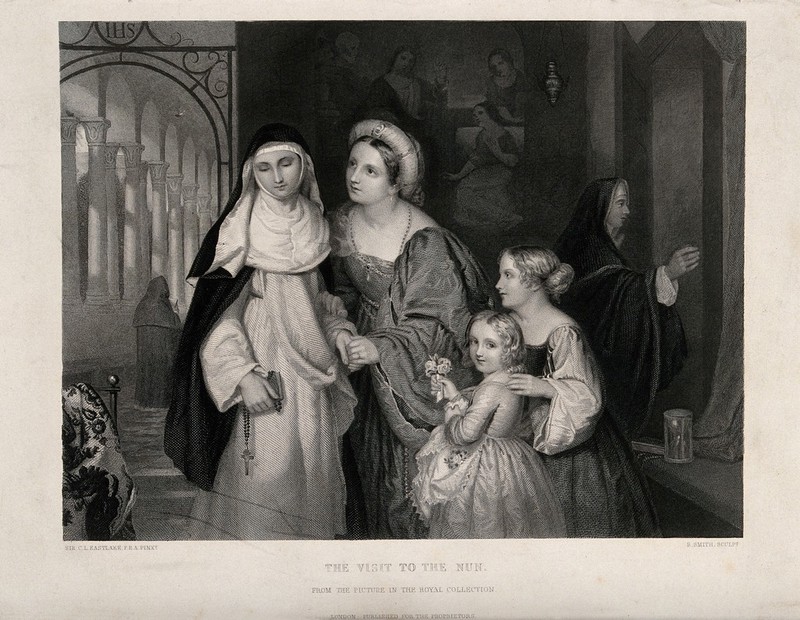
A nun being visited in the monastery by female relatives. Engraving by S. Smith after Sir C.L. Eastlake., by Charles Lock Eastlake
Charles Lock Eastlake · Wellcome Collection, London · Wellcome Collection
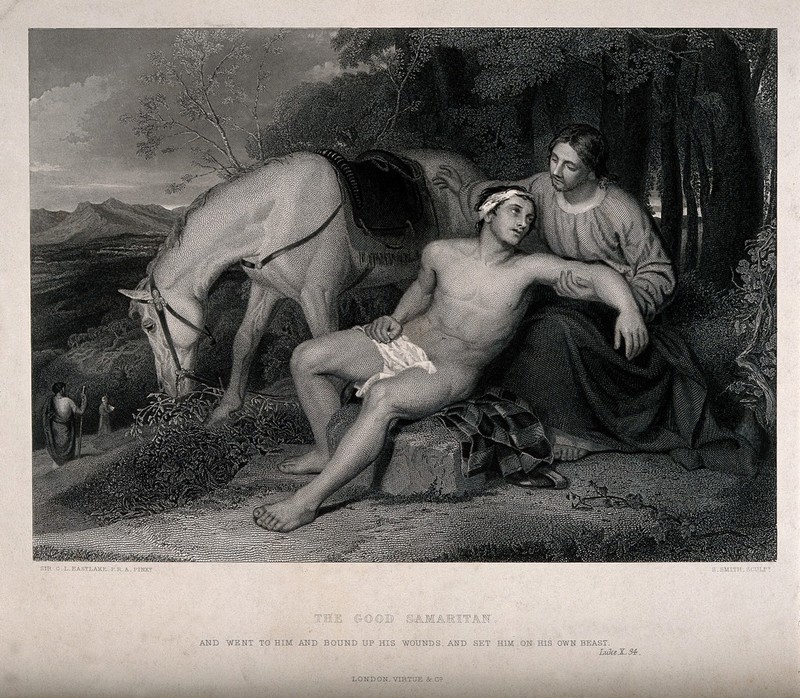
The good Samaritan helping a stranger who has been ignored by a priest and Levite. Line engraving by S. Smith after C.L. Eastlake., by Charles Lock Eastlake
Charles Lock Eastlake · Wellcome Collection, London · Wellcome Collection
Life and career
Dated record
Life and career
The full dated record · 2 entries
1793
Charles Lock Eastlake born at Plymouth.
1865
Charles Lock Eastlake died at Pisa.
Publications
• Materials for a History of Oil Painting (1847). A second volume was published posthumously in 1869. • Contributions to the Literature of the Fine Arts (1848).
Legacy
On 24 December 1865, Eastlake died in Pisa, Italy. He is buried at Kensal Green Cemetery, London. His will provided for the Gallery to purchase his collection of paintings. Lady Eastlake sold her husband's art history book collection to the Gallery's library.
Primary material
Documents and archives
Institutional database
- Wikidata, structured authority record Q1065352: Charles Lock Eastlake
Scholarly · Wikimedia Foundation
reference work
- “Charles Lock Eastlake”, English Wikipedia, consulted as further reading
Reputable secondary · Wikipedia
Notes from the source article
Cited by Wikipedia
Notes from the source article
These works are cited by the source article, in its own numbering. They are recorded as its citations, not as sources VALÉORINE has verified.
- 1., National Portrait Gallery, London, NPG 3944(22), 17 July 2013. Retrieved 17 July 2013.
- 2.Introduction to Goethe's Theory of Colours
- 3.John Murray. Goethe's Theory of Colours: Translated from the German; with Notes by Charles Lock Eastlake, R.A., F.R.S. 1840.
- 4.Fitzroy Square Pages 52-63 Survey of London: Volume 21, the Parish of St Pancras Part 3: Tottenham Court Road and Neighbourhood. Originally published by London County Council, London, 1949. British History Online.
- 5.Anon. The Spring Exhibition, 1933 (catalogue). Royal Birmingham Society of Artists. 1933.
- 6.Eastlake, Charles Lock.
References
Citations
References
Each reference names the institution holding it, so a reader may go to the document itself.
Institutional database
Wikidata, structured authority record Q1065352: Charles Lock EastlakeWikimedia Foundation
Institutional witnessreference work
Secondary witness
Further particulars
Held on the record
Further particulars
Open the remaining particulars
Recorded position is President of the Royal Academy of Arts. He belonged to Royal Society of London, Royal Academy of Arts and Accademia delle Arti del Disegno. He worked at London. Eastlake received Fellow of the Royal Society and Knight Bachelor. Recorded as Kingdom of Great Britain and United Kingdom of Great Britain and Ireland.
Career and activity
Recognition and collections
Work by Charles Lock Eastlake is
Tate, Yale Center for British Art, Art Gallery of New South Wales and Philadelphia Museum of Art
The Encyclopedia exists whether or not anything is for sale. Corrections are recorded rather than overwritten, and every version of this record is kept. Published 14 August 2026.
Elsewhere in Photography
11,392 published records in this field, each with its sources named.
- Charles LathamPhotographer
- Charles Leander WeedPhotographer
- Charles LeirensPhotographer
- Charles LindsayPhotographer
- Charles M. ConlonPhotographer
- Charles M. RoesselPhotographer
- Charles MacnamaraPhotographer
- Charles MattonPhotographer
Best supported in this field
For owners
Own a work by Charles Lock Eastlake?
A specialist will read what you send and tell you what the house can establish, what it cannot, and whether the object is suited to sale. There is no charge and no obligation. The object stays with you throughout; nothing is shipped to us unless it is arranged in writing beforehand.