
Casio VL-1
Illustration — Casio VL-Tone VL-1 The VL-1 was the first instrument of Casio's VL-Tone product line, and is sometimes referred to as the VL-Tone. It combined a calculator, a monophonic synthesizer, and sequencer. Released in 1981, it was the first affordable commercial digital synthesizer, selling for $69.95.
Casio VL-1

Dontpanic · CC BY-SA 3.0
- Field
- electronic keyboard · calculator · music sequencer
VALÉORINE Encyclopedia
VALÉORINE documentary reading
Documentary summary
Illustration — Casio VL-Tone VL-1 The VL-1 was the first instrument of Casio's VL-Tone product line, and is sometimes referred to as the VL-Tone. It combined a calculator, a monophonic synthesizer, and sequencer. Released in 1981, it was the first affordable commercial digital synthesizer, selling for $69.95.
Admitted source layer · organised and presented by VALÉORINE
Note VALÉORINE
No house-authored Note is published until its assertions and sources pass the VALÉORINE evidence contract. The documentary article remains available in full while that enrichment is being consolidated.
Documentary enrichment in progress · no unsupported statement published
Reference Check
Propose documentary evidence for Casio VL-1. A contribution is never written directly as fact: identity, source, rights and evidence gates still decide.
Sign in to contribute
World of VALÉORINE
Documentary connections
Only confirmed graph relationships appear here. Images are shown only when their identity and reuse rights both pass the documentary gate.


Documentary evidence
Evidence Panel
original value insufficient · checked 25 September 2026
- Identity
- resolved
- Independent source families
- 0
- Admitted assertions
- 0
- Open conflicts
- 0
Authority files
wikidata · Q1047696 · wikipedia · Casio VL-1
In this article
Keyboard
Keyboard
RadioShack sold a rebranded version of the VL-1 called the Realistic Concertmate 200.
The VL-1 has electronic keyboard with 29 buttons, including 23 buttons of the basic calculator, were 17 used for notes input (G to B notes) marked from the left with "Plus-minus" sign, and all rest the basic arithmetic calculator buttons placed on the right with "Equal sign" placed as right most: It also has a three-position octave switch, one programmable and five preset sounds, ten built-in rhythm patterns, an eight-character LCD, a 100-note sequencer, and a multi-function calculator mode. The VL-1 is notable for its kitsch value among electronic musicians, due to its cheap construction and its unrealistic, uniquely low-fidelity sounds. It was followed by the VL-10, a very similar machine in a smaller unit, the VL-80, a pocket calculator size version, and the VL-5, a polyphonic version, capable of playing four notes simultaneously, but lacking the VL-1's synthesizer section due to the removal of the calculator mode.
Melody-80 calculators
Melody-80 calculators
• Illustration — Casio MG-770 Game & Melody Card The ML-720 Melody Card of the Casio Mini Card calculators introduced along with the ML (Melody), MG (Game & Melody), UC (Universal Calendar) and L (Lady) series of calculators had 11-notes synthesizer, utilized only digit input buttons and operation buttons as controls, where music notes were inscribed above the buttons without noting the octave order. This made it difficult to distinguish lower and upper octave notes by its Solfège inscribed names.
VL-80 calculator
VL-80 calculator
The VL-80 is a pocket portrait oriented calculator introduced with 16-notes synthezier keypad in 4×4 layout. Comparing to VL-1, VL-80's layout missed one highest tone note moving "Equal sign" button from the right end to the left end and rearranged from arithmetic operations buttons. Comparing to Melody-80, VL-80's keyboard inscribed notes by its name additionally followed by its order number in octave prefixed with underscore sign for low octave notes and uppersocore sign for high octave notes.
Sound
Sound
• Illustration — Casio VL-1 music sample Its sounds were mostly composed of filtered squarewaves with varied pulse-widths. Its piano, violin, flute and guitar timbres were nearly unrecognizable abstractions of real instruments. It also featured a "fantasy" voice, and a programmable synthesizer which provided for choice of both oscillator waveform and ADSR envelope. It had a range of two and a half octaves.
Features
Features
• Illustration — The LCD The VL-1 featured a small LCD capable of displaying 8 characters. This was primarily used for the calculator function, but also displayed notes played. The VL-1 also had changeable tone and balance, basic tempo settings and a real-time monophonic music sequencer, which could play back up to 99 notes. There were also 10 pre-loaded rhythms which utilized just three basic drum sounds. Casio internally named these sounds "Po" (30ms), "Pi" (20ms) and "Sha" (160ms).
Voices
Voices
Piano, Fantasy, Violin, Flute, Guitar, Guitar(II), English Horn, and Electro sound (I, II and III) are available in ADSR Mode. Piano, Fantasy, Violin, Flute and Guitar (I) have direct access, and Guitar (II), English Horn, Electro sound (I, II and III) only can be used with ADSR button. The sounds (*) do not have direct access through a button, but they are part of the ADSR variables, so there are 5 more sounds in reality, although they can only be used through the synthesizer and must be entered through a code. So it would look like this: Piano, Fantasy, Violin, Flute, Guitar (I) are available at the same time, and any of the mentioned sounds or Guitar (II), English Horn, Electronic sound (I), (II) and (III) can only be obtained by means of a code and occupy one at a time on the ADSR button.
ADSR
ADSR
The VL-1 was programmed by entering a number into the calculator section's memory, then switching back to keyboard mode. It worked like this (the number is the value for each): Example (90099914) • 9 Waveform • 0 Attack • 0 Decay • 9 Sustain level • 9 Sustain time • 9 Release time • 1 Vibrato • 4 Tremolo
Notable uses and appearances
Notable uses and appearances
• Illustration — Vienna Technical Museum / VL-1 Inv. Nr 81934 • The VL-1 acquired enduring notability in 1982, when the German band Trio used it in one of their songs, the "faux-Kraftwerk tune", "Da Da Da". They used the Rock-1 rhythm preset and the Piano voice. • The VL-1's "Rock-2" drum sound is used in the song "Hanging Around" (original by The Stranglers) by Hazel O'Connor on her album Cover Plus. • The Human League used the VL-1 for "Get Carter", a song on their album Dare. • In 1995, "parsimonious" French singer/songwriter Dominique A used a minimum of instruments, including the VL-1 (called the "VL Tone" in the French press). • The 2007 single "Clumsy" by Fergie used one of the default electronic beeps from the VL-1 for its melody.
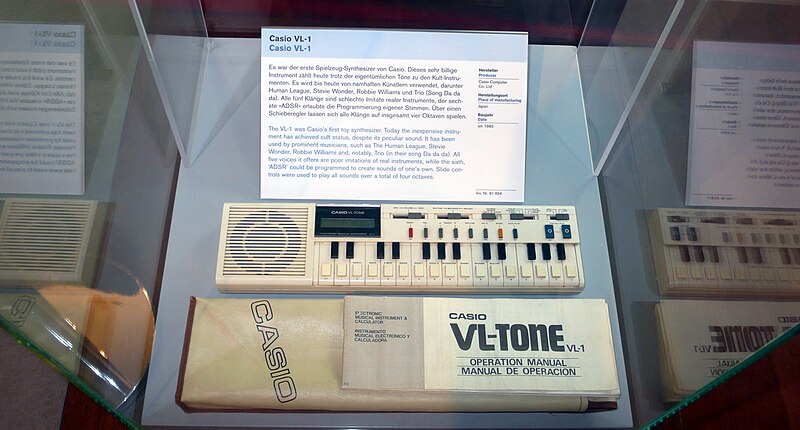
Casio VL-1 pocket synthesizer, released in 1980.
Reinraum
![Lukatoyboy live setup at Elak Gala in Vienna free download: www.archive.org/details/Lukatoyboy-LiveAtElakGalaInVienna... front table Small mixer (may be Soundcraft Spirit) Casio Sampletone SK-1 Casio VL-Tone VL-1 KORG Kaoss Pad KORG Kaoss Pad 2 Alesis ModFX Bitrman SoundMangler (Comp + Dist + Dual Phaser + Bitterness (Comb/Decimater/Bit Reducer/FM/RM/Freq Shift)) right table Cracklebox [1] MacB](https://upload.wikimedia.org/wikipedia/commons/thumb/0/0a/Lukatoyboy_live_setup_at_Elak_Gala.jpg/800px-Lukatoyboy_live_setup_at_Elak_Gala.jpg)
Lukatoyboy live setup at Elak Gala in Vienna free download: www.archive.org/details/Lukatoyboy-LiveAtElakGalaInVienna... front table Small mixer (may be Soundcraft Spirit) Casio Sampletone SK-1 Casio VL-Tone VL-1 KORG Kaoss Pad KORG Kaoss Pad 2 Alesis ModFX Bitrman SoundMangler (Comp + Dist + Dual Phaser + Bitterness (Comb/Decimater/Bit Reducer/FM/RM/Freq Shift)) right table Cracklebox [1] MacB
Luka Ivanovic · originally posted to Flickr as lukatoyboy elak gala live setup
Notes from the source article
Cited by Wikipedia
Notes from the source article
These works are cited by the source article, in its own numbering. They are recorded as its citations, not as sources VALÉORINE has verified.
- 1.Brend, Mark. Strange sounds: offbeat instruments and sonic experiments in pop. Hal Leonard. 101–102. 2005. 978-0-87930-855-1.
- 2.40th Anniversary website
- 3.Impact of MIDI on electroacoustic art music, Issue 102, page 26, Stanford University
- 4.Mark Vail, The Synthesizer: A Comprehensive Guide to Understanding, Programming, Playing, and Recording the Ultimate Electronic Music Instrument, page 277, Oxford University Press
- 5.Realistic Concertmate 200 Sound Programming. soundprogramming.net.
- 6.Paphides, Pete. The world according to Frankmusik: The world as listed by the new star of British pop. The Times. September 2024.
- 7.Adams, Cameron. Nostalgia never hurts. Herald Sun. 2009-11-07.
- 8.Renaud, Alain. A 27 ans, Dominique A est en passe de devenir un label. Libération. 1995-11-11.
- 9.Mortaigne, Veronique. Dominique A, le dépouillement élégant. Le Monde. 1995-05-18.
- 10.Clarke, Lewis. The Casio VL-1: creating with limitations and the power of toy keyboards. Happy Mag. 2017-05-12.
References
Citations
References
Each reference names the institution holding it, so a reader may go to the document itself.
reference work
Partially resolvedreference work
Partially resolved
Connections
Knowledge graph
Connections
Each connection was recorded deliberately, with the basis for it kept on the internal record.
Broader subject
1- calculatorTerminology
Established from a fact already recorded on a verified source.
The Encyclopedia exists whether or not anything is for sale. Corrections are recorded rather than overwritten, and every version of this record is kept. Published 14 August 2026.
Elsewhere in Scientific instruments
736 published records in this field, each with its sources named.
- Casio fx-991ESTerminology
- Casio Graph 100Terminology
- Casio graphic calculatorsTerminology
- Casio V.P.A.M. calculatorsTerminology
- Cassegrain mirror systemTerminology
- catadioptric telescopeTerminology
- catalytic converterTerminology
- CelatoneTerminology
Best supported in this field
For owners
Own an object connected with Casio VL-1?
A specialist will read what you send and tell you what the house can establish, what it cannot, and whether the object is suited to sale. There is no charge and no obligation. The object stays with you throughout; nothing is shipped to us unless it is arranged in writing beforehand.