
Carlos Julião
Illustration — By painting Brazil during the mining period, Carlos Julião created visual references about the costumes and the life of street sellers and slaves. Carlos Julião (1740, Turin1811, Lisbon) was a Luso-Italian artist and engineer of the Portuguese colonial army, working as a fortress inspector during the second half of the 18th century and beginning of the 19th century. He is more known for his watercolor drawings, portraying the different racial and social types inhabiting the Portuguese Empire, as well as the period and methods of mining in Brazil.
Carlos Julião

Carlos Julião · Riscos iluminados de figurinhos de brancos e negros dos uzos do Rio de Janeiro e do Cerro do Frio. Biblioteca Nacional. Rio de Janeiro. · CC0
- Born
- 1740 · Turin.
- Died
- 1811 · Rio de Janeiro.
- Nationality
- Kingdom of Portugal
- Occupation
- painter · military personnel · draftsperson · cartographer
- Honours
- Knight of the Order of Aviz
- Languages
- Portuguese
VALÉORINE Encyclopedia
VALÉORINE documentary reading
Documentary summary
Illustration — By painting Brazil during the mining period, Carlos Julião created visual references about the costumes and the life of street sellers and slaves. Carlos Julião (1740, Turin1811, Lisbon) was a Luso-Italian artist and engineer of the Portuguese colonial army, working as a fortress inspector during the second half of the 18th century and beginning of the 19th century. He is more known for his watercolor drawings, portraying the different racial and social types inhabiting the Portuguese Empire, as well as the period and methods of mining in Brazil.
Admitted source layer · organised and presented by VALÉORINE
Reference Check
Propose documentary evidence for Carlos Julião. A contribution is never written directly as fact: identity, source, rights and evidence gates still decide.
Sign in to contribute
World of VALÉORINE
Documentary connections
Only confirmed graph relationships appear here. Images are shown only when their identity and reuse rights both pass the documentary gate.
Documentary evidence
Documentary basis
Authority files
wikidata · Q7672599 · wikipedia · Carlos Julião
In this article
Biography
Biography
Carlos Julião, or Carlo Juliani, as some of the official documents refer to him, was born in 1740 in Turin, Piedmont, Italy. In 1763, he joined the royal artillery regiment of the Portuguese military as lieutenant. It is unknown what connected the Italian born to the Portuguese Empire, but a 1792 letter signed by Queen Maria, consecrating him with the title of Knight of the Military Royal Order of Saint Benedict of Aviz, mentions the name of his father – João Baptista – indicating a Portuguese paternal side. One of his first missions was at Mazagan in Morocco, the last Portuguese possession in northern Africa, which was taken by the Muslims in 1769, and where Julião, according to official documentation, risked his life under fire. After 1770, Julião served in a topographic assignment to Macao in China, as part of a reformation plan commanded by the Navy and Overseas minister, Martinho de Melo e Castro. Until 1781, when he became captain with mining expertise, Julião would have travelled the entire Portuguese colonized lands serving a fortress inspector. In Brazil, Julião participated in the collecting of woods at the captaincy of Pernambuco, under the orders of Governor Tomás José de Melo, who congratulated Julião's work in a 1788 letter to Minister Martinho de Melo e Castro. The governor of the captaincy asked that Julião got a promotion to lieutenant-coronel to lead the captaincy regiment. The request was not accepted since there is no record of Julião performing other assignments in the region. But his contribution to form a collection of wood specimens for the Royal Academy of Science in Lisbon, founded in 1779, became a personal interest of him. In 1795, Julião was promoted to major and nominated to Army Arsenal in Lisbon, and could finally dedicate himself to his “Dictionary of Trees and Bushes”, published in 1800. Promoted for the last time in 1805 to coronel, and to inspector of the army arsenal where he substituted his colleague and friend Carlos Napione, Julião also served under the command of English Marshall Beresford during the second French invasion in 1809. His request for retirement to the crown was granted but came later, after his death on the evening of 18 November 1811: “an honored and loyal servant to his majesty”.
Art work
Art work
The painting on the top right, is called "The Queen and Her Suite." This picture above has nothing do with shown costumes. This was a parade that was being held in Brazil in the King and Queen of Brazil in their honours. Carlos Julião attended drawing classes which prepared Portuguese officers assigned around the empire to collect visual information about the peoples and territories colonized by the Portuguese. For six years, Julião served in India and illustrated a manuscript called "Noticia Summária do Gentilismo na Ásia", where with drawings and texts he reproduced Hindu beliefs of Brahman tradition. These images are included in the catalogue "Riscos Iluminados de Figurinhos de Negros e Brancos dos Uzos do Rio de Janeiro e Serro Frio" maintained by the National Library in Rio de Janeiro, which was published in 1960. The title of the catalogue refers to 43 watercolor drawings portraying indigenous, military, costumes, slaves and their activities including diamond mining. Ethnographic representations of colonial Brazil; an ethnographic record of great utility to the authorities that run the empire. In the same catalogue are also included 33 drawings of Peruvian indigenous ceramic objects and textiles, confiscated from a Spanish shipwreck at Peniche in Portugal. On the back of these drawings, there are watercolor sketches representing the culture of Portugal's central plateau where Peniche is located. The three groups of illustrations related to India, Brazil and Peru were published in 1960 by the National Library but they were already property of the institution since 1947, after they were acquired from an anonymous seller, residing in the United States. Its publication in 1960 commemorated the 500th anniversary of Prince Henry, the navigator along with various events and publications which happened that year simultaneously in Portugal and Brazil. Less known but also published that year in the exhibition catalogue "Engenharia Militar no Brasil e no Ultramar Português Antigo e Moderno", are the two works preserved by the department of archaeological studies in military engineering at Lisbon. One is illustrated on the top by a view of the city of Salvador da Bahia taken from the bay, with the building numbered with legends. Other elements were added to the composition, such as the plans of the city fortresses and similar figures to the "Riscos Iluminados" catalogue, representing the city's population of masters and slaves. The other work shows four views of the city ports of Rio, Goa, Daman e Macao, as well as various figures representing those regions of the empire. In 1999, during a Sotheby's auction in New York, two more works by Carlos Julião became known to the public. The two oil paintings were acquired from an anonymous owner by Recife's Ricardo Brennand Institute. The paintings show various figures representative of the populations of Portugal, Brazil, and Angola, and from such diverse social and racial classes as a metropolitan judge or an African captured slave with her baby in her arms.
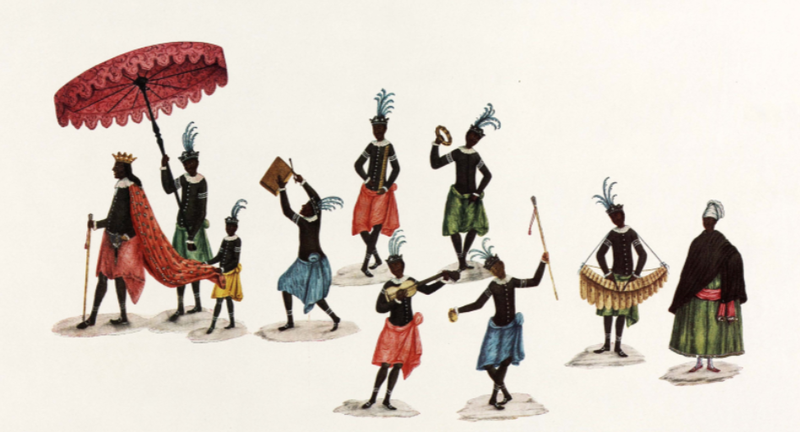
Rei negro, sob o costumeiro guarda-sol, participa da solenidade de sua coroação. Note-se os instrumentos musicais: uns de matriz européia, como a viola, e outros de matriz africana, como o atabaque e a marimba.
Carlos Julião · Riscos iluminados de figurinhos de brancos e negros dos uzos do Rio de Janeiro à Cerro do Frio. Biblioteca Nacional. Rio de Janeiro.

Nesta imagem vê-se o cortejo da rainha já coroada. No cortejo há instrumentos musicais não apenas de matriz africana, mas também européia, como uma viola, uma flauta e uma trompa.
Carlos Julião · Riscos iluminados de figurinhos de brancos e negros dos uzos do Rio de Janeiro à Cerro do Frio. Biblioteca Nacional. Rio de Janeiro.
Places
Named by the record
Places
Only places the record itself states, plotted where the house gazetteer settles their coordinates. Nothing is inferred from a name or a nationality.
Turin.
Birth place
Rio de Janeiro.
Death place
Primary material
Documents and archives
Institutional database
- Wikidata, structured authority record Q7672599: Carlos Julião
Scholarly · Wikimedia Foundation
reference work
- “Carlos Julião”, English Wikipedia, consulted as further reading
Reputable secondary · Wikipedia
Notes from the source article
Cited by Wikipedia
Notes from the source article
These works are cited by the source article, in its own numbering. They are recorded as its citations, not as sources VALÉORINE has verified.
- 1.Torre do Tombo, Livro 9 f142, 1792.
- 2.Arquivo Histórico Militar de Lisboa No. AHM/DIV/3/7/329.
- 3.Arquivo Histórico Militar de Lisboa No. AHM/DIV/3/7/329.
- 4.Arquivo Histórico Militar de Lisboa No. AHM/DIV/3/7/329.
- 5.Arquivo Histórico Ultramarino, AHU_ACL_CU_015, Cx. 166, D. 11832, 1788.
- 6.Juliao, Carlos Dicionário Histórico das Arvores e Arbustos, Biblioteca Nacional de Portugal, COD.10748, 1801.
- 7.Arquivo Histórico Militar de Lisboa No. AHM/DIV/3/7/329.
- 8.Arquivo Histórico Militar de Lisboa No. AHM/DIV/3/7/329.
- 9.Julião, Carlos "Riscos Iluminados de Figurinhos de Negros e Brancos dos Uzos do Rio de Janeiro e Serro Frio", 1960. Rio de Janeiro: Biblioteca Nacional, p.X.
- 10.Julião, Carlos "Riscos Iluminados de Figurinhos de Negros e Brancos dos Uzos do Rio de Janeiro e Serro Frio", 1960. Rio de Janeiro: Biblioteca Nacional, p.X.
- 11.Engenharia Militar no Brasil e no Ultramar Português Antigo e Moderno
- 12.Sotheby's, 28/01/1999. Old Master Paintings. New York, p.302-303
Bibliography printed in the source article · 15
- Academia Militar de Lisboa . 1960. Comemorações do Centenário da Morte do Infante D. Henrique. Lisboa: Academia Militar.
- Arquivo Histórico Militar . Carlos Julião: No. AHM/DIV/3/7/329.
- Arquivo Histórico Ultramarino . Documentos avulsos Capitania de Pernambuco: AHU_ACL_CU_015 Cx. 166, doc. 11832, 19/12/1788.
- Escorel, Silvia . 2000. Vestir Poder e Poder Vestir, o tecido social e a trama cultural nas imagens do traje negro, Rio de Janeiro, século XVIII. Tese de Mestrado, Departamento de Ciências Sociais, Universidade Federal Rio de Janeiro.
- Estado Maior do Exército Português . 1960. Engenharia Militar no Brasil e no Ultramar Português Antigo e Moderno. Lisboa: Esc. Prof Salesianos de São José.
- Juliao, Carlos Dicionário Histórico das Arvores e Arbustos, Biblioteca Nacional de Portugal, COD.10748, 1801.
- Julião, Carlos . Riscos Iluminados de Figurinhos de Negros e Brancos dos Uzos do Rio de Janeiro e Serro Frio. Rio de Janeiro: Biblioteca Nacional, 1960.
- Lara, Silvia Hunold . 2007. Fragmentos Setecentistas: Escravidão, Cultura e Poder na América Portuguesa. São Paulo: Companhia das Letras.
- Lara, Silvia Hunold . 5/7/2006. “Mulheres Escravas, Identidades Africanas”. Universidade Federal da Bahia in https://web.archive.org/web/20160304003211/http://www.desafio.ufba.br/gt3-006.html
- Lara, Silvia Hunold . 2002. “Significados Cruzados: um Reinado de Congos na Bahia Setecentista” in Cunha, Maria Clementina Pereira Carnavais e Outras Festas: Ensaios de Historia Social da Cultura. São Paulo: Editora da Unicamp, p. 71-100.
- Lara, S. H. . 2002. "Customs and costumes: Carlos Julião and the image of black slaves in late Eighteenth-century Brazil". Slavery And Abolition, v. 23, n. 2, p. 125-146.
- Sotheby's . 28/01/1999. Old Master Paintings. New York, p. 302-303.
- Tenreiro, Maria Manuela . Military Encounters in the 18th Century: Racial Representations in the work of Carlos Julião
- Tenreiro, Maria Manuela . "Military Encounters in the Eighteenth-Century: Carlos Julião and Racial Representations in the Portuguese Empire" . "Portuguese Studies", v. 23, pp. 7–35, 2007.
- Torre do Tombo . Chancelaria da Ordem de Avis, D. Maria I (Livro 391).
References
Citations
References
Each reference names the institution holding it, so a reader may go to the document itself.
Institutional database
Wikidata, structured authority record Q7672599: Carlos JuliãoWikimedia Foundation
Institutional witnessreference work
Secondary witness
The Encyclopedia exists whether or not anything is for sale. Corrections are recorded rather than overwritten, and every version of this record is kept. Published 16 August 2026.
Elsewhere in Maps and atlases
1,180 published records in this field, each with its sources named.
- Carl Ludwig von OesfeldAuthor
- Carl RathjensAuthor
- Carl SchützAuthor
- Carlos de Sigüenza y GóngoraAuthor
- Carlos Viegas Gago CoutinhoAuthor
- Carsten NiebuhrAuthor
- Casimir GoerckAuthor
- Caspar HennenbergerAuthor
Best supported in this field
For owners
Own a work by Carlos Julião?
A specialist will read what you send and tell you what the house can establish, what it cannot, and whether the object is suited to sale. There is no charge and no obligation. The object stays with you throughout; nothing is shipped to us unless it is arranged in writing beforehand.