
Carl Larsson
Carl Olof Larsson (Sv-Carl Larsson.ogg; 28 May 1853 – 22 January 1919) was a Swedish painter representative of the Arts and Crafts movement. His many paintings include oils, watercolors, and frescoes. He is principally known for his watercolors of idyllic family life.
Also recorded as Carl Olof Larsson · Karl Olof Larsson · carl Larsson
Carl Larsson
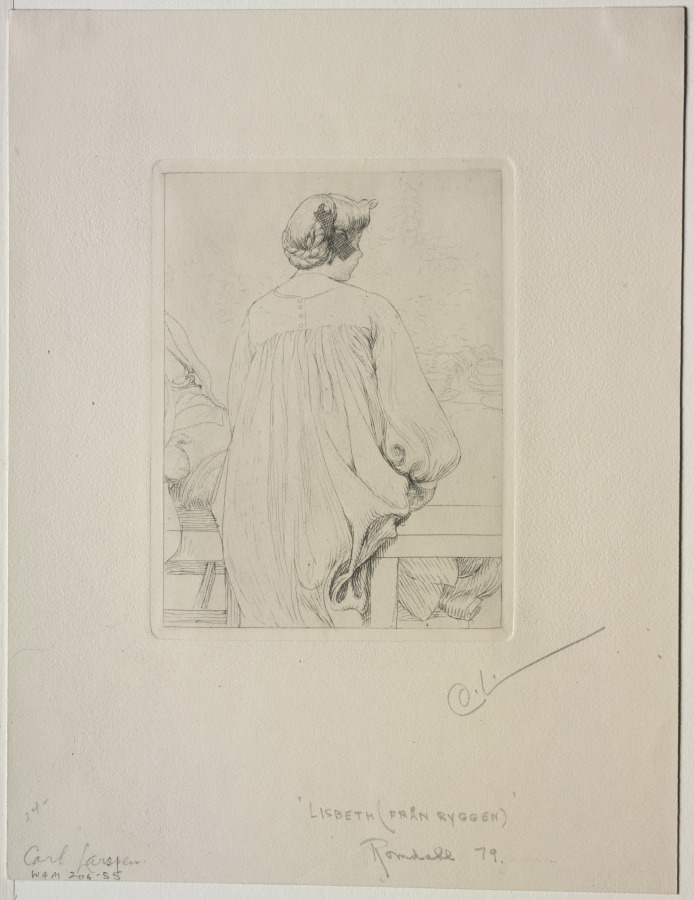
Carl Larsson · The Cleveland Museum of Art · Gift of Louis W. Black · CC0
- Name
- Carl Larsson
- Born
- 28 May 1853
- Birthplace
- Stockholm, Sweden
- Died
- 22 January 1919
- Place of death
- Falun, Sweden
- Field
- * Painting
- Spouse
- Karin Larsson
- Education
- Royal Swedish Academy of Arts
- Nationality
- Sweden
- Occupation
- watercolorist · illustrator · painter · printmaker · graphic artist · draftsperson · writer · architectural drafter · exlibrist · muralist · etcher
- Fields
- portrait painting · genre painting · landscape painting · nude · figure painting
- Movements
- Arts and Crafts movement
VALÉORINE Encyclopedia
VALÉORINE documentary reading
Documentary summary
Carl Olof Larsson (Sv-Carl Larsson.ogg; 28 May 1853 – 22 January 1919) was a Swedish painter representative of the Arts and Crafts movement. His many paintings include oils, watercolors, and frescoes. He is principally known for his watercolors of idyllic family life.
Admitted source layer · organised and presented by VALÉORINE
Reference Check
Propose documentary evidence for Carl Larsson. A contribution is never written directly as fact: identity, source, rights and evidence gates still decide.
Sign in to contribute
Documentary evidence
Documentary basis
Authority files
getty · 500309329 · wikidata · Q187310 · wikipedia · Carl Larsson
In this article
Biography
Biography
He considered his finest work to be Midvinterblot (Midwinter Sacrifice), a large painting now displayed inside the Swedish National Museum of Fine Arts.
Key facts
Key facts
• Name — Carl Larsson • Born — 28 May 1853 • Birthplace — Stockholm, Sweden • Died — 22 January 1919 • Place of death — Falun, Sweden • Field — * Painting • writing • Spouse — Karin Larsson • Education — Royal Swedish Academy of Arts • Illustration — Self-Portrait in the new studio
Early life and education
Early life and education
Larsson was born on 28 May 1853, in the Gamla stan neighborhood of Stockholm, Sweden. His parents were extremely poor, and his childhood was not happy. Renate Puvogel, in her book Carl Larsson (Cologne: Taschen; 1994), gives detailed information about Larsson's life: "His mother was thrown out of the house, together with Carl and his brother Johan; after enduring a series of temporary dwellings, the family moved into Grev Magnigränd No. 7 (later No. 5) in what was then Ladugårdsplan, present-day Östermalm". As a rule, each room was home to three families; "penury, filth and vice thrived there, leisurely seethed and smouldered, eaten-away and rotten bodies and souls. Such an environment is the natural breeding ground for cholera", he wrote in his autobiographical novel Jag. Larsson's father worked as a casual laborer, sailed as a stoker on a ship headed for Scandinavia, and lost the lease to a nearby mill, only to work there later as a mere grain carrier. Larsson portrays him as a loveless man lacking self-control; he drank, ranted and raved, and incurred the lifelong anger of his son after an outburst in which he declared, "I curse the day you were born". In contrast, Carl's mother worked long hours as a laundress to provide for her family. However, at the age of thirteen, his teacher at the school for poor children urged him to apply to the Royal Swedish Academy of Arts, and he was admitted. During his first years there, Larsson felt socially inferior, confused, and shy. In 1869, at the age of sixteen, he was promoted to the "antique school" of the same academy. There Larsson gained confidence, and even became a central figure in student life. Carl earned his first medal in nude drawing. In the meantime, Larsson worked as a caricaturist for the humorous paper Kasper (magazine) and as a graphic artist for the newspaper Ny Illustrerad Tidning. His annual wages were sufficient to allow him to help support his parents financially.
Career
Career
After several years working as an illustrator of books, magazines, and newspapers, Larsson moved to Paris in 1877, where he spent several frustrating years as a hardworking artist without any success. Larsson was not eager to establish contact with the French progressive Impressionists; instead, along with other Swedish artists, he cut himself off from the radical movement of change. After spending two summers in Barbizon, the refuge of the plein-air painters, in 1882 he settled for a time with his Swedish painter colleagues in Grez-sur-Loing at a Scandinavian artists' colony outside Paris. It was there that he met the artist Karin Bergöö, who he married in 1883. This was to be a turning point in Larsson's life. In Grez, Larsson painted some of his most important works, now in watercolour and very different from the oil painting technique he had previously employed. In 1885 he returned to Sweden where he would stay until 1888, painting scenes of southern Stockholm in en plein air studies. In 1886, he accepted the position of director at the Valand School of Fine Art in Gothenburg, a role he held until 1891. There he taught, among others, Ester Almqvist, to whom he dedicated an etching. • Illustration — Anders Zorn, Carl Larsson, 1897 His family became Larsson's favourite models. Carl and Karin Larsson together had eight children: Suzanne (b. 1884), Ulf (b. 1887), Pontus (b. 1888), Lisbeth (b. 1891), Brita (b. 1893), Mats (b. 1894), Kersti (b. 1896) and Esbjörn (b. 1900). Many of the interiors he depicted were the work of Karin Larsson, who also worked as an interior designer. In 1888, the young family was given a small house named Lilla Hyttnäs at Sundborn just outside Falun in Dalarna by Karin's father Adolf Bergöö (1828–1890). Carl and Karin decorated and furnished this house according to their particular artistic taste and also for the needs of the growing family. Through his paintings and books, Little Hyttnäs has become one of the most famous artist's homes in the world, transmitting the artistic taste of its creators and making it a major line in Swedish interior design. The descendants of Carl and Karin Larsson now own this house, now known as Carl Larsson-gården, and keep it open for tourists each summer from May until October. In his later years he suffered from bouts of depression. While working on Midvinterblot (1915), a large decoration for the vestibule of the Nationalmuseum, Larsson experienced the onset of an eye problem and a worsening of his frequent headaches. After suffering a mild stroke in January 1919, he spent his remaining time completing his memoirs. He died later that month in Falun and was buried in the cemetery of Sundborn Church.
Midvinterblot
Midvinterblot
• Illustration — Midvinterblot Nationalmuseum in Stockholm (1915) In his memoirs Jag (Stockholm: Albert Bonniers förlag, 1931) – published after Larsson's death – he declared his bitterness and disappointment over this rejection of the painting he himself considered to be his greatest achievement: "The fate of Midvinterblot broke me! This I admit with a dark anger. And still, it was probably the best thing that could have happened, because my intuition tells me – once again! – that this painting, with all its weaknesses, will one day, when I'm gone, be honoured with a far better placement." Larsson admitted, however, in the same memoirs that the pictures of his family and home "became the most immediate and lasting part of my life's work. For these pictures are of course a very genuine expression of my personality, of my deepest feelings, of all my limitless love for my wife and children." Fights between different schools of Swedish artists caused the "Midvinterblot" controversy to continue for many years. In 1987 the museum was even offered the monumental painting for free, provided it would adorn the empty wall for which it had been intended, but the museum declined the offer, so the painting was sold to the Japanese collector Hiroshi Ishizuka. In 1992, he agreed to lend it to the museum for its major Carl Larsson exhibition, where it was hung in the intended place. Public appreciation changed the experts' view of the painting, and with the help of private donations the museum was able to buy it from Ishizuka in 1997 and permanently display it in the location for which it was intended.
Gallery
Gallery
• Illustration — Martina with the breakfast tray, watercolor, 1904 • Illustration — Brita as Iduna, lithograph, 1901 • Illustration — Hide and Seek, 1898 • Illustration — Self-portrait with Brita, watercolor, 1895 • Illustration — Self-portrait, oil on canvas, 1906 • Illustration — Mamma's and the small girls' room, watercolor, 1897 • Illustration — Nameday at the storage house, watercolor, 1897 • Illustration — The kitchen, watercolor, c. 1898 • Illustration — Crayfishing, watercolor, c. 1898 • Illustration — Azalea, 1906
Identity and origins
Identity and origins
The authorities additionally record the headings Carl Olof Larsson, Karl Olof Larsson and carl Larsson. His recorded language was Swedish. He was the child of Olof Larsson and Johanna Carolina Erika Larsson. He married Karin Larsson. 4 children are recorded: Brita Larsson, Suzanne Larsson, Ulf Larsson and Pontus Larsson.
Identity
Identity
The Founders of the Art Collections: Lovisa Ulrika and C.G. The Art of Architecture: Tessin the Younger and Hårleman. The Art of Painting: Ehrenstrahl and Karl XI. Carl Larsson is recorded as watercolorist, illustrator, painter and printmaker.
Life and career
Dated record
Life and career
The full dated record · 2 entries
1853
Carl Larsson born at Storkyrkoförsamlingen.
1919
Carl Larsson died at Sundborns.
Paintings
• Illustration — A studio idyll depicting the artist's wife with their first child, Suzanne Larsson's popularity increased considerably with the development of colour reproduction technology in the 1890s, when the Swedish publisher Bonnier published books written and illustrated by Larsson and containing full colour reproductions of his watercolours, titled A Home. However, the print runs of these rather expensive albums did not come close to that produced in 1909 by the German publisher Karl Robert Langewiesche (1874–1931). Langewiesche's choice of watercolours, drawings and text by Carl Larsson, titled Das Haus in der Sonne (Königstein, Verlag Karl Robert Langewiesche. 1909), immediately became one of the German publishing industry's best-sellers of the year—40,000 copies sold in three months, and more than 40 print runs have been produced up to 2001. Carl and Karin Larsson declared themselves overwhelmed by such success. Carl Larsson considered his monumental works, such as his frescos in schools, museums and other public buildings, to be his most important works. His last monumental work, Midvinterblot (Midwinter Sacrifice), a 6 x oil painting completed in 1915, had been commissioned for a wall in the National Museum in Stockholm (which already had several of his frescos adorning its walls). However, upon completion, it was rejected by the board of the museum. The fresco depicts the blót of King Domalde at the Temple of Uppsala. Decades later, the painting was purchased and placed in the National Museum.
Primary material
Documents and archives
reference work
- “Carl Larsson”, English Wikipedia, consulted as further reading
Reputable secondary · Wikipedia
- Wikidata, structured authority record Q187310: Carl Larsson
Reputable secondary · Wikimedia Foundation
authority file
- Getty Union List of Artist Names 500309329, Carl Larsson-Garden.
General reference · The Getty Research Institute
Additional sources
Additional sources
* * * * * * • Facos, Michelle. “The Ideal Swedish Home: Carl Larsson’s Lilla Hyttnäs,” in Not at Home: The Suppression of Domesticity in Modern Art and Architecture, Christopher Reed, ed. (London: Thames and Hudson, 1996), 81–91. • Cumming, Elizabeth; Kaplan, Wendy (1991). Arts & Crafts Movement (London: Thames & Hudson)
Notes from the source article
Cited by Wikipedia
Notes from the source article
These works are cited by the source article, in its own numbering. They are recorded as its citations, not as sources VALÉORINE has verified.
- 1.nationalmuseum. Carl Olof Larsson.
- 2.Brita Linde. Carl O Larsson. Svenskt biografiskt lexikon.
- 3."The official homepage of the artist Carl Larsson", Carl and Karin Larsson Family Association, 2007, clg.se
- 4.Jag, Stockholm, 1931, p. 21
- 5.Puvogel Renate (1994) Carl Larsson (Cologne: Taschen; 1994)
- 6.Renowned Artists. Carl Larsson, Biography.
- 7.Nordisk familjebok. Ny illustrerad tidning.
- 8.Ingrid Zakrisson. Karin Larsson. Svenskt kvinnobiografiskt lexikon.
- 9.Georg Nordensvan (1928). Svensk konst och svenska konstnärer i 19de århundradet. Del II. Från Karl XV till sekelslutet (Ny grundligt omarbetad upplaga). Stockholm: Bonniers. pages 275-278, 341-353. (In Swedish)
- 10.Birgit Rausing: Ester Almqvist och hennes krets. Signum: Lund, 1998. (In Swedish)
- 11.Amanda Severn. The Life and Paintings of Swedish Artist and Illustrator, Carl Larsson. owlcation.com. 18 December 2017.
- 12.Karin Bergöö Larssons vänner. Köpmannen Adolf Bergöö – Karins pappa.
- 13.Carl Larsson-gården. Carl Larsson-gården – One of the world's best known and most depicted artist's homes.
- 14.Linde, Brita. "Larsson, Carl." Grove Art Online. Oxford Art Online. Oxford University Press. Web.
- 15.Carl, Klaus H. Carl Larsson, Parkstone Press. 2015.
- 16.Google Arts and Culture. Midvinterblot.
- 17.Carl Larsson-gården. Minneskonsert Sundborns kyrka.
- 18.Golden Thread Rare Books. Das Haus In Der Sonne illustrated by Carl Larsson.
- 19.curiator.com. Midvinterblot (Midwinter Sacrifice), 1915 by Carl Larsson.
- 20.eclecticlight.co. Carl Larsson: how a loved and popular painter became lost in controversy. 22 November 2015.
Bibliography printed in the source article · 7
- 1895: De mina. (My Loved Ones)
- 1899: Ett hem (A Home) and
- 1902: Larssons (The Larssons)
- 1906: Spadarfvet – mitt lilla lantbruk (A Farm)
- 1910: Åt solsidan (On the Sunny Side) ( and
- 1913: Andras barn (Other People's Children)
- 1931: Jag (I, Carl Larsson) (autobiography)
References
Citations
References
Each reference names the institution holding it, so a reader may go to the document itself.
reference work
Secondary witnessauthority file
Getty Union List of Artist Names 500309329, Carl Larsson-Garden.The Getty Research Institute
Secondary witnessreference work
Wikidata, structured authority record Q187310: Carl LarssonWikimedia Foundation
Secondary witness
Further particulars
Held on the record
Further particulars
Open the remaining particulars
Formation and teaching. Larsson studied at Royal Swedish Academy of Fine Arts. He trained under Johan Gustaf Köhler. His recorded influences include Jules Bastien-Lepage, Impressionism and Japanese Prints. Larsson worked in painting, interior design and young adult literature. His work is associated with Arts and Crafts movement. He belonged to Grez colony. He worked at Stockholm, Paris, Grez-sur-Loing and Falun Municipality. Larsson received Exposition Universelle of 1900 and Knight of the Legion of Honour.
Career and activity
Recognition and collections
Work by Carl Larsson is
Minneapolis Institute of Art, Art Institute of Chicago, Finnish National Gallery and Nationalmuseum
The Encyclopedia exists whether or not anything is for sale. Corrections are recorded rather than overwritten, and every version of this record is kept. Published 14 August 2026.
Elsewhere in Prints
4,138 published records in this field, each with its sources named.
- Carl Borromäus Andreas RuthartEngraver
- Carl Edvard SonneEngraver
- Carl HummelEngraver
- Carl KuntzEngraver
- Carl MorrisEngraver
- Carl Nelson GormanEngraver
- Carl RakemanEngraver
- Carl Traugott RiedelEngraver
Best supported in this field
For owners
Own a work by Carl Larsson?
A specialist will read what you send and tell you what the house can establish, what it cannot, and whether the object is suited to sale. There is no charge and no obligation. The object stays with you throughout; nothing is shipped to us unless it is arranged in writing beforehand.