
Caran d'Ache
Emmanuel Poiré (6 November 1858 – 25 February 1909), known by the pseudonym Caran d'Ache (French: [kaʁɑ̃ daʃ]), was a 19th-century Russian-French satirist and political cartoonist. While his first work glorified the Napoleonic era, he went on to create "stories without words" and as a contributor to newspapers such as the Le Figaro, he is sometimes hailed as one of the precursors of comic strips.
Also recorded as Emmanuel Poiré · Caran D'Ache · Emmanuel Poire
Caran d'Ache

Atelier Nadar · This file comes from Gallica Digital Library and is available under the digital ID btv1b53097664z · Public domain
- Born
- 1858.
- Died
- 1909.
- Nationality
- France and Russian Empire.
- Occupation
- cartoonist, caricaturist, editorial cartoonist, military personnel, illustrator and draftsperson.
- Known for
- A Family Supper.
VALÉORINE Encyclopedia
VALÉORINE documentary reading
Documentary summary
Emmanuel Poiré (6 November 1858 – 25 February 1909), known by the pseudonym Caran d'Ache (French: [kaʁɑ̃ daʃ]), was a 19th-century Russian-French satirist and political cartoonist. While his first work glorified the Napoleonic era, he went on to create "stories without words" and as a contributor to newspapers such as the Le Figaro, he is sometimes hailed as one of the precursors of comic strips.
Admitted source layer · organised and presented by VALÉORINE
Note VALÉORINE
Caran d'Ache (1858–1909) was a French and Russian caricaturist, cartoonist and draftsperson, among other activities. Born Emmanuel Poiré in Moscow, the caricaturist died in rue du Faubourg-Saint-Honoré. Caran d'Ache was a member of Ligue de la Patrie Française and worked in Paris.
Works include A Family Supper. Genres include caricature, comic and painting. Languages used include French.
Composed from admitted, traceable facts · 26 September 2026
VALÉORINE
Reference Check
Propose documentary evidence for Caran d'Ache. A contribution is never written directly as fact: identity, source, rights and evidence gates still decide.
Sign in to contribute
World of VALÉORINE
Documentary connections
Only confirmed graph relationships appear here. Images are shown only when their identity and reuse rights both pass the documentary gate.

Documentary evidence
Evidence Panel
not yet certified
- Identity
- resolved
- Independent source families
- 0
- Admitted assertions
- 0
- Open conflicts
- 0
Authority files
wikidata · Q708521 · wikipedia · Caran d'Ache
In this article
Name
Name
Emmanuel Poiré initially published his illustrations with military themes under the name Caporal Poiré, but later adopted the pseudonym Caran d'Ache, and it was under this name that his work became well known in France. The pseudonym comes from the Russian word karandash (карандаш) meaning 'pencil', which, attested in Russian from the 16th–17th centuries, is in turn a borrowing from a Turkic language. When the stationery company Fabrique Genevoise de Crayons Ecridor came under new management in 1924, the company was renamed Caran d'Ache, after Poiré, with a nod to the pseudonym's etymological roots.
Biography
Biography
Born in Moscow on 6 November 1858, d'Ache was the grandson of an Officer-Grenadier in Napoleon's Grande Armée who, wounded during the Battle of Borodino, had stayed behind in Russia. After his grandfather's death, he was adopted by a Polish family whose daughter he later married. His younger sister, Maria Poiret, became a famous dancer and actress. In 1877, he emigrated to France where he gained French citizenship and joined the Army for five years, where he was assigned to design uniforms for the ministry of war. He also contributed to their journal La Vie militaire with satirical illustrations, among them some caricatures of the German army. In 1898 he co-founded the satirical, anti-Dreyfusard weekly magazine Psst...! along with fellow artist and designer Jean-Louis Forain. The magazine lasted 85 issues and was made up entirely of editorial cartoons by Caran d'Ache and Forain, caricaturing society and its scandals from an antisemitic, pro-Army viewpoint. He died in Paris on 25 February 1909 at the age of 50.
Works
Works
Much of his work was contributed to La Vie Parisienne, Le Figaro illustré, La Caricature, and Le Chat Noir. He also issued various albums of sketches and posters, some listed below. and illustrated a good many books, notably Benardaky's Prince Kozakokoff. 1880: His first drawings of military caricatures were published in La Chronique Parisienne. 1892: Caran d'Ache published Carnet de Chèques ("Checkbook") on the Panama Canal Affair. 1895: He started publishing editorial cartoons (every Monday) in the daily Le Figaro, and soon thereafter for the popular weekly Le Rire. A poster for an «Exposition Russe» in Paris was published in Les Maîtres de l'Affiche. 1898: Caran d'Ache published the cartoon Un diner en famille ("A Family Dinner"), highlighting the intense disagreements in French society regarding the Dreyfus Affair. It appeared a month after Émile Zola's famous J'Accuse, which inflamed and hardened opinion on both sides.
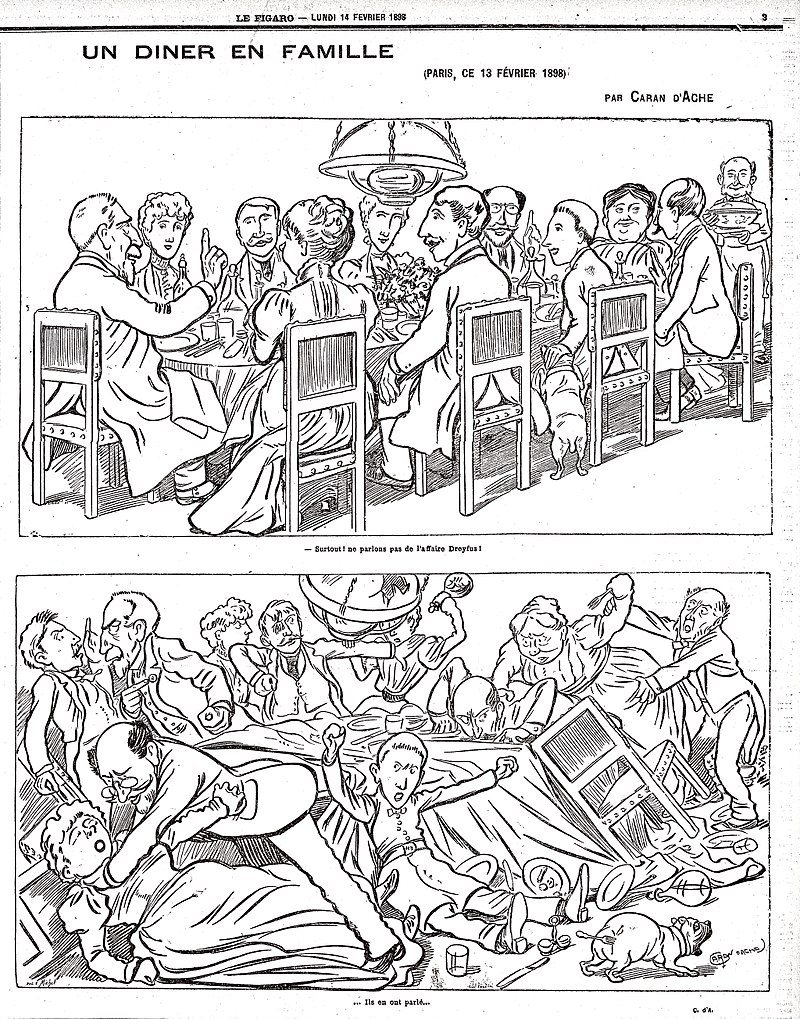
Drawing of "a family supper" by Caran d'Ache in le Figaro on February 14, 1898. The drawing depicts the divisions in French society during the Dreyfus Affair. At the top, somebody says "Above all, let us not discuss the Dreyfus Affair!". At the bottom, the whole family is fighting, and the caption says "They have discussed it".
Caran d'Ache · This file comes from Gallica Digital Library and is available under the digital ID bpt6k2842896/f3.item

Cartoon on Emile Zola J'accuse!
Scanné par moi-même · Carte postale scannée
Life and career
Dated record
Life and career
The full dated record · 2 entries
1858
Caran d'Ache was born in 1858.
1909
Caran d'Ache died at Paris.
Primary material
Documents and archives
reference work
- “Caran d'Ache”, English Wikipedia, consulted as further reading
Reputable secondary · Wikipedia
authority record
- Wikidata, structured authority record Q708521: Caran d'Ache
Unverified · Wikidata
Notes from the source article
Cited by Wikipedia
Notes from the source article
These works are cited by the source article, in its own numbering. They are recorded as its citations, not as sources VALÉORINE has verified.
- 1.Caran d'Ache - Biography. Stephen Ongpin Fine Art.
- 2.Caran d’Ache and the story of the black stone
- 3.Pencils of Caran d'Ache. The Gentleman Stationer. 2015-02-10.
- 4.Graphic Witness. Le Rire.
- 5.EB1911 inline=y wstitle=Caran d'Ache volume=5 page=301
- 6.Lethève, Jacques. La caricature et la presse sous la IIIe République. wlu.edu. Armand Colin. 1961. 801910610 <!--.
- 7.Forain, Jean-Louis. Psst.!(Paris). BnF Gallica. Plon. 10 December 2012.
- 8.Benardaky. Prince Kozakokoff. Librairie Plon. 1885.
- 9.Lambiek Comiclopedia. Caran d'Ache.
- 10.Marrus, Michael R. 'En Famille': The Dreyfus Affair and Its Myths. French Politics and Society. Berghahn Books. 12. 4. 77–90. 1994. 0882-1267.
References
Citations
References
Each reference names the institution holding it, so a reader may go to the document itself.
reference work
Partially resolvedauthority record
Unverified
People, houses and institutions
Knowledge graph
People, houses and institutions
Teachers, collaborators, publishers and institutions recorded against this person, each on a stated basis.
Died at
1- ParisPlace
Established from a fact already recorded on a verified source.
The Encyclopedia exists whether or not anything is for sale. Corrections are recorded rather than overwritten, and every version of this record is kept. Published 14 August 2026.
Elsewhere in Comics and comic art
9,920 published records in this field, each with its sources named.
- Captain Marvel AdventuresSeries
- Captain TsubasaSeries
- Captivated, by YouSeries
- Captive HeartsSeries
- Caravan KiddSeries
- Cardcaptor SakuraSeries
- Carel MoiseiwitschArtist
- Caressing the Nipples of My Hibernating BearSeries
Best supported in this field
For owners
Own a work by Caran d'Ache?
A specialist will read what you send and tell you what the house can establish, what it cannot, and whether the object is suited to sale. There is no charge and no obligation. The object stays with you throughout; nothing is shipped to us unless it is arranged in writing beforehand.