
Brian Kernighan
Brian Wilson Kernighan (born 30 January 1942) is a Canadian computer scientist. He worked at Bell Labs and contributed to the development of Unix alongside Unix creators Ken Thompson and Dennis Ritchie. Kernighan's name became widely known through co-authorship of the first book on the C programming language (The C Programming Language) with Dennis Ritchie.
Also recorded as Brian W. Kernighan · Brian Wilson Kernighan
Brian Kernighan
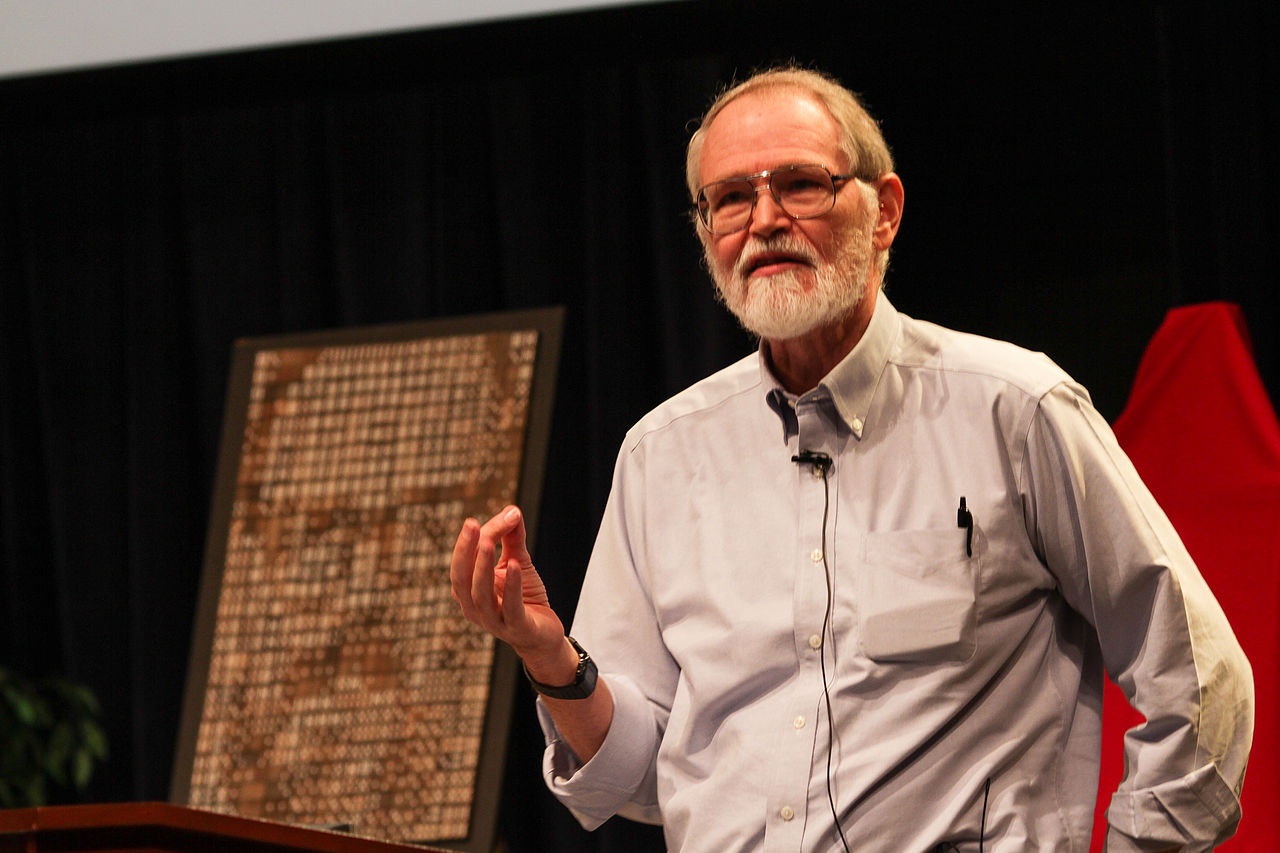
Ben Lowe · CC BY 2.0
- Full name
- Brian Wilson Kernighan.
- Born
- 1942. · Toronto.
- Nationality
- Canada and United States.
- Occupation
- computer scientist, engineer, programmer, writer and university teacher.
- Fields
- computer scientist, informatics, computer programming and programming language.
- Education
- University of Toronto and Princeton University.
- Known for
- AMPL and The C Programming Language.
- Languages
- English.
VALÉORINE Encyclopedia
VALÉORINE documentary reading
Documentary summary
Brian Wilson Kernighan (born 30 January 1942) is a Canadian computer scientist. He worked at Bell Labs and contributed to the development of Unix alongside Unix creators Ken Thompson and Dennis Ritchie. Kernighan's name became widely known through co-authorship of the first book on the C programming language (The C Programming Language) with Dennis Ritchie.
Admitted source layer · organised and presented by VALÉORINE
Note VALÉORINE
No house-authored Note is published until its assertions and sources pass the VALÉORINE evidence contract. The documentary article remains available in full while that enrichment is being consolidated.
Documentary enrichment in progress · no unsupported statement published
Reference Check
Propose documentary evidence for Brian Kernighan. A contribution is never written directly as fact: identity, source, rights and evidence gates still decide.
Sign in to contribute
World of VALÉORINE
Documentary connections
Only confirmed graph relationships appear here. Images are shown only when their identity and reuse rights both pass the documentary gate.

Documentary evidence
Evidence Panel
original value insufficient · checked 25 September 2026
- Identity
- resolved
- Independent source families
- 0
- Admitted assertions
- 0
- Open conflicts
- 0
Authority files
wikidata · Q92608 · wikipedia · Brian Kernighan
In this article
Early life and education
Early life and education
Kernighan affirmed that he had no part in the design of the C language ("it's entirely Dennis Ritchie's work"). Kernighan authored many Unix programs, including ditroff. He is coauthor of the AWK and AMPL programming languages. The "K" of K&R C and of AWK both stand for "Kernighan". In collaboration with Shen Lin he devised well-known heuristics for two NP-complete optimization problems: graph partitioning and the travelling salesman problem. In a display of authorial equity, the former is usually called the Kernighan–Lin algorithm, while the latter is known as the Lin–Kernighan heuristic. Kernighan has been a professor of computer science at Princeton University since 2000 and is the director of undergraduate studies in the department of computer science. In 2015, he co-authored the book The Go Programming Language.
Brian Kernighan studied at University of Toronto and Princeton University. The recorded working language is English. The field of work recorded is computer scientist, informatics and computer programming. Works named in the authority record are AMPL and The C Programming Language.
Kernighan was born in Toronto. He attended the University of Toronto between 1960 and 1964, earning his bachelor's degree in engineering physics. He received his Ph.D. in electrical engineering from Princeton University in 1969, completing a doctoral dissertation titled "Some graph partitioning problems related to program segmentation" under the supervision of Peter G. Weiner.
Career and research
Career and research
Kernighan has held a professorship in the department of computer science at Princeton since 2000. Each fall he teaches a course called "Computers in Our World", which introduces the fundamentals of computing to non-majors. Kernighan was the software editor for Prentice Hall International. His "Software Tools" series spread the essence of "C/Unix thinking" with makeovers for BASIC, FORTRAN, and Pascal, and most notably his "Ratfor" (rational FORTRAN) was put in the public domain. He has said that if stranded on an island with only one programming language it would have to be C. Kernighan coined the term "Unix" and helped popularize Thompson's Unix philosophy. Kernighan is also known for coining the expression "What You See Is All You Get" (WYSIAYG), which is a sarcastic variant of the original "What You See Is What You Get" (WYSIWYG). Kernighan's term is used to indicate that WYSIWYG systems might throw away information in a document that could be useful in other contexts. In 1972, Kernighan described memory management in strings using "hello" and "world", in the B programming language, which became the iconic example we know today. Kernighan's original 1978 implementation of hello, world! was sold at The Algorithm Auction, the world's first auction of computer algorithms. In 1996, Kernighan taught CS50 which is the Harvard University introductory course in computer science. Kernighan was an influence on David J. Malan who subsequently taught the course and scaled it up to run at multiple universities and in multiple digital formats. Kernighan was elected a member of the National Academy of Engineering in 2002 for contributions to software and to programming languages. He was also elected a member of the American Academy of Arts and Sciences in 2019. In 2022, Kernighan stated that he was actively working on improvements to the AWK programming language, which he took part in creating in 1977.
Programs
Programs
1972: The first documented "Hello, world!" program, in Kernighan's "A Tutorial Introduction to the Language B" 1973: ditroff, or "device independent troff", which allowed troff to be used with any device 1974: The eqn typesetting language for troff, with Lorinda Cherry 1976: Ratfor 1977: The m4 macro processing language, with Dennis Ritchie 1977: The AWK programming language, with Alfred Aho and Peter J. Weinberger, and its book The AWK Programming Language 1985: The AMPL programming language 1988: The pic typesetting language for troff

Brian Kernighan speaks at a tribute to Dennis Ritchie at Bells Labs.
Ben Lowe · File:Brian_Kernighan_in_2012_at_Bell_Labs_1.jpg
Life and career
Dated record
Life and career
The full dated record · 1 entries
1942
Brian Kernighan was born on 30 January 1942.
Books and reports
The Elements of Programming Style, with P. J. Plauger Software Tools, a book and set of tools for Ratfor, co-created in part with P. J. Plauger Software Tools in Pascal, a book and set of tools for Pascal, with P. J. Plauger The AWK Programming Language, with Alfred V. Aho, and Peter J. Weinberger The C Programming Language, with C creator Dennis Ritchie, the first book on C The Practice of Programming, with Rob Pike The Unix Programming Environment, a tutorial book, with Rob Pike "Why Pascal is Not My Favorite Programming Language", a popular criticism of Niklaus Wirth's Pascal. Some parts of the criticism are obsolete due to ISO 7185 (Programming Languages - Pascal); the criticism was written before ISO 7185 was created. (AT&T Computing Science Technical Report #100) UNIX: A History and a Memoir, a historical account of the development of Unix from the perspective of his role at Bell Labs
Primary material
Documents and archives
reference work
- “Brian Kernighan”, English Wikipedia, consulted as further reading
Reputable secondary · Wikipedia
authority record
- Wikidata, structured authority record Q92608: Brian Kernighan
Unverified · Wikidata
Notes from the source article
Cited by Wikipedia
Notes from the source article
These works are cited by the source article, in its own numbering. They are recorded as its citations, not as sources VALÉORINE has verified.
- 1.The Library of Congress. Kernighan, Brian W. - LC Linked Data Service: Authorities and Vocabularies Library of Congress, from LC Linked Data Service: Authorities and Vocabularies (Library of Congress). id.loc.gov.
- 2.Lohr, Steve. To the Liberal Arts, He Adds Computer Science. The New York Times. 31 October 2002.
- 3.Kernighan, Brian Wilson. Some Graph Partitioning Problems Related to Program Segmentation. Princeton University. 1969. 39166855.
- 4."C" Programming Language: Brian Kernighan - Computerphile.
- 5.Brian Kernighan Trims His Beard in First CS50 Lecture in 1996. YouTube. 2024-11-13.
- 6.Nerd Talk - Doug McIlroy & Brian Kernighan. 22 October 2021.
- 7.Dolya, Aleksey. Interview with Brian Kernighan. Linux Journal. 29 July 2003.
- 8.ACMPortal id=81100397511
- 9.An Oral History of Unix. 2007-06-11.
- 10.Brian Kernighan Computer Science Department at Princeton University. www.cs.princeton.edu.
- 11.Brian Kernighan - The Mathematics Genealogy Project. www.genealogy.math.ndsu.nodak.edu.
- 12.Kernighan, Brian W. Some graph partitioning problems related to program segmentation. 1969.
- 13.Brian Kernighan | Computer Science Department at Princeton University.
- 14.Kernighan, Brian. COS 109, Fall 2021: Home Page. www.cs.princeton.edu.
- 15.Kernighan, Brian. COS 109: Computers in our world. Princeton Education.
- 16.Budiu, Mihai. An Interview with Brian Kernighan. July 2000.
- 17.McIlroy, M. D. A Research Unix reader: annotated excerpts from the Programmer's Manual, 1971–1986. Bell Labs. 139. 1987.
- 18.Morris, Richard. Brian Kernighan: Geek of the Week. Simple Talk. 2010-05-19.
- 19.Bell Laboratories. THE PROGRAMMING LANGUAGE B. 16 October 2021.
- 20.Brian Kernighan Hello World. Artsy.
- 21.Malan, David J. Proceedings of the 41st ACM technical symposium on Computer science education. 152–156. 2010. 9781450300063.
- 22.Dr. Brian W. Kernighan. NAE Website.
- 23.Brian W. Kernighan. American Academy of Arts & Sciences.
- 24.Unix legend, who owes us nothing, keeps fixing foundational AWK code. Ars Technica. 23 August 2022.
- 25.Original paper in Postscript
- 26.D is for Digital: What a well-informed person should know about computers and communications
- 27.Brian Kernighan and Alan Donovan (2015) The Go Programming Language
- 28.UNIX: A History and a Memoir
References
Citations
References
Each reference names the institution holding it, so a reader may go to the document itself.
reference work
Partially resolvedauthority record
Unverified
People, houses and institutions
Knowledge graph
People, houses and institutions
Teachers, collaborators, publishers and institutions recorded against this person, each on a stated basis.
Studied at
1- Princeton UniversityOrganisation
Established from a fact already recorded on a verified source.
The Encyclopedia exists whether or not anything is for sale. Corrections are recorded rather than overwritten, and every version of this record is kept. Published 14 August 2026.
Elsewhere in Books
38,342 published records in this field, each with its sources named.
- Brian HookerAuthor
- Brian HowardAuthor
- Brian JonesAuthor
- Brian KennedyAuthor
- Brian LumleyAuthor
- Brian MerrimanAuthor
- Brian MooreAuthor
- Brian MulroneyAuthor
Best supported in this field
For owners
Own a work by Brian Kernighan?
A specialist will read what you send and tell you what the house can establish, what it cannot, and whether the object is suited to sale. There is no charge and no obligation. The object stays with you throughout; nothing is shipped to us unless it is arranged in writing beforehand.