
Boris Iofan
Boris Mikhailovich Iofan (April 28, 1891 – March 11, 1976) was a Soviet architect of Jewish origin, known for his Stalinist architecture buildings like the 1931 House on the Embankment and the 1931–1933 winning draft of the Palace of the Soviets. • Illustration — Iofan's House on the Embankment, present day
Also recorded as Boris Mikhaĭlovich Iofan · Boris Mikhaylovich Iofan · Boris M. Iofan · Boris Mikhailovich Iofan
Boris Iofan

Илюхин Б.С. · filpersona.ru · Public domain
- Name
- Boris Iofan
- Born
- 28 April 1891
- Birthplace
- Odessa, Kherson Governorate, Russian Empire
- Died
- 11 March 1976
- Place of death
- Moscow, Russian SFSR, Soviet Union
- Education
- Grekov Odessa Art school, Accademia di Belle Arti
- Awards
- People's Architect of the USSR (1970)
- Birth Name
- Boris Mikhailovich Iofan
- Nationality
- Russian Empire and Soviet Union.
- Occupation
- architect.
- Known for
- House on the Embankment.
VALÉORINE Encyclopedia
VALÉORINE documentary reading
Documentary summary
Boris Mikhailovich Iofan (April 28, 1891 – March 11, 1976) was a Soviet architect of Jewish origin, known for his Stalinist architecture buildings like the 1931 House on the Embankment and the 1931–1933 winning draft of the Palace of the Soviets. • Illustration — Iofan's House on the Embankment, present day
Admitted source layer · organised and presented by VALÉORINE
Note VALÉORINE
No house-authored Note is published until its assertions and sources pass the VALÉORINE evidence contract. The documentary article remains available in full while that enrichment is being consolidated.
Documentary enrichment in progress · no unsupported statement published
Reference Check
Propose documentary evidence for Boris Iofan. A contribution is never written directly as fact: identity, source, rights and evidence gates still decide.
Sign in to contribute
Documentary evidence
Evidence Panel
not yet certified
- Identity
- resolved
- Independent source families
- 0
- Admitted assertions
- 0
- Open conflicts
- 0
Authority files
wikidata · Q167816 · wikipedia · Boris Iofan
In this article
Key facts
Key facts
• Name — Boris Iofan • Born — 28 April 1891 • Birthplace — Odessa, Kherson Governorate, Russian Empire • Died — 11 March 1976 • Place of death — Moscow, Russian SFSR, Soviet Union • Education — Grekov Odessa Art school, Accademia di Belle Arti • Significant Buildings — House on the Embankment • Significant Projects — Palace of the Soviets (never built) • Awards — People's Architect of the USSR (1970) • Birth Name — Boris Mikhailovich Iofan
Background
Background
Born in Odessa, Iofan entered school in his home town at the age of 12 in 1903. He left for Italy shortly before the outbreak of the First World War. He graduated in 1916 from Italy's Regio Istituto Superiore di Belle Arti (now Accademia di Belle Arti) in Rome with a degree in architecture, initially following the Neoclassical tradition. His first major work was a Barvikha sanatorium for the Party elite (1929), which introduced him to clients at the top of the state. In 1931, Iofan completed the elite block-wide House on the Embankment (official name Дом Правительства, Government Building). The structure, containing 505 apartments, two theaters and retail stores, became an iconic example of early Stalinism. Boris Iofan was a lifelong resident of this building.
Palace of Soviets
Palace of Soviets
Iofan's entry to the Palace of Soviets contest won in 1932 (first prize was actually split among three competing entries, but eventually Joseph Stalin awarded the job to Iofan). On June 4, 1933, the Construction Council appointed Vladimir Shchuko and Vladimir Helfreich as Iofan's co-authors. His design was awarded a gold medal during the 1937 International Exposition dedicated to Art and Technology in Modern Life in Paris. The Cathedral of Christ the Saviour, a monument initiated by Alexander I and consecrated by Alexander III, was razed for construction of the palace before the contest began. Construction proceeded slowly; in response to the Nazi invasion of the Soviet Union as part of Operation Barbarossa, construction work was halted in June 1941, at a time when the structure's steel frame stood 50 metres high. The frame was subsequently disassembled and scrapped for weapons production. In 1958, the Moscow Swimming Pool was built at the site, after construction of the palace was abandoned. This open-air pool was eventually shut down and the cathedral was rebuilt at the same location in 1994–1995.
Later work
Later work
Iofan designed the Soviet Pavilions at the World Expo in Paris (1937) and New York (1939), respectively. Later, he bid for the Moscow State University skyscraper project in Moscow (1947); the job was awarded to Lev Rudnev.
Projects
Projects
• 1925 – Building on Rusakovskaya Street, 7 • 1927 – Russian State Agrarian University – Moscow Timiryazev Agricultural Academy, Administrative building, Kolkhoz building • 1928–1931 – First House of Soviets of the CEC and SNK of the USSR (House on the Embankment) • 1931 – Designing the Palace of the Soviets • 1935 – Sanatorium of the Medical and Sanitary Management of the Kremlin "Barvikha" (now clinical sanatorium "Barvikha") • 1937 – Pavilion of the international exhibition in Paris and the idea of the sculpture by V. Mukhina Worker and Kolkhoz Woman • 1938 – ZiS Culture House (then the cinema and branch No. 1 of the Amo Palace of Culture "ZiL", now the Leisure Center in the Zyuzino area on Simferopol Boulevard, 4) • 1939 – Soviet pavilion at the 1939 New York World's Fair • 1938–1944 – Baumanskaya metro station • 1944–1947 – Laboratory of Academician Pyotr Kapitsa • Reconstruction and restoration of the Vakhtangov Theater • 1947–1948 – Projects of Stalin high-rises, buildings of the Moscow University • 1957 – Moscow Central Clinical Hospital, 15 Marshal Timoshenko Street, Kuntsevo District, Moscow • 1962–1975 – Complex of apartment buildings in Moscow on Shcherbakovskaya Street (houses No. 7, 9, 11, co-authors D. Alekseev, N. Chelyshev, A. Smekhov) • 1972 – Russian State University of Physical Education, Sport, Youth and Tourism (last implemented project)

Дом культуры ЗиС в Коломенском посёлке, затем — кинотеатр и филиал № 1 Дворца культуры АМО «ЗиЛ»; затем — Досуговый центр в районе Зюзино, 1938-1940 гг. (Cимферопольский бульвар 4, угол Сивашской).
Неизвестны · Семейный архив
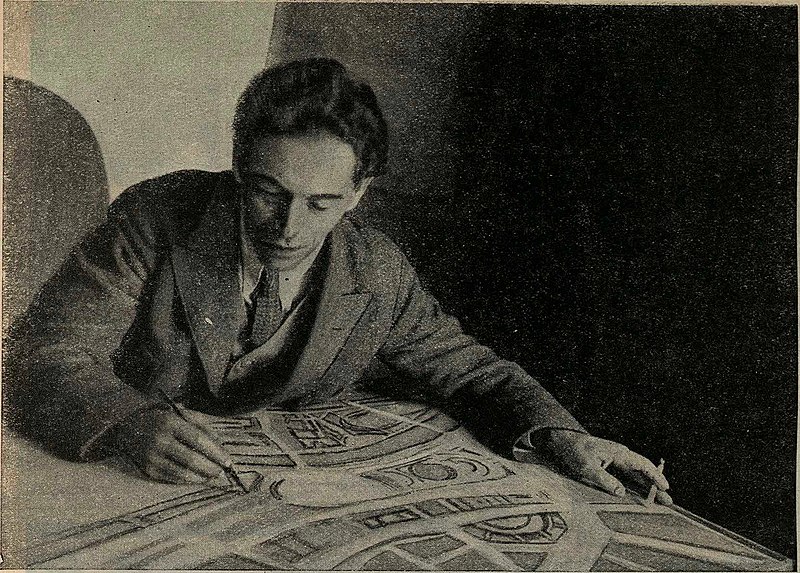
Архитектор Борис Михайлович Иофан за работой
журнал "Строительство Москвы". 1933, № 5-6, С. 34.
Life and career
Dated record
Life and career
The full dated record · 2 entries
1891
Boris Iofan was born in 1891.
1976
Boris Iofan died at Barvikha.
Awards
On October 20, 1970, Iofan was awarded the title of People's Architect of the USSR.
Citations
References
Each reference names the institution holding it, so a reader may go to the document itself.
reference work
Partially resolvedreference work
Partially resolved
The Encyclopedia exists whether or not anything is for sale. Corrections are recorded rather than overwritten, and every version of this record is kept. Published 14 August 2026.
Elsewhere in Design
11,558 published records in this field, each with its sources named.
- Bonanno PisanoDesigner
- Bonino da CampioneDesigner
- Bontadino de BontadiniDesigner
- Boris BernaskoniDesigner
- Boris MagašDesigner
- Boris PodreccaDesigner
- Boris ZeisserDesigner
- Borislav StojkovDesigner
Best supported in this field
For owners
Own a work by Boris Iofan?
A specialist will read what you send and tell you what the house can establish, what it cannot, and whether the object is suited to sale. There is no charge and no obligation. The object stays with you throughout; nothing is shipped to us unless it is arranged in writing beforehand.