
bombo
Illustration — Argentine bombos legüeros in a store in Buenos Aires. The bombo criollo, or simply bombo, is any of a family of Latin American drums derived from the European bass drum (also called in Spanish bombo) and native Latin American drum traditions. These drums are of smaller dimensions than the orchestral bass drum, and their frame can be made of wood or steel.
Also recorded as bombo criollo
bombo
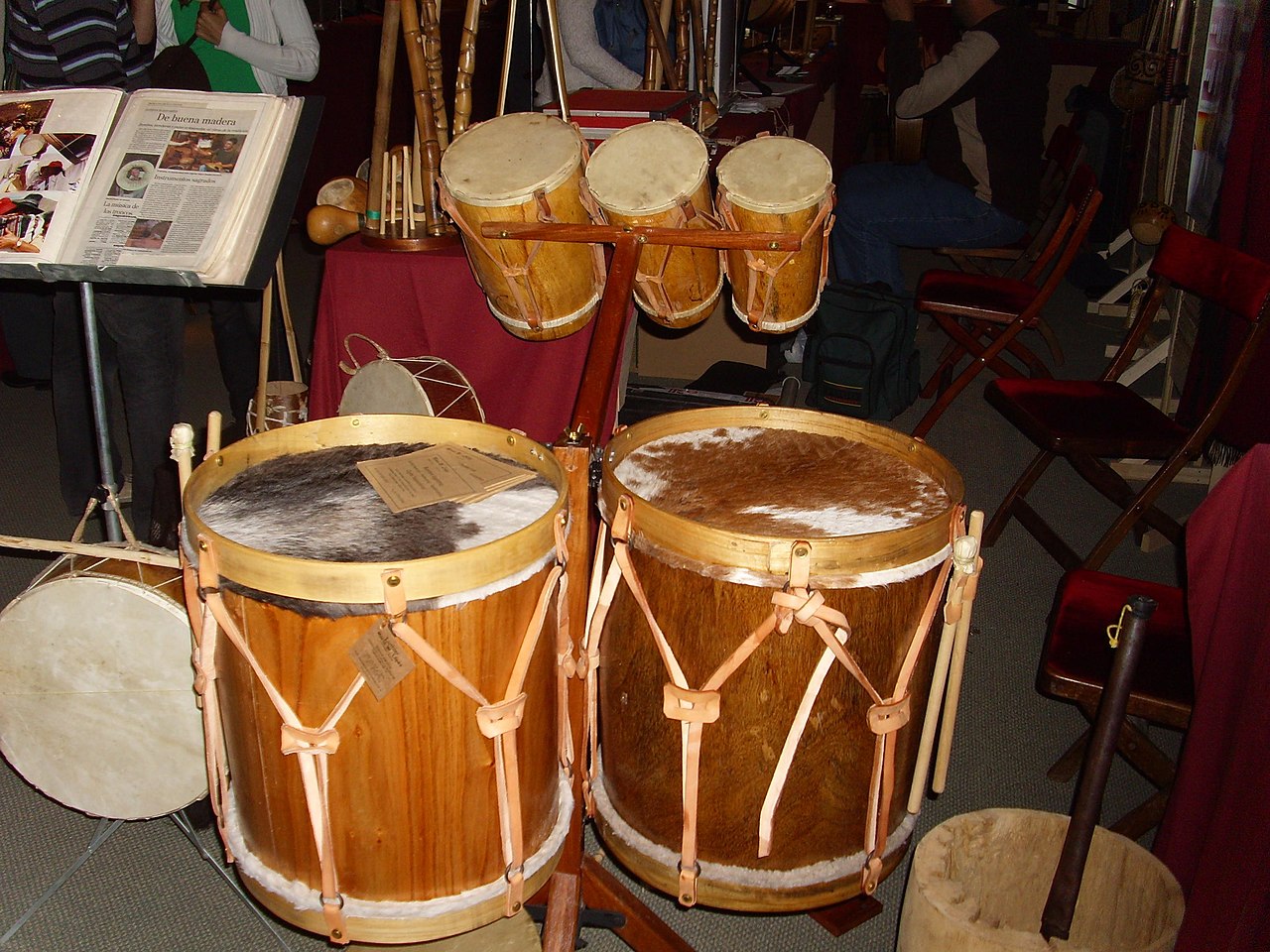
Matías Ávalos from Buenos Aires, Argentina · Bombos Uploaded by clusternote · CC BY-SA 2.0
- Field
- directly struck membranophone · Long drum
VALÉORINE Encyclopedia
VALÉORINE documentary reading
Documentary summary
Illustration — Argentine bombos legüeros in a store in Buenos Aires. The bombo criollo, or simply bombo, is any of a family of Latin American drums derived from the European bass drum (also called in Spanish bombo) and native Latin American drum traditions. These drums are of smaller dimensions than the orchestral bass drum, and their frame can be made of wood or steel.
Admitted source layer · organised and presented by VALÉORINE
Reference Check
Propose documentary evidence for bombo. A contribution is never written directly as fact: identity, source, rights and evidence gates still decide.
Sign in to contribute
World of VALÉORINE
Documentary connections
Only confirmed graph relationships appear here. Images are shown only when their identity and reuse rights both pass the documentary gate.
Documentary evidence
Documentary basis
Authority files
wikidata · Q4940751
In this article
Argentina
Argentina
They can be held vertically or diagonally on the body or a stand. The specific make of the instrument depends on the regional tradition. In Argentina, the bombo criollo is called bombo legüero and played in many folkloric styles. In Cuba, bombos are the largest drums played by the street comparsas in Santiago. In other countries, the term tambora is commonly used. The bombo should not be confused with the Puerto Rican bomba, a genre of music played with hand drums called barriles de bomba (bomba barrels), which are unrelated to the European bass drums.
The bombo legüero is a common instrument in Argentine folk traditions such as zamba and chacarera. The body of the drum is made out of a hollowed tree trunk, and the head is made of animal skins.
Cuba
Cuba
The bombo or tambora is the lowest drum used in conga santiaguera, the music of the street carnivals from Santiago de Cuba. They are tuneable, two-headed military drums introduced in the island by the Spanish settlers. In tumba francesa and tahona, two styles imported into Oriente by Afro-Haitian slaves after the Haitian Revolution, the bass drum (slightly smaller than the bombo) is called tambora, tamborita or tambuché.
Tamboras
Tamboras
• Illustration — Mexican brass band tambora. In some Latin American countries the term tambora is used to refer to bombos criollos. Nonetheless, tamboras are generally wider than other bombos criollos, possibly being an adaptation of both European bass drums (bombos) and side drums (redoblantes).
Colombia and Panama
Colombia and Panama
In Colombia and Panama, tamboras are used to play cumbia. Traditionally, this kind of tambora is played with sticks and fixed on a stand.
Dominican Republic
Dominican Republic
In the Dominican Republic, tamboras are two-headed drums used in merengue music. They were traditionally made from salvaged rum barrels.
Mexico
Mexico
Mexican tamboras have a diameter of 20 to 26 inches. There are two types of tambora in Mexican music: a traditional, with no cymbals, used in the folk ensembles tamborileros del norte, violín y tambora and jaraberos, and the one used en Mexican brass bands, as in banda sinaloense, tamborazo zacatecano and duranguense which has a cymbal over the frame and a stand for the drum. A felt mallet is used to beat the drum.
Venezuela
Venezuela
The Venezuelan tambora is played in gaita zuliana. It is a one-headed drum played with sticks. The player can sit on it or put it between his or her legs to perform rhythms on the instrument, strucking the head, the rim or the body of the drum.
Notes from the source article
Cited by Wikipedia
Notes from the source article
These works are cited by the source article, in its own numbering. They are recorded as its citations, not as sources VALÉORINE has verified.
- 1.Moroy, Alberto. El origen del bombo legüero.
- 2.Ramos Venéreo, Zobeyda. Instrumentos de la música folclórico-popular de Cuba, Volume 1. Centro de Investigación y Desarrollo de la Música Cubana. 297. 1997. 9789590602795.
- 3.Dirección de cultura del Ministerio de Educación. Los instrumentos de la música afrocubana: Los membranófonos abiertos Ñ a Z, los bimembranófonos y otros tambores especiales. 348. 1954.
- 4.Sher Music Co. Salsa Guidebook for Piano and Ensemble. 32. 1993. 9781457101410.
- 5.Ramos Venereo, Zobeyda. Music in Latin America and the Caribbean: An Encyclopedic History, Vol. 2. University of Texas Press. 265–280. 2007. 9780292784987.
- 6.Mirabeu, Daniel. Tradiciones danzario musicales de raices haitianas en el oriente cubano. Ritmacuba.
- 7.Brandt, Max H. The Concise Garland Encyclopedia of World Music, Volume 1. Routledge. 201. 2013. 9781136095627.
- 8.Deive, Carlos Esteban. Diccionario de dominicanismos. Manatí. 194. 2002. 9789993439073.
References
Citations
References
Each reference names the institution holding it, so a reader may go to the document itself.
reference work
Secondary witness
The Encyclopedia exists whether or not anything is for sale. Corrections are recorded rather than overwritten, and every version of this record is kept. Published 16 August 2026.
Elsewhere in Collectables
20,755 published records in this field, each with its sources named.
- Bomberman TouchWork
- Bomberman TournamentWork
- Bomberman UltraWork
- Bomberman WorldWork
- bombo legűeroTerminology
- BombuzalWork
- BombyWork
- bonangTerminology
Best supported in this field
For owners
Own an object connected with bombo?
A specialist will read what you send and tell you what the house can establish, what it cannot, and whether the object is suited to sale. There is no charge and no obligation. The object stays with you throughout; nothing is shipped to us unless it is arranged in writing beforehand.