
Bobby Troup
Robert William Troup Jr. (October 18, 1918 – February 7, 1999) was an American actor, jazz pianist, singer, and songwriter. He composed the rhythm and blues standard "(Get Your Kicks on) Route 66" and portrayed Dr.
Also recorded as Robert Wesley Troup, Jr. · Robert William Troup Jr.
Bobby Troup

NBC Television · ebay item photo front photo back · Public domain
- Name
- Bobby Troup
- Birth Name
- Robert William Troup Jr.
- Born
- 18 October 1918
- Birthplace
- Harrisburg, Pennsylvania, U.S.
- Died
- 7 February 1999
- Place of death
- Los Angeles, California, U.S.
- Occupation
- * Actor
- Education
- Wharton School
- Full name
- Robert Wesley Troup Jr.
- Nationality
- United States.
- Fields
- jazz.
- Known for
- Get Your Kicks on Route 66!
VALÉORINE Encyclopedia
VALÉORINE documentary reading
Documentary summary
Robert William Troup Jr. (October 18, 1918 – February 7, 1999) was an American actor, jazz pianist, singer, and songwriter. He composed the rhythm and blues standard "(Get Your Kicks on) Route 66" and portrayed Dr.
Admitted source layer · organised and presented by VALÉORINE
Reference Check
Propose documentary evidence for Bobby Troup. A contribution is never written directly as fact: identity, source, rights and evidence gates still decide.
Sign in to contribute
World of VALÉORINE
Documentary connections
Only confirmed graph relationships appear here. Images are shown only when their identity and reuse rights both pass the documentary gate.
Documentary evidence
Documentary basis
Authority files
wikidata · Q655122 · wikipedia · Bobby Troup
In this article
Biography
Biography
Joe Early in the television program Emergency! Co-starring with his wife Julie London, in the 1970s.
Bobby Troup studied at The Hill School. The recorded working language is English. Subjects and genres recorded for the work are jazz. Works named in the authority record are Get Your Kicks on "Route 66!". Work by Bobby Troup is recorded in the collections of Eye Filmmuseum.
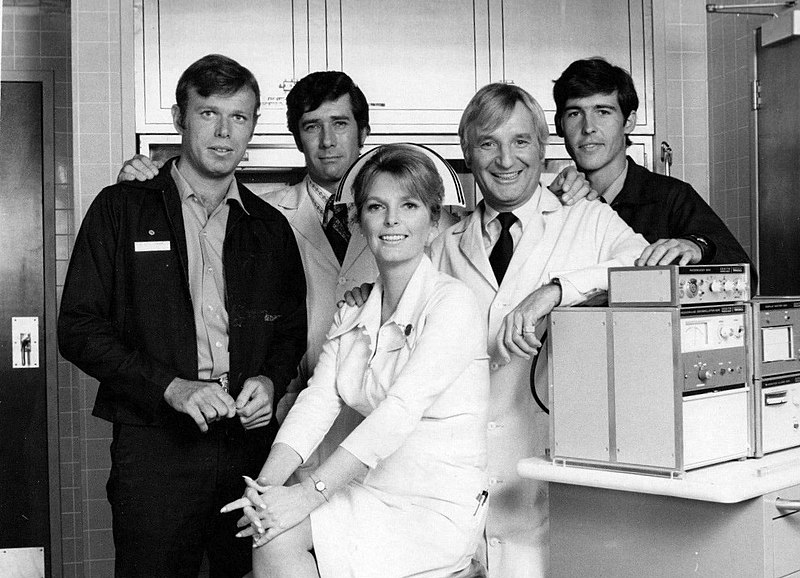
Photo of the cast of the television program Emergency!. From left: Kevin Tighe, Robert Fuller, Julie London, Bobby Troup and Randolph Mantooth.
NBC Television · eBay front back

Bobby Troup and Julie London photographed in Los Angeles, 1959.
Hollywood Press Syndicate · eBay Front and back
Key facts
Key facts
• Name — Bobby Troup • Birth Name — Robert William Troup Jr. • Born — 18 October 1918 • Birthplace — Harrisburg, Pennsylvania, U.S. • Died — 7 February 1999 • Place of death — Los Angeles, California, U.S. • Children — 5, including Ronne • Occupation — * Actor • musician • Years Active — 1941–1995 • Education — Wharton School
Early life
Early life
Robert William Troup Jr. was born in Harrisburg, Pennsylvania. His father Robert William Troup worked as a pianist for the family business J. H. Troup Music House and founded its Lancaster, Pennsylvania, branch store. He graduated from The Hill School, a preparatory school in Pottstown, Pennsylvania, in 1937. He went on to graduate Phi Beta Kappa from the Wharton School at the University of Pennsylvania with a degree in economics.
Military and music
Military and music
His earliest musical success came in 1941 with the song "Daddy" written for a Mask and Wig production. Sammy Kaye and His Orchestra recorded "Daddy", which was number one for eight weeks on the Billboard chart and the number five record of 1941; other musicians who recorded it include Glenn Miller, Bing Crosby, Kay Kyser, and The Andrews Sisters. "Daddy" can be heard in the 1941 film Two Latins from Manhattan. The song is also performed by the title character in Tex Avery's cartoon short Red Hot Riding Hood (1943). After graduating from college in 1941, he enlisted in the United States Marine Corps but did not receive orders until January 1942. After completing officer training, he was assigned as one of two dozen white officers to direct recruit training at Montford Point, the recruit depot for the first black Marines. In 1943 he became recreation officer and helped build a recreation hall, basketball court, and outdoor boxing ring. A friend installed a miniature golf course. At Montford Point, he also organized the first African-American band of U.S. Marines. During this time he composed "Take Me Away from Jacksonville", which was to become an anthem of sorts for the Marines at Montford Point and other areas of Camp Lejeune. In February 1942, Troup's song "Snootie Little Cutie" was recorded by Frank Sinatra and Connie Haines with the Tommy Dorsey Orchestra and the Pied Pipers. In 1946, Nat King Cole had a hit with Troup's most popular song, "(Get Your Kicks on) Route 66". The song was also recorded by Chuck Berry (1961), The Rolling Stones (1964), Depeche Mode (1987) and hundreds of other artists. Troup's hipster interpretation of the fairy tale "The Three Bears" was first recorded by the Page Cavanaugh Trio in 1946 and later by Leon McAuliffe, and Ray Ellington. Troup's recordings in the 1950s and 1960s were not commercially successful. He recorded for Liberty and Capitol. He wrote the title song (sung by Little Richard) for the 1950s rock and roll film The Girl Can't Help It. An instrumental version of his song "The Meaning of the Blues" appeared on the Miles Davis album Miles Ahead. Around 1969, Troup collaborated with entertainer Tommy Leonetti, writing the lyrics for Leonetti's song "My City of Sydney".
Personal life
Personal life
Troup married Cynthia Hare in May 1942. They had two daughters, Cynnie Troup (born 1943) and Ronne Troup (born 1945); both had careers in entertainment. The marriage ended in divorce in 1955. He met singer Julie London at the Celebrity Room, where he was singing. He encouraged her to pursue her singing career, and in 1955 he produced her million-selling hit record "Cry Me a River". London, previously married to actor Jack Webb (1947 to 1953), married Troup in 1959. They had one daughter, Kelly Troup (1962–2002), and twin sons, Jody (1963–2010) and Reese Troup.
Death
Death
On February 7, 1999, Troup died of a heart attack in the Los Angeles suburb of Sherman Oaks.
Places
Named by the record
Places
Only places the record itself states, plotted where the house gazetteer settles their coordinates. Nothing is inferred from a name or a nationality.
Harrisburg.
Birth place
Los Angeles.
Death place
Selected compositions
• "Baby, Baby, All the Time" – Frankie Laine, Julie London, Nat King Cole, June Christy, Diana Krall • "Bran' New Dolly" – written and sung by Bobby Troup on RCA Victor (1949) • "Daddy" – Sammy Kaye (1941), The Andrews Sisters, The Charioteers, Glenn Miller, Julie London • "Girl Talk", (Troup/Hefti) – Tony Bennett, Ella Fitzgerald, Julie London, Holly Cole, Betty Carter, and Ben Sidran (with new lyrics by Sidran). • "Hungry Man" – Louis Jordan • "I See Your Bass Before Me" • "I'd Like You for Christmas" – Julie London • "It Happened Once Before" – The Four Freshmen • "Jack 'N Jill" • "Jaded Joker Theme" – 1959 episode of Perry Mason, "The Case of the Jaded Joker", co-star Frankie Laine • "Just the Way I Am" – June Christy, Stan Kenton • "Lemon Twist" – Stan Kenton, Billy May, John Pizzarelli • "Let's Keep Dancing" – Peggy Lee • "My City of Sydney" (Troup/Leonetti) – Tommy Leonetti, XL Capris, Mary Schneider • "Now You Know" – The Four Freshmen • "One October Morning" • "Out of the Shadows" – June Christy • "Please Belong to Me" • "(Get Your Kicks on) Route 66" – Nat King Cole Trio (1946), Bing Crosby and the Andrews Sisters, Perry Como, Chuck Berry, The Rolling Stones, Them, The Manhattan Transfer, Patti Page, Sandie Shaw and numerous others • "Snootie Little Cutie", (1941) – Tommy Dorsey and His Orchestra featuring Frank Sinatra, Connie Haines, The Manhattan Transfer • "The Feeling of Jazz" – words to Duke Ellington's composition • "The Girl Can't Help It", (1956) – Little Richard, the Animals, Bobby Vee, Cliff Richard • "The Meaning of the Blues" – Julie London, Miles Davis (1957), Shirley Horn, Irene Kral, Buddy Rich, Michael Brecker, Keith Jarrett • "The Three Bears", (1946) – Page Cavanaugh Trio, Ray Ellington, Leon McAuliffe • "Their Hearts Were Full of Spring" – The Four Freshmen, Jimmie Rodgers, The Beach Boys, Sue Raney, The Cyrkle • "There She Goes" • "This October" – The Four Freshmen, Julie London • "You're Looking at Me" – Nat King Cole, Don Fagerquist, Stacey Kent, Diana Krall, Cleo Laine, Carmen McRae, Jerry Costanzo • "Walking Shoes" – words to Gerry Mulligan's composition
Television and films
• Illustration — Cast of TV's Emergency! (1973), L-R: Kevin Tighe, Robert Fuller, Julie London, Bobby Troup and Randolph Mantooth While he relied on songwriting royalties, Troup worked as an actor, appearing in Bop Girl Goes Calypso (1957), The High Cost of Loving (1958), The Five Pennies (1959), and playing musician Tommy Dorsey in the film The Gene Krupa Story (1959). He appeared as himself in the short-lived NBC television series Acapulco. He made three guest appearances on Perry Mason, and on two appearances, "The Case of the Jaded Joker" in 1959 and "The Case of the Missing Melody" in 1961, he showed his musical talents. In 1960 he appeared with his wife Julie London in an episode of Rawhide, "Incident at Royo Canyon". In 1969 and 1970, he appeared as "Bobby" in two episodes of Mannix, where he was a lounge piano player who helped Mannix unravel cases. Troup tried his luck at bowling on two episodes of Celebrity Bowling (1973–1975). He again appeared as a piano player in a cameo on The Hardy Boys/Nancy Drew Mysteries in 1978. Also in 1978 he appeared as a guest on Fantasy Island episode "Stalag 3". His later films included First to Fight (1967) and Number One (1969) with Charlton Heston. He appeared as disgruntled staff sergeant Gorman in Robert Altman's 1970 film M*A*S*H. He is the last actor named by the camp PA announcer in the end credits, and he has the last line of the film: "God-damned Army!" Troup had appeared in several episodes of the Jack Webb television series Dragnet. In 1972, Webb cast Troup as Dr. Joe Early in the television series Emergency! with Webb's former wife Julie London as nurse Dixie McCall. Both Troup and London guest-starred as Emergency! personnel on an episode of Adam-12 also produced by Webb. In 1979, Troup played the part of Sam Gill in the TV miniseries The Rebels.
Discography
• Bobby Troup! (Capitol, 1953) • Bobby Troup and His Trio (Liberty, 1955) • The Songs of Bobby Troup (Bethlehem, 1955) • Bobby Troup Sings Johnny Mercer (Bethlehem, 1955) • The Distinctive Style of Bobby Troup (Bethlehem, 1955) • Bobby Swings Tenderly (Mode, 1957) • Do Re Mi (Liberty, 1957) • Here's to My Lady (Liberty, 1958) • Cool Bobby Troup (Interlude, 1959) • Bobby Troup and His Stars of Jazz (RCA Victor, 1959) • Two Part Inventions for Trumpet with Benny Golson (Twig, 1970) • In a Class Beyond Compare (Audiophile, 1981) • Kicks On Route 66 (Hindsight, 1995) • Makin' Whoopee But Oh So Tenderly (Vintage Jazz) • The Feeling of Jazz (Starline, 1994)
Notes from the source article
Cited by Wikipedia
Notes from the source article
These works are cited by the source article, in its own numbering. They are recorded as its citations, not as sources VALÉORINE has verified.
- 1.Omnibus Press. The Encyclopedia of Popular Music. 1920. May 27, 2011. 978-0-8571-2595-8.
- 2.Yanow, Scott. Bobby Troup Biography. AllMusic.
- 3.Bobby Troup. Oxford Reference.
- 4.Wallis, Michael. Route 66: The Mother Road. St. Martin's. 9. 1990. 0-312-08285-1.
- 5.Lewis Historical Publishing Company. Lancaster County, Pennsylvania: A History. 3. 207. 1924.
- 6.The Hill School. Hill School Class of 2013 Recognized at Inaugural Class Day Gala.
- 7.Williams, Kenneth H. 'Route 66' Detour to Jacksonville, NC. Fortitudine. 37. 2. 26–32. 2012.
- 8.Yanow, Scott. The Jazz Singers: The Ultimate Guide. Backbeat. 216. 2008. 978-0-87930-825-4.
- 9.Woods, Bernie. When the Music Stopped: The Big Band Era Remembered. Barricade Books. 1994. 978-1-5698-0022-5.
- 10.Leading Music Box Record of 1941. Billboard. 54. 5. 60. January 31, 1942. 0006-2510.
- 11.Two Latins from Manhattan – Full credits. Turner Classic Movies.
- 12.Wild Realm Reviews: Eighth Clutch of Soundies. Weirdwildrealm.com.
- 13.Nalty, Bernard C. The Right to Fight: African American Marines in World War II. Marine Corps History and Museums Division.
- 14.Albright, Alex. The Forgotten First: B-1 and the Integration of the U.S. Navy. R.A. Fountain. 46. 2013. 978-0-9842-1022-0.
- 15.Shaw, Henry I. Blacks in the Marine Corps. USMC History and Museums Division. 12–13. 1976. 978-0-1605-1124-0.
- 16.Victor matrix PBS-072107. Snooty little cutie/ Connie Haines; The Pied Pipers; Frank Sinatra; Tommy Dorsey Orchestra. Discography of American Historical Recordings; UCSB Library.
- 17.Cover versions of "(Get Your Kicks on) Route 66", Secondhandsongs.com
- 18.Page Cavanaugh, leader of Jazz Trio, Dies at 86. The New York Times. Associated Press. December 25, 1988.
- 19.Leon McAuliffe. HillbillyMusic.com.
- 20.Ray Ellington: The Three Bears. AllMusic.
- 21.My city of Sydney [music] / lyrics by Bobby Troup; music by Tommy Leonetti. National Library of Australia. 1969.
- 22.A Pittance of Faith.
- 23.Medal for a Hero.
- 24.Voodoo Doll: Part 1.
- 25.Greene, Jo-Ann. From Hometown to Hollywood. LNP.
- 26.Smith, RJ. Julie London. Los Angeles. 26. January 2001. 1522-9149.
- 27.Canongate. The Mojo Collection: the Ultimate Music Companion. 8. 2007. 978-1-8419-5973-3.
- 28.Actress-Singer Julie London Dies. ABC News. October 19, 2000.
- 29.Heckman, Don. Bobby Troup, Writer of Classic Song 'Route 66', Dies. Los Angeles Times. February 9, 1999.
References
Citations
References
Each reference names the institution holding it, so a reader may go to the document itself.
reference work
Secondary witnessreference work
Secondary witness
The Encyclopedia exists whether or not anything is for sale. Corrections are recorded rather than overwritten, and every version of this record is kept. Published 14 August 2026.
Elsewhere in Music memorabilia
42,375 published records in this field, each with its sources named.
- Bobby SteelePerson
- Bobby TenchPerson
- Bobby ThomasPerson
- Bobby TimmonsPerson
- Bobby ValentínPerson
- Bobby VanPerson
- Bobby VeePerson
- Bobby WatsonPerson
Best supported in this field
For owners
Own a work by Bobby Troup?
A specialist will read what you send and tell you what the house can establish, what it cannot, and whether the object is suited to sale. There is no charge and no obligation. The object stays with you throughout; nothing is shipped to us unless it is arranged in writing beforehand.