
Biswajit Das
Biswajit Das (18 August 1936 – 30 December 2004) was an Odia playwright, short story writer, film director and script writer.
Also recorded as Biswajeet Das
Biswajit Das

Girijaprasadnanda · CC BY-SA 4.0
- Name
- Biswajit Das
- Born
- 18 August 1936
- Died
- 30 December 2004
- Occupation
- Playwright, short story writer, film director and script writer
- Education
- Ravenshaw College, Cuttack
- Spouse
- Gayatri
- Nationality
- India · British Raj · Dominion of India
- Languages
- Odia
VALÉORINE Encyclopedia
VALÉORINE documentary reading
Documentary summary
Biswajit Das (18 August 1936 – 30 December 2004) was an Odia playwright, short story writer, film director and script writer.
Admitted source layer · organised and presented by VALÉORINE
Reference Check
Propose documentary evidence for Biswajit Das. A contribution is never written directly as fact: identity, source, rights and evidence gates still decide.
Sign in to contribute
World of VALÉORINE
Documentary connections
Only confirmed graph relationships appear here. Images are shown only when their identity and reuse rights both pass the documentary gate.
Documentary evidence
Documentary basis
Authority files
wikidata · Q15724850
In this article
Key facts
Key facts
• Name — Biswajit Das • Born — 18 August 1936 • Died — 30 December 2004 • Occupation — Playwright, short story writer, film director and script writer • Education — Ravenshaw College, Cuttack • Spouse — Gayatri • Children — Ananya, Samanjasa, Ipsita, Shreyasee and Subarna
Early life
Early life
Das was born on 18 August 1936 at Jajpur, a sub-division of the Cuttack in Odisha and was the eldest of four siblings. His father, Subodh Das, a homeopathic doctor by profession, was also a freedom fighter, dramatist and actor, while his mother, Krushna Kamini Devi, was a freedom fighter. During his primary school days Das was profoundly influenced by the traditional open-air theatre form, "jatra", which he used to witness in his village. In 1946, Das was enrolled at the Peary Mohan Academy, Cuttack for his secondary education and thereafter did his graduation from the Ravenshaw College, Cuttack where his contemporaries included Sarat Pujari, Hemant Das and above all, Ananta Mahapatra, who would later on direct and act in several of his plays. Asim Basu, started an amateur dramatic troupe in 1967-68 called Roopakar Natya Group. Biswajit Das and Ananta Mahapatra joined the group and it was decided to offer something new to the audience other than just recreation or amusement. The group gave new thoughts and posed new questions to the intellectual elite that made the plays more vibrant and attractive.
Career
Career
Das started his professional career in 1958 as Public Information Officer in the Information and Public Relations Department of the Government of Odisha. Das served as Public Relations Officer of four Chief Ministers and one Governor of Odisha, including Nandini Sathpathy, Biju Patnaik and Janaki Ballabh Patnaik. He retired from service in 1994 as Additional Director, Information and Public Relations Department.
Works and Plays
Works and Plays
Biswajit Das was a powerful, experimental, contemporary Odia dramatist who authored many plays of great prominence. Post 1960 a new phase of modern Odia theatre was created by breaking the conventional style of professional theatre. The Naba Natya Andolan: (New Theater Movement) started with modern experimentation of plays inspired by Ibsen, Brecht, Freud, Bernard Shaw and Sartre. Das entered into the dramatics arena in the early fifties and was one of the pioneers of the New Theatre Movement. He started writing one-act plays in 1952. His first one act play was "Gotte Drushya" which was staged on the Janata Ranga Mancha. The play which portrayed an impoverished middle-class family's life struggle was directed by Ananta Mahapatra and both Das and Mahapatra acted in it. Biswajit Das wrote more than 60 one act plays which include Chhadmabeshi, Tandra, Dahini, Show, Banshi, Byartha Lagna, Trushna, Antara, Chief Guest, Probesh-Prasthan, Kitta, Suryastha, Shilpinka Anupasthitire and Swarga Martya. The success of his one-act plays led Das to write his first full-fledged play, Banhi (Fire) which was adjudged the best in a competition organized by the State Government on the eve of the centenary celebrations of India's First War of Independence in 1957. At that time he was a student at Ravenshaw College, Cuttack. This encouraged him to write more. Nishipadma (Nocturnal Lotus) in 1967, Nalipana rani kalapana tika (Queen of Hearts and Ace of Spades) in 1968, and Nija pratinidhinka tharu (From Our Correspondent) in 1968, are some of his prominent plays. Though written in traditional style these were novel in presentation. In Nishipadma Das speaks about how difficult situations can bring adversaries together forcing them to shun their differences. Das' adaptation of Gogol's Inspector General in Pratapgarhe didin (Two Days in Pratapgarh) was produced on the platform of the "Srujani" Dramatics Organization in 1961-62 and received great appreciation as a powerful political satire. Suna Sujane (1971) was another highly acclaimed play. In 1970 Das produced Mrugaya (The Hunt). This was an experimental play of a different taste, analysing artistically the agony and helplessness of hypocritical human beings. Psychoanalysis of the modern mind gave this effort a touch of reality. Das opines that craving for happiness always ends in the agony of contemporary life. In this play he has shown how darkness is the essence of life and the ever-increasing gap between what we aspire for and what we achieve. Similarly, in Samrat (Emperor) in 1972, an adaptation of Albert Camus' Caligula, Das analyses the mental state of present-day man through the emperor's personality. Paapi and Brutte were adaptations of Bernard Shaw's Devil's Disciple and On the rock, respectively. Other prominent plays include Mahamaya Opera (1999), Om Sri Sri Prajapateya Namah, Mukha, Sei Ten Jon and Nua Janha. Das started a dramatics centre called "Rupakar" in Bhubaneswar in 1967. The first play staged by Rupakar was Das’ "Nishipadma." Subsequently, his play "Nija pratinidhinka tharu" was also staged. Das wrote his play "Nalipana rani kalapana tika" for a competition organised by the Odisha Sangeet Natak Academy. Rupakar bagged four of the five awards given by the Academy – Best Actor, Best Actress, Best Dramatics Organisation – Rupakar and Best Director – Biswajit Das. In 1970 Rupakar was bifurcated into "Sanket" and "Uttar Purusha" with Das heading the former. Sanket's birth was heralded with the staging of Das’ most acclaimed play "Mrugaya" which he also directed. Unlike many of his contemporaries Das was not a prolific writer, but his body of work is remarkable for its qualitative excellence. His characters are three-dimensional. He brought logic and reality into his plays and during the 1970s, when professional Odia theatre had nearly closed down and audiences had turned their back on absurdist drama, he succeeded to some extent in bringing them back to the halls mainly through emotional dialogue. This is regarded as a major contribution of Biswajit Das. He also contributed lighting techniques to the Odia stage, which was underdeveloped for long.
Filmography
Filmography
Biswajit Das was also an acclaimed film director. Some of his notable films are Priyatama (1978), Nijhum Ratir Sathi (1979) and Maana Abhimaan (1980). Other movies which he scripted include Ahalya, Kaberi, Naga Phasa and Gouri. Das won the Cine Critics award in 1987 and the State Government award for his contribution to Odia cinema. Das also wrote serials for Doordarshan. These included the popular Satya and Sadhu Sabhdan. He also produced a documentary film on World Theater Day. Das wrote a weekly column called "Bhinna Swar" (Different Tunes) in the Sambad daily newspaper, which was subsequently compiled into a collection of short stories.
Director
Director
• Priyatama (1978) • Nijhum Ratir Sathi (1979) • Maana Abhimaan (1980)
Serials
Serials
• Satya • Sadhu Sabhdan
Personal life
Personal life
Das married Gayatri in 1962. Gayatri was a noted educationist and was the principal of several Government schools. They had a son, Samanjasa, and four daughters, named Ananya, Ipsita, Shreyasee and Subarna. His wife predeceased him in 2002.
Death
Death
Das died on 30 December 2004 at the age of 68.
Gallery
Gallery
* • Illustration — Biswajit at his young age — • Illustration — Biswajit with Gayatri — • Illustration — Biswajit receiving award — • Illustration — Biswajit at his workplace

Biswajit with Gayatri
Girijaprasadnanda
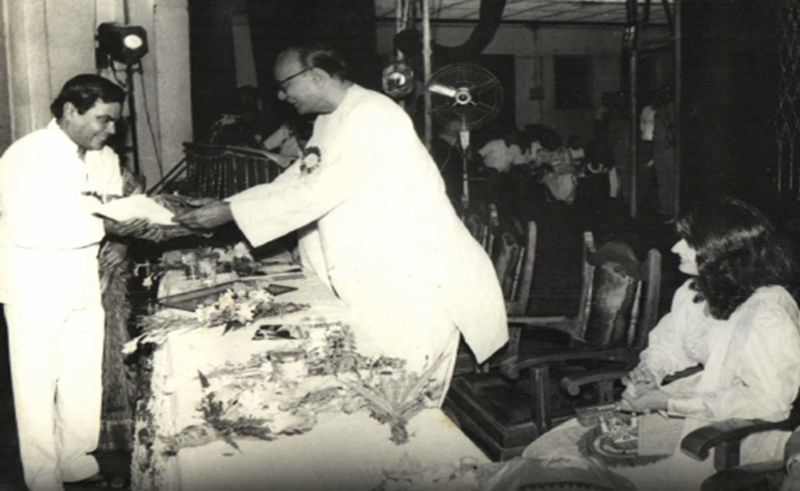
Biswajit receiving award
Girijaprasadnanda
Scriptwriter
• Ahalya • Kaberi • Naga Phasa • Gouri
Honours and awards
• Orissa Sangeet Parishad award (1957) for "Banhi" – Best playwright • Orissa Sangeet Natak Akademi Award for Playwright and Direction (1982) • Cine Critics Association award (1987) • State Government award for contribution to Odia cinema (1989) • Cine Critics award (1991) • Ramachandra Mishra Memorial Award (1998) • Satabdira Kalakar award
References
Citations
References
Each reference names the institution holding it, so a reader may go to the document itself.
authority record
General reference
People, houses and institutions
Knowledge graph
People, houses and institutions
Teachers, collaborators, publishers and institutions recorded against this person, each on a stated basis.
Citizenship
1- IndiaPlace
Established from a fact already recorded on a verified source.
Studied at
1- Ravenshaw CollegeOrganisation
Established from a fact already recorded on a verified source.
The Encyclopedia exists whether or not anything is for sale. Corrections are recorded rather than overwritten, and every version of this record is kept. Published 20 August 2026.
Elsewhere in Film memorabilia
37,604 published records in this field, each with its sources named.
- Bishakha DattaPerson
- Bisi KomolafePerson
- Biswajeet BoraPerson
- Biswajit ChatterjeePerson
- Bita ElahianPerson
- Bitty SchramPerson
- Bițu FălticineanuPerson
- Biyi BandelePerson
Best supported in this field
For owners
Own a work by Biswajit Das?
A specialist will read what you send and tell you what the house can establish, what it cannot, and whether the object is suited to sale. There is no charge and no obligation. The object stays with you throughout; nothing is shipped to us unless it is arranged in writing beforehand.