
Bernard Palissy
Bernard Palissy (bɛʁnaʁ palisi; c. 1589) was a French Huguenot potter, hydraulics engineer and craftsman, famous for having struggled for sixteen years to imitate Chinese porcelain. He is best known for his so-called "rusticware", typically highly decorated large oval platters featuring small animals in relief among vegetation, the animals apparently often being moulded from casts taken of dead specimens.
Also recorded as Bernardo De Palissy
Bernard Palissy
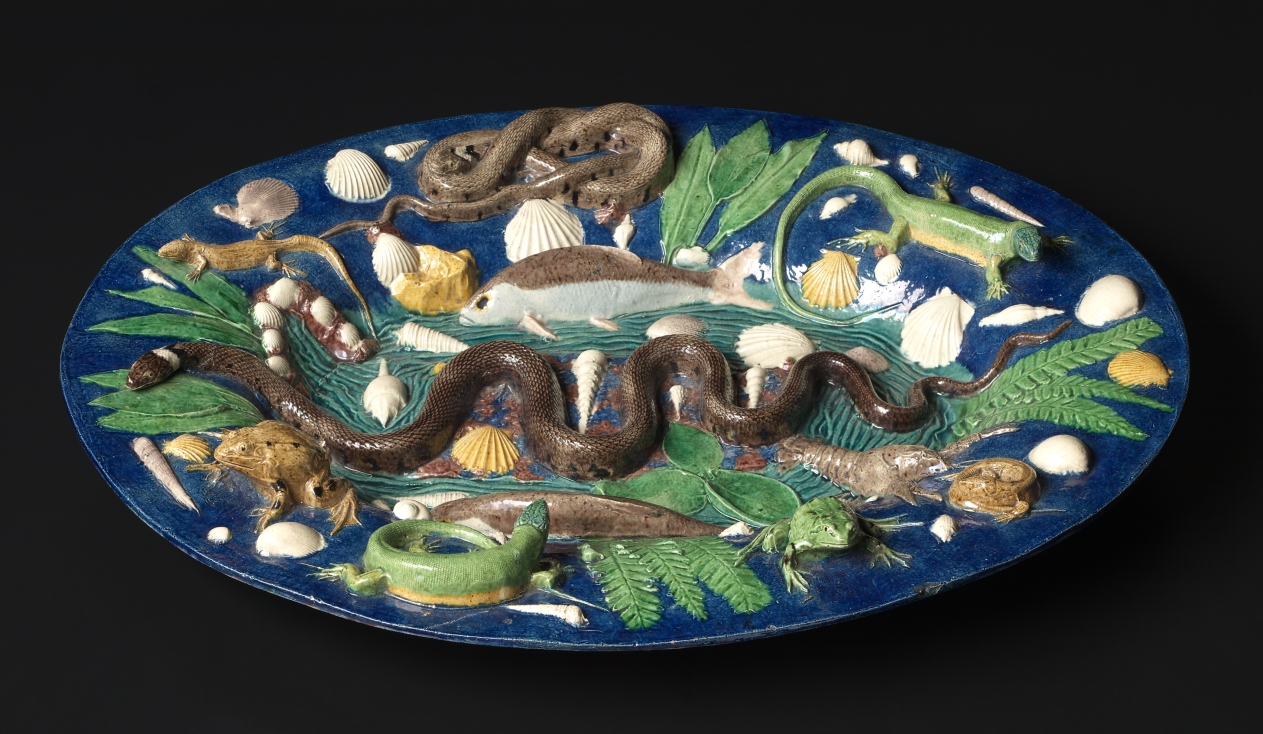
Bernard Palissy · The Cleveland Museum of Art · Purchase from the J. H. Wade Fund · CC0
- Occupation
- French Huguenot pottery and hydraulics engineer
- Born
- 1510
- Nationality
- France
VALÉORINE Encyclopedia
VALÉORINE documentary reading
Documentary summary
Bernard Palissy (bɛʁnaʁ palisi; c. 1589) was a French Huguenot potter, hydraulics engineer and craftsman, famous for having struggled for sixteen years to imitate Chinese porcelain. He is best known for his so-called "rusticware", typically highly decorated large oval platters featuring small animals in relief among vegetation, the animals apparently often being moulded from casts taken of dead specimens.
Admitted source layer · organised and presented by VALÉORINE
Note VALÉORINE
Bernard Palissy was ceramicist, chemist and geographer; nationality: France. Bernard Palissy was born in 1510. Died in 1589.
Composed from admitted, traceable facts · 27 September 2026
VALÉORINE
Reference Check
Propose documentary evidence for Bernard Palissy. A contribution is never written directly as fact: identity, source, rights and evidence gates still decide.
Sign in to contribute
Documentary evidence
Evidence Panel
not yet certified
- Identity
- resolved
- Independent source families
- 0
- Admitted assertions
- 0
- Open conflicts
- 0
Authority files
wikidata · Q524252 · wikipedia · Bernard Palissy
In this article
Biography
Biography
It is often difficult to distinguish examples from Palissy's own workshop and those of a number of "followers" who rapidly adopted his style. Imitations and adaptations of his style continued to be made in France until roughly 1800, and then revived considerably in the 19th century. In the 19th century, Palissy's pottery became the inspiration for Mintons Ltd's Victorian majolica, which was exhibited at the London Great Exhibition of 1851 under the name "Palissy ware". Palissy is known for his contributions to the natural sciences, and is famous for discovering principles of geology, hydrology and fossil formation. A Protestant, Palissy was imprisoned for his belief during the tumultuous French Wars of Religion and sentenced to death.
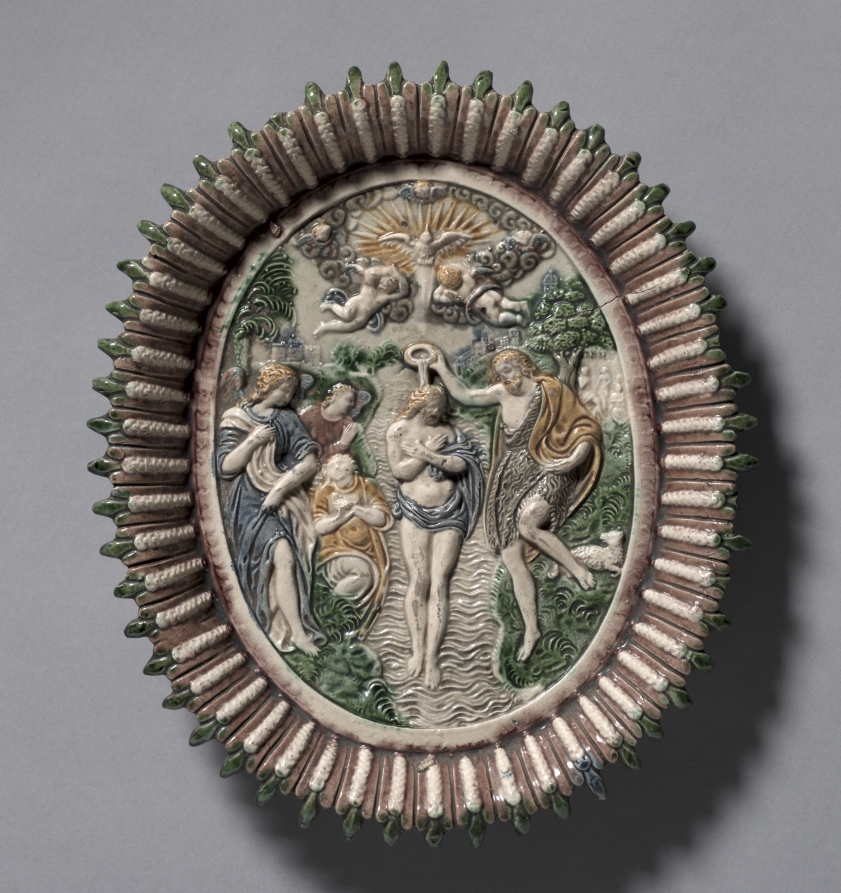
Plate Depicting the Baptism of Christ, late 1500s, by Bernard Palissy
Bernard Palissy · The Cleveland Museum of Art · Purchase from the J. H. Wade Fund
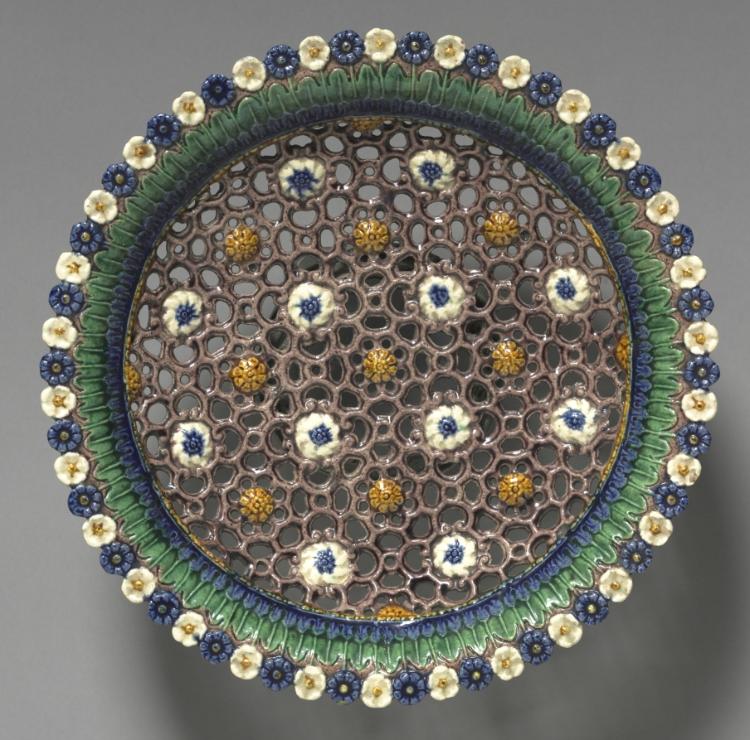
Dish with Open Work, late 1500s, by Bernard Palissy
Bernard Palissy · The Cleveland Museum of Art · Purchase from the J. H. Wade Fund
Key facts
Key facts
• Occupation — French Huguenot pottery and hydraulics engineer • Illustration — Detail of a Palissy still-life platter of c. 1550 (see below for the whole piece)
Early life
Early life
According to his friend Pierre de L'Estoile, Palissy was born in 1510. The location of Palissy's birth is not certain, but it is believed to be either Saintes, Périgord, Limousin or Agen. He lived most of his life in Saintonge. Palissy was born to a poor family, and while his education did not include Greek or Latin, it did instruct him in practical sciences including geometry and surveying. Early in his life, Palissy was commissioned by the crown to survey the salt marshes of Saintonge. In his memoirs, Palissy tells us that he was apprenticed to a glass painter. At the end of his apprenticeship he spent a year as a wandering journeyman acquiring fresh knowledge in many parts of France, including Guyenne, Languedoc, Provence, Dauphiné, Burgundy and the Loire. He later traveled north to the Low Countries, perhaps even in the Rhine Provinces of Germany, and to Italy. • Illustration — Workshop of Palissy, rusticware platter, 1575–1600 Palissy returned to Saintonge where he married and had children. Other than what he tells us in his autobiography, namely that he worked as a portrait painter, glass painter, and land surveyor, we have little record of how he lived during the first years of his married life.
Interest in ceramics
Interest in ceramics
In 1539 or 1540, Palissy was shown a white enamelled cup that astonished him, and he began a project to determine the nature of its production. The piece of fine white pottery may have derived from Faenza, Urbino, Saint-Porchaire or even China. In Palissy's time pottery covered with beautiful white tin-glaze painted with enamels was manufactured throughout Italy, Spain, Germany and the South of France. A man as travelled and as acute as Palissy, however, would have been acquainted with its appearance and properties. At the neighboring village of La Chapelle-des-Pots, Palissy mastered the rudiments of peasant pottery as it was practised in the 16th century. He may also have learned of manufacture of European tin-enamelled pottery. In his work Palissy produced ceramics using a great many ingredients including tin, lead, iron, steel, antimony, sapphire, copper, sand, saltwort, pearlash, and litharge.
Rustic pottery
Rustic pottery
• Illustration — Rusticware featuring casts of sea life (1550) For nearly sixteen years Palissy labored to recreate the pottery that he had seen, working with the utmost diligence but never succeeding. At times he and his family were reduced to poverty; he is said to have burned his furniture and the floor boards of his house to feed the fires of his furnaces. Meanwhile, he endured the reproaches of his wife, who, with their children clamouring for food, likely regarded her husband's endeavors as little short of insanity. All these struggles and failures are faithfully recorded by Palissy in his autobiography. Palissy failed to discover the secrets of Chinese porcelain or white tin-glaze maiolica, but he created a style of rustic pottery, called "Palissy ware," for which he is now famous. Analysis confirms that Palissy used coloured lead glazes, lead silicates with added metal oxides of copper [for green], cobalt [for blue], manganese [for brown and black], or iron [for yellow ochre], with a small addition of tin [for opacity] to some of the glazes. The pottery is decorated with reliefs mimicking wildlife from Palissy's native Saintonge marshes. These include fish, crustaceans, reptiles, ferns, and flowers. In 1542, a peasant revolt against the "gabelle" salt tax in Saintonge resulted in royal forces, headed by the Duc de Montmorency, arriving near Palissy's home. The duke was impressed by Palissy's artistry and commissioned him to build retreats at the Château d'Écouen and Meudon. Palissy's work there included the construction of wild gardens and ceramic creatures, following a romantic style similar to that of Italian artists Vasari, Cellini, and Michelangelo, and foreshadowing the baroque period.
Work in Paris
Work in Paris
• Illustration — Ewer, 1580–1600, by follower of Bernard Palissy, Victoria and Albert Museum, no. 7178-1860 In 1548 Palissy was brought to Paris under the protection of Montmorency and Catherine des Medicis. Despite his conversion to Protestantism in 1546, in a departure from the established Catholic religion, Catherine asked Palissy to construct gardens for her in the Tuileries. In 1562, she gave him an official title in her court: "the king's inventor of rustic figurines." Palissy was outspoken in his Protestant religious beliefs; he sometimes chastised influential officials by quoting from the prophetic books of the Old Testament. According to contemporaries, Palissy would criticize traders, judges, or Parliamentary counsellors, and benefices by citing the Book of Ezekiel: "They are accursed, damned, and lost... Woe be to you, shepherds, who eat the fat and clothe you with the wool, and leave my flock scattered upon the mountains." Although Palissy was Protestant, these nobles protected him from the ordinances of the parliament of Bordeaux. In 1562, it seized the property of all the Protestants in this district. Palissy's workshops and kilns were destroyed, but he was saved. By the interposition of the all-powerful constable, he was appointed inventor of rustic pottery to the king and the queen-mother. Around 1563, under royal protection, he was allowed to establish a fresh pottery works in Paris in the vicinity of the royal palace of the Louvre. The site of his kilns afterward became included within a portion of the Tuileries Garden. For about twenty-five years from this date, Palissy lived and worked in Paris. He appears to have remained a personal favorite of Catherine de' Medici and of her sons, in spite of his Protestantism. Catherine may have saved him from the bloodshed of Saint Bartholemew's Day Massacre in 1572. While he was working for the court, he produced numerous and varied works. In addition to continuing rustic figurines, he made a large number of dishes and plaques ornamented with scriptural or mythological subjects in relief. He seems to have made reproductions of pewter dishes of François Briot and other metal workers of the period.
Imprisonment and death
Imprisonment and death
• Illustration — Oval Dish with Winged Putti The close of Palissy's life was quite in keeping with his active and stormy youth. Despite the protection of the nobles and the court, the fanatical outburst of 1588 associated with the War of the Three Henrys led to his being thrown into the Bastille. According to D'Aubigné and fellow Protestants, Henry III offered Palissy his freedom if he would recant, though Palissy refused. Condemned to death when nearly eighty years of age, he died in a Bastille dungeon in 1590. Friend, chronicler and fellow prisoner Pierre de L'Estoile later recounted Palissy's fate: Pierre L'Estoile
In fiction
In fiction
• Illustration — Rusticware platter (detail shown above) In Alexandre Dumas's The Count of Monte Cristo, Palissy is mentioned when the author describes the opulence of a character's apartment: "The rest of the furniture of this privileged apartment consisted of old cabinets, filled with Chinese porcelain and Japanese vases, Lucca della Robbia faience, and Palissy platters; of old arm-chairs, in which perhaps had sat Henry IV." Marcel Proust mentions Palissy in the third volume of Remembrance of Things Past: "...and a fish cooked in a court-bouillon was brought in on a long earthenware platter, on which, standing out in relief on a bed of bluish herbs, intact but still contorted from having been dropped alive into boiling water, surrounded by a ring of satellite shell-fish, of animalcules, crabs, shrimps, and mussels, it had the appearance of a ceramic dish by Bernard Palissy." In Michel Zévaco's Les Pardaillan, Jean de Pardaillan helps Pallissy in Bastille, and leaves him free. His guilt is described as "make angry the fictional Catherine de' Medici" Palissy's life and work are described in A.S. Byatt's The Children's Book. Palissy serves as an inspiration to the potter Benedict Fludd and his apprentice, Philip Warren. Palissy figures as one of nineteen exemplary heroes in a series written by Uruguayan author Horacio Quiroga that was first published in 1927 in the popular Argentine weekly Caras y Caretas. Author Léonard N. Amico has produced a recent English language biography. In the chapter on 'Shells', Gaston Bachelard, in his poetics of space, describes in some detail Palissy's description of a natural fortress. It is constructed on the principle of a shell, with rough exterior and smooth interior in the form of a citadel. (Poetics of Space: Beacon Press. Ed 1994. XI. pp 127–132)
Identity
Identity
Bernard Palissy is recorded with the occupation ceramicist. Recorded as chemist, ceramicist, physicist and geographer. Established in Library of Congress under n85830104. Established in RKDartists under 312983. Established in FAST under 164734. Recognition and collections. Paul Getty Museum, National Gallery of Victoria and Nationalmuseum.
Life and career
Dated record
Life and career
Explore 1510–1589
The full dated record · 3 entries
1510
Bernard Palissy born at Lacapelle-Biron.
1589
Dies at Paris.
1589
Bernard Palissy died on 1 January 1589.
Lectures on natural science
• Illustration — Bernard Palissy by Mihály Zichy During this period Palissy gave several series of public lectures on natural history, the entrance fee being one crown, a large fee for those days. His ideas of springs and underground waters were published in his Discours admirables, de la nature des eaux et fontaines, tant naturelles qu'artificielles, des metaux, des sels et salines, des pierres, des terres, du feu et des maux (Paris, 1580). While Aristotle and Wang Chong correctly hypothesized about the role of precipitation in the water cycle, Palissy was the first to accurately surmise that rainfall alone was sufficient for the process and that rising underground water played no vital part. He was one of the first Europeans to enunciate theory consistent with today's understandings of the origin of fossils. That and his practical application of Alexandrian theoretical works on hydraulics to the social issue of delivering public water to cities, were far in advance of the general knowledge of his time. Palissy maintained that experience or practice should inform theory, which was useless without empirical foundations. He furthermore argued that scientific knowledge should be derived from observation and practice before classical philosophy: Palissy described systems for acquiring or transporting water, and for insuring its quality, adding that any unable to reproduce his instructions were free to contact him through his publisher. He elaborated upon a theory of hydrothermal vents, volcanoes and earthquakes, which he attributed to a mixture of volatile substances and combustion beneath the earth surface. Palissy furthermore correctly surmised the origin of springs in his study of hydrology and geology. Palissy correctly maintained that fossils were the remains of once living organisms, and contested the prevailing view that they had been produced by the biblical flood, or by astrological influence. He argued that minerals, dissolving into water to form "congelative water," would precipitate and thereby petrify once living organisms in order to create fossils.
Primary material
Documents and archives
reference work
- “Bernard Palissy”, English Wikipedia, consulted as further reading
Reputable secondary · Wikipedia
authority record
- Wikidata, structured authority record Q524252: Bernard Palissy
Unverified · Wikidata
Notes from the source article
Cited by Wikipedia
Notes from the source article
These works are cited by the source article, in its own numbering. They are recorded as its citations, not as sources VALÉORINE has verified.
- 1.Wright, Brooks. The Geological Studies of Bernard Palissy. Harvard University Thesis. 1943.
- 2.Burty, Philippe. Bernard Palissy. Librairie de l'Art. 1886.
- 3.Morley, Henry. Palissy the Potter: The Life of Bernard Palissy. Ticknor, Reed and Fields. 1853.
- 4.Palissy, Bernard. 20. 634–635.
- 5.Bouquillon, A & Castaing, J & Barbe, F & Paine, S.R. & Christman, B & Crépin-Leblond, T & Heuer, A.H.. (2016). "Lead-Glazed Rustiques Figulines [Rustic Ceramics] of Bernard Palissy [1510–90] and his Followers": Archaeometry. 59. 10.1111/arcm.12247.
- 6."Admirable discourses, of the nature of waters and fountains, both natural and artificial, of metals, salts and brines, of stones, earths, fire and enamels."
- 7.James C.I. Dodge. Concepts of the hydrological Cycle. Ancient and modern.
- 8.Marcel Proust, In Search of Lost Time, Volume 3, The Guermantes Way, Modern Library edition, p 152.
- 9.Byatt, A.S. The Children's Book. Chatto & Windus. 675. 2009. 978-0-7011-8389-9.
- 10.Horacio Quiroga, Los heroismos. Ed. Annie Boule. Posasas, Argentina: Editorial Universitaria, U. Nac. de Misiones, 1998.
- 11.Léonard N. Amico, Bernard Palissy: in search of earthly paradise, 1996.
References
Citations
References
Each reference names the institution holding it, so a reader may go to the document itself.
reference work
Partially resolvedauthority record
Unverified
People, houses and institutions
Knowledge graph
People, houses and institutions
Teachers, collaborators, publishers and institutions recorded against this person, each on a stated basis.
Died at
1- ParisPlace
Established from a fact already recorded on a verified source.
The Encyclopedia exists whether or not anything is for sale. Corrections are recorded rather than overwritten, and every version of this record is kept. Published 14 August 2026.
Elsewhere in Ceramics
1,104 published records in this field, each with its sources named.
- Bennett BeanArtist
- Berend HendriksArtist
- Bernard LeachArtist
- Bernard MooreArtist
- Bert NienhuisArtist
- Bertha George HarrisArtist
- Bertil PerssonArtist
- Bertold LöfflerArtist
Best supported in this field
For owners
Own a work by Bernard Palissy?
A specialist will read what you send and tell you what the house can establish, what it cannot, and whether the object is suited to sale. There is no charge and no obligation. The object stays with you throughout; nothing is shipped to us unless it is arranged in writing beforehand.