
Benedetto Montagna
Illustration — Engraving of Orpheus Benedetto Montagna (c. 1480–1555/58) was an Italian engraver and painter. Montagna was born in Vicenza, the son of the leading painter of the city, Bartolomeo Montagna, with whom he trained and perhaps continued to work.
Benedetto Montagna
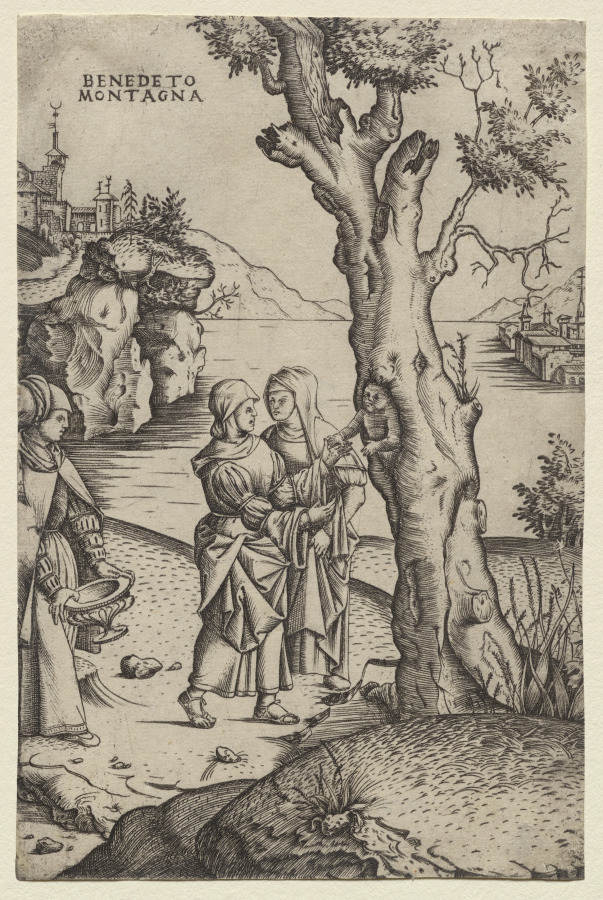
Benedetto Montagna · The Cleveland Museum of Art · John L. Severance Fund · CC0
- Born
- 1480 · Vicenza.
- Nationality
- Republic of Venice
- Occupation
- painter · copper engraver
- Languages
- Italian
VALÉORINE Encyclopedia
VALÉORINE documentary reading
Documentary summary
Illustration — Engraving of Orpheus Benedetto Montagna (c. 1480–1555/58) was an Italian engraver and painter. Montagna was born in Vicenza, the son of the leading painter of the city, Bartolomeo Montagna, with whom he trained and perhaps continued to work.
Admitted source layer · organised and presented by VALÉORINE
Reference Check
Propose documentary evidence for Benedetto Montagna. A contribution is never written directly as fact: identity, source, rights and evidence gates still decide.
Sign in to contribute
World of VALÉORINE
Documentary connections
Only confirmed graph relationships appear here. Images are shown only when their identity and reuse rights both pass the documentary gate.
Documentary evidence
Documentary basis
Authority files
wikidata · Q816840 · wikipedia · Benedetto Montagna
In this article
Life
Life
His approximately 53 engravings seem to have been produced in the period from about 1500 until his father died in 1523 and he inherited the workshop; in these years he was "the most prolific engraver of his generation in northern Italy". He ran the workshop into at least the 1540s, but his paintings fell behind the development of Italian styles as they largely follow his father's style, less successfully. Many do not survive. His prints are generally found more significant by art historians. He engraved primarily subjects from classical mythology, with a middle period with many religious subjects in about 1506–12.
The recorded working language is Italian. Places of work recorded in the authority are Vicenza and Padua. Work by Benedetto Montagna is recorded in the collections of Minneapolis Institute of Art, Art Institute of Chicago, Cleveland Museum of Art, Print Collection and Museo della Scienza e della Tecnologia "Leonardo da Vinci".
• Illustration — St Paul the Hermit sees the death of St Anthony the Abbot, engraving He was given a power of attorney for his father in 1504, suggesting a birth date around 1480. His father was paid in 1517 for some painting Benedetto did in the Palazzo del Podestà, Vicenza, seat of the chief magistrate; Vicenza had long been a territory of the Venetian Republic. Otherwise, his earliest documented works are frescos, which have not survived, for a chapel in Padua, painted in 1522. His father's wills of 1521 and 1523 reveal that he was not then married but had an illegitimate son. When his father died in 1523, Benedetto took over the workshop. He may already have ceased to make engravings by this point. His last documented painting is from 1541, and he had certainly died by 4 April 1558. A statue of the Madonna and Child in the Louvre has been attributed to him. The painter Giovanni Speranza, briefly mentioned by Vasari, was a collaborator, who was perhaps some years older. In 2004 there was an exhibition on the work of the two Montagnas, father and son, held in Palladio's Villa Caldogno near Vicenza.
Life and career
Dated record
Life and career
The full dated record · 2 entries
1480
Benedetto Montagna born at Vicenza.
1600
Benedetto Montagna died.
Prints
His prints are mostly relatively small, with the longest side rarely more than about 200 mm or 8 inches. The figures are often smaller relative to the overall size than in other contemporary Italian prints. Most of his prints are prominently signed with his full name, unlike the initials or monograms used by many printmakers of this period. Like Giulio Campagnola, the obtrusive signatures reveal "a remarkable willingness to intrude upon an image for the sake of self-promotion". In all, 47 of his prints are signed or carry his initials. Many of his prints borrow elements from the work of his father, or other artists, mostly via their prints. Like other Italian printmakers in this period, his technique and especially his landscape backgrounds are heavily influenced by Albrecht Dürer. These influences are apparent throughout the development of his prints, whose rough chronological sequence is agreed, and some prints are direct copies of their works, or nearly so. As his style develops, influences from Giulio Campagnola, Girolamo Mocetto, and Marcantonio Raimondi appear. In turn, Montagna influenced Mocetto, Nicoletto da Modena and Giovanni Antonio da Brescia. His prints include seven, from about 1515–20, that are close reworkings of some of the woodcut illustrations in an edition of Ovid's Metamorphoses in Italian published in Venice in 1497. The Birth of Adonis (see gallery) is an eighth Ovidian print not using this source; as in many prints with mythological subjects, the two women wear essentially contemporary dress (compare the figures in the print of Europa). Examples of common northern subjects that were very rare in Italian printmaking of the period are an engraving of a soldier, and one of peasants fighting. • Illustration — The Birth of Adonis, who emerges from a tree assisted by two women • Illustration — A satyr family • Illustration — A river god seated with a flowing urn, and a winged genius beside him • Illustration — The Rape of Europa, who prepares to sit on the bull which is being crowned by a companion • Illustration — Venus • Illustration — St Jerome seated beneath an arch of rock • Illustration — The Agony in the Garden, c. 1506-07 • Illustration — Madonna with Saints, painting
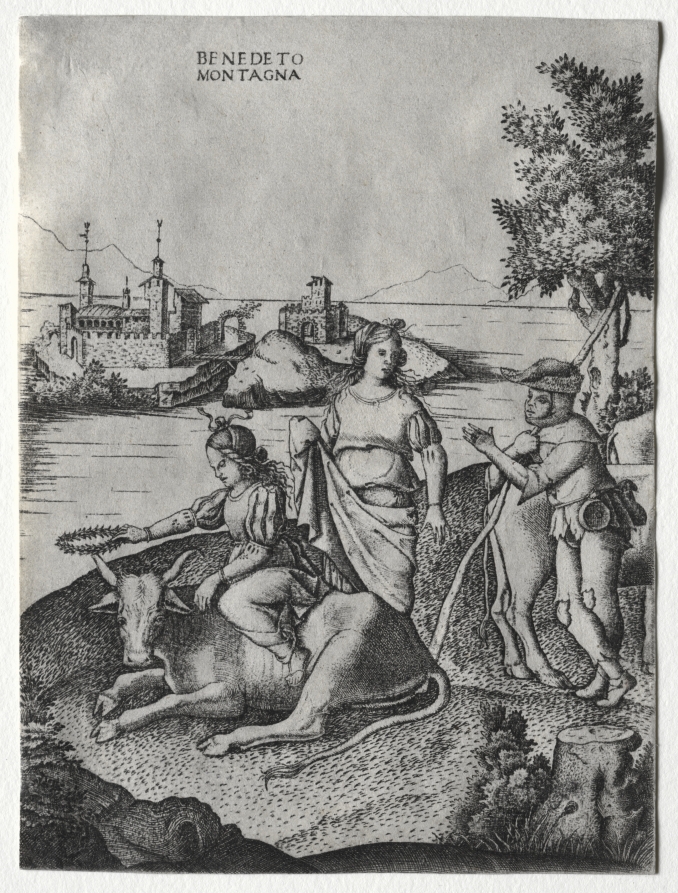
Rape of Europa, c. 1515–1520, by Benedetto Montagna
Benedetto Montagna · The Cleveland Museum of Art · Dudley P. Allen Fund
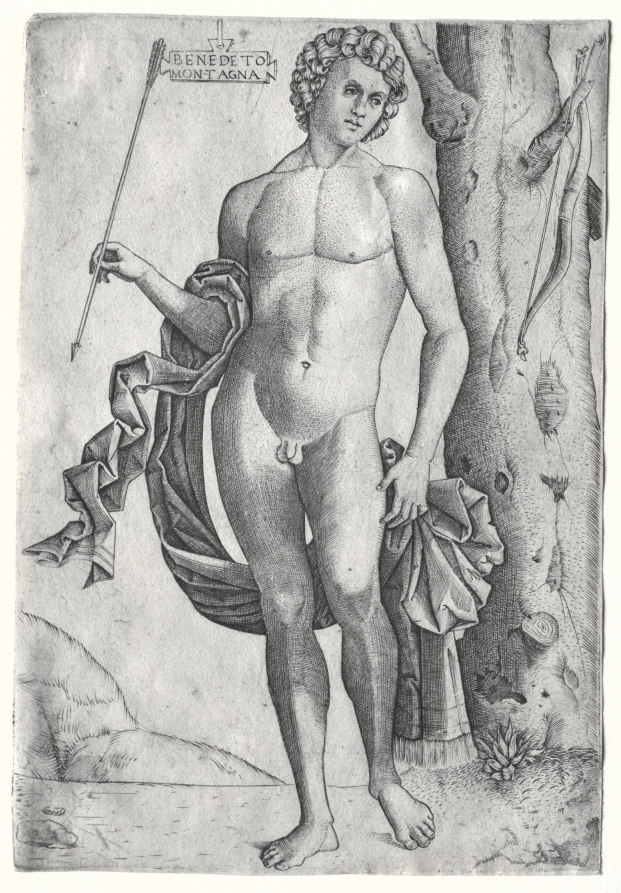
Man with an Arrow, c. 1515, by Benedetto Montagna
Benedetto Montagna · The Cleveland Museum of Art · Dudley P. Allen Fund
Notes from the source article
Cited by Wikipedia
Notes from the source article
These works are cited by the source article, in its own numbering. They are recorded as its citations, not as sources VALÉORINE has verified.
- 1.Richardson
- 2.Sheehan, 307, 311; Zucker, 82 ( "pictures of no great merit"); Richardson ("As a painter, he is of merely local significance. His style is based on his father’s, with some admixture from contemporaries such as Moretto, Pordenone and Domenico Campagnola. He is more important, however, as an engraver"); BM
- 3.Hind, 68; Sheehan, 309, 318; Richardson
- 4.Richardson
- 5.Sheehan, 307
- 6.Benezit
- 7.Sheehan, 307
- 8.See further reading for the catalogue
- 9.Hind, 68
- 10.Landau, 102
- 11.Richardson
- 12.Sheehan, 307–311; Zucker, 82–83; Richardson; Hind, 68; BM
- 13.Zucker, 83; Sheehan, 328–332
- 14.Sheehan, 328
- 15.Rubin, Patricia. "'Che è Di Questo Culazzino!': Michelangelo and the Motif of the Male Buttocks in Italian Renaissance Art." p. 440, note 40, Oxford Art Journal, vol. 32, no. 3, 2009, pp. 427–446, JSTOR
- 16.Hind, 68
Bibliography printed in the source article · 3
- Zucker, M. J., Early Italian Masters (1980), 25 [XIII/ii] of The Illustrated Bartsch, ed. W. Strauss (New York, 1978–), pp. 198–230; Commentary (1984), pp. 385–432
- Benedetto e Bartolomeo Montagna e i grandi maestri dell’incisione europea del Cinquecento (exh. cat., ed. F. Morello; Caldogno, Villa Caldogno, 2004)
- AM Hind, 'Early Italian Engraving', vol.V (53 nos catalogued)
References
Citations
References
Each reference names the institution holding it, so a reader may go to the document itself.
reference work
Secondary witnessreference work
Secondary witness
The Encyclopedia exists whether or not anything is for sale. Corrections are recorded rather than overwritten, and every version of this record is kept. Published 17 August 2026.
Elsewhere in Paintings
18,859 published records in this field, each with its sources named.
- Benedetto dal BuonoArtist
- Benedetto GennariArtist
- Benedetto Gennari IIArtist
- Benedetto LutiArtist
- Benedetto NucciArtist
- Benedetto OrsiArtist
- Benedetto PagniArtist
- Benedetto ServoliniArtist
Best supported in this field
For owners
Own a work by Benedetto Montagna?
A specialist will read what you send and tell you what the house can establish, what it cannot, and whether the object is suited to sale. There is no charge and no obligation. The object stays with you throughout; nothing is shipped to us unless it is arranged in writing beforehand.