
Arcminute Microkelvin Imager
The Arcminute Microkelvin Imager (AMI) consists of a pair of interferometric radio telescopes - the Small and Large Arrays - located at the Mullard Radio Astronomy Observatory near Cambridge. AMI was designed, built and is operated by the Cavendish Astrophysics Group. AMI was designed, primarily, for the study of galaxy clusters by observing secondary anisotropies in the cosmic microwave background (CMB) arising from the Sunyaev–Zel'dovich (SZ) effect.
Arcminute Microkelvin Imager
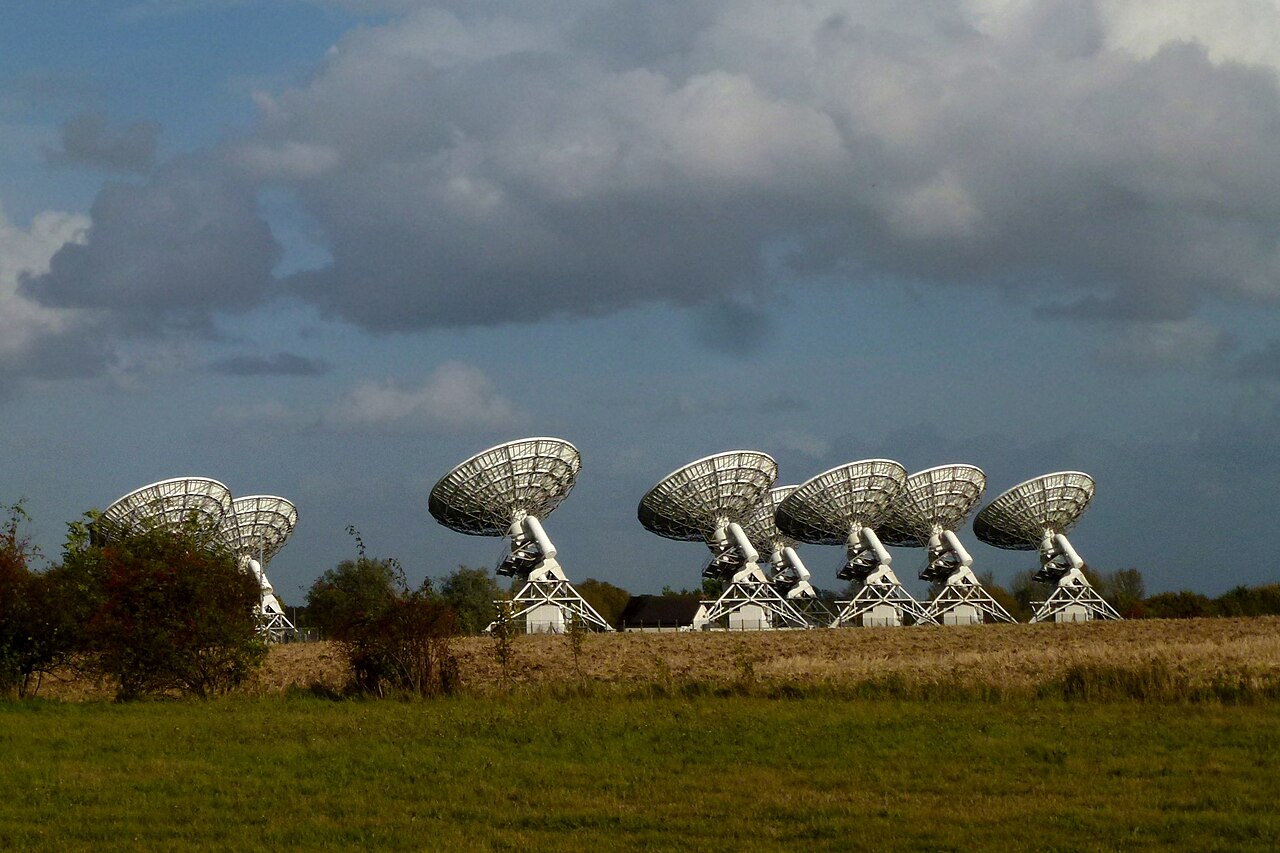
Cmglee · CC BY-SA 3.0
- Region
- United Kingdom
VALÉORINE Encyclopedia
VALÉORINE documentary reading
Documentary summary
The Arcminute Microkelvin Imager (AMI) consists of a pair of interferometric radio telescopes - the Small and Large Arrays - located at the Mullard Radio Astronomy Observatory near Cambridge. AMI was designed, built and is operated by the Cavendish Astrophysics Group. AMI was designed, primarily, for the study of galaxy clusters by observing secondary anisotropies in the cosmic microwave background (CMB) arising from the Sunyaev–Zel'dovich (SZ) effect.
Admitted source layer · organised and presented by VALÉORINE
Reference Check
Propose documentary evidence for Arcminute Microkelvin Imager. A contribution is never written directly as fact: identity, source, rights and evidence gates still decide.
Sign in to contribute
World of VALÉORINE
Documentary connections
Only confirmed graph relationships appear here. Images are shown only when their identity and reuse rights both pass the documentary gate.
Documentary evidence
Documentary basis
Authority files
wikidata · Q4787411 · wikipedia · Arcminute Microkelvin Imager
In this article
AMI Large Array
AMI Large Array
Both arrays are used to observe radiation with frequencies between 12 and 18 GHz, and have very similar system designs. The telescopes are used to observe both previously known galaxy clusters, in an attempt to determine, for example, their masses and temperatures, and to carry out surveys, in order to locate previously undiscovered clusters.
• Illustration — AMI Large Array • Illustration — AMI Large Array in June 2014 • Illustration — AMI Large Array silhouette in 2020 The AMI Large Array (AMI LA) is composed of eight 12.8-metre-diameter, equatorially mounted parabolic antennas, which were previously part of the Ryle Telescope. The antennas are separated by distances ranging between 18 and 110 m. The telescope has an angular resolution of approximately 30 arcseconds. The LA is used to image the radio sources (mainly radio galaxies) that contaminate the Small Array observations of the CMB. The LA is being used to carry out the Tenth Cambridge Survey of radio sources. The first results from the survey were used to extend the measured 15-GHz source counts to sub-millijansky levels; this is an order of magnitude deeper than achieved by the Ninth Cambridge Survey, which was the first survey of significant sky coverage at a comparable radio frequency.
AMI Small Array
AMI Small Array
• Illustration — AMI Small Array • Illustration — AMI Small Array in June 2014 The AMI Small Array (AMI SA) consists of 10 3.7-m-diameter antennas, similar in design to those of the LA. They are arranged at intervals of between 5 and 20 m. The SA has an angular resolution of approximately 3 arcminutes and is used to image, at high resolution, the galaxy clusters of interest. The SA is being used to search for previously unknown galaxy clusters; results from the first such cluster, detected using AMI, were released in December 2010. In addition to observations of galaxy clusters, the SA has been used to carry out observations, amongst other things, towards supernova remnants and anomalous microwave emission.
Chronology
Dated record
Chronology
The full dated record · 2 entries
1643
Arcminute Microkelvin Imager is recorded at coordinates 52.1643, 0.0393.
1698
Arcminute Microkelvin Imager is recorded at coordinates 52.1698, 0.0592.
Places
Named by the record
Places
Only places the record itself states, plotted where the house gazetteer settles their coordinates. Nothing is inferred from a name or a nationality.
- United Kingdom
Context
Primary material
Context
The circumstances in which Arcminute Microkelvin Imager stands. Recorded as cosmic microwave background experiment. Recorded at coordinates 52.1643, 0.0393. Recorded at coordinates 52.1698, 0.0592. Recorded at an elevation of 15. Situated in United Kingdom. Imager lies within Cambridge.
Documents and archives
Primary material
Documents and archives
authority record
- Wikidata, structured authority record Q4787411: Arcminute Microkelvin Imager
General reference · Wikidata
reference work
- “Arcminute Microkelvin Imager”, English Wikipedia, consulted as further reading
Reputable secondary · Wikipedia
Citations
References
Each reference names the institution holding it, so a reader may go to the document itself.
authority record
Secondary witnessreference work
Secondary witness
The Encyclopedia exists whether or not anything is for sale. Corrections are recorded rather than overwritten, and every version of this record is kept. Published 16 August 2026.
Elsewhere in Scientific instruments
736 published records in this field, each with its sources named.
- Apollo Lunar Surface Experiments PackageTerminology
- AquariusTerminology
- Arago telescopeTerminology
- AragoscopeTerminology
- Arecibo Radio TelescopeTerminology
- Argunov–Cassegrain telescopeTerminology
- Aristarchos 2.3 m TelescopeTerminology
- arithmometerTerminology
Best supported in this field
For owners
Own an object connected with Arcminute Microkelvin Imager?
A specialist will read what you send and tell you what the house can establish, what it cannot, and whether the object is suited to sale. There is no charge and no obligation. The object stays with you throughout; nothing is shipped to us unless it is arranged in writing beforehand.