
Antoni Wiwulski
Antoni Wiwulski (Lithuanian: Antanas Vivulskis; 20 February 1877 – 10 January 1919) was a Polish-Lithuanian architect and sculptor.
Antoni Wiwulski

Public domain
- Born
- 1877.
- Died
- 1919.
- Nationality
- Poland.
- Occupation
- sculptor and architect.
- Known for
- Grunwald Monument.
VALÉORINE Encyclopedia
VALÉORINE documentary reading
Documentary summary
Antoni Wiwulski (Lithuanian: Antanas Vivulskis; 20 February 1877 – 10 January 1919) was a Polish-Lithuanian architect and sculptor.
Admitted source layer · organised and presented by VALÉORINE
Reference Check
Propose documentary evidence for Antoni Wiwulski. A contribution is never written directly as fact: identity, source, rights and evidence gates still decide.
Sign in to contribute
Documentary evidence
Documentary basis
Authority files
wikidata · Q598094 · wikipedia · Antoni Wiwulski
In this article
Biography
He was born 20 February 1877 in Totma, in Russia, where his father Antoni, veteran of the January Uprising of 1863, served as a forest superintendent. Both parent were born in Samogitia, his mother Adelajda Karpuszko was able to speak in Samogitian. Antoni Wiwulski graduated from the German gymnasium in Mitau, and later from the reputable Jesuit boarding school in Khyriv. There he met Jan Beyzym, who developed in him a passion for carving. He graduated in 1897 and then two of the most prestigious art and architecture universities of the epoch: the École Supérieure des Beaux-Arts in Paris and the Higher Technical School in Vienna. In Paris he met Władysław Mickiewicz and, through this acquaintance, Ignacy Paderewski. In July 1908 he stayed at Paderewski's residence in Morges, Switzerland, where the idea of creating a monument commemorating the 500th anniversary of the Battle of Grunwald was born. His work was part of the sculpture event in the art competition at the 1912 Summer Olympics. Among the most notable of his works are: the Grunwald Monument in Kraków, Poland (1910) Chapel in Šiluva, Lithuania (1912–1924) the Holy Heart of Jesus' Church in Vilnius, Lithuania (started in 1913, unfinished) Three Crosses on the Hill of the Three Crosses Vilnius, Lithuania (1916) The Holy Heart of Jesus' Church was started in 1913 and was the first monumental building created with usage of reinforced concrete in the former Polish–Lithuanian Commonwealth. Wiwulski, impressed by the possibility of building gigantic buildings with the newly rediscovered material prepared a project of a giant church with a stylised gigantic sculpture of the Creator sitting on the dome. However, the project was discontinued after Wiwulski's death on 10 January 1919. In 1919, despite suffering from tuberculosis, he volunteered for the Polish militia (Self-Defence of Lithuania and Belarus) and took part in the defence of Vilnius against Bolshevik assault in the early stages of the Polish-Bolshevik War campaigns. He contracted pneumonia while on guard in the Vilnius' suburb of Užupis. After his death he was buried in the cellars beneath the church he had designed. When it was converted by the Soviets into a Palace of the Construction Workers in 1964, his ashes were moved to Rasos Cemetery.

"Smiling man" (1911) by Antoni Vivulski (1877-1919). National Gallery of Art (Vilnius)
Alma Pater
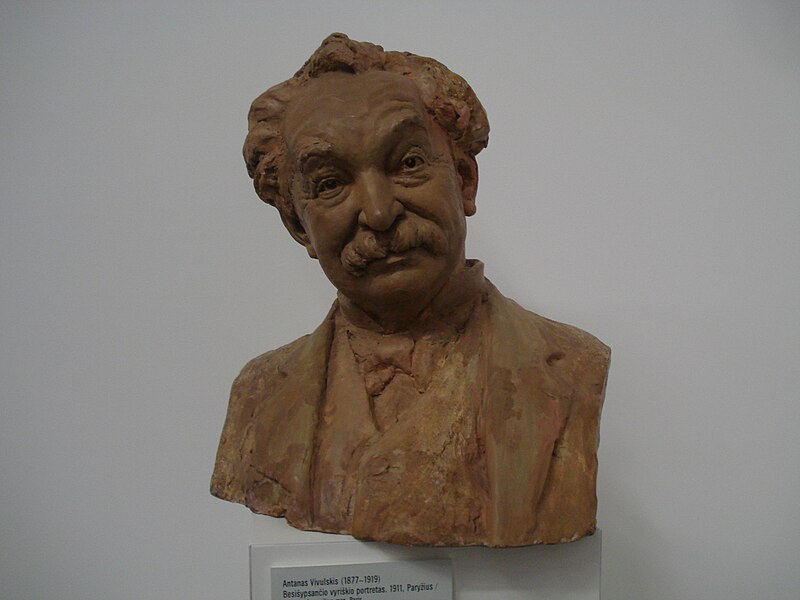
"Smiling man" (1911) by Antoni Vivulski (1877-1919). National Gallery of Art (Vilnius)
Alma Pater
Notes from the source article
Cited by Wikipedia
Notes from the source article
These works are cited by the source article, in its own numbering. They are recorded as its citations, not as sources VALÉORINE has verified.
- 1.Phillips, Charles. Paderewski - The Story of a Modern Immortal. The Macmillan Company. 280. 1933. 0-306-77534-4.
- 2.Cornis-Pope. History of the Literary Cultures of East-Central Europe: Junctures and disjunctures in the 19th and 20th centuries. Vol. 2. John Benjamins Publishing. 22–23. 2006. 9789027293404.
- 3.Mokslo ir enciklopedijų leidybos centras. Antanas Vivulskis. VLE.
- 4.Stefański, Krzysztof. Polish ecclesiastical architecture of the early 20th century - between the new form and national obligation. Centropa: A Journal of Central European Architecture and Related Arts. 3. 249. 2003.
- 5.Korotyński, Władysław. Antoni Wiwulski. Kurjer Warszawski. 193. 8-10.
- 6.Antoni Wiwulski. Olympedia.
- 7.Wiktor Zenonowicz. Rys życia autora wileńskich Trzech Krzyży (A sketch on the author of Three Crosses). Nasza Gazeta. 8. 547. 1986.
- 8.J. Polonus. Grunwaldzkie uroczystości (Anniversary of Grunwald). Źródło. 705. 27. 31–33. July 2005.
- 9.Katarzyna Deptuła. Cmentarz na Rossie (Rasos Cemetery). Gazeta Wyborcza. April 2001.
Bibliography printed in the source article · 2
- Nijolė Lukšionytė-Tolvaišienė. Antanas Vivulskis: Tradicijų ir modernumo dermė. Vilniaus dailės akademijos leidykla (Vilnius Academy of Arts Press). 2002. 9986571790.
- Stefański, Krzysztof. Antoni Wiwulski jako architekt. Biuletyn Historii Sztuki. 56. 1-2. 1994.
References
Citations
References
Each reference names the institution holding it, so a reader may go to the document itself.
reference work
Secondary witnessreference work
Secondary witness
The Encyclopedia exists whether or not anything is for sale. Corrections are recorded rather than overwritten, and every version of this record is kept. Published 14 August 2026.
Elsewhere in Sculpture
6,174 published records in this field, each with its sources named.
- Antoni KenarArtist
- Antoni LlenaArtist
- Antoni MiraldaArtist
- Antoni PopielArtist
- Antonin CarlèsArtist
- Antonin IdracArtist
- Antonin MoineArtist
- Antonín Pavel WagnerArtist
Best supported in this field
For owners
Own a work by Antoni Wiwulski?
A specialist will read what you send and tell you what the house can establish, what it cannot, and whether the object is suited to sale. There is no charge and no obligation. The object stays with you throughout; nothing is shipped to us unless it is arranged in writing beforehand.