
Alfred Drury
Edward Alfred Briscoe Drury (11 November 1856 – 24 December 1944) was a British architectural sculptor and artist active in the New Sculpture movement. During a long career Drury created a great number of decorative figures such as busts and statuettes plus larger monuments, war memorials, statues of royalty and architectural pieces. During the opening years of the 20th century he was among the foremost architectural sculptors active in Britain and in that period created the series of works in central London for which he is perhaps now best known.
Also recorded as Edward Alfred Briscoe Drury · Edward Alfred Drury · Edward Alfred Briscoe Drury · Edward Drury
Alfred Drury
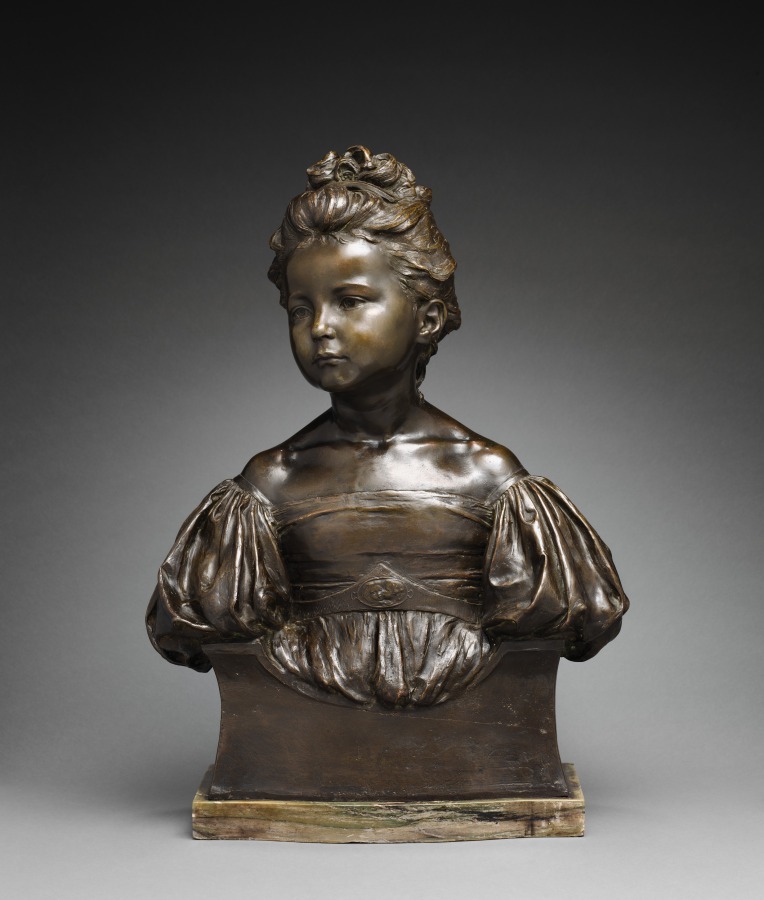
Alfred Drury · The Cleveland Museum of Art · Purchase from the J. H. Wade Fund · CC0
- Name
- Alfred Drury
- Born
- 11 November 1856
- Birthplace
- Islington, London
- Died
- 24 December 1944
- Place of death
- Lancaster Lodge, Wimbledon, London
- Education
- * Oxford School of Art
- Known for
- Sculpture
- Nationality
- United Kingdom · United Kingdom of Great Britain and Ireland
- Occupation
- sculptor · artist
- Movements
- New Sculpture
- Languages
- English
VALÉORINE Encyclopedia
VALÉORINE documentary reading
Documentary summary
Edward Alfred Briscoe Drury (11 November 1856 – 24 December 1944) was a British architectural sculptor and artist active in the New Sculpture movement. During a long career Drury created a great number of decorative figures such as busts and statuettes plus larger monuments, war memorials, statues of royalty and architectural pieces. During the opening years of the 20th century he was among the foremost architectural sculptors active in Britain and in that period created the series of works in central London for which he is perhaps now best known.
Admitted source layer · organised and presented by VALÉORINE
Reference Check
Propose documentary evidence for Alfred Drury. A contribution is never written directly as fact: identity, source, rights and evidence gates still decide.
Sign in to contribute
World of VALÉORINE
Documentary connections
Only confirmed graph relationships appear here. Images are shown only when their identity and reuse rights both pass the documentary gate.

Documentary evidence
Documentary basis
Authority files
wikidata · Q2835078 · wikipedia · Alfred Drury
In this article
Biography
Biography
These include the figures on the Old War Office building in Whitehall, elements of the facade of the Victoria and Albert Museum and four of the colossal statues on Vauxhall Bridge.
Lucy Gwendolen Williams is recorded as having studied under Alfred Drury. The recorded working language is English. Places of work recorded in the authority are London and Paris. Works named in the authority record are statue of Joshua Reynolds. Work by Alfred Drury is recorded in the collections of Auckland Art Gallery, Tate and The New Art Gallery Walsall.
Key facts
Key facts
• Name — Alfred Drury • Born — 11 November 1856 • Birthplace — Islington, London • Died — 24 December 1944 • Place of death — Lancaster Lodge, Wimbledon, London • Education — * Oxford School of Art • National Art Training School • Known for — Sculpture
Education and training
Education and training
Drury was born in Islington, London but raised in Oxford, where his father was a pub landlord. Drury studied at the Oxford School of Art and then at the National Art Training School in South Kensington, where his teachers included Jules Dalou and, later, Édouard Lantéri. Drury won gold medals in National Art Competitions in 1879, 1880 and 1881 before moving to Paris where he worked as an assistant to Dalou until 1885. While in Paris he assisted Dalou on the monumental Triumph of the Republic in the Place de la Nation. When he returned to London, Drury worked as an assistant to the sculptor Joseph Edgar Boehm and began establishing himself as an independent artist. In 1885 Drury showed his first work at the Royal Academy, a terracotta copy of a sculpture by Dilou, The Triumph of Silenus. Also during 1885, he had pieces shown at exhibitions in both Paris and Brussels. While his early exhibition pieces, such as 1886s' The First Lesson, clearly showed the impact of his time in France, Drury soon became associated with the British New Sculpture movement. Both Circe, from 1895, and Griselda of 1896 were typical of the allegorical female figures from mythology and literature that were key subjects of the movement and both sculptures were reproduced in several different sizes in bronze and marble by Drury in subsequent years. • Illustration — The Age of Innocence, c. 1900 • Illustration — Life-size bronze version of Circe in Leeds City Museum • Illustration — Griselda, c. 1897
Early commissions
Early commissions
• Illustration — Blackwall Tunnel plaque (1897) Alongside work on his exhibition pieces, Drury also began undertaking architectural commissions. In 1897, for example, he created a set of terracotta spandrels, representing Art and Design, for a coach builder's premises, now demolished, at Hammersmith in London and is thought to have completed other projects outside of London at this time for which records have been lost. He is known to have completed the two low-relief bronze plaques, featuring the head of a river god and female figures, installed to mark the opening of the Blackwall Tunnel in 1897. He collaborated with architect Inigo Thomas on a decorative scheme for the gardens at Barrow Court near Bristol. Tasked with providing sculptures for twelve pillars along a boundary wall, Drury carved a sequence of female heads from a baby to that of an old women to represent the months of the year from January to December. Drury's original life-size bronze version of Circe was purchased for a park in Leeds and is now in Leeds City Museum. This led to him receiving several commissions in that city, including for the eight lamp standards representing Morning and Evening positioned in Leeds City Square. Drury was awarded a gold medal at the 1900 Paris International Exhibition for a version of Circe and for a bust of a child, The Age of Innocence. The art historian Benedict Read considered the latter as one of the 'major icons' of the New Sculpture movement. In 1905, Drury exhibited a new cast of the Evening head titled Spirit of the Night and in 1911 carved a marble version of the statue. Architect John Belcher hired Drury, and others, to create the external decoration for Electra House at Moorgate in central London in 1902, and he also employed him, the following year, to sculpt external features for the nearby offices of the Royal London Friendly Society in Finsbury Square. For the latter scheme, Drury carved several female faces and half-figures including a large keystone figure above the main entrance, consisting of the head of a woman wearing a bronze helmet and framed by oak and ivy branches. The model for this composition was shown at the Royal Academy in 1904 and was widely praised.
Major works
Major works
• Illustration — Victory and Fame, Old War Office Building By 1904, Drury had become established as one of the foremost architectural sculptors active in Britain at the time and this led to the series of commissions for which he is perhaps best known, for the War Office in Whitehall, for the facade of the Victoria and Albert Museum and for Vauxhall Bridge. For the Old War Office Building on Horse Guards Avenue and Whitehall, Drury created four groups of two seated, twice life-size, female figures in Portland stone during 1904 and 1905. The pairs were The Sorrow of Peace opposite The Winged Messinger of Peace, the Horrors of War against the Dignity of War, Truth and Justice plus Victory and Fame. The artistic choices Drury made with the pairings and the amount of detail he incorporated into the carvings drew much attention in the newspaper coverage of the new building. For example, the War pairing contrasted a figure of Minerva holding a sword and shield with a more fearful figure holding a skull while some of the figures had gilded bronze attachments such as Victory who holds a small gilded statuette and Truth who has a gilded mirror. Although the works were 70 feet above street level it was reported that crowds of sightseers gathered to view them. In late 1904 the London County Council commissioned Drury and F. W. Pomeroy to each create four colossal bronze figures for niches on the piers supporting the new Vauxhall Bridge. For the eastern, downstream, side of the bridge Drury created four female figures representing the Fine Arts, holding a statuette and palette, Science holding a globe, Education and Local Government. • Illustration — Victoria and Albert Museum, Cromwell Road entrance with statue of Albert, Prince Consort By March 1905 Aston Webb, the architect of the Cromwell Road extension to the Victoria and Albert Museum had commissioned over twenty sculptors to provide statues, carvings and decorations for the facade of the building. Webb allocated what he considered the most prominent areas to Drury and George Frampton. The area over the main entrance arch was assigned to Frampton who created spandrel figures of Truth and Beauty for the space. The area under the arch and the remainder of the main entrance were allocated to Drury. Within the curve of entrance arch he created nine low-relief panels featuring kneeling or crouching female figures holding plaques with gold lettering that when read together form a quotation from Sir Joshua Reynolds. Below the arch, and immediately above the main entrance, is Drury's statue of Albert, Prince Consort and above the arch is his statue of Queen Victoria, carrying a staff and flanked by figures of St George and St Michael. Drury's work was singled out for praise in art press reviews when the overall scheme was completed in 1908. That same year, Webb commissioned Drury to produce a relief panel, of children at play, for the new offices of the Grand Trunk Railway Company in Cockspur Street in central London.
Exhibition record
Exhibition record
Drury was elected an Associate of the Royal Academy of Arts in 1900 and a full Academician in 1913. He exhibited works at the academy each year from 1885 to 1942, and at the Royal Scottish Academy between 1903 and 1917. He also showed works at the Aberdeen Artists Society, the Royal Glasgow Institute of the Fine Arts and at Leeds City Art Gallery on a regular basis. He was a member of the International Society of Sculptors, Painters and Gravers and, from 1899, a member of the Art Workers' Guild. In 1932, Drury received the Royal Society of British Sculptors' silver medal for his statue of Joshua Reynolds in the courtyard of Burlington House in London.
Personal life
Personal life
Drury lived and worked at Gunter Grove in Chelsea, London. In 1900, Drury married the artist Phoebe Maud Turner. The couple had two children, including artist Paul Dalou Drury. Alfred Drury died on Christmas Eve 1944, aged 88.
Other works
Other works
• The Boer War Memorial, a plaque in deep relief, in the Cloisters at New College, Oxford • Rhodes University (Grahamstown) War Memorial to the 1914-1918 and 1939-1945 conflicts, depicting a medieval knight in armour and chain mail, with gauntletted hands resting on the hilt of his sword. • Two relief panels and two spandrels in marble, 1916, representing the Golden Jubilee of Queen Victoria, the Queen's proclamation of 1858, Industry and Commerce for the Victoria Memorial, Kolkata
Identity
Identity
Alfred Drury is recorded as sculptor and artist. Formation and teaching. Each of those relationships is stated by the authority record rather than inferred from style.
Life and career
Dated record
Life and career
Explore 1856–1944
The full dated record · 12 entries
1856
Alfred Drury born at Islington.
1895
Statue of Circe at West End of Central Garden is dated 1895.
1903
Statue of Queen Victoria is dated 1903.
1904
South African War Memorial is dated 1904.
1904
Victoria Memorial is dated 1904.
1907
Statue of Bishop Hooker is dated 1907.
1910
Statue of Spencer Cavendish, 8th Duke of Devonshire is dated 1910.
1914
Statue of Edward VII is dated 1914.
1920
London Troops War Memorial is dated 1920.
1921
Hertford War Memorial Including Raised Elliptical Surround is dated 1921.
1931
statue of Joshua Reynolds is dated 1931.
1944
Alfred Drury died at Wimbledon.
Places
Named by the record
Places
Only places the record itself states, plotted where the house gazetteer settles their coordinates. Nothing is inferred from a name or a nationality.
Islington.
Birth place
Wimbledon.
Death place
Primary material
Documents and archives
scholarly publication
- Drury, (Alfred) Paul Dalou (1903–1987), artist and teacher of art, Oxford Dictionary of National Biography, 2004
Scholarly · Crossref registry · 2004
- Drury, Alfred Edward, Benezit Dictionary of Artists, 2011
Scholarly · Crossref registry · 2011
reference work
- “Alfred Drury”, English Wikipedia, consulted as further reading
Reputable secondary · Wikipedia
authority record
- Wikidata, structured authority record Q2835078: Alfred Drury
General reference · Wikidata
Notes from the source article
Cited by Wikipedia
Notes from the source article
These works are cited by the source article, in its own numbering. They are recorded as its citations, not as sources VALÉORINE has verified.
- 1.University of Glasgow History of Art / HATII. Alfred Drury. Mapping the Practice and Profession of Sculpture in Britain & Ireland 1851–1951. 2011.
- 2.Susan Beattie. The New Sculpture. Paul Mellon Centre for Studies in British Art / Yale University Press. 1983. 0300033591.
- 3.Mark Quinlan. Sculptors and Architects of Remembrance. Sandy, Authors Online. 2007. 978-0755203-98-7.
- 4.Martina Droth, Jason Edwards & Michael Hatt. Sculpture Victorious: Art in the Age of Invention, 1837-1901. Yale Center for British Art, Yale University Press. 2014. 9780300208030.
- 5.James Mackay. The Dictionary of Western Sculptors in Bronze. Antique Collectors' Club. 1977. 0902028553.
- 6.Ian Chilvers. The Oxford Dictionary of Art. Oxford University Press. 2004. 0-19-860476-9.
- 7.Bronze Panel. The Courtauld Institute of Art.
- 8.The Age of Innocence. Victoria and Albert Museum. 1897.
- 9.Electra House (now part of the London Guildhall University). The Victorian Web. 24 July 2011.
- 10.Sculpture, Royal London House. The Courtauld Institute of Art.
- 11.Royal Academy. Keystone to New Buildings Royal London Friendly Society. Academy Architecture 1904–1908.
- 12.Pediment, sculpture Old War Office. The Courtauld Institute of Art.
- 13.A grand entrance on Cromwell Road. Victoria & Albert Museum.
- 14.Lilith, 1916 Alfred Drury RA (1856–1944). Royal Academy.
- 15.Frances Spalding. 20th Century Painters and Sculptors. Antique Collectors' Club. 1990. 1-85149-106-6.
- 16.Alfred Drury (1856–1944). Royal Society of Sculptors.
- 17.Victoria County History, 2004. Settlement and building: Artists and Chelsea Pages 102-106 A History of the County of Middlesex: Volume 12, Chelsea. British History Online.
- 18.Alfred Drury, 88, British Sculptor. Londoner, Noted for Statue of Sir Joshua Reynolds, Dies. Works Seen by Millions. The New York Times. 25 December 1944.
- 19.Mark Stocker. Drury, (Edward) Alfred Briscoe (1856–1944). Oxford Dictionary of National Biography. Oxford University Press. 2004.
- 20.Diane Bilbey with Marjorie Trusted. British Sculpture 1470 to 2000 A Concise Catalogue of the Collection at the Victoria and Albert Museum. V&A Publications. 2002. 1851773959.
- 21.Jo Darke. The Monument Guide to England and Wales. Macdonald Illustrated. 1991. 0-356-17609-6.
- 22.1375465. Statue of Circe at West End of Central Garden.
- 23.1129171. Gatepiers, Gates and series of 12 Pillars forming west boundary wall of formal garden at Barrow Court.
- 24.1329249. Monument in Victoria Gardens.
- 25.Sir William Penn Symons monument. Art UK.
- 26.Statue of Joseph Priestley. 1375043.
- 27.1255575. Four lamp posts: 'Even'.
- 28.1375012. Four lamp posts: 'Morn'.
- 29.1289022. Royal Arsenal Cooperative Society Headquarters Building.
- 30.Alexander McLeod. Vads / Public Monuments and Sculpture Association.
- 31.Statue of Queen Victoria. 1104315.
- 32.Clifton College, South African War Memorial. 1282343.
- 33.War Memorials Register: Clifton College - Boer War. Imperial War Museum.
- 34.Boer War Memorial. The Courtauld Institute of Art.
- 35.English Heritage / PMSA. A User's Guide to Public Sculpture. 2000. 185074776-8.
- 36.Victoria Memorial. 1132899.
- 37.Bust of Lord Byron. The Courtauld Institute of Art.
- 38.NZHPT 3663 Queen Victoria Monument 17 January 2021
- 39.Statue of Queen Victoria 1905. Yale Centre for British Art.
- 40.Vauxhall Bridge. 1393011.
- 41.Statue of Bishop Hooker. 1104024.
- 42.War Memorials Register:South Lancashire Regiment Second Boer War. Imperial War Museum.
- 43.1329723. War Memorial to South Lancashire Regiment in Queen's Gardens.
- 44.Boer War Memorial. The Courtauld Institute of Art.
- 45.Statue, Gateposts at the Victoria Memorial Complex. The Courtauld Institute of Art.
- 46.1353136. Statue of Spencer Cavendish, Eighth Duke of Devonshire KG (1833/1908) Mayor of Eastbourne 1897/98.
- 47.Memorial to Elizabeth Fry. The Courtauld Institute of Art.
- 48.1270597. Statue of King Edward VII.
- 49.LB20004. Edward VII, Statue, Junction of Union Street and Union Terrace.
- 50.Jude Elton. Charles Cameron Kingston Memorial. Adelaidia. 26 May 1916.
- 51.1064714. The City and County of London Troops War Memorial, Non Civil Parish.
- 52.War Memorials Register: Men of the City and County of London. Imperial War Museum.
- 53.1391825. Sculpture of the Angel of Peace at St Mary and All Saints Church.
- 54.War Memorials Register: Kidderminster. Imperial War Museum.
- 55.1268806. Hertford War Memorial includingraised elliptical surround.
- 56.War Memorials Register: Hertford WW1 and WW2. Imperial War Museum.
- 57.Grove Park War Memorial, Weston-super-Mare. 1430882.
- 58.War Memorials Register: Weston Super Mare, Uphill and Kewstoke. Imperial War Museum.
- 59.War Memorials Register: Denstone College WW1 Figure. Imperial War Museum.
- 60.1230583. War Memorial South West of Denstone College.
- 61.1226714. Statue of Sir Joshua Reynolds in Burlington House Courtyard.
- 62.John Blackwood. London's Immortels. The Complete Outdoor Commemorative Statues. Savoy Press. 1989. 0951429604.
- 63.Statue of Sir Joshua Reynolds. The Courtauld Institute of Art.
- 64.Mary Ann Steggles & Richard Barnes. British Sculpture in India: New Views & Old Memories. Frontier Publishing. 2011. 9781872914411.
References
Citations
References
Each reference names the institution holding it, so a reader may go to the document itself.
scholarly publication
Drury, (Alfred) Paul Dalou (1903–1987), artist and teacher of art, Oxford Dictionary of National Biography, 2004Crossref registry
Institutional witnessscholarly publication
Drury, Alfred Edward, Benezit Dictionary of Artists, 2011Crossref registry
Institutional witnessreference work
Secondary witnessauthority record
General reference
The Encyclopedia exists whether or not anything is for sale. Corrections are recorded rather than overwritten, and every version of this record is kept. Published 16 August 2026.
Elsewhere in Sculpture
6,174 published records in this field, each with its sources named.
- Alfonso LombardiArtist
- Alfred Amadu ContehArtist
- Alfred BaryeArtist
- Alfred BoucherArtist
- Alfred DubucandArtist
- Alfred GatleyArtist
- Alfred GilbertArtist
- Alfred HofmannArtist
Best supported in this field
For owners
Own a work by Alfred Drury?
A specialist will read what you send and tell you what the house can establish, what it cannot, and whether the object is suited to sale. There is no charge and no obligation. The object stays with you throughout; nothing is shipped to us unless it is arranged in writing beforehand.