
Alex Grey
Alex Grey (born November 29, 1953) is an American visual artist, author, teacher, and Vajrayana practitioner known for creating spiritual and psychedelic artwork such as his 21-painting Sacred Mirrors series. He works in multiple forms including performance art, process art, installation art, sculpture, visionary art, and painting. He is also on the board of advisors for the Center for Cognitive Liberty and Ethics, and is the Chair of Wisdom University's Sacred Art Department.
Also recorded as Alex V. Grey
Alex Grey

Alexgreycosm · CC BY-SA 3.0
- Name
- Alex Grey
- Born
- 29 November 1953
- Birthplace
- Columbus, Ohio, U.S.
- Education
- School of the Museum of Fine Arts at Tufts
- Known for
- Painting, illustration
- Spouse
- Allyson Grey
- Movement
- Visionary art, psychedelic art
- Nationality
- United States
- Occupation
- sculptor · painter · draftsperson · writer · artist
- Fields
- spirituality
VALÉORINE Encyclopedia
VALÉORINE documentary reading
Documentary summary
Alex Grey (born November 29, 1953) is an American visual artist, author, teacher, and Vajrayana practitioner known for creating spiritual and psychedelic artwork such as his 21-painting Sacred Mirrors series. He works in multiple forms including performance art, process art, installation art, sculpture, visionary art, and painting. He is also on the board of advisors for the Center for Cognitive Liberty and Ethics, and is the Chair of Wisdom University's Sacred Art Department.
Admitted source layer · organised and presented by VALÉORINE
Reference Check
Propose documentary evidence for Alex Grey. A contribution is never written directly as fact: identity, source, rights and evidence gates still decide.
Sign in to contribute
World of VALÉORINE
Documentary connections
Only confirmed graph relationships appear here. Images are shown only when their identity and reuse rights both pass the documentary gate.
Documentary evidence
Documentary basis
Authority files
wikidata · Q725199 · wikipedia · Alex Grey
In this article
Biography
Biography
He and his wife Allyson Grey are the co-founders of The Chapel of Sacred Mirrors (CoSM), a non-profit organization in Wappingers Falls, New York.
Alex Grey studied at Columbus College of Art and Design, Whetstone High School and School of the Museum of Fine Arts. The field of work recorded is spirituality. Subjects and genres recorded for the work are figurative art. Places of work recorded in the authority are New York City, San Francisco and Boulder. Work by Alex Grey is recorded in the collections of Museum of Modern Art.

Alex Grey
Dan Allison
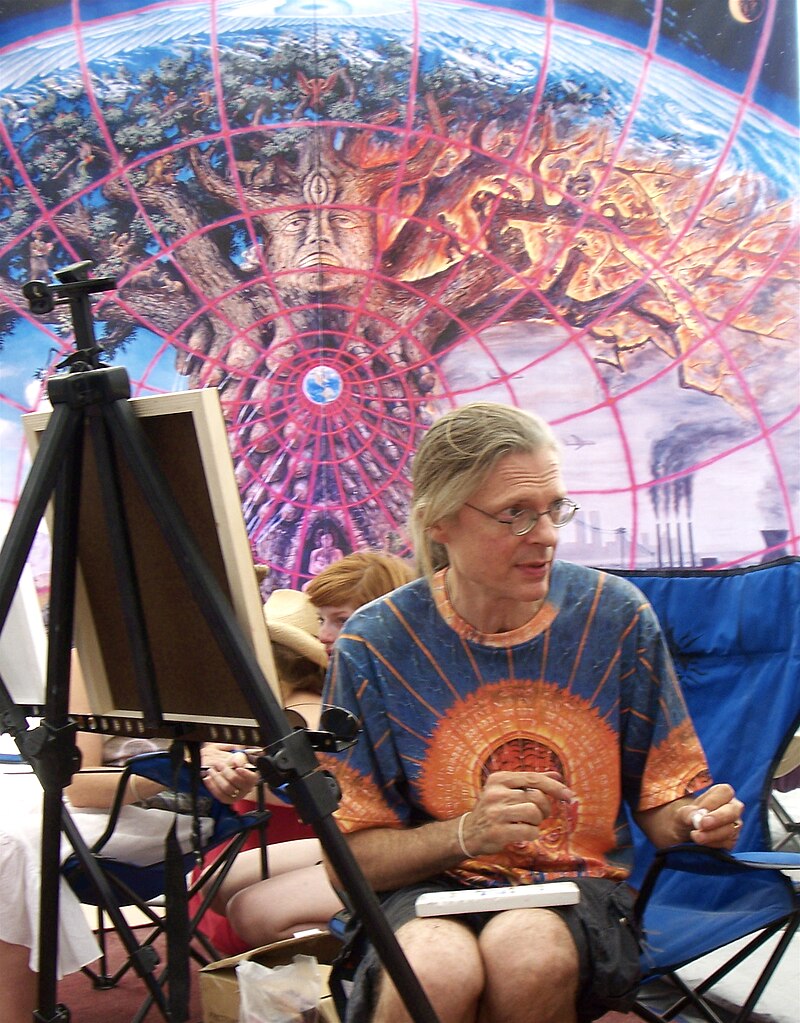
Alex Grey
David M*
Key facts
Key facts
• Name — Alex Grey • Born — 29 November 1953 • Birthplace — Columbus, Ohio, U.S. • Education — School of the Museum of Fine Arts at Tufts • Notable Works — The Chapel of Sacred Mirrors • Known for — Painting, illustration • Website — https: www.alexgrey.com • Spouse — Allyson Grey • Movement — Visionary art, psychedelic art
Early life and education
Early life and education
Grey was born Alexander Velzy on November 29, 1953, in Columbus, Ohio. His father was a graphic designer and artist. Grey was the middle child. He attended the Columbus College of Art and Design for two years before dropping out. Grey went on to study art at the School of the Museum of Fine Arts at Tufts in Boston in 1975. At the end of art school, Grey met his wife Allyson at a party where they both ingested LSD and later bonded over the experience. He reported that the LSD was initially given to him by his professor.
Career
Career
• Illustration — A viewer in front of Grey's art in 2007 Grey learned anatomy by working to prepare cadavers for dissection at Harvard Medical School's anatomy department, a position he held for five years. He worked as a medical illustrator for approximately ten years in order to support his studio art practice. Grey also taught anatomy and figure sculpture at New York University for ten years. Grey is best known for his psychedelic paintings and illustrations. In 1986, Grey's artwork was exhibited at the New Museum in New York City. Alex and Allyson Grey have worked collaboratively and have openly supported the use of entheogens. Mending the Heart Net, an interactive installation artwork by Alex and Allyson Grey, was displayed at Baltimore's American Visionary Art Museum in 1998–99 as part of the exhibition "Love: Error and Eros". In 1999, the Museum of Contemporary Art San Diego held a mid-career retrospective of Grey's work titled "Sacred Mirrors: The Visionary Art of Alex Grey". That same year, Grey was noticed by guitarist Adam Jones of the rock band Tool, who later featured his artwork on their albums Lateralus, 10,000 Days, and Fear Inoculum. Illustrations created by Grey have been selected to appear on albums for musical groups such as the Beastie Boys, Nirvana, Meshuggah, and The String Cheese Incident. Newsweek magazine and the Discovery Channel have featured his artwork. His images have been printed onto sheets of blotter acid and have been used on flyers to promote Rave events. Grey's artwork has been exhibited worldwide, including at Feature Inc., Tibet House US, Stux Gallery, MoMA PS1, the Outsider Art Fair, the Grand Palais in Paris, and the Sao Paulo Biennial in Brazil. Grey has been a keynote speaker at conferences in Tokyo, Amsterdam, Basel, Barcelona, and Manaus. In the 2012 book Psychedelia, author Patrick Lundborg credits Grey as "the leading psychedelic artist of today, and also one of the foremost proponents of Visionary Art as a style." Since 2020, the Greys have hosted a podcast about religion, science, visionary art, nature, meditations, and full-moon ceremonies. The pair has interviewed artists, philosophers, YouTubers, musicians, and PhD candidates.
The Chapel of Sacred Mirrors
The Chapel of Sacred Mirrors
• Illustration — Inside the Chapel of Sacred Mirrors Grey founded the Foundation for Sacred Mirrors, a 501(c)(3) organization, as a place to permanently display the Chapel of Sacred Mirrors. Additionally, he created the Church of Sacred Mirrors (CoSM). The CoSM provides a space for meditation and worship; visitors can also admire Grey's artwork and writings, as well as works by invited artists. According to the CoSM's website, "The mission of CoSM is to build an enduring sanctuary of visionary art to inspire a global community." Located in Wappinger, New York, visitors can explore 40 acres featuring art by Alex Grey, Allyson Grey, and Amy Senn, among others. Murals by Grey and others are in the cafeteria. The property also includes a 10-bedroom Victorian guest house decorated with visionary art. Much of Grey's work is displayed in Entheon, a converted carriage house, which the Greys are fundraising to complete. Visitors enter through bronze doors inscribed with "Creating a Better World" by Grey. While in Entheon, visitors can also admire Grey's works Kissing, Copulating, Pregnancy, Birth, Gaia, Net of Being (featured by the band Tool), and Nursing. Grey's project the Chapel of Sacred Mirrors first opened to the public in Chelsea, New York, in 2004 and drew visionary and psychedelic art fans to the site for four years until its closure in December 2008. The CoSM featured 20 life-size paintings of standing human figures Grey created in the early 1980s. The Greys reopened CoSM in Wappingers Falls, New York, a community within Hudson Valley.
Painting
Painting
• Illustration — Alex Grey painting in 2007 Grey's paintings are a blend of sacred art, visionary art, postmodern art, and psychedelic art. He is best known for his paintings of glowing anatomical human bodies, images that "x-ray" the multiple layers of reality. His art is a complex integration of body, mind, and spirit. The Sacred Mirrors, a life-sized series of 21 paintings, took 10 years to complete, and examines in detail the physical and metaphysical anatomy of the individual. "The inner body is meticulously rendered - not just anatomically precise but crystalline in its clarity". Many of his paintings include detailed representations of the skeleton, nervous system, cardiovascular system, and lymphatic system. Grey applies this multidimensional perspective to paint the universal human experience. His figures are shown in positions such as praying, meditating, kissing, copulating, pregnancy, birth, and death. Grey's work incorporates many religious symbols, including auras, chakras, and icons with geometric shapes and tessellations in natural, industrial, and multicultural situations. Grey's paintings are permeated by an intense, subtle light. "It is the light that is sublime in Grey's oeuvre - which is the most important innovation in religious light since the Baroque - and that makes the mundane beings in them seem sublime, in every realistic detail of their exquisite being". His highly detailed paintings are spiritual and scientific in equal measure, revealing his psychedelic, spiritual, and supernatural view of the human species. In 2002, Holland Cotter, New York Times art critic, wrote, "Alex Grey's art, with its New Age symbolism and medical-illustration finesse, might be described as psychedelic realism, a kind of clinical approach to cosmic consciousness. In it, the human figure is rendered transparently with X-ray or CAT-scan eyes, the way Aldous Huxley saw a leaf when he was on mescaline. Every bone, organ and vein is detailed in refulgent color; objects and space are knitted together in dense, decorative linear webs."
Writing
Writing
In 1990, Grey published a large-format art book, Sacred Mirrors: The Visionary Art of Alex Grey. The book included essays on the significance of Grey's work by Ken Wilber, and by New York art critic, Carlo McCormick. Grey's The Mission of Art, a philosophy of art, originally published in 1998 with a foreword by Ken Wilber, was reissued in 2017. The book traces the evolution of human consciousness through art history, explores the role of an artist's intention and conscience, and reflects on the creative process as a spiritual path. He promotes the mystical potential of art and argues that the process of artistic creation plays an important role in the enlightenment of both the artist and the broader culture. In Transfigurations, published in 2001, Grey addresses his portrayals of light bodies, performance works, his collaborative relationship with Allyson Grey, and their quest to build a Chapel of Sacred Mirrors. Sounds True has released The Visionary Artist, a CD of Grey's reflections on art as a spiritual practice. Grey co-edited the book, Zig Zag Zen: Buddhism and Psychedelics (Chronicle Books, 2002, reprinted by Synergetic Press, 2015). Alex Grey has published a 10-volume journal featuring his own artistic works and those of other visionary thinkers and philosophers.
Personal life
Personal life
In 2008, the San Francisco Chronicle reported that Grey lived in New York City with his wife, painter Allyson Grey. They have one daughter, Zena Grey. Grey is a member of the Integral Institute, formed by his friend Ken Wilber.
Necrophilia controversy
Necrophilia controversy
Grey is said to have had sex with a mutilated female corpse while working at a morgue in March 1976. This was part of his controversial performance art piece Necrophilia and was photographed by his wife Allyson Grey. The story was subsequently described in 1981 and thereafter and a recreated photograph of the act was distributed in several publications, including in WET Magazine and High Performance Magazine among others, with authors including Lewis MacAdams, Linda Frye Burnham, and Grey himself. Following revelations during a subsequent high-dose LSD trip, Grey described the act as "probably the worst thing I've ever done" and as feeling "disgraced and disgusted with myself" for it, deciding from then on to do only positive rather than negative or harmful works. In his 1998 book The Mission of Art however, Grey wrote that he does not regret his early "dark works" like Necrophilia, as they pushed him towards more virtuous work. Grey's disclosure of Necrophilia (1976) quickly followed American artist John Duncan's similar performance art piece Blind Date (1980), in which Duncan described having sex with a female corpse in Tijuana, Mexico and released an audiotape of the act. Subsequently, MacAdams published a pamphlet called Blind Date (1981) that detailed both Duncan's and Grey's works involving sex with corpses. The art community is said to have been horrified by Duncan's Blind Date (1980) piece. As a result of the piece, Duncan was informally banned from the art community, shunned even by his close friends, and eventually relegated to self-imposed exile outside of the United States. There were also attempts to have him legally prosecuted. Women were said to have felt particularly violated by Duncan's work. Conversely, although Grey describes his early dark works like Necrophilia (1976) as likewise having resulted in serious professional consequences, his own piece has been much less well-known, and Grey nonetheless went on to become a renowned visionary artist, for instance with his subsequent Sacred Mirrors (1979–1988) works.
In fiction
In fiction
• Illustration — Grey in 2007 with one of his artworks In Variable Star, a 2006 science fiction novel written by Spider Robinson based on a story outline by Robert A. Heinlein, Robinson devotes several pages to his protagonist's discovery of Grey's Sacred Mirrors and Progress of the Soul series, and to using them to enhance meditation.
Life and career
Dated record
Life and career
The full dated record · 2 entries
1953
Alex Grey born at Columbus.
2006
Alex Grey 2007 Calendar is dated 2006.
Publications
• 1990: Sacred Mirrors: The Visionary Art of Alex Grey, Inner Traditions - Bear & Company, • 1998: The Mission of Art, Shambhala Publications Inc., • 2001: Transfigurations, Inner Traditions - Bear & Company, • 2007: CoSM, Chapel of Sacred Mirrors (Alex Grey & Allyson Grey), CoSM Press, • 2008: Art Psalms, North Atlantic Books, • 2012: Net of Being (Alex Grey & Allyson Grey), Inner Traditions - Bear & Company, • 2015: Zig Zag Zen: Buddhism and Psychedelics, (Ed. Allan Badiner, Alex Grey), Synergetic Press,
Film
As an advocate for sacred art, Grey was the subject of the 2004 documentary ARTmind: the healing potential of sacred art. Grey and the Chapel of Sacred Mirrors gallery in New York City were featured in the 2006 documentary CoSM The Movie, directed by Nick Krasnic. Grey appeared in the 2006 film Entheogen: Awakening the Divine Within, a documentary about rediscovering an enchanted cosmos in the modern world. He also appeared in the film DMT: The Spirit Molecule, in which he talked about the importance of the substance DMT in the past and present world, as well as describing some of his personal experiences with the substance and how it influenced his painting. Grey appeared in the 2016 documentary film Going Furthur.
Notes from the source article
Cited by Wikipedia
Notes from the source article
These works are cited by the source article, in its own numbering. They are recorded as its citations, not as sources VALÉORINE has verified.
- 1.Johnson, Ken. Turning On, Tuning In and Painting the Results (Published 2008). The New York Times. December 20, 2008. 0362-4331.
- 2.Zeiba, Drew. In upstate New York, an ecstasy-inspired psychedelic temple rises. The Architect's Newspaper. June 13, 2018.
- 3.Lyttle, Thomas. Interview With Alex Grey. High Times. November 29, 2002.
- 4.Ernest, Nuala. Alex Grey: Net of Being. Issuu. Raw Vission. August 4, 2013.
- 5.Rogers, Clay Allen. Alex Grey: Art influenced by psychedelics. The Aggie. April 10, 2019.
- 6.David Ian Miller. LSD Helped Forge Alex Grey's Spiritual, Artistic and Love Lives. San Francisco Chronicle "Finding My Religion" series. March 24, 2008.
- 7.Grosso, Chris. Visionary Art, Psychedelics, Tool: The Mystical Life of Alex and Allyson Grey. Revolver. February 12, 2019.
- 8.Remesch, Karin. American Visionary Art Museum. Baltimore Sun. May 17, 1998.
- 9.The Artist as Visionary. Los Angeles Times. May 8, 1999.
- 10.10 old school album cover artists, you should know about. Noizr. May 8, 2015.
- 11.Pareles, Jon. A Night To Honor Bands That Jam (Published 2004). The New York Times. March 18, 2004. 0362-4331.
- 12.Sexton, Jason S. Jesus on LSD: When California blotter acid got religion. Boom. 5. 4. 78–84. Winter 2015. 10.1525/boom.2015.5.4.78.
- 13.Lundborg, Patrick, Psychedelia, An Ancient Culture, A Modern Way of Life, 2012, Lysergia, pg 421
- 14.Podcast. CoSM, Chapel of Sacred Mirrors.
- 15.Entheon. CoSM, Chapel of Sacred Mirrors.
- 16.Kuspit, Donald. Redeeming Art: Critical Reveries. Allworth Press. 2000. 9781581150551.
- 17.Outsider Art Sourcebook , ed. John Maizels, Raw Vision, Watford, 2009, p.82
- 18.Cotter, Holland, The New York Times, Alex Grey Tibet House review, October 4, 2002
- 19.Grey, Alex. Sacred Mirrors: The Visionary Art of Alex Grey. Inner Traditions/Bear. September 1, 1990. 978-0-89281-314-8.
- 20.Grey, Alex. The Mission of Art. Shambhala Publications. May 23, 2017. 978-0-8348-4086-7.
- 21.Reviews: The Mission of Art. Publishers Weekly. November 30, 1998.
- 22.Grey, Alex. Transfigurations. Inner Traditions/Bear. November 9, 2004. 978-1-59477-017-3.
- 23.Rico, Diana. A Book of Art and Essays Explores Psychedelics as a Spiritual Technology. Hyperallergic. January 4, 2016.
- 24.Grey, Alex. CoSM, the Movie: Chapel of Sacred Mirrors. Docurama. 2006. 978-0-7670-9192-3.
- 25.Critical Mass Productions. Entheogen: Awakening the Divine Within. 2006. 181630835.
- 26.Go Furthur at CoSM | Blog | Alex Grey. www.alexgrey.com.
- 27.Gonzalez Rice, Karen. Long Suffering: American Endurance Art as Prophetic Witness. University of Michigan Press. 162. 29 September 2016. 978-0-472-05324-7.
- 28.Grey, Alex. The Mission of Art. Shambhala. 50–53. 1998. 978-1-57062-396-7.
- 29.Lewis MacAdams. It Started With Death: Lewis MacAdams on Boston Artist Alex Grey. High Performance Magazine. 5. 1/2. 43–49. 1982.
- 30.Lewis MacAdams. Blind Date. Am Here Books / Immediate Editions. 1981.
- 31.Linda Frye Burnham. High Performance, Performance Art, and Me. The Drama Review. Cambridge University Press. 30. 1. 15–51. 1986. 10.2307/1145710.
- 32.Grey, Alex. More Sex With The Dead. WET. 32. 9. 1981.
- 33.Gonzalez Rice, Karen. No Pictures: Blind Date and Abject Masculinity. Performance Research. 19. 1. 15–24. 2 January 2014. 1352-8165.
- 34.Harvey, Doug. Corpsefucker Makes Good. LA Weekly. 25 July 2007.
- 35.Wlassoff, Boris. [Interview by Boris Wlassoff for revue & corrigée]. revue & corrigée. 51. March 2002.
- 36.John Duncan. Nicodim Gallery. 4 March 2018.
- 37.Fusco, Coco. Art World Voodoo. The Brooklyn Rail. June 2013.
- 38.Heinlein, Robert. Variable Star. Tom Doherty Associates. 170–173. September 2006. 0-7653-1312-X.
Bibliography printed in the source article · 6
- Adams, Benjamin M. Profound Parallels: The psychedelic art of Allyson Grey explores timeless themes. High Times. December 10, 2023.
- Eckstein, Noah. A Sanctuary for Psychedelic Art Opens in the Hudson Valley. The New York Times. May 23, 2023.
- Ellis, Karen. Alex Grey's Body of Light. Raw Vision. 26. Spring 1999.
- Oroc, James. The New Psychedelic Revolution: The Genesis of the Visionary Age. Inner Traditions/Bear. 2018. 978-1620556627.
- Rosenbaum, Cassady. Pilgrims Are Flocking to This Psychedelic Temple. Rolling Stone. June 30, 2023.
- Sayej, Nadja. Chapel of Sacred Mirrors: Cosmic Creativity, Entheogens, and Psilocybin with Allyson and Alex Grey. Vice. December 15, 2012.
References
Citations
References
Each reference names the institution holding it, so a reader may go to the document itself.
reference work
Secondary witnessreference work
Secondary witness
Further particulars
Held on the record
Further particulars
Open the remaining particulars
Formation and teaching. Grey studied at Columbus College of Art and Design, Whetstone High School and School of the Museum of Fine Arts. Recorded as sculptor, painter, draftsperson, writer and artist.
The Encyclopedia exists whether or not anything is for sale. Corrections are recorded rather than overwritten, and every version of this record is kept. Published 15 August 2026.
Elsewhere in Books
39,529 published records in this field, each with its sources named.
- Alex DimitrovAuthor
- Alex Faickney OsbornAuthor
- Alex FergusonAuthor
- Alex GarlandAuthor
- Alex HaleyAuthor
- Alex HorneAuthor
- Alex JonesAuthor
- Alex MillerAuthor
Best supported in this field
For owners
Own a work by Alex Grey?
A specialist will read what you send and tell you what the house can establish, what it cannot, and whether the object is suited to sale. There is no charge and no obligation. The object stays with you throughout; nothing is shipped to us unless it is arranged in writing beforehand.