
Alessandro Pieroni
Illustration — Alessandro Pieroni, San Giovanni Gualberto e l'uccisore di suo fratello davanti al crocifisso di San Miniato, 1580 Alessandro Pieroni (18 April 1550 in Impruneta – 24 July 1607 in Livorno) was an Italian architect and painter. He was active mainly in a Mannerist style, working for the courts of Grandukes Francesco I and Ferdinando I de' Medici, Grand Duke of Tuscany.
Alessandro Pieroni
Sailko · CC BY 3.0
- Born
- 1550 · Florence.
- Died
- 1607 · Livorno.
- Nationality
- Italy
- Occupation
- architect · painter · decorator · artist
VALÉORINE Encyclopedia
VALÉORINE documentary reading
Documentary summary
Illustration — Alessandro Pieroni, San Giovanni Gualberto e l'uccisore di suo fratello davanti al crocifisso di San Miniato, 1580 Alessandro Pieroni (18 April 1550 in Impruneta – 24 July 1607 in Livorno) was an Italian architect and painter. He was active mainly in a Mannerist style, working for the courts of Grandukes Francesco I and Ferdinando I de' Medici, Grand Duke of Tuscany.
Admitted source layer · organised and presented by VALÉORINE
Reference Check
Propose documentary evidence for Alessandro Pieroni. A contribution is never written directly as fact: identity, source, rights and evidence gates still decide.
Sign in to contribute
World of VALÉORINE
Documentary connections
Only confirmed graph relationships appear here. Images are shown only when their identity and reuse rights both pass the documentary gate.
Documentary evidence
Documentary basis
Authority files
wikidata · Q2641144 · wikipedia · Alessandro Pieroni
In this article
Biography
Biography
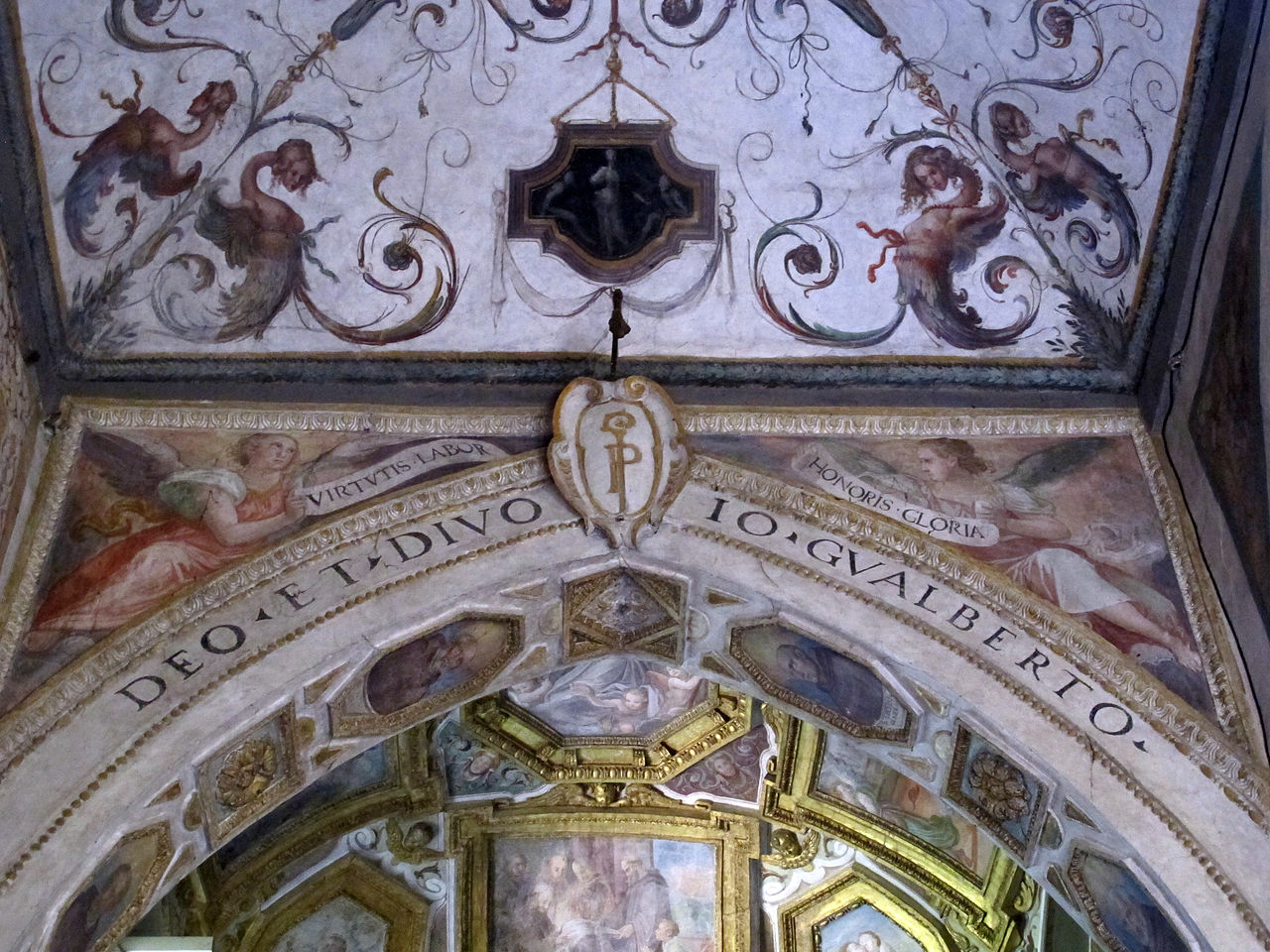
Pieroni was also known as the Sandrino dall' Impruneta. He was born in Florence in 1550 where he graduated from the Accademia del Disegno in 1570. He began his career as an assistant to Alessandro Allori. Allori led the team between 1587 and 1591, including Pieroni, Giovanni Bizelli, Giovanni Maria Butteri, and a young Cigoli in decorating the ceilings of the corridors of the Uffizi in Florence. For the chapel of San Giovan Gualberto in the Abbey of San Michele in Passignano, Pieroni painted an altarpiece of San Giovan Gualberto pardons the murderers of his brother before the crucifix of San Miniato. For the visit of Grand-Duke Ferdinand to Pisa in 1588, Pieroni completed, along with the painter Filippo Paladino, a canvas for the church of the Santo Stefano dei Cavalieri, depicting scenes from the life of Santo Stefano Martire. He also helped design the facade. Giorgio Vasari likely also participated in the design of the ceiling decorations. He painted an altarpiece for the Cappella dei Principi in the church of San Lorenzo. While serving as an artist in the court, he was commissioned works to celebrate the weddings of the Medici. In 1589, he was among the artists engaged in the elaborate decorations to celebrate the marriage of Ferdinando I and Cristina di Lorraine, painting the Defeat of Gian Galeazzo Visconti at Mantua. With Bernardo Buontalenti, he also made scenography for the Theater at the Uffizi, for the 1600 presentation of the comedy La Pellegrina and also made decorations to celebrate the wedding of Marie de' Medici to Henry IV of France. As an architect, he worked with Bernardo Buontalenti in the design of fortifications of the Belvedere in Florence and the Corsini Chapel in church of the Carmine, and the facade of Santa Maria del Fiore. In Volterra, he helped design the Chapel of St Paul for the Admiral Jacopo Inghirami (and paint the main altarpiece). Many of his architectural skills were focused on Livorno. When confronted by the Grand Duke about the size of the Cathedral of Livorno (built 1594-1606), he replied that public works can never be too large. He also helped design the church of the Madonna (begun in 1607), the church of the Greci Uniti (1606), and the Synagogue of Livorno (1603). He helped design porticos for the Piazza d'Armi. His son Giovanni de Galliano Pieroni was an architect; in addition, the elder Pieroni collaborated with Don Giovanni de' Medici, the illegitimate son of Cosimo who dabbled in architecture, mainly the facade of Santo Stefano dei Cavalieri in Pisa. Pieroni died on 24 July 1607 in Livorno where a street, Via Alessandro Pieroni, is named after him.

Abbazia di San Michele Arcangelo a Passignano - Cappella di San Giovanni Gualberto
Sailko

Abbazia di San Michele Arcangelo a Passignano - Cappella di San Giovanni Gualberto
Sailko
Life and career
Dated record
Life and career
The full dated record · 2 entries
1550
Alessandro Pieroni born at Florence.
1607
Alessandro Pieroni died at Livorno.
Places
Named by the record
Places
Only places the record itself states, plotted where the house gazetteer settles their coordinates. Nothing is inferred from a name or a nationality.
Florence.
Birth place
Livorno.
Death place
Notes from the source article
Cited by Wikipedia
Notes from the source article
These works are cited by the source article, in its own numbering. They are recorded as its citations, not as sources VALÉORINE has verified.
References
Citations
References
Each reference names the institution holding it, so a reader may go to the document itself.
reference work
Secondary witnessreference work
Secondary witness
People, houses and institutions
Knowledge graph
People, houses and institutions
Teachers, collaborators, publishers and institutions recorded against this person, each on a stated basis.
Died at
1- LivornoPlace
Established from a fact already recorded on a verified source.
The Encyclopedia exists whether or not anything is for sale. Corrections are recorded rather than overwritten, and every version of this record is kept. Published 16 August 2026.
Elsewhere in Design
11,558 published records in this field, each with its sources named.
- Alessandro MelisDesigner
- Alessandro MendiniDesigner
- Alessandro MoscardiDesigner
- Alessandro PasqualiniDesigner
- Alessandro PompeiDesigner
- Alessandro SanquiricoDesigner
- Alessandro SpecchiDesigner
- Alessandro TremignonDesigner
Best supported in this field
For owners
Own a work by Alessandro Pieroni?
A specialist will read what you send and tell you what the house can establish, what it cannot, and whether the object is suited to sale. There is no charge and no obligation. The object stays with you throughout; nothing is shipped to us unless it is arranged in writing beforehand.