
François Duquesnoy
François Duquesnoy or Frans Duquesnoy (12 January 1597 – 18 July 1643) was a Flemish Baroque sculptor who was active in Rome for most of his career, where he was known as Il Fiammingo ("the Fleming"). His idealized representations represented a quieter and more restrained version of Italian baroque sculpture, and are often contrasted with the more dramatic and emotional character of Bernini's works, while his style shows a great affinity to Algardi's sculptures.
Also recorded as Francois Canoi · Francois du Quesnoi · Frans Van Cannoy · Frans van Canoi
François Duquesnoy
François Duquesnoy · Wellcome Collection, London · Wellcome Collection · Public Domain Mark
- Name
- François Duquesnoy
- Born
- 12 January 1597
- Birthplace
- Brussels, Duchy of Brabant, Holy Roman Empire
- Died
- 18 July 1643
- Place of death
- Livorno, Grand Duchy of Tuscany
- Field
- Sculpture
- Movement
- Baroque
- Nationality
- Southern Netherlands
- Occupation
- sculptor · draftsperson
- Fields
- art of sculpture
- Teachers
- Hiëronymus Duquesnoy the Elder
- Languages
- Dutch
VALÉORINE Encyclopedia
VALÉORINE documentary reading
Documentary summary
François Duquesnoy or Frans Duquesnoy (12 January 1597 – 18 July 1643) was a Flemish Baroque sculptor who was active in Rome for most of his career, where he was known as Il Fiammingo ("the Fleming"). His idealized representations represented a quieter and more restrained version of Italian baroque sculpture, and are often contrasted with the more dramatic and emotional character of Bernini's works, while his style shows a great affinity to Algardi's sculptures.
Admitted source layer · organised and presented by VALÉORINE
Note VALÉORINE
No house-authored Note is published until its assertions and sources pass the VALÉORINE evidence contract. The documentary article remains available in full while that enrichment is being consolidated.
Documentary enrichment in progress · no unsupported statement published
Reference Check
Propose documentary evidence for François Duquesnoy. A contribution is never written directly as fact: identity, source, rights and evidence gates still decide.
Sign in to contribute
Documentary evidence
Evidence Panel
not yet certified
- Identity
- resolved
- Independent source families
- 0
- Admitted assertions
- 0
- Open conflicts
- 0
Authority files
wikidata · Q960381 · wikipedia · François Duquesnoy
In this article
Biography
Biography
Training under Hiëronymus Duquesnoy the Elder is recorded. Justus de Corte is recorded as having studied under François Duquesnoy. The recorded working language is Dutch. The field of work recorded is art of sculpture. Places of work recorded in the authority are Rome. Work by François Duquesnoy is recorded in the collections of Belvedere, Minneapolis Institute of Art, Museo del Prado, Art Institute of Chicago and The Nelson-Atkins Museum of Art.
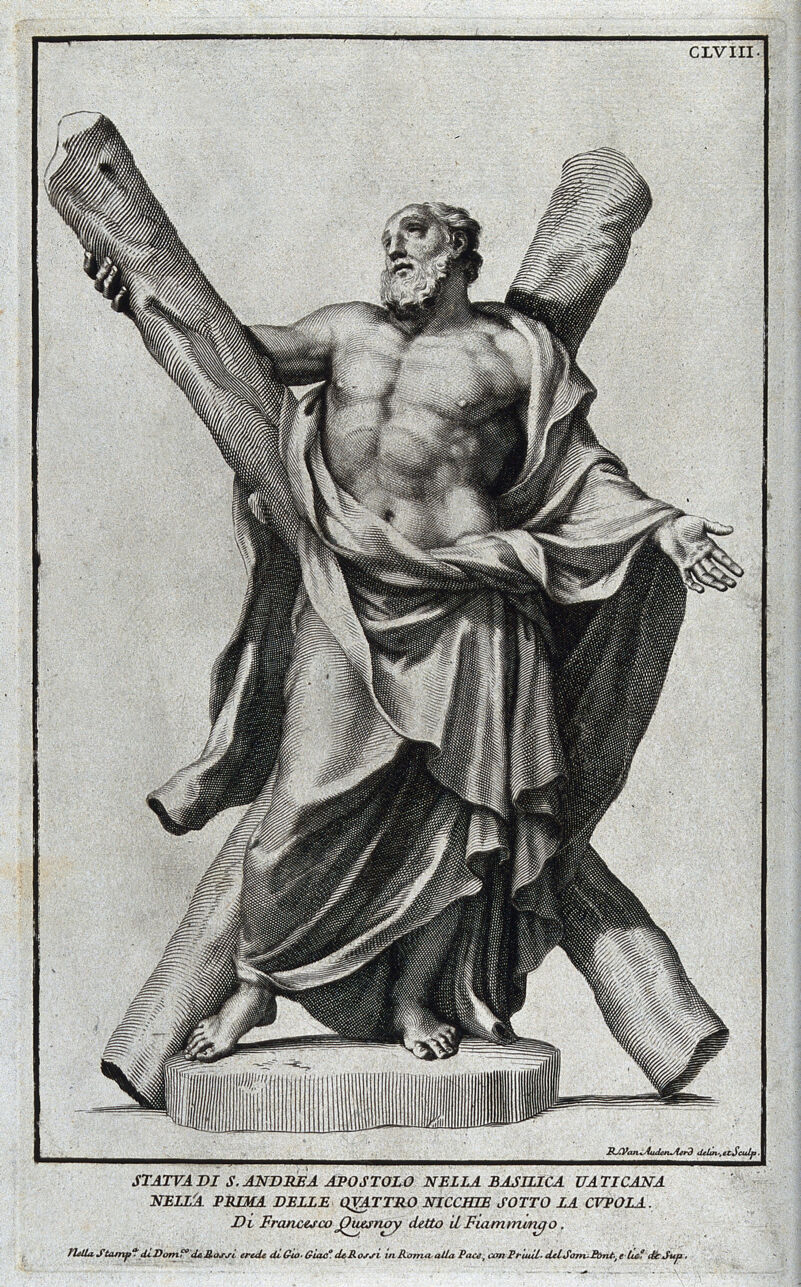
Saint Andrew. Line engraving by R. van Audenaerd after F. Duquesnoy., by François Duquesnoy
François Duquesnoy · Wellcome Collection, London · Wellcome Collection
Key facts
Key facts
• Name — François Duquesnoy • Born — 12 January 1597 • Birthplace — Brussels, Duchy of Brabant, Holy Roman Empire • Died — 18 July 1643 • Place of death — Livorno, Grand Duchy of Tuscany • Field — Sculpture • Movement — Baroque • Works — Saint Susanna, Saint Andrew, Tomb of Ferdinand van den Eynde
Early years
Early years
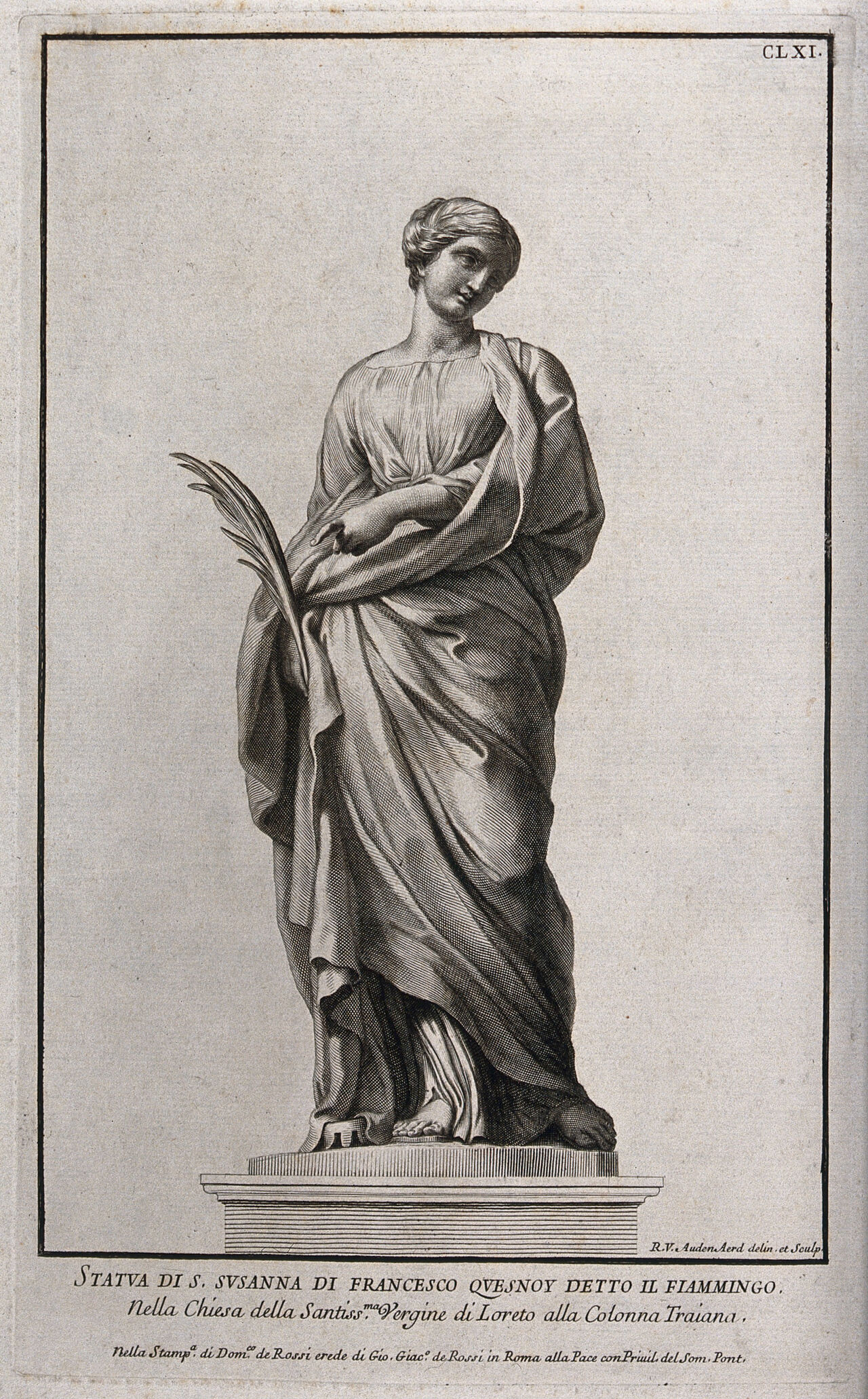
Duquesnoy was born in Brussels. Having come from Flanders, Duquesnoy was called Il Fiammingo by the Italians and François Flamand by the French. His father, Jérôme Duquesnoy the Elder, sculptor of the Manneken Pis fountain in Brussels (1619), was the court sculptor to Archduchess Isabella and Archduke Albert, governor of the Low Countries. The sculptor Jérôme Duquesnoy the Younger was his brother. Some of Francois' early work in Brussels attracted the notice of the Archduke, who gave him the wherewithal to study in Rome, where he would spend his whole career. According to early biographers, when Duquesnoy arrived in Rome in 1618, he studied antique sculpture in detail, climbing over the equestrian Marcus Aurelius to determine how it was cast, or making a pilgrimage to the shrine of Diana at Lake Nemi. In 1624, Nicolas Poussin, who shared his classicly styled, emotionally detached manner of depiction, arrived in Rome, and the two foreign artists lodged together. Both moved in the circle of patronage of Cassiano dal Pozzo. They developed a canon of ideal expressive figures, counter to the theatrical baroque of Bernini. Contemporary critics, like Giovanni Bellori, in Lives of the Modern Painters, Sculptors and Architects from 1672, hailed Duquesnoy's art as restoring contemporary sculpture to quality of antique Roman sculpture. Bellori said that with his Santa Susanna, Duquesnoy "had left to modern sculptors the example for statues of clothed figures, making him more than the equal of the best ancient sculptors...". Among Duquesnoy's early works are bas-relief putti for Villa Doria Pamphili. In spite of the contrast perceived by contemporaries in their stylistic approaches, Duquesnoy collaborated with Bernini in the design, among others, of the angels offering garlands of the baldacchino for Saint Peter's (in process 1624–1633). The four angels are entirely Duquesnoy's work, and this work earned him future commissions.
The statue of Santa Susanna
The statue of Santa Susanna
• Illustration — Santa Susanna Duquesnoy's classicly styled Saint Susanna (1629) depicts the saint as both modest and revealing under marble draperies – "so much so that the pure volume of the members is visible" (Bellori). This is one of four sculptures depicting virgin martyrs by various sculptors for the church of Santa Maria di Loreto in front of the Roman Forum of Trajan (1630–33). Critics have remarked on the refined surfaces and the softness and sweetness with which Duquesnoy invested this statue. There is a transcendence in her empty gaze. The sculpture was little known until the 18th century, when a marble copy by Guillaume Coustou was sent to Paris (1739) and Duquesnoy's Susanna entered the canon of most-admired modern sculptures. • Illustration — Saint Andrew
The statue of Saint Andrew in the Transept of St Peter's
The statue of Saint Andrew in the Transept of St Peter's
The more extroverted marble representation of Saint Andrew (1629–33) was begun a few months after his completion of the Santa Bibiana. It is one of the four larger-than-life statues which frame the baldacchino in the transept of St. Peter's Basilica; each statues is associated with the basilica's primary holy relics (the other three statues in St. Peter are Bernini's Saint Longinus, Mochi's Saint Veronica, and Bolgi's St Helena). It is useful to contrast the tone of Andrew with that of Longinus: in Andrew the draperies fall vertically or droop, while Longinus clothes inflate in improbably starched ebullience. Andrew leans over the saltire cross of his martyrdom, while Longinus theatrically flings arms outward expostulating divine influence. Both statues accentuate the diagonals, but Duquesnoy's is more restrained than either Bernini's or Mochi's contribution. • Illustration — Adonis, a Roman torso, restored and completed by François Duquesnoy (Louvre Museum)
Other works
Other works
Poussin recommended Duquesnoy to Cardinal Richelieu, who offered the position of royal sculptor to Louis XIII and with the goal of founding a royal academy of sculpture in Paris. Duquesnoy was about to sail from Livorno, when he died; he had suffered for years from gout and episodes of vertigo (he fell from the scaffolding while attaching the gilded palm branch to his Susanna) and bouts of depression. His brother, Jérôme Duquesnoy the Younger (1612–1654) inherited the chests with the designs of uncompleted work, including some designs for putti for the tomb of Bishop Triest in the Saint Bavo Cathedral in Ghent. Like other sculptors working in 17th century Rome, Duquesnoy was called upon to restore and complete antiquities, for headless torsos rarely found a market with contemporary connoisseurs. With the Rondanini Faun (1625–30; now in the British Museum) Duquesnoy amplified a torso into a characteristically Baroque expansive gesture that deeply satisfied contemporary taste but was bitterly criticised by Neoclassicists by the end of the 18th century. He completed a Roman torso as Adonis. It found its way into the collection of Cardinal Mazarin and is now in the Louvre. There are bronze busts of the Susanna in Vienna, Berlin, and Copenhagen. Finely finished small-scale bronzes of antique subjects, suitable for collectors, occupied the sculptor and his studio assistants. A Mercury and Cupid is at the Louvre, a gracile Bacchus at the Hermitage Museum. A bronze Mercury was commissioned by the collector of antiquities Vincenzo Giustiniani as a pendant to a Hellenistic bronze Hercules in his collection, a compliment to Duquesnoy and implicitly a statement of the parity of the Ancients and the Moderns. Giustiniani commissioned a life-size Virgin and Child from Duquesnoy in 1622, at a moment when the sculptor was hard pressed to finish his Andrew, due to interruption of payments instigated by a cabal (Joachim von Sandrart). His terracotta modelli were more likely to carry the immediacy of the sculptor's touch and were of especial value to other sculptors, if they could afford them. Louis XIV's royal sculptor François Girardon owned a great number of Duquesnoy's terra-cotta models, which are recorded in the inventory of Girardon's collection drawn up after his death in 1715.
Bas-reliefs of putti
Bas-reliefs of putti
• Illustration — Tomb of Ferdinand van den Eyndein Santa Maria dell'Anima in Rome • Illustration — Children Playing with a Goat is one of several copies after his bas-relief of putti playing with a he-goat, which became quite popular with Dutch artists. His characteristic putti, plump, with carefully observed children's heads, helped to establish the conventional type, familiar in the paintings of Rubens: in fact Rubens wrote Duquesnoy in 1640 to thank him for sending him casts of the putti from the sculptor's Tomb of Ferdinand van den Eynde in Santa Maria dell'Anima in Rome. Flemish boxwood or ivory carvings, especially with scenes of putti, are often casually described as "in his manner", though he never left Rome. Aside from his brother, who collaborated with him in his studio, his most prominent pupils were François Dieussart and Artus Quellinus. Quellinus and Rombaut Pauwels, another Flemish sculptor who familiarized himself with Duquesnoy's style in Rome, brought the classicly styled Baroque style of what Duquesnoy's circle, an informal academy, called la gran maniera greca to the Netherlands on their return from Rome. In Rome, Duquesnoy's student Orfeo Boselli wrote Osservazioni della scoltura antica in the 1650s; his observations reflected connoisseurship of the subtle contours of superior Greek sculpture, considered superior to Roman work, which had been developed in Duquesnoy's circle and would inform the sensibility of Winckelmann and Neoclassicism.
Life and career
Dated record
Life and career
The full dated record · 2 entries
1597
François Duquesnoy born at Brussels.
1643
François Duquesnoy died at Livorno.
Places
Named by the record
Places
Only places the record itself states, plotted where the house gazetteer settles their coordinates. Nothing is inferred from a name or a nationality.
Brussels.
Birth place
Livorno.
Death place
Primary material
Documents and archives
reference work
- Wikidata, structured authority record Q960381: François Duquesnoy
Reputable secondary · Wikidata
- “François Duquesnoy”, English Wikipedia, consulted as further reading
Reputable secondary · Wikipedia
scholarly publication
- Duquesnoy, François (1597–1643), Historical Dictionary of Baroque Art and Architecture, 2018
Scholarly · Crossref registry · 2018
References
Citations
References
Each reference names the institution holding it, so a reader may go to the document itself.
scholarly publication
Duquesnoy, François (1597–1643), Historical Dictionary of Baroque Art and Architecture, 2018Crossref registry
Verifiedreference work
Partially resolvedreference work
Partially resolved
Further particulars
Held on the record
Further particulars
Open the remaining particulars
The authorities additionally record the headings Francois Canoi, Francois du Quesnoi, Frans Van Cannoy, Frans van Canoi and Francois di Quesnoy. His recorded language was Dutch. Formation and teaching. He trained under Hiëronymus Duquesnoy the Elder. Each of those relationships is stated by the authority record rather than inferred from style.
Identity and origins
The Encyclopedia exists whether or not anything is for sale. Corrections are recorded rather than overwritten, and every version of this record is kept. Published 14 August 2026.
Elsewhere in Sculpture
6,174 published records in this field, each with its sources named.
- François BrochetArtist
- François ClémencinArtist
- François CoudrayArtist
- François DieussartArtist
- François Gaspard AdamArtist
- François GirardonArtist
- François JouffroyArtist
- François LannoArtist
Best supported in this field
For owners
Own a work by François Duquesnoy?
A specialist will read what you send and tell you what the house can establish, what it cannot, and whether the object is suited to sale. There is no charge and no obligation. The object stays with you throughout; nothing is shipped to us unless it is arranged in writing beforehand.