
Aleksei Balabanov
Aleksei Oktyabrinovich Balabanov (Russian: Алeксeй Oктябpинoвич Балабанoв; 25 February 1959 – 18 May 2013) was a Russian filmmaker. A member of the European Film Academy, he began his career by creating mostly arthouse pictures and music videos but gained significant mainstream popularity in action crime drama movies Brother (1997) and Brother 2 (2000), both of which starred Sergei Bodrov, Jr. Later, Balabanov directed the films Cargo 200 (2007), Morphine (2008), and A Stoker (2010), which also received critical recognition.
Also recorded as Aleksey Oktyabrinovich Balabanov · Aleksei Oktyabrinovich Balabanov
Aleksei Balabanov

Олег Беляев · This image has been extracted from another file · CC BY-SA 3.0
- Born
- 1959.
- Died
- 2013.
- Nationality
- Soviet Union and Russia.
- Occupation
- film director, screenwriter, film editor, film producer, actor, manufacturer, film actor and director.
VALÉORINE Encyclopedia
VALÉORINE documentary reading
Documentary summary
Aleksei Oktyabrinovich Balabanov (Russian: Алeксeй Oктябpинoвич Балабанoв; 25 February 1959 – 18 May 2013) was a Russian filmmaker. A member of the European Film Academy, he began his career by creating mostly arthouse pictures and music videos but gained significant mainstream popularity in action crime drama movies Brother (1997) and Brother 2 (2000), both of which starred Sergei Bodrov, Jr. Later, Balabanov directed the films Cargo 200 (2007), Morphine (2008), and A Stoker (2010), which also received critical recognition.
Admitted source layer · organised and presented by VALÉORINE
Note VALÉORINE
Aleksei Balabanov (1959–2013) was a Russian and Soviet actor, director and film actor, among other activities. Born in Yekaterinburg, the actor died in Sestroretsk. Aleksei Balabanov studied at Top Courses for Scriptwriters and Film Directors.
Languages used include Russian. The actor received Nika Award, Nika Award for Best Director and Nika Award for Best Picture.
Composed from admitted, traceable facts · 26 September 2026
VALÉORINE
Reference Check
Propose documentary evidence for Aleksei Balabanov. A contribution is never written directly as fact: identity, source, rights and evidence gates still decide.
Sign in to contribute
World of VALÉORINE
Documentary connections
Only confirmed graph relationships appear here. Images are shown only when their identity and reuse rights both pass the documentary gate.
Documentary evidence
Evidence Panel
original value insufficient · checked 25 September 2026
- Identity
- resolved
- Independent source families
- 0
- Admitted assertions
- 0
- Open conflicts
- 0
Authority files
wikidata · Q557323 · wikipedia · Aleksei Balabanov
In this article
Life and career
Life and career
Balabanov was born on 25 February 1959, in Sverdlovsk (now Yekaterinburg). In 1981, Balabanov graduated from the Translation Department of the Gorky Pedagogical University of Foreign Languages. He then served in the Soviet Army as an officer-interpreter. After his discharge, he worked as an assistant film director at the Sverdlovsk Film Studio. from 1983 to 1987. Balabanov shot his first film in 1987, in the Urals. The script of the film was written over the course of one night. This low-budget work was filmed in a restaurant. Later, Balabanov studied at the experimental workshop "Auteur Cinema" (Russian: Авторское кино) at High Courses for Scriptwriters and Film Directors, graduating in 1990. Balabanov lived and worked in St. Petersburg From 1990. In 1991, Balabanov directed his feature film debut Happy Days based on the works of Samuel Beckett. It was screened at the Cannes Film Festival in 1994. In 1994, Balabanov, together with Sergey Selyanov and Viktor Sergeyev, founded the production company CTV. That same year, he directed an adaptation of Franz Kafka's The Castle. His next film, Brother (1997), a crime drama about a contract killer, was a box-office and critical success. The film featured music by the band Nautilus Pompilus for which Balabanov had previously directed several music videos. It was screened at the Cannes Film Festival in 1997. It was a breakthrough film for Balabanov and the lead actor Sergei Bodrov Jr., making them instantly known throughout Russia. The success of the movie led to the creation of the sequel, Brother 2, also directed by Balabanov and starring Bodrov. The film is set in Chicago. He directed Of Freaks and Men in 1998 about the emerging pornography business in turn-of-the-century Imperial Russia. The film premiered at the Directors' Fortnight of 1998 Cannes Film Festival. Dead Man's Bluff (2005) was Balabanov's first foray into dark comedy. Cargo 200 (2007), partially based on Faulkner's novel Sanctuary, was controversial among critics and audiences because of the graphic display of violence in the film. Cannes Film Festival programmer Joël Chapron likened the picture to a "snuff film" at the Sochi Film Festival premiere. Balabanov's last completed film was Me Too, which was screened at the Venice Film Festival in 2012.
Personal life
Personal life
He was married to costume designer Nadezhda Vasilyeva. He had two sons.
Death
Death
Balabanov struggled to cope with the death of actor and close friend Sergei Bodrov Jr., who was killed during the Kolka–Karmadon rock ice slide while filming Bodrov Jr.'s later-cancelled film Messenger in September 2002. Also killed by the mudslide were 41 cast and crew members of Messenger, many of whom had also worked with Balabanov. Balabanov felt guilty over Bodrov Jr.'s death as he had suggested the shooting location to him. Prior to that, in 2000, actress Tuyara Svinoboeva had been killed in a car crash during the shoot of The River. Balabanov's alcohol consumption increased considerably and he died on 18 May 2013 of a heart attack. Balabanov was buried near his father's grave at Smolensky Cemetery in St. Petersburg.
Unfinished projects
Unfinished projects
Prior to his death, Balabanov was reportedly planning to make a film on Stalin, portraying him as a 'godfather of crime'. After a fatal car crash on set, Balabanov's film The River about a leper colony in Yakutia was released as a short film with a voiceover narrating unfilmed parts of the story.
Music videos
Music videos
Balabanov directed several music videos: Three clips for the band Nautilus Pompilius: "A glimpse from the screen" (Russian: Взгляд с экрана, 1988), "Pure demon" (Russian: Чистый бес, 1992), and "In the rain" (Russian: Во время дождя, 1997; soundtrack to his movie Brother); A clip for Nastya (band): "Stratosphere" (Russian: Стратосфера, 1989); Together with the director Valery Makushchenko, a clip for the band Bi-2: "No One Writes to the Colonel" (Russian: Полковнику никто не пишет, 2000; soundtrack to his film Brother 2).
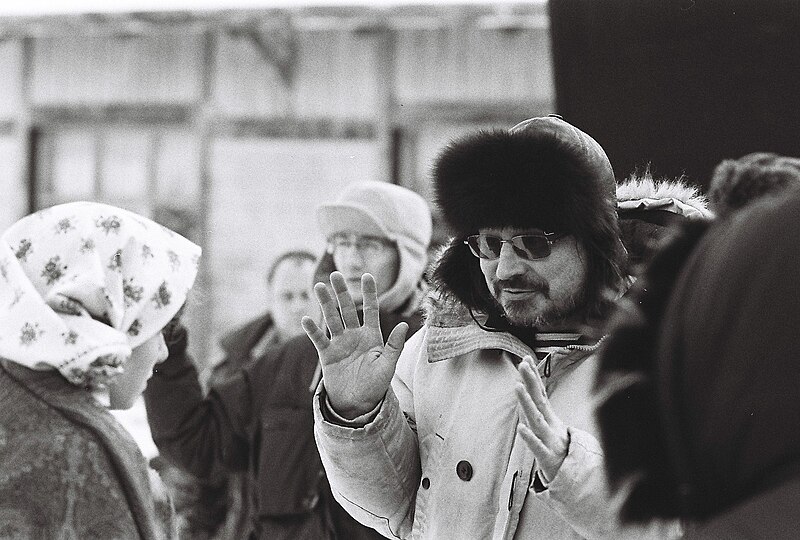
Director Alexey Balabanov on set of "Morfiy (Morphine)" movie
Олег Беляев
Life and career
Dated record
Life and career
The full dated record · 1 entries
2013
Aleksei Balabanov died at Sestroretsk.
Legacy
Largely due to the popularity of Brother and Brother 2, Balabanov is frequently cited as one of Russia's greatest ever film directors.
Primary material
Documents and archives
reference work
- “Aleksei Balabanov”, English Wikipedia, consulted as further reading
Reputable secondary · Wikipedia
authority record
- Wikidata, structured authority record Q557323: Aleksei Balabanov
Unverified · Wikidata
Notes from the source article
Cited by Wikipedia
Notes from the source article
These works are cited by the source article, in its own numbering. They are recorded as its citations, not as sources VALÉORINE has verified.
- 1.BBC News. Russian cult film director Alexei Balabanov dies. 18 May 2013.
- 2.Peter Rollberg. Historical Dictionary of Russian and Soviet Cinema. Rowman & Littlefield. 75–78. 2016. 978-1442268425.
- 3.Oxford University Press. The Imperial Trace : Recent Russian Cinema. 217–236. 2009. 978-0199710546.
- 4.Russian cult film director Balabanov dies. Herald Sun. 19 May 2013.
- 5.Aleksei Balabanov. Cannes Film Festival. 5 March 2024.
- 6.Прощание с кинорежиссером Алексеем Балабановым в Петербурге прошло тихо и скромно – Первый канал
- 7.Maria Baker. Алексей Балабанов "грузит" Кинотавр. BBC. 10 June 2007.
- 8.Me Too (Ya tozhe hochu): Venice Review. The Hollywood Reporter. 7 September 2012.
- 9.Aleksei Balabanov Russian Film Director Dies at 54. The New York Times. 21 May 2013.
- 10.III, Harris M. Lentz. Obituaries in the Performing Arts, 2013. McFarland, Incorporated, Publishers. 2014-05-16. 978-0-7864-7665-7.
- 11.The Story of Aleksei Balabanov's Unfinished Film The American and Its Potential Afterlife. Jordan Russia Center.
- 12.Dead Man's Bluff. V–A–C.
- 13.Akhmetzhanova, Maria. Al eksey Balabanov: where to start with his films. New East Digital Archive.
- 14.Причиной смерти Алексея Балабанова стала сердечная недостаточность. Российская газета. 20 May 2013.
- 15.KinoKultura. www.kinokultura.com.
- 17.Österberg, Ira. Aleksei Balabanov: 'Brother'. Intellect. 2022. 978-1-78938-483-3.
- 18.Brother. Variety.
- 19.Of Freaks and Men. Variety.
- 20.Brother 2. Variety.
- 21.War. Variety.
- 22.Dead Man's Bluff. Variety.
- 23.It Doesn't Hurt. Variety.
- 24.Cargo 200. Variety.
- 25.Morphia. Variety.
- 26.A Stoker. Variety.
- 27.Me Too (Ya tozhe hochu): Venice Review. The Hollywood Reporter.
Bibliography printed in the source article · 1
- Florian Weinhold (2013), Path of Blood: The Post-Soviet Gangster, His Mistress and Their Others in Aleksei Balabanov's Genre Films. Reaverlands Books: North Charleston, SC.
References
Citations
References
Each reference names the institution holding it, so a reader may go to the document itself.
reference work
Partially resolvedauthority record
Unverified
The Encyclopedia exists whether or not anything is for sale. Corrections are recorded rather than overwritten, and every version of this record is kept. Published 14 August 2026.
Elsewhere in Film memorabilia
37,178 published records in this field, each with its sources named.
- Aleksandre KoberidzePerson
- Aleksandrs LeimanisPerson
- Aleksei Alekseivich GermanPerson
- Aleksei ArbuzovPerson
- Aleksei FedorchenkoPerson
- Aleksei GuskovPerson
- Aleksei KaplerPerson
- Aleksei KravchenkoPerson
Best supported in this field
For owners
Own a work by Aleksei Balabanov?
A specialist will read what you send and tell you what the house can establish, what it cannot, and whether the object is suited to sale. There is no charge and no obligation. The object stays with you throughout; nothing is shipped to us unless it is arranged in writing beforehand.