
Akiva Aryeh Weiss
Akiva Arieh Weiss, also spelled Aryeh (December 11, 1868 – May 23, 1947), was a Zionist activist, architect, and city planner in Palestine. He is best known as the primary founder of Tel Aviv. He had been the initiator of the project to create the "first Hebrew city" in Palestine and presided over its establishment.
Also recorded as Akiva Arieh Weiss
Akiva Aryeh Weiss
Gellerj · CC BY-SA 3.0
- Born
- 11 December 1868
- Birthplace
- Grodno, Grodno Governorate, Russian Empire (present-day Belarus)
- Died
- 23 May 1947
- Place of death
- Mandatory Palestine
- Known for
- Founder of Ahuzat Bayit
- Nationality
- Ottoman Empire · Russian Empire · United Kingdom
- Occupation
- architect · watchmaker · jeweler · urban planner · textile manufacturer
- Fields
- architecture
- Movements
- Eretz Israel style
- Languages
- English
VALÉORINE Encyclopedia
VALÉORINE documentary reading
Documentary summary
Akiva Arieh Weiss, also spelled Aryeh (December 11, 1868 – May 23, 1947), was a Zionist activist, architect, and city planner in Palestine. He is best known as the primary founder of Tel Aviv. He had been the initiator of the project to create the "first Hebrew city" in Palestine and presided over its establishment.
Admitted source layer · organised and presented by VALÉORINE
Reference Check
Propose documentary evidence for Akiva Aryeh Weiss. A contribution is never written directly as fact: identity, source, rights and evidence gates still decide.
Sign in to contribute
World of VALÉORINE
Documentary connections
Only confirmed graph relationships appear here. Images are shown only when their identity and reuse rights both pass the documentary gate.
Documentary evidence
Documentary basis
Authority files
wikidata · Q12410432 · wikipedia · Akiva Aryeh Weiss
In this article
Biography
Biography
He also helped establish the Jewish diamond industry and textile industry in Palestine.

שיפוץ לצילום ישן של חברי אגודת אחוזת בית. נציגי 60 משפחות מייסדי תל אביב בתמונה משותפת ב-1929 בעת שמלאו לתל אביב 20 שנה. במרכז המייסד עקיבא אריה וויס ובשורה למטה ביתו אחוזה בית וויס
Unknown autor · This image has been extracted from another file

Name: The cemetery on Trumpeldor Street in Tel Aviv
יואל פיקסלר · photografed by yoel fixler Pikiwiki Israel · yoel fixler via the PikiWiki - Israel free image collection project
Key facts
Key facts
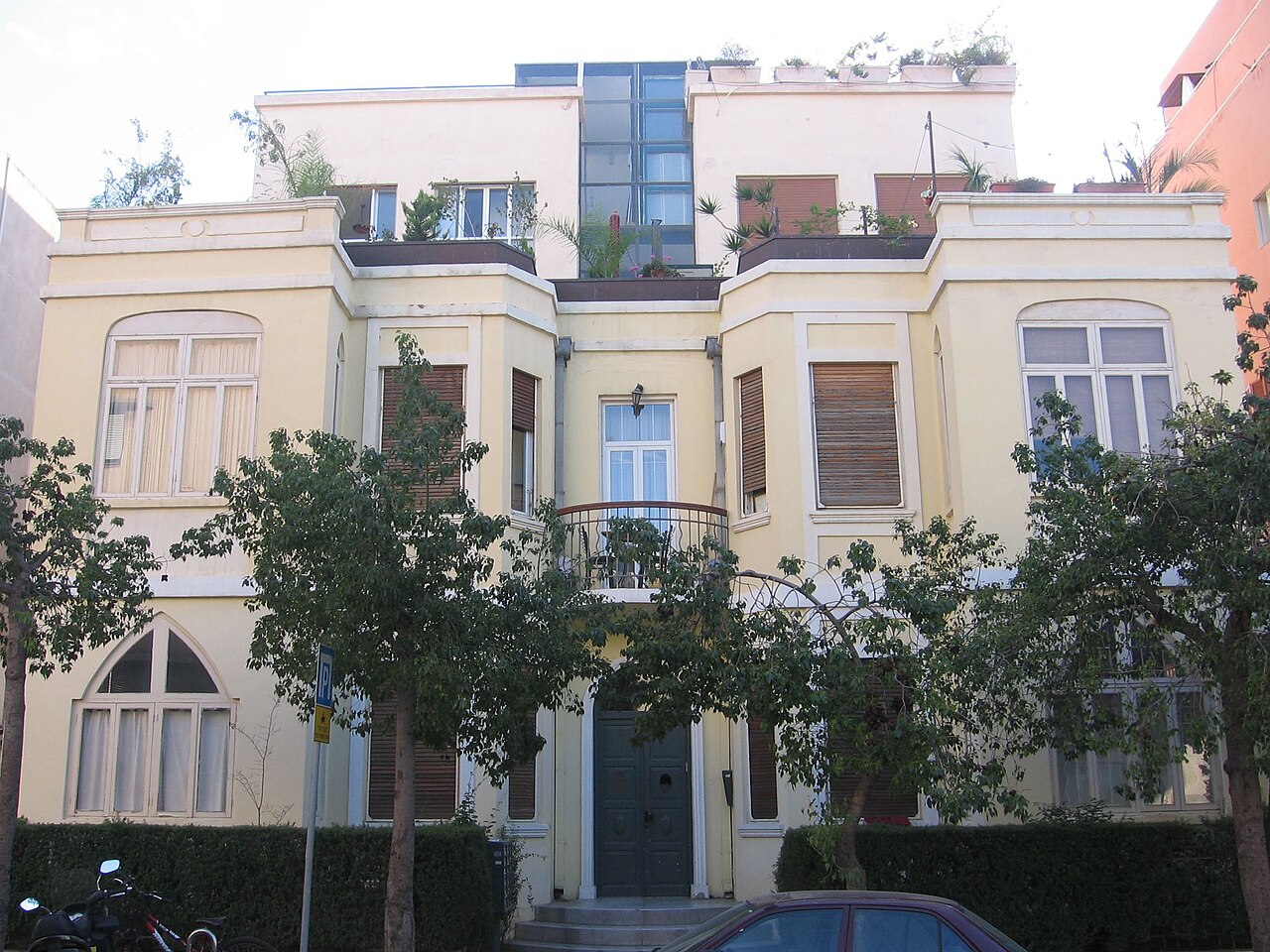
• Native Name — עקיבא אריה ויס • Born — 11 December 1868 • Birthplace — Grodno, Grodno Governorate, Russian Empire (present-day Belarus) • Died — 23 May 1947 • Place of death — Mandatory Palestine • Known for — Founder of Ahuzat Bayit • Relatives — Yosef Yekutieli (son-in-law) Daniel Yekutieli (great-grandson) • Illustration — Akiva Arie Weiss House, ground floor built 1909
Biography
Biography
Weiss, a jeweler and watchmaker, was born to a Jewish family in Grodna (in present day Belarus) in 1868, but raised in Łódz, Poland. Along with his wife and six children, he immigrated from Russian Poland to Palestine in 1906. • Illustration — Ahuzat Bayit, 1929. Weiss is at center. As president of the then newly established building cooperative named Ahuzat Bayit, Hebrew for Building Society, Weiss wrote and presented a prospectus to the group in which he laid out his vision for a new Jewish city. Arthur Ruppin's memoirs recount that Weiss demanded the creation of "a Hebrew urban centre in a healthy environment, planned according to the rules of aesthetics and modern hygiene." Weiss would later on tell Ruppin; “Outside Jaffa, on the road to Petach Tikva...we intend to found a modern Jewish urban district. We already have our eye on a particular tract of land.” Currently scholarship also suggests that he likely presided over the 1909 real estate lottery (and is the leading figure in Abraham Soskin's famous photograph of the event) in which 66 Jewish families drew numbers written on seashells to determine the allocation of lots in the about-to-be established city of Tel Aviv. Weiss was a founder of the textile industry in Mandatory Palestine, and built the earliest textile factory, the Lodzia House. One of Weiss' visions which became reality was the establishment of a Jewish diamond industry in Palestine.
House
House
The cornerstone of Weiss's Tel Aviv house at #2 Herzl Street was laid in 1909. Originally a single-story structure, the upper floor was added in the 1920s. The house was restored between 1996 and 2011.
Life and career
Dated record
Life and career
The full dated record · 2 entries
1868
Akiva Aryeh Weiss born at Hrodna.
1947
Akiva Aryeh Weiss died at Tel Aviv.
Places
Named by the record
Places
Only places the record itself states, plotted where the house gazetteer settles their coordinates. Nothing is inferred from a name or a nationality.
Hrodna.
Birth place
Tel Aviv.
Death place
Legacy
In 1956, Weiss’s children put together a posthumous collection of his works, essays and letters. The book featured an introduction by Moshe Sharett, the 2nd Prime Minister of Israel and a man of considerable stature at the time. Sharett's introduction read thus (translated from Hebrew): "It is not always those who start things that are remembered. Sometimes they are forgotten, and those who continue and finish the work are those who ultimately win praise. This is what happened with Tel Aviv. The "first founder" was forgotten. There are no pictures of him in the mayor's office and no streets named after him….The people who have put together this book have done a good thing by making this book. Let this collection serve as a memorial to this modest and noble man who was full of ideas and actions, and whose ideas have and will came to life."
Notes from the source article
Cited by Wikipedia
Notes from the source article
These works are cited by the source article, in its own numbering. They are recorded as its citations, not as sources VALÉORINE has verified.
- 1.Yekutieli Kohen, Edna. עיר מראשיתה. Orah ḥadashah. 2. 2009. 432295641.
- 2.Kohen, Edna Yekutieli. Tel-Aviv Centennial - Akiva Aryeh Weiss (1868-1947). boeliem.com/index.html. Boeleim; Complete Reference to Israeli Stamps.
- 3.Azaryahu, Maoz. Tel Aviv : mythography of a city. Syracuse Univ. Press. 50. 2007. 978-0815631293.
- 4.Schlör, Joachim. Tel Aviv: from dream to city. Reaktion Books Ltd. 41. 1999. 1861890338.
- 5.Azaryahu, Maoz. Tel-Aviv, the First Century: Visions, Designs, Actualities. Indiana University Press. 31. 2012. 9780253223579.
- 6.Kosharek, Noah. Seashell lottery. Haaretz. 20 April 2009.
- 7.Rotbard, Sharon. White city, black city architecture and war in Tel Aviv and Jaffa. Pluto Press. 49. 2015. 9780745335117.
- 8.BarOr. 43 Nahmani Street, Tel Aviv-Jaffa – Lodzia House. amnon-baror.co.il/?lang=en.
- 9.The Early 1900s by Shira Ami
- 10.עקיבא אריה בן יוסף חיים ויס 1868-1947. ראשיתה של תל אביב תולדות ייסוד העיר ורשימות יומן. ʻAyanot, Tel-Aviv. 1956–1957. 1001810559.
- 11.Amnon Bar & Co. Architects. 2 Herzl St., Tel Aviv-Yafo – Akiva Arieh Weiss House. amnon-baror.co.il/?lang=en.
References
Citations
References
Each reference names the institution holding it, so a reader may go to the document itself.
reference work
Wikidata, structured authority record Q12410432: Akiva Aryeh WeissWikimedia Foundation
Secondary witnessreference work
Secondary witness
Further particulars
Held on the record
Further particulars
Open the remaining particulars
Akiva Aryeh Weiss is recorded as architect, watchmaker, jeweler, urban planner and textile manufacturer.
The Encyclopedia exists whether or not anything is for sale. Corrections are recorded rather than overwritten, and every version of this record is kept. Published 16 August 2026.
Elsewhere in Watches
318 published records in this field, each with its sources named.
- Achille BrocotArtist
- Adhémar SchwitzguébelArtist
- Adolf SeefeldArtist
- Adrien PhilippeArtist
- Alexander CummingArtist
- Alfred CartierArtist
- Alfred Mathias GrønnebergArtist
- AmfibiaTerminology
Best supported in this field
For owners
Own a work by Akiva Aryeh Weiss?
A specialist will read what you send and tell you what the house can establish, what it cannot, and whether the object is suited to sale. There is no charge and no obligation. The object stays with you throughout; nothing is shipped to us unless it is arranged in writing beforehand.