
Agostino Scilla
Illustration — Portrait traditionally attributed to Andrea Sacchi, re-identified by historian Paula Findlen as a self-portrait of Agostino Scilla. Museum of Fine Arts, Boston. Agostino Scilla (10 August 1629 – 31 May 1700) was an Italian Baroque painter, paleontologist, geologist, numismatist, and a pioneer in the study of fossils and in scientific illustration.
Also recorded as Augustin Scilla · Agostino Silla · Augustino Scilla · Ag.o Scilla
Agostino Scilla
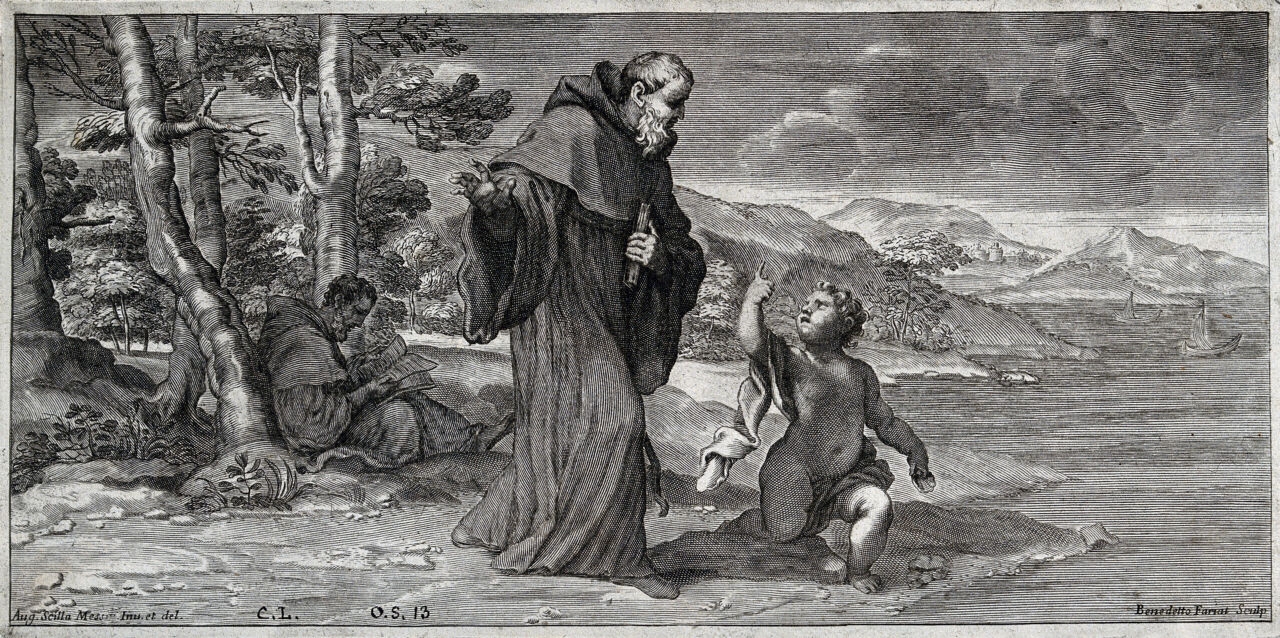
Agostino Scilla · Wellcome Collection, London · Wellcome Collection · Public Domain Mark
- Born
- Agostino Scilla was born, sources differ on the date (on 10 August 1629 and on 10 August 1639). · Messina.
- Died
- 1700. · Rome.
- Nationality
- France.
- Occupation
- painter, numismatist, writer, philosopher, draftsperson, poet, artist and paleontologist.
- Movements
- mail art.
- Teachers
- Andrea Sacchi and Antonio Barbalonga.
- Languages
- Italian and Latin.
VALÉORINE Encyclopedia
VALÉORINE documentary reading
Documentary summary
Illustration — Portrait traditionally attributed to Andrea Sacchi, re-identified by historian Paula Findlen as a self-portrait of Agostino Scilla. Museum of Fine Arts, Boston. Agostino Scilla (10 August 1629 – 31 May 1700) was an Italian Baroque painter, paleontologist, geologist, numismatist, and a pioneer in the study of fossils and in scientific illustration.
Admitted source layer · organised and presented by VALÉORINE
Reference Check
Propose documentary evidence for Agostino Scilla. A contribution is never written directly as fact: identity, source, rights and evidence gates still decide.
Sign in to contribute
World of VALÉORINE
Documentary connections
Only confirmed graph relationships appear here. Images are shown only when their identity and reuse rights both pass the documentary gate.
Documentary evidence
Documentary basis
Authority files
wikidata · Q395714 · wikipedia · Agostino Scilla
In this article
Biography
Biography
In addition to his paintings, he published an early text on paleontology: La vana speculazione disingannata dal senso ("Vain Speculation Undeceived by Sense", 1670) which was introduced to English audiences by William Wotton of the Royal Society in 1696. He was among the first to promote a scientific understanding of fossils in contrast to fantastic Biblical and divine interpretations.
Training under Andrea Sacchi and Antonio Barbalonga is recorded. The recorded working language is Italian and Latin. Places of work recorded in the authority are Rome and Messina. Work by Agostino Scilla is recorded in the collections of Museum of Fine Arts Boston.
The son of a notary in Messina in Sicily, Scilla studied under Antonio Barbalunga in Messina. Thanks to the influence of his master, he was awarded a grant by the Senate in Messina to continue his studies in Rome, where he studied under Andrea Sacchi for four years. On returning to his native city he opened a very popular academy and painted frescoes in the churches of San Domenico and of the Nunziata de' Teatini. Among his canvases are a depiction of Death of San Ilarione painted for the church of Sant'Ursula. His frescos in the Cathedral of Syracuse date from 1657. After participating in an unsuccessful revolt against Spanish rule, in 1678 he was exiled from Sicily. Scilla worked as a painter in Turin and then Rome for the rest of his life. He was a censor in the Academy of Design in Rome in 1695. Scilla was an excellent landscape painter ad was much admired for the realism of his portraits. Among his pupils wete the painters Antonio Madiona and Placido Celi. Agostino's brother Giacinto, and Giacinto's son Saverio, were also painters.
Works
Works
• Illustration — Frontispiece showing allegorical struggle between truth and speculation with truth depicted by Mercury bearing an eye of reason on the chest, holding a fossil echinoid and pointing to many more specimens Scilla began to study fossils found in the hills of Sicily, sometimes accompanied by botanist Paolo Boccone. His only written scientific work is La vana speculazione disingannata dal senso ("Vain Speculation Undeceived by Sense", 1670). The book was dedicated to the Sicilian nobleman Don Carlo di Gregorio, who founded the Accademia della Fucina (1639–1678) in Messina. In this work Scilla argues for a scientific explanation for fossils, as opposed to them being of fantastic origin or a test of faith from God. He also correctly identified the supposedly magical objects that were called glossopetrae, or "tongue stones", as shark teeth. He was however not the first to do this. Nicolas Steno had made a similar claim about three years earlier but it is not known if Scilla had seen that work. Fabio Colonna in Dissertatio de glossopetris (1616) had burnt these fossils to show that they were made of lime, organic matter, rather than minerals. The book included 29 drawings of fossils drawn from specimens by him and engraved using copper-plate by Pietro Santi Bartoli. The book was rediscovered by William Wotton of the Royal Society in 1696 and an English summary became widely available. Scilla was apologetic about being but an untrained artist and the style of writing was commented on by Wotton as lacking art. Scilla argued that his training gave him a painter's eye with the ability to probe into nature and interpret things better, and depict nature without mediation. • Illustration — Shark teeth and glossopetrae drawn by Scilla Scilla argued that fossils were not lusus naturae, whimsical simulacra of animals and plants created by God or divine Nature. He termed fossils as "jokes of time, not of nature." Athanasius Kircher had claimed that inanimate nature could produce pictures and sculptures that resembled living things. Girolamo Cardano claimed in his On the Subtlety of Things (1550) that he owned a piece agate that had the face of the Roman emperor Galba in it. Scilla dismissed Cardano's claim. Scilla may have seen fossil collections in Rome belonging to Cardinal Francesco Barberini (1597–1679) and his secretary Cassiano dal Pozzo (1588–1657). Scilla had also been influenced by Giovan Pietro Bellori (1613–1696) who had lectured on the role of the artist in inquiry. Bellori besought artists to go deep into a subject just as they examined the squaring of the circle and explored anatomy below the skin of the nudes they depicted, as depicted in Carlo Maratta's Tanto che basti (1682). Maratta had been a student of Sacchi alongside Scilla. Scilla gained reputation as a scientific illustrator and worked for Marcello Malpighi. Scilla is considered to have been the first to use dotted lines to indicate reconstructions in paleontological illustration. John Ray made use of some of Scilla's fossil illustrations. Scilla's fossil collection was acquired by John Woodward (1665–1728), an English physician, in 1717. These went into the University of Cambridge and became the nucleus of the collections of the Sedgwick Museum of Earth Sciences. Dorsum Scilla on the Moon is named after him.
Places
Named by the record
Places
Only places the record itself states, plotted where the house gazetteer settles their coordinates. Nothing is inferred from a name or a nationality.
Messina.
Birth place
Rome.
Death place
Notes from the source article
Cited by Wikipedia
Notes from the source article
These works are cited by the source article, in its own numbering. They are recorded as its citations, not as sources VALÉORINE has verified.
- 1.Lanzi, Luigi. History of Painting in Italy. Henry Bohn, Publishers. II. 44. 1853.
- 2.Il centesimo dell'anno 1695 celebrato in Roma dall'Accademia del Disegno, by Giuseppe Ghezzi, page 5.
- 3.Giornale di scienze, letteratura ed arti per la Sicilia Volumes 3-4, Memoria di Pittori Messinesi by Giuseppe Grossi Cacopardi, (1823), page 94-95.
- 4.Agostino Scilla, La vana speculazione disingannata dal senso, ed. by Marco Segala, Florence: Giunti, 1996. Original edition available on archive.org.
- 5.Findlen, Paula. Science in the Age of Baroque. Springer. 119–159. 2012. 978-94-007-4806-4.
- 6.Findlen, Paula. The Specimen and the Image: John Woodward, Agostino Scilla, and the Depiction of Fossils. Huntington Library Quarterly. 78. 2. 217–261. 2015. 0018-7895.
- 7.Romano, Marco. 'The vain speculation disillusioned by the sense': the Italian painter Agostino Scilla (1629–1700) called 'The Discoloured', and the correct interpretation of fossils as 'lithified organisms' that once lived in the sea. Historical Biology. 26. 5. 631–651. 2014-09-03. 0891-2963.
- 8.Findlen, Paula. Projecting Nature: Agostino Scilla's Seventeenth-Century Fossil Drawings. Endeavour. 42. 2–3. 99–132. 2018. 10.1016/j.endeavour.2018.07.004.
- 9.Romano, Marco, Historical Biology (2013): ‘The vain speculation disillusioned by the sense’: the Italian painter Agostino Scilla (1629–1700) called ‘The Discoloured’, and the correct interpretation of fossils as ‘lithified organisms’ that once lived in the sea, Historical Biology: An International Journal of Paleobiology, DOI: 10.1080/08912963.2013.825257
References
Citations
References
Each reference names the institution holding it, so a reader may go to the document itself.
reference work
Secondary witnessreference work
Secondary witness
The Encyclopedia exists whether or not anything is for sale. Corrections are recorded rather than overwritten, and every version of this record is kept. Published 16 August 2026.
Elsewhere in Paintings
18,623 published records in this field, each with its sources named.
- Agostino CiampelliArtist
- Agostino CottolengoArtist
- Agostino MasucciArtist
- Agostino MitelliArtist
- Agostino TassiArtist
- Agostino UgoliniArtist
- Agostino VeraciniArtist
- Agustín AbarcaArtist
Best supported in this field
For owners
Own a work by Agostino Scilla?
A specialist will read what you send and tell you what the house can establish, what it cannot, and whether the object is suited to sale. There is no charge and no obligation. The object stays with you throughout; nothing is shipped to us unless it is arranged in writing beforehand.