
70 pounder Whitworth gun
The 70-pounder Whitworth naval gun was designed by Joseph Whitworth during the 1860s. It was a rifled muzzle loader and used his hexagonal, rifled-bore design.
70 pounder Whitworth gun
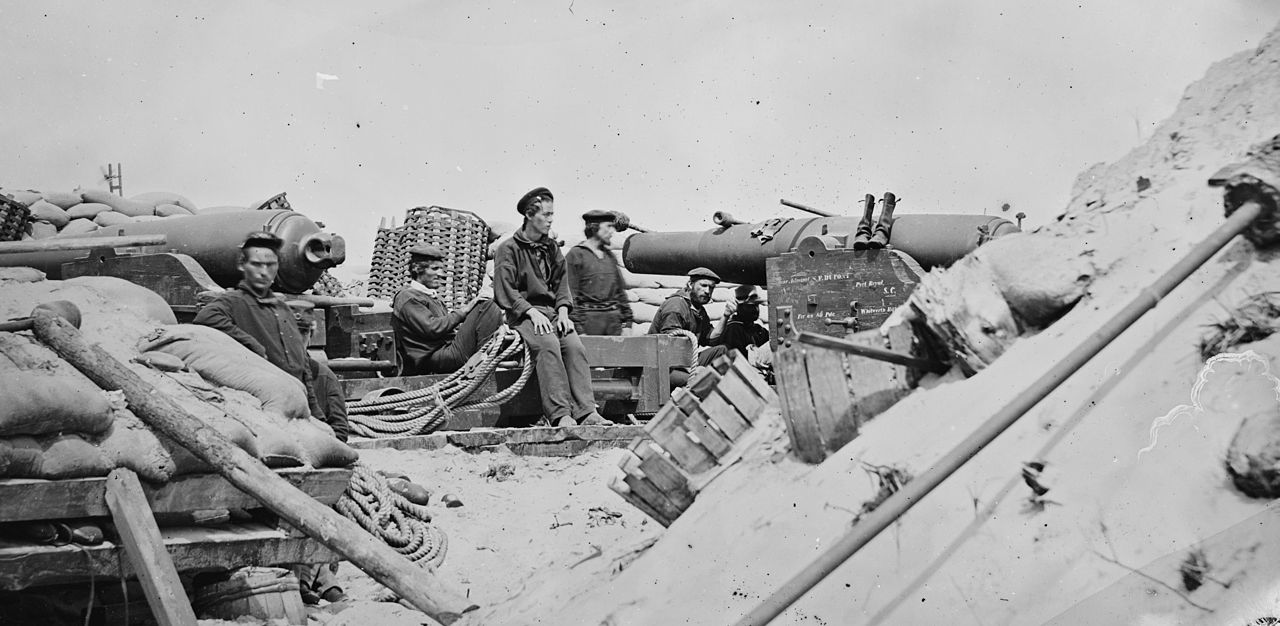
Haas Peale, photographer. · Library of Congress Prints and Photographs Division Washington, D.C. · Public domain
- Name
- 70-pounder Whitworth gun
- Field
- polygonal rifling · rifled muzzle loader · naval artillery
- Region
- United Kingdom of Great Britain and Ireland
VALÉORINE Encyclopedia
VALÉORINE documentary reading
Documentary summary
The 70-pounder Whitworth naval gun was designed by Joseph Whitworth during the 1860s. It was a rifled muzzle loader and used his hexagonal, rifled-bore design.
Admitted source layer · organised and presented by VALÉORINE
Reference Check
Propose documentary evidence for 70 pounder Whitworth gun. A contribution is never written directly as fact: identity, source, rights and evidence gates still decide.
Sign in to contribute
World of VALÉORINE
Documentary connections
Only confirmed graph relationships appear here. Images are shown only when their identity and reuse rights both pass the documentary gate.

Documentary evidence
Documentary basis
Authority files
wikidata · Q4642939
In this article
Key facts
Key facts
• Name — 70-pounder Whitworth gun • Origin — United Kingdom • Type — Naval gun • Is Ranged — yes • Is Explosive — y • Is Artillery — yes • Is Uk — yes • Service — 1863– • Used By — Confederate States, United States, Brazil • Wars — American Civil War, Paraguayan War • Designer — Joseph Whitworth • Manufacturer — Joseph Whitworth • Production Date — 1863?– • Unit Cost — £3500 • Weight — 8582 lb • Length — 118 in • Cartridge — Solid shot Explosive shell • Cartridge Weight — 81 lb • Caliber — 5.5 in • Max Range — 5540 yd • Filling — Black powder • Filling Weight — 3 lb
Principle
Principle
The gun used polygonal rifling, a principle invented by Whitworth in 1853. The concept was to use the hexagon to impart a very rapid spin to the projectile. The method of manufacturing the rifling was thus described by the Report of the Armstrong & Whitworth Committee of the British War Office (1866): [I]t may be described in general terms as a hexagonal bore with a rapid twist, although, strictly speaking, the bore is not hexagonal, but has 24 surfaces. The gun is, in the first instance, bored out cylindrically; a part of this original bore is left in the centre of each side of the hexagon, making six surfaces, then there are the coming out sides of the hexagon which give six more surfaces, and the going in sides giving also six surfaces, and lastly, the rounding off of the angles, which give six more, making 24 surfaces in all. The projectile was hexagonal to match. The gun was highly accurate at long ranges, but the very precise manufacturing tolerances required a high standard of maintenance by the artillerymen. Wrote Jeff Kinard: "The odd shape of the projectile produced a weird, unnerving shriek as it traveled through the air."
American civil war
American civil war
Four guns were captured by the United States Navy on the blockade-runner Princess Royal on 29 January 1863. Two were sent to Morris Island, Charleston, South Carolina to bombard Fort Sumter during the summer of 1863. One gun had a premature detonation that killed four of its crew when trying to ram a projectile home. Another gun was disabled after 111 shots when its inner tube moved back far enough to block the vent.
Paraguayan war
Paraguayan war
A number of 70-pounders as well as larger calibers were bought by the Imperial Brazilian Navy and used to arm some of its ironclads during the Paraguayan War in the late 1860s. British lieutenant colonel George Thompson of the Paraguayan army recorded that the Brazilians cut the fuses to the wrong length, so the shells often failed to explode. Thousands of them were collected by the Paraguayans, who made a gun of their own ("a beautiful casting") at their foundry at Asunción – on the Whitworth principle – called the Criollo; this gun shot them back at the Brazilians. Thompson recorded that For precision and range, Whitworth's guns are splendid weapons, but they require good gunners... Whitworth's balls had such a high velocity, that the report of the gun, and the shot flying by, were both heard at the same moment. The Paraguayans, from the sound these balls made going through the air, called Whitworth's balls 'phews'. All of the Brazilian river monitors who effected the Passage of Humaitá − described as a nearly impossible feat − were equipped with 70-pounder Whitworth guns; the larger ironclad vessels who accompanied them had Whitworth guns of larger calibre.
Gallery
Gallery
• Illustration — On a naval carriage • Illustration — On a coastal carriage in Rio de Janeiro

Front view of the 70-pounder Whitworth gun from Princess Royal in Willard Park at the Washington Navy Yard. The muzzle shows the hexagonal rifling.
Sturmvogel 66

Side view of the 70-pounder Whitworth gun from Princess Royal in Willard Park at the Washington Navy Yard.
Sturmvogel 66
References
Citations
References
Each reference names the institution holding it, so a reader may go to the document itself.
authority record
General reference
Connections
Knowledge graph
Connections
Each connection was recorded deliberately, with the basis for it kept on the internal record.
Broader subject
1- naval artilleryTerminology
Established from a fact already recorded on a verified source.
The Encyclopedia exists whether or not anything is for sale. Corrections are recorded rather than overwritten, and every version of this record is kept. Published 16 August 2026.
Elsewhere in Militaria
6,095 published records in this field, each with its sources named.
- 7×54mm FournierTerminology
- 7×57mm MauserTerminology
- 7×61mm Sharpe & HartTerminology
- 7×64mmTerminology
- 73mm LRACTerminology
- 75 mm 50 caliber Pattern 1892Terminology
- 75 mm anti-aircraft gun Type 88Terminology
- 75 mm Cannon Model 1897Terminology
Best supported in this field
For owners
Own an object connected with 70 pounder Whitworth gun?
A specialist will read what you send and tell you what the house can establish, what it cannot, and whether the object is suited to sale. There is no charge and no obligation. The object stays with you throughout; nothing is shipped to us unless it is arranged in writing beforehand.