
Yury Vlasov
Yury Petrovich Vlasov (5 December 1935 – 13 February 2021) was a Soviet and Russian heavyweight weightlifter, writer and politician. He competed at the 1960 and 1964 Olympics and won a gold medal in 1960 and a silver in 1964; at both games, he was the Olympic flag bearer for the Soviet Union. During his career, Vlasov won four world titles and set 31 ratified world records.
Also recorded as Yury Petrovich Vlasov
Yury Vlasov

Public domain
- Born
- 5 December 1935
- Birthplace
- Makeyevka, Ukrainian SSR, Soviet Union
- Died
- 13 February 2021
- Place of death
- Moscow, Russia
- Nationality
- Soviet Union · Russia
- Occupation
- journalist · writer · politician · weightlifter · athlete
- Fields
- weightlifting · politics · creative and professional writing
- Honours
- Order of Lenin · Order of the Red Banner of Labour · Order of the Badge of Honour · Honoured Master of Sports of the USSR
- Languages
- Russian
VALÉORINE Encyclopedia
VALÉORINE documentary reading
Documentary summary
Yury Petrovich Vlasov (5 December 1935 – 13 February 2021) was a Soviet and Russian heavyweight weightlifter, writer and politician. He competed at the 1960 and 1964 Olympics and won a gold medal in 1960 and a silver in 1964; at both games, he was the Olympic flag bearer for the Soviet Union. During his career, Vlasov won four world titles and set 31 ratified world records.
Admitted source layer · organised and presented by VALÉORINE
Note VALÉORINE
No house-authored Note is published until its assertions and sources pass the VALÉORINE evidence contract. The documentary article remains available in full while that enrichment is being consolidated.
Documentary enrichment in progress · no unsupported statement published
Reference Check
Propose documentary evidence for Yury Vlasov. A contribution is never written directly as fact: identity, source, rights and evidence gates still decide.
Sign in to contribute
World of VALÉORINE
Documentary connections
Only confirmed graph relationships appear here. Images are shown only when their identity and reuse rights both pass the documentary gate.
Documentary evidence
Evidence Panel
not yet certified
- Identity
- resolved
- Independent source families
- 0
- Admitted assertions
- 0
- Open conflicts
- 0
Authority files
wikidata · Q49606 · wikipedia · Yury Vlasov
In this article
Biography
Biography
He retired in 1968 and became a prominent writer and later a politician. He was a member of the Congress of People's Deputies of the Soviet Union (1989) and then of the Russian State Duma (1993) and took part in the 1996 Russian presidential election.
The recorded working language is Russian. The field of work recorded is weightlifting, politics and creative and professional writing. Places of work recorded in the authority are Moscow. Positions recorded include member of the State Duma. Distinctions recorded are Order of Lenin, Order of the Red Banner of Labour, Order of the Badge of Honour and Honoured Master of Sports of the USSR.
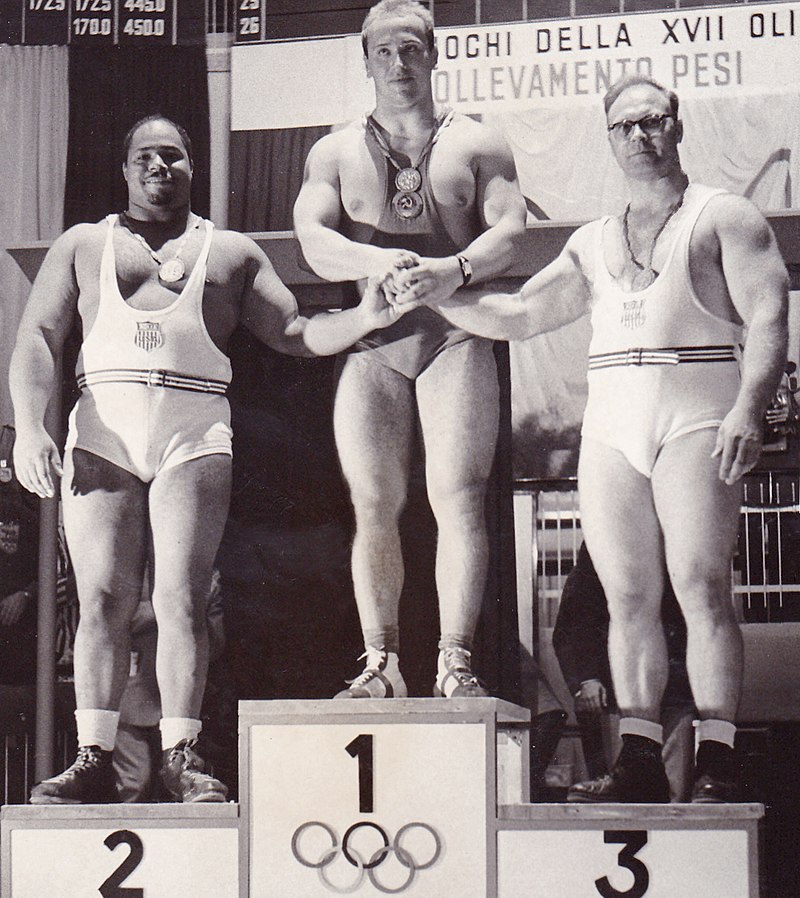
James Bradford, Yury Vlasov, Norbert Schemansky, 1960

Yury Vlasov, 1964 Olympics
Unknown author Unknown author (Asahi Shinbun) · [1]
Key facts
Key facts
• Born — 5 December 1935 • Birthplace — Makeyevka, Ukrainian SSR, Soviet Union • Died — 13 February 2021 • Place of death — Moscow, Russia • Height — 1.85 m • Weight — 125–136 kg • Sport — Weightlifting • Coach — Suren Bogdasarov • Show Medals — yes • Medal Templates — Olympic Games World Weightlifting Championships 1959 Warsaw 1961 Vienna 1962 Budapest 1963 Stockholm 1964 Tokyo European Weightlifting Championships 1959 Warsaw 1960 Milan 1961 Vienna 1962 Budapest 1963 Stockholm 1964 Moscow
Early life and competitive career
Early life and competitive career
• Illustration — Vlasov at the 1964 Olympics Yury was born in Makeyevka, Ukrainian SSR, to the family of Pyotr Vlasov (1905–1953), a military journalist and Comintern agent, and Maria Danilovna Vlasova (née Lymar), a Kuban Cossacks. His father worked as the General Consul in Shanghai and then the Ambassador to Burma. Both his parents were born in Russia. Yury studied at the Saratov Suvorov military school (1946–1953), then at the Zhukovsky Air Force Academy in Moscow, from which he graduated with honors in 1959. In 1956, while studying at the academy he became interested in weightlifting, joined the Armed Forces sports society and soon became Master of Sport of the USSR (1957). He was noticed in 1958 when he finished third at the Soviet Union championships. Between 1959 and 1963 he won all the competitions he participated in, with a major success at the Rome 1960 Summer Olympics where he set three world records and became the first man to clean and jerk more than 200 kg (202.5). He was proclaimed the best sportsman of the 1960 Olympics and the "Strongest Man on the Planet". Going against the stereotypes attached to weightlifting, he was considered a nerdish intellectual in rim glasses. At the 1964 Summer Olympics he finished second, after another Soviet weightlifter, Leonid Zhabotinsky. Vlasov was breaking world records at the 1964 Olympics and was aiming to retire from competitions with the gold medal. He was bitterly disappointed by the tactical tricks played by Zhabotinsky during the final clean-and-jerk event, which he considered dishonest – Zhabotinsky intentionally failed his second attempt, and talked and behaved as if he would not compete for the gold medal. In reality Zhabotinsky merely positioned himself behind Vlasov, who started the event first, and in his last attempt would order (and lift) any weight required to win the overall competition. Although Vlasov announced his retirement after the 1964 Olympics, he resumed top-level training in 1966 for financial reasons. He set his last world record on 15 May 1967, by pressing 199 kg, for which he received 850 rubles. Vlasov retired from senior competitions in June 1968. Around the same time he also retired from the Soviet Army, where he worked as a sports instructor. He held the rank of captain. In 1969, while lecturing in Norway, he was asked to lift 200 kg, which he easily did despite a year-long break in training.
Weightlifting achievements
Weightlifting achievements
• Illustration — Vlasov (center) at the Olympic podium in 1960 with his gold medal • Olympic champion (1960); silver medalist in 1964; • Four-time world champion (1959, 1961–1963); silver medalist in 1964; • Six-time consecutive European champion (1959–1964); • Set thirty four world records.
Post-retirement sports activities
Post-retirement sports activities
Vlasov's health suddenly deteriorated in 1978–1979, which was related to a nervous breakdown due to his writing activities but not to weightlifting. Later he had a few surgeries on his spine. In the 1980s he returned to sport as a functionary – between 1985 and 1987 he was president of the Soviet Weightlifting Federation, and from 1987 to 1989 headed the Soviet Bodybuilding Federation. As a dope-free athlete he was stunned by the massive use of anabolic steroids by weightlifters and bodybuilders in those years. Vlasov continued training with weights through most of his life. In 2004, aged 69, he took part in a masters competition in Moscow and lifted 185 kg in the clean and jerk event. By then he lowered his body weight to 109 kg, while his maximum senior weight was 136.4 kg at the 1964 Olympics.
Writing
Writing
Vlasov became a professional writer and journalist years before his retirement from competitions – his short stories were published by Soviet newspapers back in 1959. In 1961 he won a prize for best sports story from the Union of Soviet Writers. Starting from the 1962 European Championships, he was attending international competitions not only as a weightlifter, but also as a special correspondent to the major Soviet newspaper Izvestia. Before the 1964 Olympics he published his first book, a collection of short stories titled Overcoming Yourself. After retiring both from competition and military service, in 1968 Vlasov dedicated himself to writing. He published over 15 novels, most notably the Flaming Cross trilogy (1991–93) about life during and after the Russian Revolution, and more than 10 short story collections. His books were translated into several languages, including English. In 1973 he edited and published his father's diaries titled The Vladimirov diaries: Yenan, China, 1942–1945, which were translated into six languages, including English and Chinese. In that book, Vlasov uses the pen name of his father, Vladimirov. Other books by Vlasov include: • Себя преодолеть. — М.: Молодая гвардия, 1964. — 270 с. / Overcome Yourself • Формула мужества. — М.: Знание, 1987. — 94 с. / The Formula for Courage • Справедливость силы. — Л.: Лениздат, 1989. — 608 с. — / The Justice of Strength • Геометрия чувств. — Киев: Ленинградский комитет литераторов, 1991. — 256 с. / The Geometry of Feelings • Стечение сложных обстоятельств. — М.: «Советский спорт», 1990. — 18 с. — / Confluence of Difficult Circumstances • Огненный Крест: в 3-х кн. — М.: Прогресс, Культура 1993. — / Flaming Cross: 3 vol. • Русь без вождя. — Воронеж: Воронежская областная организация Союза писателей России, 1995. — 528 с. — / Rus' Without a Chieftain • Мы есть и будем. — Воронеж: Издательство Воронежской областной типографии, 1996. — 718 с. — / We Are and Will Be • Временщики. — М.: Детектив-Пресс, 1999. — 464 с. — / Timeservers • Красные валеты. — М.: Алгоритм, 2005. — 360 с. — / Red Jacks • 93-й. Год великого поражения. — М.: Алгоритм, 2006. — 288 с. — / 1993: The Year of the Great Defeat • Великий Передел: в 2-х кн. — М.: ДПК Пресс, 2011. / The Great Repartition: 2 vol.
Politics
Politics
• Illustration — Vlasov in 1993 Vlasov was elected to the Congress of People's Deputies for the Lublinsky district of Moscow in 1989 and broke from the Communist Party. In 1993, Vlasov was elected to the State Duma of the Russian Federation. Vlasov's tenure in the State Duma saw him take a strong departure from his earlier politics. However, he moved away from liberal politics and adopted the policies of nationalists and Christian Democrats. During his Soviet political career, and his very early Duma career, Vlasov had been supportive of democratic reforms. When he first entered the Duma, Vlasov was a member of the liberal Inter-regional Deputies Group, along with Andrei Sakharov, Anatoly Sobchak and Boris Yeltsin. However, as a member of the Duma, Vlasov subsequently strongly embraced authoritarian policies. Ultimately, Vlasov's post-Soviet politics would be characterized as nationalist. It would also feature prominent antisemitic rhetoric.
Presidential campaign
Presidential campaign
Vlasov ran as an independent candidate in the 1996 Russian presidential election. During his presidential campaign, Vlasov promoted himself as patriot fighting both communism and an alleged "Zionist conspiracy" against the Russian people. He dubbed his politics as "people's patriotism". He also likened his politics to Gaullism. He claimed that his politics were a more effective unifying force than communist or democratic ideals. His campaign platform proclaimed, "There is only one single force that is able to unite almost all and at the same time become the ideological basis of the Russian state – popular patriotism". Vlasov alleged that Yeltsin's policies had pushed 40% of Russia's populace below the poverty line and brought the government only 3% of the real value of privatized state property. Vlasov accused the Communists of stealing many of his ideas, including the name of his People's Patriotic Party, as Communist Party nominee Gennady Zyuganov had taken to referring to himself the leader of a "coalition of popular-patriotic forces". Vlasov's campaign saw very little media coverage. While he was nominally an independent candidate, his campaign was supported by the People's National Party. However, by the end of the election, many in the party grew dissatisfied with his campaign style, believing he failed to campaign aggressively enough. Despite the fact that he was polling at under one percent, Vlasov had stated that he anticipated capturing between six and seven percent of the vote. He pledged to refuse to support either Yeltsin or Zyuganov in the runoff. Ultimately, Vlasov received only 0.20% of the vote in the first round of the election. Following his presidential defeat, Vlasov retired from politics.
Personal life
Personal life
Vlasov had a brother Boris. He first married in 1957, to Natalia Modorova, a student of the Moscow Institute of Arts who was visiting his gym to draw athletes. They had a daughter Yelena. Vlasov remarried in 1976, after the death of his first wife, to Larisa Sergeyevna Vlasova, a student 21 years his junior. In his memoirs Vlasov mentions that he had another daughter, perhaps with Larisa. According to his 1960 Olympic teammate Boris Nikonorov, Vlasov spoke fluent English at the Rome Olympics. Vlasov underwent several surgeries, with the final surgery occurring in 2019 or 2020. He fully recovered some time afterwards, and had no illnesses. Vlasov died of natural causes on 13 February 2021, in Moscow, Russia.
Identity
Identity
Yury Vlasov is recorded as having received Order of Lenin, Order of the Red Banner of Labour and Order of the Badge of Honour.
Life and career
Dated record
Life and career
The full dated record · 2 entries
1935
Yury Vlasov born at Makiivka.
2021
Yury Vlasov died at Moscow.
Places
Named by the record
Places
Only places the record itself states, plotted where the house gazetteer settles their coordinates. Nothing is inferred from a name or a nationality.
Makiivka.
Birth place
Moscow.
Death place
Legacy and awards
• Illustration — A 1960 Soviet postal stamp dedicated to Vlasov's victory at the 1960 Olympic Games • Illustration — Vlasov heading the Soviet team at the 1964 Olympics At the peak of his popularity Vlasov was frequently included in international delegations visiting foreign leaders, such as Fidel Castro and Charles de Gaulle. He was a favorite of Nikita Khrushchev; Leonid Brezhnev offered him a position of a personal adviser on China, and Yuri Andropov was supervising his book The Vladimirov diaries: Yenan, China, 1942–1945 as it involved Soviet intelligence activities. Arnold Schwarzenegger, seven-times Mr. Olympia, considered Vlasov as a major motivation for his career as a bodybuilder and a strongman. They first met at the 1961 World Championships in Vienna when Schwarzenegger was only 14. Vlasov did not recall what he said to Schwarzenegger then, but remembered that he was excited after winning the championships and encouraged Schwarzenegger to continue strength training no matter what. In 1988, while filming Red Heat in Moscow, Schwarzenegger insisted on meeting Vlasov, who by then had fallen out of grace with the Soviet leaders, and gave him his photograph signed "To my Idol Yuri Vlasov". For his weightlifting victories Vlasov was awarded the Order of Lenin (1960) and Order of the Badge of Honour (1965). He was a member of the Union of Soviet Writers and was a member of the Union of Russian Writers.
Notes from the source article
Cited by Wikipedia
Notes from the source article
These works are cited by the source article, in its own numbering. They are recorded as its citations, not as sources VALÉORINE has verified.
- 1.Yury Vlasov: Training Session. chidlovski.net
- 2.Yury Vlasov. sports-reference.com
- 3.В.В.Иванцов. Власов Юрий Петрович. ХРОНОС.
- 4.knowbysight.info. Справочник по истории Коммунистической партии и Советского Союза 1898 - 1991 [Handbook of the history of the Communist Party and the Soviet Union 1898 - 1991].
- 5.Belousenko, Alexandra. Юрий Петрович ВЛАСОВ (1935-2021) [Yuri Petrovich VLASOV (1935-2021)]. www.belousenko.com/.
- 6.biograph.comstar.ru.
- 7.Peoples.ru. Юрий Петрович Власов / Yuriy Vlasov.
- 8.Bumer.ru. О спорт, в твоей силе – твоя слабость!. October 2005.
- 9.YURY VLASOV: Biography. chidlovski.net
- 10.Yury Vlasov (1989). Chapter 8 in Справедливость силы. Lenizdat. .
- 11.Vlasov published that photograph in his 1989 book Справедливость силы. Lenizdat.
- 12.Outstanding Russian sportsman Yuri Vlasov. allrus.me
- 13.Danila Dubshin (21 January 2013) ШВАРЦЕНЕГГЕР В РОССИИ. citycelebrity.ru
- 14.A message to the Russian people. YouTube. 17 March 2022.
- 15.Yury Vlasov (1989). Chapter 9 in Справедливость силы. Lenizdat. .
- 16.Rezeptsport.ru. Олимпийский чемпион по тяжелой атлетике Юрий ВЛАСОВ: В 70 лет поднимаю 185 килограммов "Самый сильный человек планеты" отпраздновал юбилей и после 9 лет затворничества дал интервью корреспонденту "КП". 15 December 2005.
- 17.Petr Parfenovich Vladimirov. The Vladimirov diaries: Yenan, China, 1942–1945. Doubleday. 1975. 978-0-385-00928-7.
- 18.Shenfield, Stephen. Russian Fascism: Traditions, Tendencies and Movements: Traditions, Tendencies and Movements. Routledge. 8 July 2016.
- 19.Russian Election Watch, May 9, 1996. 9 May 1996.
- 20.The 1996 Russian presidential election / Jerry F. Hough, Evelyn Davidheiser, Susan Goodrich Lehmann. Brookings occasional papers.
- 21.Bohlen, Celestine. Russia's Stubborn Strains of Anti-Semitism. The New York Times. 2 March 1999.
- 22.CCSU. Yuri Vlasov. www.cs.ccsu.edu. 1996.
- 23.RadioFreeEurope/RadioLiberty. Newsline – May 30, 1996. www.rferl. 30 May 1996.
- 24.Программа кандидата на пост президента России Юрия Власова. 27 January 1997.
- 25.Юрий Петрович Власов . olimpic.su
- 26.Картинка. km.ru
- 27.Boris Valiyev. Борис Никоноров: Я и сейчас уверен, что на Олимпиаде в Риме и чемпионате Европы в Москве не проиграл. bmsi.ru (interview in Russian)
- 28.Умер олимпийский чемпион по тяжелой атлетике Юрий Власов. ITAR-TASS. 13 February 2021.
References
Citations
References
Each reference names the institution holding it, so a reader may go to the document itself.
reference work
Partially resolvedreference work
Partially resolved
Further particulars
Held on the record
Further particulars
Open the remaining particulars
The authorities additionally record the heading Yury Petrovich Vlasov. His recorded language was Russian. He was the child of Peter Vladimirov. Vlasov worked in weightlifting, politics and creative and professional writing. Recorded position is member of the State Duma. He belonged to 1st State Duma of the Russian Federation. He worked at Moscow. Vlasov received Order of Lenin, Order of the Red Banner of Labour, Order of the Badge of Honour and Honoured Master of Sports of the USSR.
Identity and origins
Career and activity
Recognition and collections
The Encyclopedia exists whether or not anything is for sale. Corrections are recorded rather than overwritten, and every version of this record is kept. Published 14 August 2026.
Elsewhere in Books
38,960 published records in this field, each with its sources named.
- Yury RydkinAuthor
- Yury TrifonovAuthor
- Yury TynyanovAuthor
- Yury VelloAuthor
- Yury YakovlevAuthor
- Yusef KomunyakaaAuthor
- Yusef SalaamAuthor
- Yūshi Naishinnō-ke no KiiAuthor
Best supported in this field
For owners
Own a work by Yury Vlasov?
A specialist will read what you send and tell you what the house can establish, what it cannot, and whether the object is suited to sale. There is no charge and no obligation. The object stays with you throughout; nothing is shipped to us unless it is arranged in writing beforehand.