
Yun Shouping
Yun Shouping (1633 – 1690), also known as Nantian, was a Chinese calligrapher and painter. He was a major artist of the early Chinese Qing dynasty. Along with the Four Wangs and Wú Lì, he was regarded as one of the "Six Masters" of the Qing period.
Also recorded as Nanguoyumin · Shou-pʻing Yün · Yunxilanyu · Ko Yün
Yun Shouping
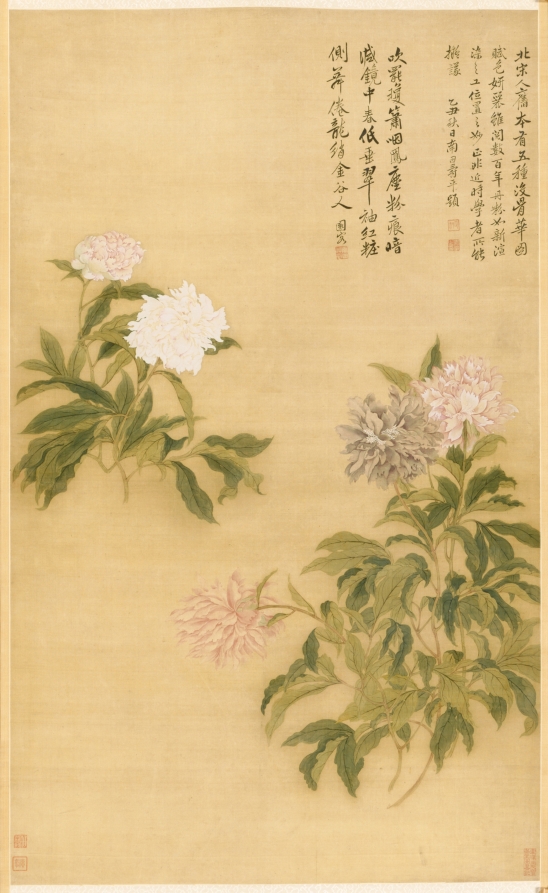
Yun Shouping · The Cleveland Museum of Art · Gift of the American Foundation for the Maud E. and Warren H. Corning Botanical Collection · CC0
- Name
- Yun Shouping
- Born
- 1633
- Died
- 1690
- Movement
- Ch'ang-chou school
- Full name
- 恽格.
- Nationality
- Qing dynasty and Ming dynasty.
- Occupation
- painter, poet, calligrapher, writer and artist.
- Fields
- shan shui and bird-and-flower painting.
VALÉORINE Encyclopedia
VALÉORINE documentary reading
Documentary summary
Yun Shouping (1633 – 1690), also known as Nantian, was a Chinese calligrapher and painter. He was a major artist of the early Chinese Qing dynasty. Along with the Four Wangs and Wú Lì, he was regarded as one of the "Six Masters" of the Qing period.
Admitted source layer · organised and presented by VALÉORINE
Note VALÉORINE
Yun Shouping (1633–1690) was an artist, calligrapher and painter, among other activities, a national of Ming dynasty and Qing dynasty. The artist was born 恽格 in Wujin District.
Yun Shouping was a member of Six Masters of the early Qing period and worked in China. Activity centred on bird-and-flower painting and shan shui. Works are held at Ashmolean Museum, Cleveland Museum of Art and Metropolitan Museum of Art, among others.
Composed from admitted, traceable facts · 27 September 2026
VALÉORINE
Reference Check
Propose documentary evidence for Yun Shouping. A contribution is never written directly as fact: identity, source, rights and evidence gates still decide.
Sign in to contribute
World of VALÉORINE
Documentary connections
Only confirmed graph relationships appear here. Images are shown only when their identity and reuse rights both pass the documentary gate.
Documentary evidence
Documentary basis
Authority files
getty · 500328444 · gnd · 1351794051 · wikidata · Q1329823 · wikipedia · Yun Shouping
In this article
Biography
Biography
Zhang Wei is recorded as having studied under Yun Shouping. The field of work recorded is shan shui and bird-and-flower painting. Xu Chongsi, Chu Suiliang and Wang Hui are recorded as an influence. Places of work recorded in the authority are China. Work by Yun Shouping is recorded in the collections of The Nelson-Atkins Museum of Art, Ashmolean Museum, Metropolitan Museum of Art, National Palace Museum and Phoenix Art Museum.
Key facts
Key facts
• Name — Yun Shouping • Born — 1633 • Died — 1690 • Style — mogu • Movement — Ch'ang-chou school
Biography
Biography
Yun Shouping was born to an impoverished family in Wujin, Jiangsu province. Although he excelled in his classes, his family could not afford for him to attend the civil service examinations. Yun Shouping devoted himself to art. As a child, he composed poetry on lotus blossoms.
Career
Career
As an artist, poet, and calligrapher, Yun Shouping has been said to have mastered the three perfections. He is the founder of the Ch'ang-chou school of painting, and he is credited with reviving the popularity of flower paintings. The mogu bird-and-flower motif experienced a resurgence through Yun Shouping's works and school of art. Yun Shouping was initially a landscape painter, but he was reportedly so impressed by the works of the artist Wang Hui that he abandoned his training in favor of flower, animal, and insect paintings. Yun Shouping has been mistakenly credited with influencing the works of Jiang Tingxi. Yun was also recognized as a prominent calligrapher, in which he followed the style of Chu Suiliang.
Style
Style
Yun imitated the 11th-century artist Xu Xi's mogu (or 'boneless') method, an approach that tried to express art without rigidly defined outlines and forms. This style became a hallmark of the Yun family's artistic style, and Yun's daughter Bing continued to develop the technique. Yun's style was vibrant and expressive; he attempted to display the inner vitality and spirit of his subjects in painting. Yun sought inspiration from the past; his Flower and Fruit imitated the style of the masters of the Yuan dynasty. He used strong colors such as reds and purples, which had traditionally been considered gaudy and offensive by Chinese painters.
Gallery
Gallery
• Illustration — alt=A painting of a red lotus flower with a green lily pad. Ink and color used on scroll. The lotus is the left third of the image, the lily pad is the bottom third, and the upper-right quadrant is calligraphy. Lotus Flower Breaking the Surface (出水芙蓉圖), Palace Museum, Beijing • Illustration — alt=Painting of pink lily magnolias and white anise magnolias on scroll. The lily magnolias are small and left of center, and the thin branch is almost intertwined with the branch of the four white magnolias, of which three are in bloom, located center to the right of the scroll. Light blue is used to bring out the edges of the white flowers. One line of calligraphy in the bottom right of the painting Magnolias • Illustration — alt=Painting of various flowers, including white, pink, and lavender peonies as well as blue-green leaves. Flowers are in the right two-thirds of the scroll, with calligraphy in the left third. Peonies • Illustration — alt=Painting of trees and bamboo on vertical scroll with calligraphy in the two upper corners. Old Trees and Bamboo • Illustration — alt=Painting of distant mountains and proximate trees on vertical scroll with calligraphy in the upper left corner. Sunset along Floral Embankment (花隝夕陽圖), Kyoto National Museum • Illustration — alt=Painting of white, pale pink, and lavender peonies on shrub on a vertical scroll. The tree has a brown trunk and deep green leaves, and the brightness of the flowers are contrasted against the background. Tree Peonies, Metropolitan Museum of Art • Illustration — alt=Painting of trees and mountains on scroll. Minimalist line renditions of a few small homes in a gathering in the foreground. Gray mountain outlines in the background. Calligraphy in the top left Landscapes in the Manner of Song and Yuan Masters, Metropolitan Museum of Art • Illustration — Peonies
Identity and origins
Identity and origins
Yun Shouping was recorded at birth as 恽格. The authorities additionally record the headings Nanguoyumin, Shou-pʻing Yün, Yunxilanyu, Ko Yün and Shenliuxitang. He was the child of Yun Richu.
Career and activity
Career and activity
Yun Shouping worked in shan shui and bird-and-flower painting. He belonged to Six Masters of the early Qing period. He worked at China.
Identity
Identity
Yun Shouping is recorded as painter, poet, calligrapher, writer and artist.
Life and career
Dated record
Life and career
The full dated record · 2 entries
1633
Yun Shouping born at Wujin District.
1690
Yun Shouping died.
Primary material
Documents and archives
scholarly publication
- Differences as a Source of Creativity: Friendship Between Wang Hui and Yun Shouping, ECAH Official Conference Proceedings, 2021
Scholarly · Crossref registry · 2021
- Yun Shouping, Benezit Dictionary of Artists, 2011
Scholarly · Crossref registry · 2011
authority file
- Gemeinsame Normdatei 1351794051, Yun, Shouping.
General reference · Deutsche Nationalbibliothek
- Getty Union List of Artist Names 500328444, Yun Shouping.
General reference · The Getty Research Institute
reference work
- Wikidata, structured authority record Q1329823: Yun Shouping
Reputable secondary · Wikimedia Foundation
- “Yun Shouping”, English Wikipedia, consulted as further reading
Reputable secondary · Wikipedia
Literature
Scholarly footprint
A count of publications is evidence of attention, not of standing, and is given here only as a measure.
Notes from the source article
Cited by Wikipedia
Notes from the source article
These works are cited by the source article, in its own numbering. They are recorded as its citations, not as sources VALÉORINE has verified.
- 1.Peonies.
- 2.Xiaofei, Hao. The Inheritance and Development of Contemporary Mogu Flower-bird Painting. 2018.
- 3.Rongrong, Mao. Research on Taiwan Painting Schools in the Qing Dynasty. 2019.
- 4.Lu Haiyang 路海洋. 毗陵望族恽氏家族文化成就考述. Changzhou Gong Xueyuan Xuebao (Shekeban). 31. 1. 1–7. 2013.
Bibliography printed in the source article · 1
- Yün Shou-p'ing.
References
Citations
References
Each reference names the institution holding it, so a reader may go to the document itself.
scholarly publication
Differences as a Source of Creativity: Friendship Between Wang Hui and Yun Shouping, ECAH Official Conference Proceedings, 2021Crossref registry
Institutional witnessscholarly publication
Yun Shouping, Benezit Dictionary of Artists, 2011Crossref registry
Institutional witnessauthority file
Gemeinsame Normdatei 1351794051, Yun, Shouping.Deutsche Nationalbibliothek
Secondary witnessauthority file
Getty Union List of Artist Names 500328444, Yun Shouping.The Getty Research Institute
Secondary witnessreference work
Wikidata, structured authority record Q1329823: Yun ShoupingWikimedia Foundation
Secondary witnessreference work
Secondary witness
Further particulars
Held on the record
Further particulars
Open the remaining particulars
His recorded influences include Xu Chongsi, Chu Suiliang and Wang Hui. Each of those relationships is stated by the authority record rather than inferred from style.
Those registers additionally record the forms Nantian, 南田, 恽寿平, Yun Shouping and 惲, 壽平.
The Encyclopedia exists whether or not anything is for sale. Corrections are recorded rather than overwritten, and every version of this record is kept. Published 15 August 2026.
Elsewhere in Books
39,529 published records in this field, each with its sources named.
- Yun Dong-juAuthor
- Yun Hu-myongAuthor
- Yun Hyon-seokAuthor
- Yun HyuAuthor
- Yun SŏndoAuthor
- Yun WangAuthor
- Yun ZhuAuthor
- YunduanAuthor
Best supported in this field
For owners
Own a work by Yun Shouping?
A specialist will read what you send and tell you what the house can establish, what it cannot, and whether the object is suited to sale. There is no charge and no obligation. The object stays with you throughout; nothing is shipped to us unless it is arranged in writing beforehand.