
Yamabe no Akahito
Yamabe • Illustration — Kanō Tan'yū,Yamabe no Akahito,1642 Yamabe no Akahito (山部 赤人 or 山邊 赤人) (fl. 724–736) was a poet of the Nara period in Japan. The Man'yōshū, an ancient anthology, contains 13 chōka ("long poems") and 37 tanka ("short poems") of his.
Yamabe no Akahito

Utagawa Kuniyoshi · http: q=%272aAuthors/K/Kuniyoshi%201797-1861%2C%20Utagawa%2C%20Japan%27 s=11 l=en u=2 ub=1 k=1 · Public domain
- Nationality
- Japan
- Occupation
- poet · kanjin · writer
- Languages
- Japanese
VALÉORINE Encyclopedia
VALÉORINE documentary reading
Documentary summary
Yamabe • Illustration — Kanō Tan'yū,Yamabe no Akahito,1642 Yamabe no Akahito (山部 赤人 or 山邊 赤人) (fl. 724–736) was a poet of the Nara period in Japan. The Man'yōshū, an ancient anthology, contains 13 chōka ("long poems") and 37 tanka ("short poems") of his.
Admitted source layer · organised and presented by VALÉORINE
Note VALÉORINE
Yamabe no Akahito was a kanjin, poet and writer, of Japanese nationality. The kanjin worked in Japan. Languages used include Japanese.
Composed from admitted, traceable facts · 27 September 2026
VALÉORINE
Reference Check
Propose documentary evidence for Yamabe no Akahito. A contribution is never written directly as fact: identity, source, rights and evidence gates still decide.
Sign in to contribute
Documentary evidence
Evidence Panel
not yet certified
- Identity
- resolved
- Independent source families
- 0
- Admitted assertions
- 0
- Open conflicts
- 0
Authority files
wikidata · Q180929 · wikipedia · Yamabe no Akahito
In this article
Works
Works
Many of his poems were composed during journeys with Emperor Shōmu between 724 and 736. Yamabe is regarded as one of the kami of poetry, and is called Waka Nisei along with Kakinomoto no Hitomaro. He is noted as one of the Thirty-six Poetry Immortals. His contemplation of Mount Fuji across Tago Bay became a popular view depicted by ukiyo-e artists, including Hiroshige and Utagawa Kuniyoshi. The American composer Alan Hovhaness used a text by Yamabe from the Man'yōshū in his cantata Fuji, Op. 182 (1960, rev.
Shin Kokin Wakashu (New Collection of Ancient and Modern Japanese Poetry) ・田子の浦に うち出でてみれば 白妙の 富士の高嶺に 雪は降りつつ Tagonoura ni Uchiide te mire ba Shirotae no Fuji no takane ni Yuki wa furi tsutsu Explanation When you go to Tagonoura and look in the distance, you can see pure white Mt. Fuji and snow is piled up. This poem describes the beautiful winter scenery of Mt. Fuji seen from Tagonoura. Later, this poem was selected for Hyakunin Isshu (one hundred waka poems by one hundred poets).
Historic Sites
Historic Sites
There is a grave of Yamabe no Akahito at Haibara Yamanobe in Uda City, Nara Prefecture. It is a quiet graveyard with a Gorinto (a gravestone composed of five pieces piled up one upon another), Manyo kahi (a monument engraved in the Manyo style of poetry) and a small signboard. The Gorinto is 210 centimeters high and very simple. It seems to have been built in the Kamakura period, and there is no evidence that Yamabe no Akahito is buried here.
Cultural Properties
Cultural Properties
At Fujinokuni Tagonoura Minato Park in Fuji City, Shizuoka Prefecture, there is a Man’yo kahi. This monument is engraved with "a poem about Mt. Fuji" written by Akahito Yamabe, and uses Matsuno stone (commonly known as "bale stone") from Minami Matsuno, Fuji City. Mt. Fuji can be seen from this park, and eight stone pillars are arranged in the shape of Mt. Fuji to overlap it. The inscription has a high cultural value because the manuscript Man'yogana is engraved as it is.

early 1840s Series: Hundred Poets Prints; woodcuts Color woodblock print The Joan Elizabeth Tanney Bequest (M.2006.136.239) Japanese Art
Utagawa Kuniyoshi · Image: http: Gallery: http: archive copy at the Wayback Machine
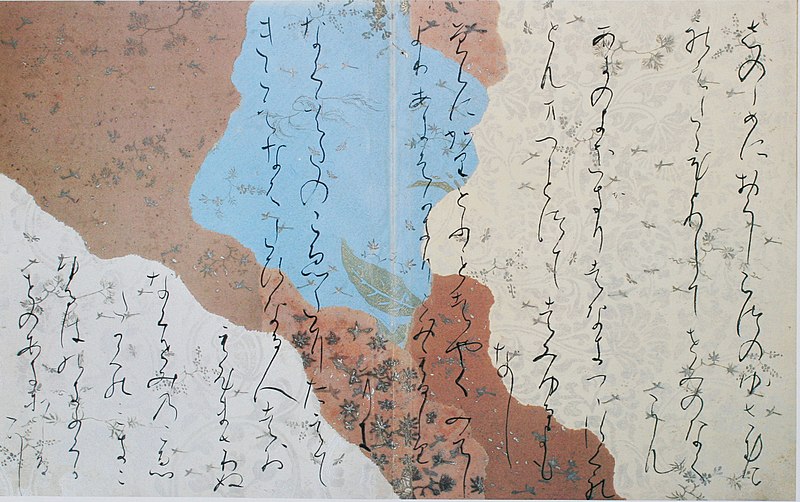
Two pages of the collected poems of Yamabe Akahito (ACE 8 century), 20cm height, 32cm wide. Silver, Gold, Colour, and ink on ornamented paper. One of the Collection of the works of thirty six master poets in the NISHI-HONGANJI, Kyoto. Most luxurious illuminated manuscript books survived from ancient Japan.
Thirty six master poets in the NISHI-HONGANJI, 1980, NISHI-HONGANJI Temple, Kyoto, Japan
Primary material
Documents and archives
reference work
- Wikidata, structured authority record Q180929: Yamabe no Akahito
Reputable secondary · Wikimedia Foundation
- “Yamabe no Akahito”, English Wikipedia, consulted as further reading
Reputable secondary · Wikipedia
scholarly publication
- Considerações sobre Yamabe no Akahito, um poeta do século VIII, Estudos Japoneses, 1979
Scholarly · Crossref registry · 1979
authority file
Citations
References
Each reference names the institution holding it, so a reader may go to the document itself.
scholarly publication
Considerações sobre Yamabe no Akahito, um poeta do século VIII, Estudos Japoneses, 1979Crossref registry
Verifiedauthority file
Partially resolvedreference work
Wikidata, structured authority record Q180929: Yamabe no AkahitoWikimedia Foundation
Partially resolvedreference work
Partially resolved
The Encyclopedia exists whether or not anything is for sale. Corrections are recorded rather than overwritten, and every version of this record is kept. Published 14 August 2026.
Elsewhere in Books
38,661 published records in this field, each with its sources named.
- Yakov PolonskyAuthor
- Yakub KolasAuthor
- Yakubu GowonAuthor
- Yaltah MenuhinAuthor
- Yamada BimyōAuthor
- Yamagata BantōAuthor
- Yamaguchi SeishiAuthor
- Yamamoto TsunetomoAuthor
Best supported in this field
For owners
Own a work by Yamabe no Akahito?
A specialist will read what you send and tell you what the house can establish, what it cannot, and whether the object is suited to sale. There is no charge and no obligation. The object stays with you throughout; nothing is shipped to us unless it is arranged in writing beforehand.