
Wu Bin
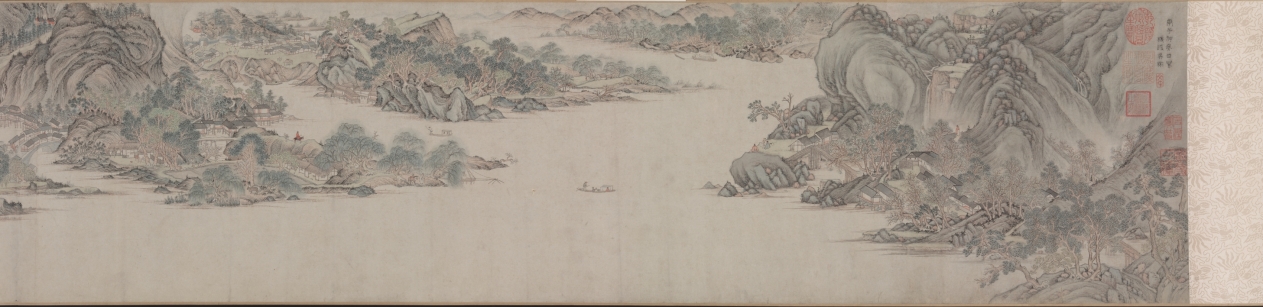
Wu • Illustration — Detail of landscape by Wu Bin, ink and color on paper, 1610; Honolulu Museum of Art Wu Bin was a Ming dynasty Chinese landscape painter during the reign of the Wanli Emperor (r. His courtesy name was "Wenzhong" and his art name "Zhiyin Toutuo" means "Mendicant monk at the temple hidden by tree branches". His specific dates of birth and death are unknown.
Wu Bin
Wu Bin · The Cleveland Museum of Art · Purchase from the J. H. Wade Fund · CC0
- Born
- Wu Bin was born in 1573. · Putian.
- Died
- 1620
- Nationality
- Ming dynasty
- Occupation
- painter · writer · poet
- Fields
- landscape
VALÉORINE Encyclopedia
VALÉORINE documentary reading
Documentary summary
Wu • Illustration — Detail of landscape by Wu Bin, ink and color on paper, 1610; Honolulu Museum of Art Wu Bin was a Ming dynasty Chinese landscape painter during the reign of the Wanli Emperor (r. His courtesy name was "Wenzhong" and his art name "Zhiyin Toutuo" means "Mendicant monk at the temple hidden by tree branches". His specific dates of birth and death are unknown.
Admitted source layer · organised and presented by VALÉORINE
Note VALÉORINE
No house-authored Note is published until its assertions and sources pass the VALÉORINE evidence contract. The documentary article remains available in full while that enrichment is being consolidated.
Documentary enrichment in progress · no unsupported statement published
Reference Check
Propose documentary evidence for Wu Bin. A contribution is never written directly as fact: identity, source, rights and evidence gates still decide.
Sign in to contribute
Documentary evidence
Evidence Panel
wikipedia incomplete · checked 25 September 2026
- Identity
- resolved
- Independent source families
- 0
- Admitted assertions
- 0
- Open conflicts
- 0
Authority files
wikidata · Q453832
In this article
Works
Works
Wu was born in Putian in the Fujian province, and was linked to the Ōbaku Buddhism sect, having painted a large Nirvana scene for them. Educated as one of the literati and skilled as a painter, he worked mainly in Nanjing about 1590–1610. He became a devout follower of Buddhism and lived and worked in a Buddhist temple. In Nanjing, he often depicted Buddhist arhats behaving as magicians, performing superstitious rituals and healing practices to satisfy requests made by religious men and women. These are colorful portraits where irony and sarcasm prevail. The 1591 handscroll entitled "The 16 Luohans" exemplifies such work. He also produced 500 arhat hanging scrolls in Qixia Temple in Nanjing in about 1601, some of which have survived. It is uncertain whether he worked for the vice imperial government in Nanjing. Mi Wanzong (1570-1628), a high ranking government officer, calligrapher, and painter, was his patron from about ACE1600. Bin moved to Beijing with Mi Wanzong's support in about 1610, where he produced several masterpieces such as a landscape of Mi's Garden and ten portraits of a marvelous rock which Mi had appreciated. The latter, "Ten Views of Lingbi Rock", is one of the world's most expensive paintings. The Beijing imperial court assigned him the status for a professional technocrat as painter. There are no records of him after 1626, with some sources indicating that he was purged by the powerful and notorious eunuch Wei Zhongxian.
• Illustration — Pine Lodge amid Tall Mountains (Asian Art Museum, San Francisco) • Asian Art Museum, San Francisco • "Pine Lodge amid Tall Mountains" • Cleveland Museum of Art • Greeting the Spring (Landscape Handscroll) in 1600. • Five Hundred arhat handscroll • Metropolitan Museum of Art • Sixteen Arhats Handscroll in 1591 "The 16 Luohans" • Honolulu Museum of Art • Landscape Handscroll • Shanghai Museum • Journey in San Yin, handscroll, Ink and color on Paper • Palace Museum, Beijing • Arhats • Illustration — 500 arhats (Cleveland Museum of Art)
Identity
Identity
Wu Bin is classed in the genre landscape painting. Recorded as a citizen of Ming dynasty. Recorded with the occupation painter. Recorded with the occupation writer. Recorded with the occupation poet.

The Five Hundred Arhats, 1591–1626, by Wu Bin
Wu Bin · The Cleveland Museum of Art · John L. Severance Fund
Life and career
Dated record
Life and career
The full dated record · 2 entries
1573
Wu Bin was born in 1573.
1620
Wu Bin died on 1 January 1626.
Places
Named by the record
Places
Only places the record itself states, plotted where the house gazetteer settles their coordinates. Nothing is inferred from a name or a nationality.
Wu Bin was born in Putian.
Birthplace
Putian.
Birth place
Notes from the source article
Cited by Wikipedia
Notes from the source article
These works are cited by the source article, in its own numbering. They are recorded as its citations, not as sources VALÉORINE has verified.
- 1.198.
- 2.Emmanuel Bénézit. Dictionnaire des peintres,sculpteurs, dessinateurs et graveurs. éditions Gründ. 10. 13440. 1999. 2700030184.
- 3.236.
- 4.238.
Bibliography printed in the source article · 2
- Yang Xin, Richard M. Barnhart, Nie Chongzheng, James Cahill, Lang Shaojun, Wu Hung. Trois mille ans de peinture chinoise. Éditions Philippe Picquier. 1997. 2-87730-341-1.
- James Cahill, Fantastic and Eccentrics in Chinese Painting, New York, 1972.
References
Citations
References
Each reference names the institution holding it, so a reader may go to the document itself.
authority record
Partially resolved
The Encyclopedia exists whether or not anything is for sale. Corrections are recorded rather than overwritten, and every version of this record is kept. Published 14 August 2026.
Elsewhere in Books
38,661 published records in this field, each with its sources named.
- Wolfhart PannenbergAuthor
- Wolfram von EschenbachAuthor
- Woodrow WilsonAuthor
- Wopko JensmaAuthor
- Wu ChengAuthor
- Wu Cheng'enAuthor
- Wu HanAuthor
- Wu JingziAuthor
Best supported in this field
For owners
Own a work by Wu Bin?
A specialist will read what you send and tell you what the house can establish, what it cannot, and whether the object is suited to sale. There is no charge and no obligation. The object stays with you throughout; nothing is shipped to us unless it is arranged in writing beforehand.