
William Wilkins
William Wilkins (31 August 1778 – 31 August 1839) was an English architect, classical scholar and archaeologist. He designed the National Gallery, Downing College, Cambridge and University College London, and buildings for several Cambridge colleges.
Also recorded as William, the younger Wilkins · William, I Wilkins · William Wilkins the Younger · William, II Wilkins
William Wilkins
William Wilkins · Wellcome Collection, London · Wellcome Collection · Public Domain Mark
- Name
- William Wilkins
- Born
- 31 August 1778
- Birthplace
- Norwich, Norfolk, England
- Died
- 31 August 1839
- Place of death
- Lensfield, Cambridge, England
- Nationality
- Kingdom of Great Britain
- Occupation
- anthropologist · architect · archaeologist · classical philologist · scholar
- Fields
- architecture · classical philology · archaeology
- Movements
- Greek Revival architecture
- Education
- Norwich School · Gonville and Caius College
- Known for
- St. Paul's Church, George Street and Nottingham · Theatre Royal
- Honours
- Fellow of the Royal Society
VALÉORINE Encyclopedia
VALÉORINE documentary reading
Documentary summary
William Wilkins (31 August 1778 – 31 August 1839) was an English architect, classical scholar and archaeologist. He designed the National Gallery, Downing College, Cambridge and University College London, and buildings for several Cambridge colleges.
Admitted source layer · organised and presented by VALÉORINE
Reference Check
Propose documentary evidence for William Wilkins. A contribution is never written directly as fact: identity, source, rights and evidence gates still decide.
Sign in to contribute
World of VALÉORINE
Documentary connections
Only confirmed graph relationships appear here. Images are shown only when their identity and reuse rights both pass the documentary gate.
Documentary evidence
Documentary basis
Authority files
wikidata · Q676998
In this article
Biography
Biography
William Wilkins studied at Norwich School and Gonville and Caius College. The recorded working language is English. The field of work recorded is architecture, classical philology and archaeology. Residence is recorded at England. Works named in the authority record are St. Work by William Wilkins is recorded in the collections of Yale Center for British Art. Distinctions recorded are Fellow of the Royal Society.
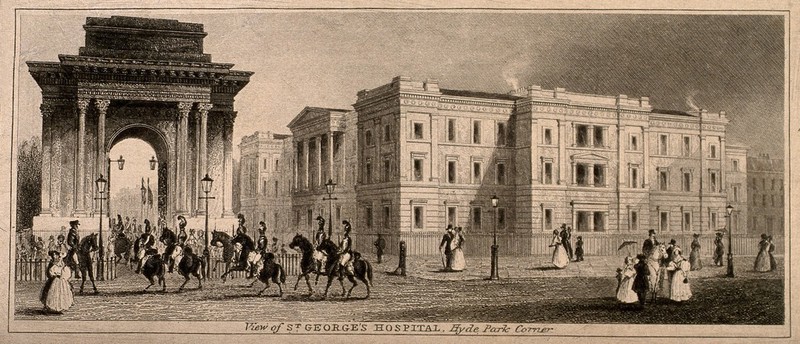
St. George's Hospital and the Constitution Arch, Hyde Park Corner. Engraving., by William Wilkins
William Wilkins · Wellcome Collection, London · Wellcome Collection
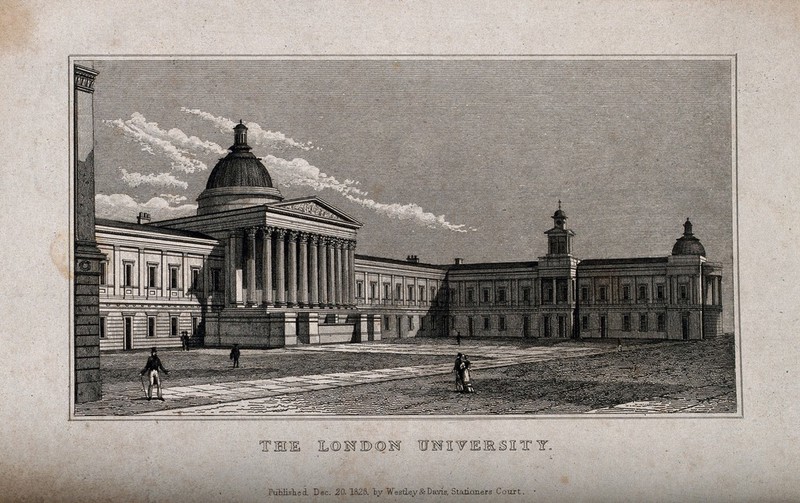
University College,
William Wilkins · Wellcome Collection, London · Wellcome Collection
Key facts
Key facts
• Name — William Wilkins • Born — 31 August 1778 • Birthplace — Norwich, Norfolk, England • Died — 31 August 1839 • Place of death — Lensfield, Cambridge, England • Significant Buildings — University College London National Gallery, London
Life
Life
Wilkins was born in the parish of St Giles, Norwich, the son of William Wilkins (1751–1815), a successful builder who also managed the Norwich Theatre Circuit, a chain of theatres. His younger brother George Wilkins became Archdeacon of Nottingham. He was educated at Norwich School and then won a scholarship to Gonville and Caius College, Cambridge. He graduated as 6th wrangler in 1800. With the award of the Worts Travelling Bachelorship in 1801, worth £100 for three years, he was able to visit the classical antiquities Greece, Asia Minor, and Magna Græcia in Italy between 1801 and 1804. On his tour he was accompanied by the Italian landscape painter Agostino Aglio, whom Wilkins had commissioned as a draughtsman on the expedition. Aglio supplied the drawings for the aquatint plates of monuments illustrating Wilkins' volumes from the expedition, such as The Antiquities of Magna Graecia (1807). Wilkins was a member of the Society of Dilettanti from 1817. He published researches into both Classical and Gothic architecture, becoming one of the leading figures in the English Greek Revival of the early 19th century. • Illustration — The Grange, Northington His architectural career began in 1804 with his Greek-revival designs for the newly established Downing College, Cambridge. The commission came after earlier plans in a Palladian style by James Wyatt had been rejected as insufficiently classical. Wilkins arranged the college buildings around a single large courtyard. Construction began in 1807 and proceeded slowly, coming to a halt in 1821 with Wilkins' scheme still incomplete. In 1806, Wilkins designed a college near Hertford for the East India Company. It became Haileybury College following the dissolution of the company. His first domestic commission was for Osberton House in Nottinghamshire, possibly incorporating parts of an existing building. These works were followed in 1808 by the Doric entrance to the Lower Assembly Rooms at Bath, and a villa at North Berwick for Sir H. D. Hamilton. At Grange Park, Northington, Hampshire, in 1809, Wilkins encased and remodelled an existing seventeenth-century house, giving it something of the form of a Greek temple, with a large Doric portico at one end. In 1815, Wilkins inherited his father's chain of six theatres. He continued to manage them for the rest of his life, and rebuilt or remodelled several of them, occasionally also designing scenery. In 1822–26, he collaborated with John Peter Gandy on the Clubhouse for the new United University Club, in Pall Mall, London. He was made an associate of the Royal Society in 1824 and given full membership in 1826. • Illustration — Trafalgar Square in 1852 Wilkins was influential in the development of London's Trafalgar Square, which had been opened up as part of a scheme by John Nash. He campaigned to have the new building for the National Gallery sited on the north side of the square, initially suggesting that the existing building, William Kent's Great Mews should be converted for the purpose. The government accepted the idea, but opted for a wholly new building, and a Neoclassical design by Wilkins was accepted over alternative schemes by Nash and CR Cockerell. Wilkins also drew up plans for the laying out of the square itself. They were not put into effect, although the scheme eventually carried out by Charles Barry after Wilkins' death replicated many of his ideas. The appearance of the National Gallery (1832–38), which was originally shared with the Royal Academy, attracted adverse criticism from the beginning. John Summerson concluded in 1962 that although Wilkins' frontage has many virtues "considered critically as a façade commanding a great square, its weakness is apparent". In 1827–28 Wilkins designed two other major London buildings in a severe Classical style: University College in Gower Street, and St George's Hospital (now The Lanesborough Hotel) on Hyde Park Corner. His other Greek Revival works include the Theatre Royal Bury St Edmunds 1819, St. Paul's Church, George Street, Nottingham 1822 and the Yorkshire Museum (1830). He was responsible for two columns commemorating Admiral Nelson, Nelson's Pillar in Dublin and the Britannia Monument in Great Yarmouth. Both predate William Railton's design for Trafalgar Square. He also produced buildings in the Gothic style, such as Dalmeny House for Lord Rosebery in 1814–17 and Tregothnan for Lord Falmouth in 1816. He used the style at several Cambridge colleges: in 1823 he won the competition to design a set of new buildings for King's College, Cambridge, comprising the hall, provost's lodge, library, and a stone screen towards Trumpington Street, and in the same year started work on the King's court of Trinity College, and new buildings, including the chapel, at Corpus Christi College. • Illustration — Corpus Christi College, Cambridge. Wilkins is buried in the chapel at centre. In 1827, Wilkins was appointed architect to the East India Company, and the next year made alterations to its building in Leadenhall Street. He entered the competition to design the Duke of York's Column, and in 1836 that for the rebuilding of the Houses of Parliament. After failing to win the latter he attacked the plans of his rivals and the decision of the committee in a pamphlet signed "Phil-archimedes". He was appointed professor of architecture at the Royal Academy following the death of John Soane in 1837, but gave no lectures before he himself died at his house in Cambridge on 31 August 1839. He was buried in the crypt under the chapel of Corpus Christi College.
List of architectural work
List of architectural work
• Downing College, Cambridge, designed (1805), west range built (1807–13), east range built (1818–22); the remainder of the design remained unexecuted. • East India College (now Haileybury College), Hertfordshire (1805–09). • Norwich Cathedral, restoration work with his father (1806). • Lower Assembly Rooms, Bath, Somerset, later the Bath Royal Literary Institution, (1808); demolished (1933). • Nelson's Pillar, Dublin, altered in execution by Francis Johnston. • The Grange, Northington, remodelling based on a Greek temple (1809). • Argyll House, Argyll Street, London, alterations to the interior (1809); demolished. • Pentillie Castle, Cornwall, addition of a new wing (1810). • Theatre, Colchester, Essex, renovations (1811); demolished. • Lensfield House, Lensfield Road, Cambridge, remodelled, including portico (1811); Wilkins' own house, demolished (1955) and now replaced by the Chemistry Department of Cambridge University. • Theatre Royal, Newmarket Road, Cambridge (1814), later remodelled. • Dalmeny House, West Lothian (1814–19). • Nelson Column, Great Yarmouth (1815–17). • Tregothnan, Cornwall (1815–18). • Theatre Royal, Great Yarmouth (1816); demolished. • The Perse School, Cambridge, remodelling of interiors (1816); demolished. • Former Freemason's Hall, Bath, Somerset (1817). • Keswick Hall, Norfolk, remodelling and additions (1817–19). • King's College Bridge, Cambridge (1818). • Theatre Royal, Bury St Edmunds (1818). • Church of St Mary the Great, Cambridge, alterations to the interior including a new west gallery (1819). • Dunmore Park, Stirlingshire, (1820–2); now derelict/ ruinous. • New Norfolk Gaol and Shire House, Norwich, built as part of the Norwich Castle complex (1820–24); partly demolished. • St. Paul's Church, Nottingham (1821–22); demolished (1926). • New Court, Trinity College, Cambridge (1821–1827). • United University Club, Pall Mall East, London (1821–26); rebuilt 1902. • New Court, Corpus Christi College, Cambridge (1821–27). • Entrance Screen with Gatehouse and South Range with Great Hall and Library. King's College, Cambridge (1823–28). • East India Company Military Seminary, Addiscombe, Surrey, added dining room, barracks and office block (1825–27); demolished 1861. • Theatre Royal, Norwich, reconstruction, including a Greek doric colonnade (1825–26); burnt down 1934. • Former St George's Hospital, (now The Lanesborough Hotel), Hyde Park Corner, London (1826–28). • County Gaol, Huntingdon (1826). • University College London (1826–1830), later completed to amended designs by 1869. • Yorkshire Philosophical Society Museum (now Yorkshire Museum) (1827–30). • Brooke Hall, Norfolk, additions (1827). Demolished 1949 following wartime damage. • House, Kingsweston, Bristol, addition of a Doric portico (1828). • National Gallery, London (1831–1838); originally only one room deep, and also housing the Royal Academy; since much extended and remodelled.
Gallery of architectural work
Gallery of architectural work
• Illustration — National Gallery, London • Illustration — University College, London • Illustration — Downing College, Cambridge • Illustration — Haileybury College • Illustration — King's College, Cambridge • Illustration — King's College, Cambridge • Illustration — Great Hall, King's College, Cambridge • Illustration — The Grange, Northington • Illustration — Tregothnan House • Illustration — Tregothnan House • Illustration — Dalmeny House • Illustration — New Court, Trinity College, Cambridge • Illustration — Theatre Royal, Bury St Edmunds • Illustration — Britannia Monument, Great Yarmouth • Illustration — The Yorkshire Museum designed by William Wilkins in a Greek revival style • Illustration — Lower Assembly Rooms, Bath 1808–9, demolished 1933 • Illustration — Former St George's Hospital, London, now Lanesborough Hotel
Identity
Identity
William Wilkins is recorded as anthropologist, architect, archaeologist, classical philologist and scholar. Career and activity. Wilkins worked in architecture, classical philology and archaeology. His work is associated with Greek Revival architecture. He belonged to Royal Society and Royal Academy of Arts. He worked at England.
Life and career
Dated record
Life and career
Explore 1778–1839
The full dated record · 7 entries
1778
William Wilkins born at Norwich.
1808
Nelson's Pillar is dated 1808.
1818
King's College, Gateway to Queen's Road is dated 1818.
1819
Theatre Royal is dated 1819.
1822
St. Paul's Church, George Street, Nottingham is dated 1822.
1824
National Gallery is dated 1824.
1839
William Wilkins died at Cambridge.
Places
Named by the record
Places
Only places the record itself states, plotted where the house gazetteer settles their coordinates. Nothing is inferred from a name or a nationality.
- England
Named but not plotted · 2
Norwich.
Birth place
Cambridge.
Death place
List of publications
• Some Account of the Prior's Chapel at Ely in pages 105–12 Archaeologia XIV (1801) • Antiquities of Magna Graecia (1807). • Observations on the Porta Honoris of Caius College, Cambridge in Vetusta Monumenta, iv (1809) • The Civil Architecture of Vitruvius: Comprising those Books of the Author which Relate to the Public and Private Edifices off the Ancients (1813 and 1817). • Atheniensia, or Remarks of the Topography and Buildings in Athens (1816). • Remarks on the Architectural Inscription Brought from Athens, and now Preserved in the British Museum in pages 580–603, Memoirs relating to European & Asiatic Turkey edited by Robert Walpole (1817). • On the Sculptures of the Parthenon in Travels in Various Countries edited by Walpole (1820). • Report on the State of Sherborne Church (1828). • Prolusiones Architectonicae or Essays on Subjects Connected with Grecian and Roman Architecture (1837). • The Lydo-Phrygian Inscription in pages 155–60 of Transactions of the Royal Society of Literature of the United Kingdom, III (1839).
Notes from the source article
Cited by Wikipedia
Notes from the source article
These works are cited by the source article, in its own numbering. They are recorded as its citations, not as sources VALÉORINE has verified.
- 1.Wilkins, William.
- 2.Waterhouse, Paul. 61.
- 3.1095216.
- 4.Mackintosh, Iain. Architecture, actor, and Audience. Routledge. 158. 1993. 978-0-415-03183-7.
- 5.Knight. The English Cyclopædia. Bradbury & Evans. 6. 704. 1858.
- 6.Site-of-Brooke-Hall - Norfolk Heritage Explorer. heritage.norfolk.gov.uk.
Bibliography printed in the source article · 6
- Liscombe, R. W. William Wilkins 1778–1839. Cambridge University Press. 1980.
- Mace, Rodney. Trafalgar Square: Emblem of Empire. Lawrence and Wishart. 2005. 978-1-905007-11-0.
- Pevsner, Nikolaus. Cambridgeshire. 1954.
- Searby, Peter. A History of the University of Cambridge. Cambridge University Press. 3. 1988. 978-0-521-35060-0.
- Summerson, John. Georgian London. Penguin Books. 1962.
- Liscombe, R. Windsor. Oxford Dictionary of National Biography. 2004. 10.1093/ref:odnb/29422.
References
Citations
References
Each reference names the institution holding it, so a reader may go to the document itself.
reference work
Wikidata, structured authority record Q676998: William WilkinsWikimedia Foundation
Secondary witness
The Encyclopedia exists whether or not anything is for sale. Corrections are recorded rather than overwritten, and every version of this record is kept. Published 16 August 2026.
Elsewhere in Design
11,558 published records in this field, each with its sources named.
- William West NeveDesigner
- William WhiteDesigner
- William WhitfieldDesigner
- William WiggintonDesigner
- William WilkinsonDesigner
- William WillcocksDesigner
- William Wilmer PocockDesigner
- William WindeDesigner
Best supported in this field
For owners
Own a work by William Wilkins?
A specialist will read what you send and tell you what the house can establish, what it cannot, and whether the object is suited to sale. There is no charge and no obligation. The object stays with you throughout; nothing is shipped to us unless it is arranged in writing beforehand.