
William Walcot
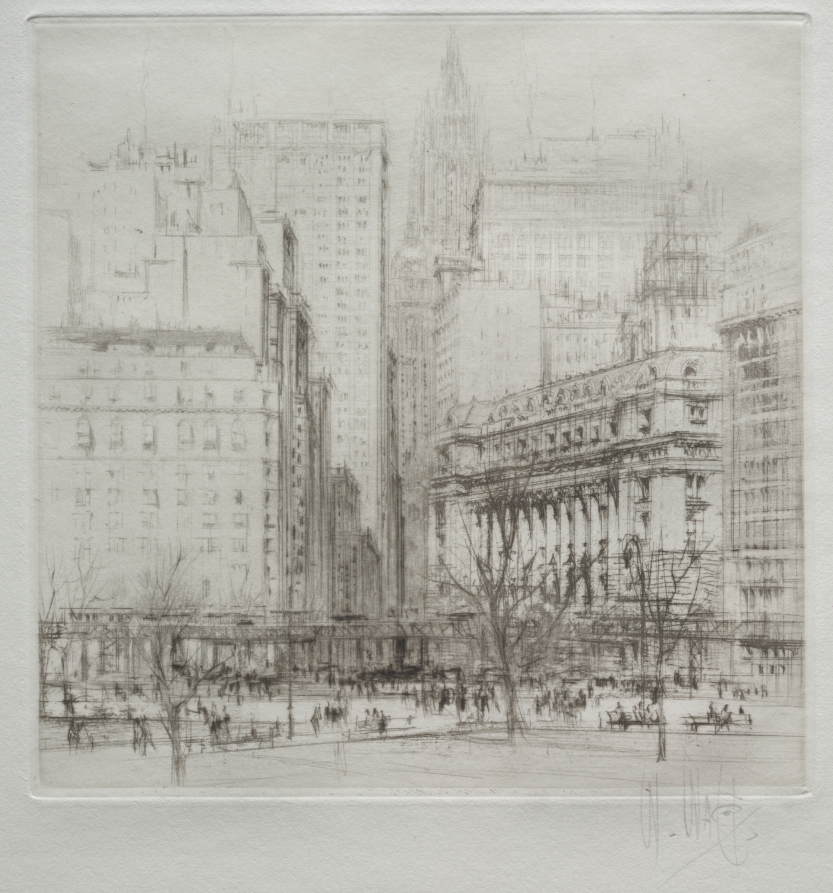
William Walcot · The Cleveland Museum of Art · Charles W. Harkness Endowment Fund · CC0
- Name
- William Walcot
- Born
- 10 March 1874
- Birthplace
- Lustdorf, Russian Empire
- Died
- 21 May 1943
- Place of death
- Hurstpierpoint, Sussex, England
Reference Check
Propose documentary evidence for William Walcot. A contribution is never written directly as fact: identity, source, rights and evidence gates still decide.
Sign in to contribute
Documentary evidence
Documentary basis
Authority files
wikidata · Q4103082 · wikipedia · William Walcot
In this article
Key facts
Key facts
• Name — William Walcot • Born — 10 March 1874 • Birthplace — Lustdorf, Russian Empire • Died — 21 May 1943 • Place of death — Hurstpierpoint, Sussex, England • Significant Buildings — Metropol Hotel, Gutheil and Yakunchikova mansions (all in Moscow, Russia)
Russia
Russia
William Walcot was born in the village of Lustdorf, near Odessa in a mixed Scottish-Russian family. His mother was Russian, from a wealthy family. He grew up in Western Europe and South Africa, returning to Russia at the age of 17, and studied arts and architecture under Leon Benois at the Imperial Academy of Arts in Saint Petersburg. Later, he attended art schools in Paris. Walcot's career as an architect in Moscow lasted only six years, but he managed to leave a lasting heritage of refined, pure Art Nouveau. Unlike contemporary architects like Fyodor Schechtel, Walcot never ventured into Neo-Gothic or Russian Revival styles – his work is strictly Art Nouveau, in its English Decadent variety (according to contemporary Russian critics). • Illustration — Hotel Metropol His largest and best known work was the Hotel Metropol in Moscow, financed by Savva Mamontov. The spacious building, now operating as a hotel only, was conceived as a cultural center around Private Opera hall. In 1899, Walcot applied to the open contest with a draft codenamed A Lady's Head (Женская головка), earning the fourth prize and losing to Lev Kekushev. However, Mamontov discarded the professional jury decision, and awarded the design to Walcot (Lev Kekushev later joined the team as project manager). More than once, Walcot's original plans were changed in the process; in fact, there is little in common between the extant building and his 1899 draft (Brumfield, fig.56) – but the Lady's Head persisted in the main hall ornaments. The building, completed in 1905 after a devastating fire in 1901, was decorated by Mikhail Vrubel, Alexander Golovin, Nikolai Andreev and other artists. Participation of Victor Vesnin and Fyodor Schechtel, suggested by William Brumfield, has not been confirmed. • Illustration — Yakunchikova House, 1899–1900. Three Lady's Heads by the entrance Lady's Head became Walcot's trademark, repeated in his later works (usually in place of an arch keystone), and frequently imitated by local craftsmen. For a while, he enjoyed an unprecedented flow of inquiries and secured two high-profile commissions of his own choice. These buildings, soon occupied by foreign embassies, are well maintained and retain most of their original interiors: • 1899–1900 Yakunchikova House (Prechistensky lane, 10) • 1902–1903 Gutheil House (Prechistensky lane, 8, Embassy of Morocco) Walcot's mosaic, signed W.W., adorns the List House in Glazovsky Lane, built by Lev Kekushev. Walcot's 1902 draft for the Lutheran Cathedral in Moscow won the contest, but the cathedral was eventually built to another architect's design. Walcot published various drafts in architectural magazines, influencing many local architects (Brumfield, fig.58). In 1904, Walcot lost the contest for the Polytechnical Society Building in Myasnitskaya Street to Adolph Mincus; the building, completed in 1905–1907 by Alexander Kuznetsov (1874–1954), bears some details from Walcot's rejected draft.
United Kingdom
United Kingdom
• Illustration — Villa Quintillii, etching, drypoint, & aquatint, 1921, 181 x 254 mm In 1906, Walcot relocated to London. There he was initially employed as a draughtsman for the South African architect Eustace Frere. He rarely returned to practical construction, designing only one London building: 61 St James's Street (1933). Rather, Walcot worked as an architectural draftsman, famous for his artistic presentation of other architects' designs, and developing as a watercolour painter and printmaker of architectural subjects, exhibiting his own work at the Royal Academy summer exhibitions. Walcot, along with his contemporary Cyril Farey, was one of the most sought after English architectural illustrators of the 1920s and 30s. Walcot developed his own impressionistic style in gouache and watercolour which won numerous commissions from Edwin Lutyens, Herbert Baker and Aston Webb. • Illustration — The Bank of England, watercolour, 1931, 507 x 666 mm He had five exhibitions at the Fine Arts Society, from 1909 to 1914. The first four were called "Watercolours of London & Venice" (1909) and so on, but all appear to have contained some etchings, and the last, in 1914, was called "Etchings by William Walcot", and from this time onwards, most of his output was etchings. But later exhibitions included paintings as well. A folio of his work was published in 1919 as Architectural Watercolours and Etchings of William Walcot. He was elected to the Royal Society of British Artists in 1913, as an associate of the Royal Society of Painter-Etchers and Engravers in 1916 and a Fellow of the RIBA in 1922. He was also an associate of the British School at Rome, where he had a studio, and kept in close touch with the developing archaeology of the city. His etching style was apparently influenced by his great friend Frank Brangwyn. Both used unusually large plates for the period, and for large prints, of zinc rather than copper. He also used drypoint and aquatint for some effects. His later prints were often smaller, done on copper plates, and became more free in style, leaving figures with no feet. His edition sizes were 50 to 100 before 1918, but rose to 400 in the boom of the 1920s. In the early 1920s his prices ranged from 5 to 12 guineas, apparently largely depending on size, and sometimes the attractiveness of the subject. Typically for the period, he did not sign in the plate, but in pencil below it, without any numbering. His etchings included many street scenes showing the monumental centre of London, and a number of recreations of scenes from Imperial Rome, as well as reconstructions of ancient Greek, Roman, Babylonian and ancient Egyptian buildings. He also etched scenes from various Continental cities, especially Rome and Venice, and from as far away as New York. With some exceptions, his etchings showed grand buildings in their settings. The etching boom of the 1920s collapsed after the Great Crash of 1929, and Walcot's remaining architectural practice was ruined with the outbreak of World War II, and his poor health. In 1943, Walcot died after a fall from a hospital window, perhaps suicide, at Hurstpierpoint, Sussex. Walcot's painting and etchings are frequently exhibited; his painting palette is preserved at the Royal Institute of British Architects. He had a retrospective exhibition at the Fine Arts Society in 1974. His etchings frequently come up for sale in British auctions, fetching good prices.
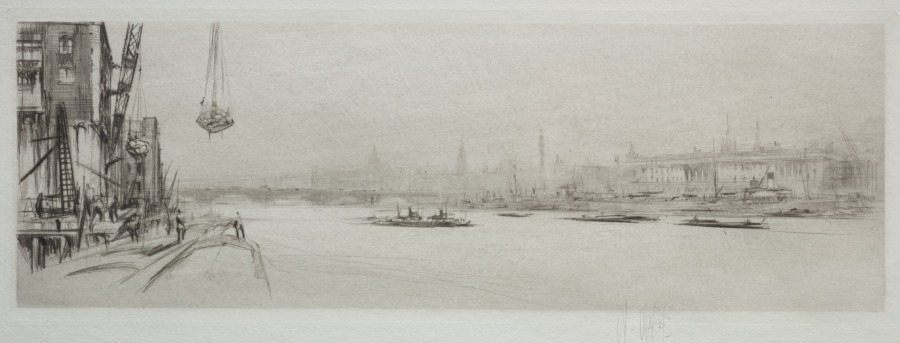
Arteries of Great Britain, 1922, by William Walcot
William Walcot · The Cleveland Museum of Art · Dudley P. Allen Fund
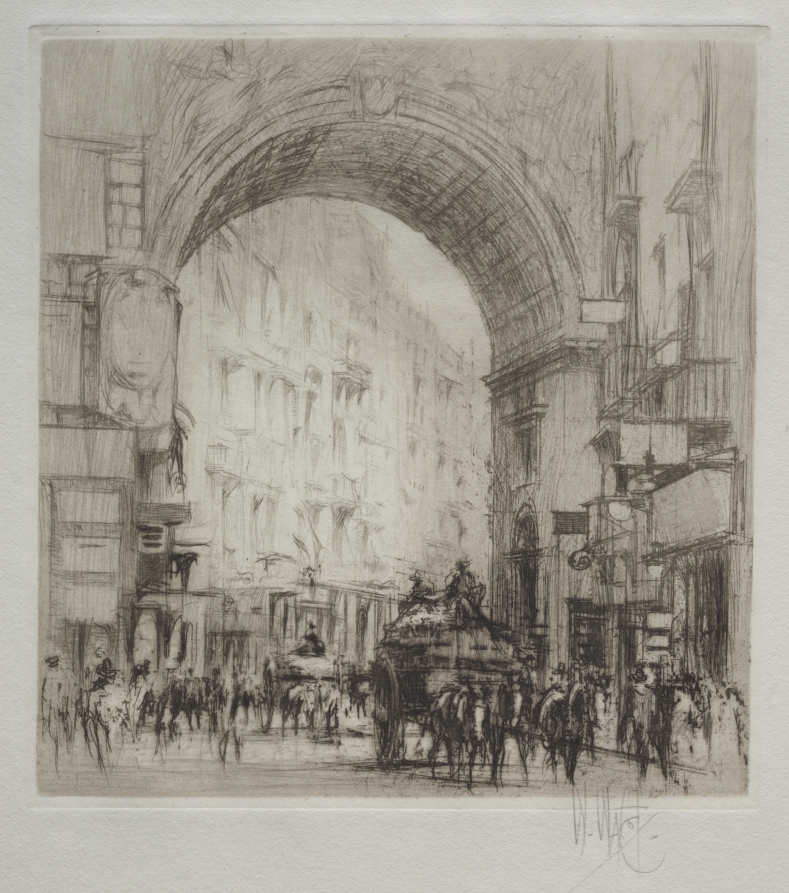
Arco San Carlo, Naples, 1921, by William Walcot
William Walcot · The Cleveland Museum of Art · Gift of Leonard C. Hanna Jr.
Primary material
Documents and archives
reference work
- Wikidata, structured authority record Q4103082: William Walcot
Reputable secondary · Wikimedia Foundation
- “William Walcot”, English Wikipedia, consulted as further reading
Reputable secondary · Wikipedia
scholarly publication
- Walcot, William, Benezit Dictionary of Artists, 2011
Scholarly · Crossref registry · 2011
Notes from the source article
Cited by Wikipedia
Notes from the source article
These works are cited by the source article, in its own numbering. They are recorded as its citations, not as sources VALÉORINE has verified.
- 1.Harvey-Lee
- 2.Harvey-Lee
- 3.Harvey-Lee; for the prices and more details see the online catalogue raisonne
- 4.Harvey-Lee
Bibliography printed in the source article · 2
- Architectural water-colours & etchings of William Walcot (London: H.C. Dickins, 1919).
- Salaman, M.C. (intro) (1927), Modern Masters of Etching: William Walcot, R.E., 'The Studio' Limited, London.
References
Citations
References
Each reference names the institution holding it, so a reader may go to the document itself.
scholarly publication
Walcot, William, Benezit Dictionary of Artists, 2011Crossref registry
Institutional witnessreference work
Wikidata, structured authority record Q4103082: William WalcotWikimedia Foundation
Secondary witnessreference work
Secondary witness
The Encyclopedia exists whether or not anything is for sale. Corrections are recorded rather than overwritten, and every version of this record is kept. Published 16 August 2026.
Elsewhere in Design
11,558 published records in this field, each with its sources named.
- William VertueDesigner
- William Vitruvius MorrisonDesigner
- William W. BosworthDesigner
- William W. BoyingtonDesigner
- William Wallace AndersonDesigner
- William Wallace Barbour SheldonDesigner
- William WallenDesigner
- William Wallen Sr.Designer
Best supported in this field
For owners
Own a work by William Walcot?
A specialist will read what you send and tell you what the house can establish, what it cannot, and whether the object is suited to sale. There is no charge and no obligation. The object stays with you throughout; nothing is shipped to us unless it is arranged in writing beforehand.