
William J. Haywood
Illustration — William Haywood William J. Haywood (8 December 1821 – 13 April 1894) was an English surveyor and an engineer to the City of London Commissioners of Sewers. He was also known as an architect.
Also recorded as Haywood · W. Haywood · Wm. Haywood · W. J. Haywood
William J. Haywood

Acabashi · CC BY-SA 4.0
- Born
- 1821
- Died
- 1894
- Occupation
- engineer · architect
- Known for
- Holborn Viaduct
- Languages
- English
VALÉORINE Encyclopedia
VALÉORINE documentary reading
Documentary summary
Illustration — William Haywood William J. Haywood (8 December 1821 – 13 April 1894) was an English surveyor and an engineer to the City of London Commissioners of Sewers. He was also known as an architect.
Admitted source layer · organised and presented by VALÉORINE
Note VALÉORINE
William J. Haywood (1821–1894) was an architect and engineer.
Works include Holborn Viaduct. Languages used include English.
Composed from admitted, traceable facts · 01 October 2026
VALÉORINE
Reference Check
Propose documentary evidence for William J. Haywood. A contribution is never written directly as fact: identity, source, rights and evidence gates still decide.
Sign in to contribute
Documentary evidence
Documentary basis
Authority files
wikidata · Q8011794
In this article
Personal life
Personal life
William Haywood was born as the eldest of three children in Camberwell. His father was probably also called William Haywood. Nothing is known about his mother. In the census of 1871 he was no longer alone and living in Maida Vale. He died at 56 Hamilton Terrace, Maida Vale, on 13 April 1894.
Education
Education
He was probably educated in Camberwell. There are records suggesting he went to Camberwell Grammar School. Later he trained with George Aitchison (1792–1861).
Work
Work
• Illustration — Section of the Holborn Viaduct showing the subways, taken from his report for the Metropolitan Board of Works With Joseph Bazalgette he was responsible for the enormous undertaking of improving the London sewerage system, which enabled the growth of the city (Abbey Mills pumping station). He worked with James Bunning on the Holborn Viaduct. His main work is the City of London Cemetery and Crematorium. The facility was built near Little Ilford (now Manor Park) as a way of relieving the appalling overcrowding of London's church burial grounds (described e.g. in Dickens's 'Bleak House'). As the City was redeveloped the remains from many of its churchyards were reinterred there. Haywood was a pioneer of cemetery reform. He was a Lieutenant-Colonel of the London Volunteer Rifle Brigade. There is a small Gothic mausoleum, containing his ashes, near the gates of The City of London Cemetery and Crematorium.
Life and career
Dated record
Life and career
The full dated record · 2 entries
1821
William J. Haywood was born on 8 December 1821.
1894
William J. Haywood died on 13 April 1894.
Other activities
In 1858, Haywood was one of the founders of the Geologists' Association. In an article published in 2002, John Patrick Pattinson suggested that Haywood was the pseudonymous "Walter", the author of the erotic memoir, My Secret Life.
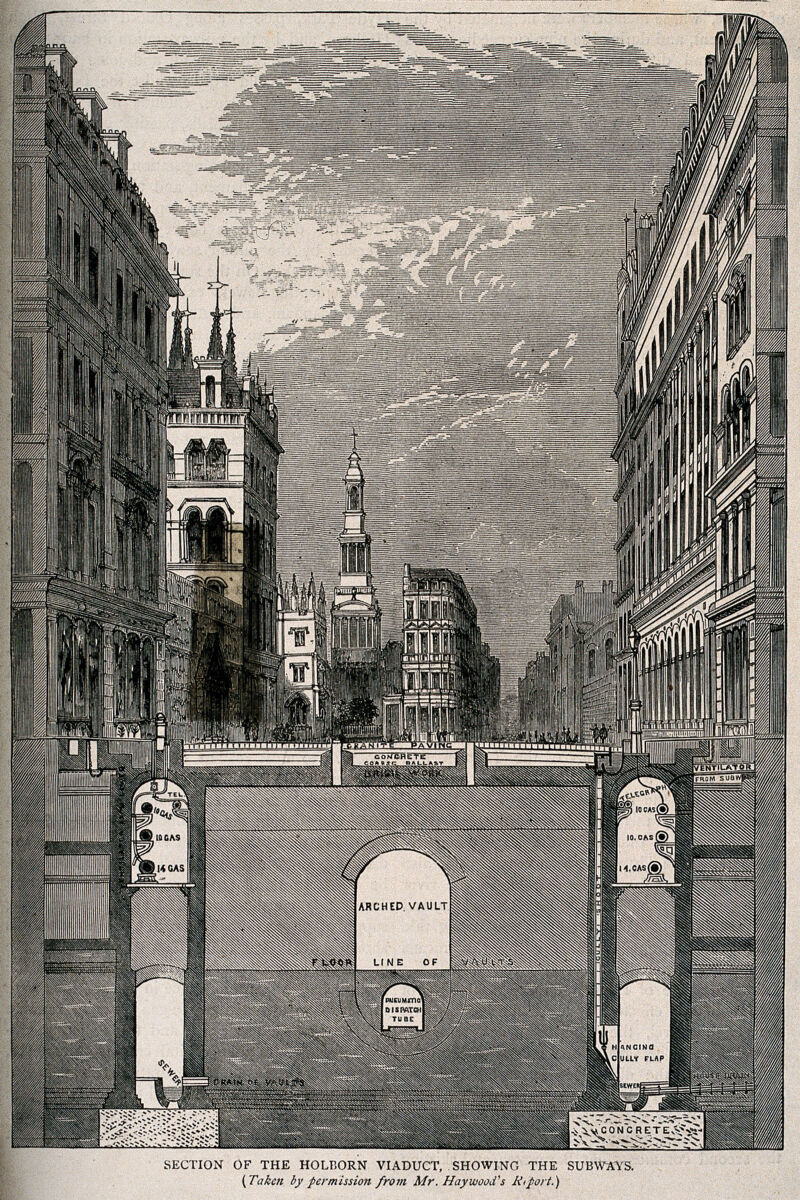
A section through the roadway of Holborn Viaduct,
William J. Haywood · Wellcome Collection, London · Wellcome Collection
Notes from the source article
Cited by Wikipedia
Notes from the source article
These works are cited by the source article, in its own numbering. They are recorded as its citations, not as sources VALÉORINE has verified.
- 1.Beare, Thomas Hudson.
- 2.Exterior plaque to William Haywood on the 1889-constructed buttressed, crocketed and pinnacled tomb holding the ashes of Lieutenant Colonel William Haywood (1821-1894), the tomb also including the ashes of his wife Jemima Emma (1841-1896), at the City of London Cemetery, Newham, London, England. The City of London Cemetery was laid out to the designs of William Haywood, who also aided Joseph Bazalgette in the design and improvement of the London sewerage system, and worked with James Bunning on the Holborn Viaduct.Mobile device view: Wikimedia (April 2020) makes it difficult to immediately view photo groups related to this image. To see its most relevant allied photos, click on City of London Cemetery and Crematorium, and this uploader's Photos. You can add a click-through 'categories' button to the very bottom of photo-pages you view by going to settings. Three-bar icon top left.Desktop view: Wikimedia (April 2020) makes it difficult to immediately view the helpful category links where you can find images related to this one in a variety of ways; for these go to the very bottom of the page.This image is one of a series of date and/Or subject allied consecutive photographs kept in progression or location by file name number and/Or time marking.Camera: Canon EOS 6D Mark II with Canon EF 24-105mm F4L IS USM lens.Software: File lens-corrected, optimized, perhaps cropped, with DxO OpticsPro Elite, and likely further optimized with Adobe Photoshop CS2. 3 May 2020.
- 3.Geoscientist Online. A true amateur. July 2008.
- 4.Freeman, Eric F., (1994) "In search of W.J. Haywood"; Proceedings of the Geologists' Association Volume 105; pp. 161–166;
- 5.John Patrick Pattinson, The man who was Walter, in Victorian Literature and Culture, Cambridge University Press, 2002, pp. 19–40
Bibliography printed in the source article · 2
- The government of Victorian London, 1855–1889: the Metropolitan Board of Works, The Vestries and The City Corporation; Owen, David Edward and Roy M. MacLeod; reprinted in 1982 by the Harvard University Press. 480pp.
- Public sculpture of the City of London; Ward-Jackson, Philip; Liverpool University Press; 2003; 680pp; .
References
Citations
References
Each reference names the institution holding it, so a reader may go to the document itself.
authority record
General reference
Further particulars
Held on the record
Further particulars
Open the remaining particulars
The identifiers under which William J. Haywood may be traced in institutional catalogues.
The Encyclopedia exists whether or not anything is for sale. Corrections are recorded rather than overwritten, and every version of this record is kept. Published 17 August 2026.
Elsewhere in Design
11,558 published records in this field, each with its sources named.
- William J. BrinkmannDesigner
- William J. BrownDesigner
- William J. DoddDesigner
- William J. GageDesigner
- William J. HicksDesigner
- William James MorleyDesigner
- William James NeatbyDesigner
- William JayDesigner
Best supported in this field
For owners
Own a work by William J. Haywood?
A specialist will read what you send and tell you what the house can establish, what it cannot, and whether the object is suited to sale. There is no charge and no obligation. The object stays with you throughout; nothing is shipped to us unless it is arranged in writing beforehand.