
William Combe
Illustration — Portrait of William Combe drawn by George Dance (1793) • Illustration — Dr Syntax, losing his way. Combe wrote verses to accompany Thomas Rowlandson's comic caricatures. • Illustration — Dr Syntax in Danger, print after a drawing by Thomas Rowlandson William Combe (25 March 174219 June 1823) was a British miscellaneous writer. His early life was that of an adventurer; his later life was passed chiefly within the "rules" of the King's Bench Prison.
Also recorded as Doctor Syntax
William Combe
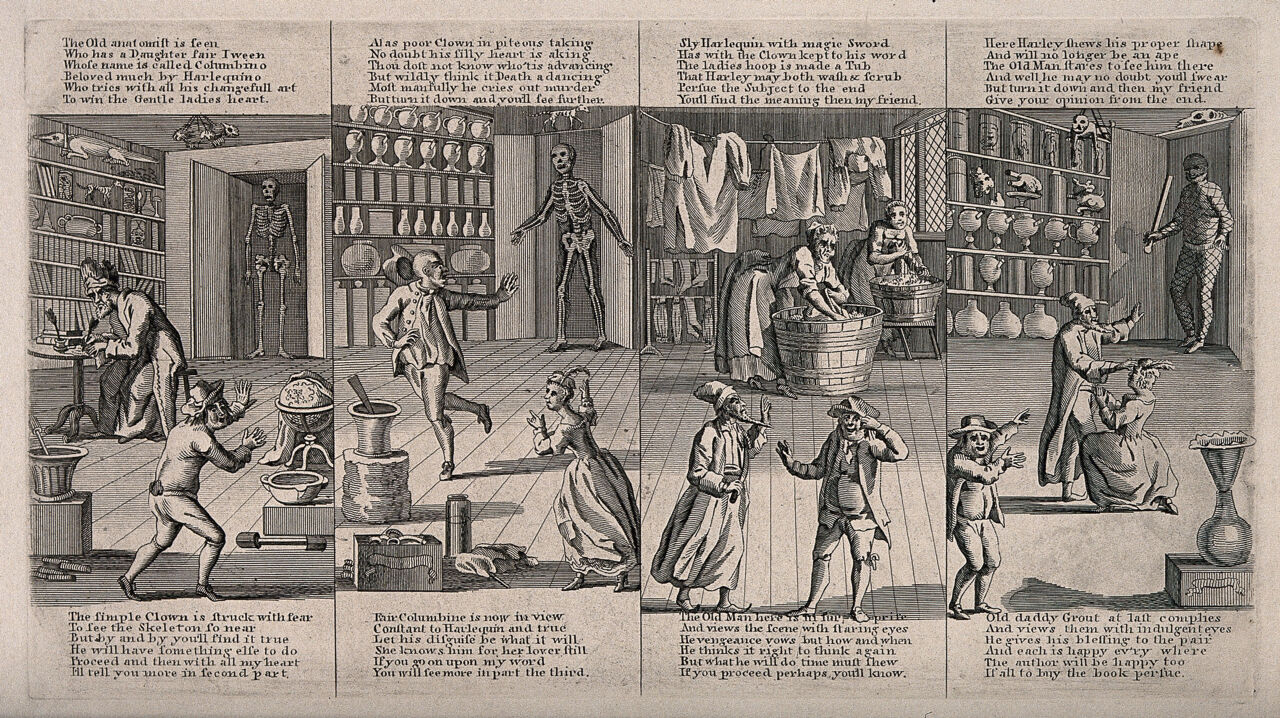
William Combe · Wellcome Collection, London · Wellcome Collection · Public Domain Mark
- Born
- 1742
VALÉORINE Encyclopedia
VALÉORINE documentary reading
Documentary summary
Illustration — Portrait of William Combe drawn by George Dance (1793) • Illustration — Dr Syntax, losing his way. Combe wrote verses to accompany Thomas Rowlandson's comic caricatures. • Illustration — Dr Syntax in Danger, print after a drawing by Thomas Rowlandson William Combe (25 March 174219 June 1823) was a British miscellaneous writer. His early life was that of an adventurer; his later life was passed chiefly within the "rules" of the King's Bench Prison.
Admitted source layer · organised and presented by VALÉORINE
Note VALÉORINE
No house-authored Note is published until its assertions and sources pass the VALÉORINE evidence contract. The documentary article remains available in full while that enrichment is being consolidated.
Documentary enrichment in progress · no unsupported statement published
Reference Check
Propose documentary evidence for William Combe. A contribution is never written directly as fact: identity, source, rights and evidence gates still decide.
Sign in to contribute
Documentary evidence
Evidence Panel
not yet certified
- Identity
- unresolved
- Independent source families
- 0
- Admitted assertions
- 0
- Open conflicts
- 0
Authority files
wikidata · Q4229432 · wikipedia · William Combe
In this article
Early life
Early life
He is most notable as the author of The Three Tours of Doctor Syntax, a comic poem, illustrated by artist Thomas Rowlandson's colour plates, that satirised William Gilpin. Combe also wrote a series of imaginary letters, supposed to have been written by the second, or "wicked" Lord Lyttelton. He also wrote the letterpress for various illustrated books, and was a general hack.
Combe's father, Robert Combes, was a rich Bristol ironmonger who died in 1756; his mother, Susannah Hill (died 1748), was from a Quaker background. He was educated at Eton College, but was withdrawn from the school by William Alexander, his guardian, on his father's death; Alexander died in 1762. He inherited from both his father and guardian, aspired to the status of gentleman, and changed his name to Combe. He spent his fortune, travelled and was nicknamed "Count Combe"; and in the period 1769–1773 was low in funds, existing in France, Wales and the West Midlands. In 1773 Robert Berkeley employed Combe to edit Thomas Falkner's Description of Patagonia. Combe then settled to work as a writer and book editor.
Works
Works
section • Illustration — A Derby Porcelain figure of Dr Syntax in Derby Museum In 1776 Combe made his first success in London with The Diaboliad, a satire full of bitter personal attacks. Four years later, in 1780, debts brought him into the King's Bench Prison, and much of his subsequent life was spent in prison. Combe's spurious Letters of the Late Lord Lyttelton (1780) took in many of his contemporaries: as late as 1851, a writer in the Quarterly Review regarded these letters as authentic, basing on them a claim to have solved the riddle of identity of Junius, in Thomas Lyttelton, 2nd Baron Lyttelton. An early acquaintance with Laurence Sterne resulted in Combe's anonymous Letters supposed to have been written by Yorick and Eliza (1779), the named characters being from Sterne's The Life and Opinions of Tristram Shandy, Gentleman. Periodical literature of all sorts—pamphlets, satires, burlesques, "two thousand columns for the papers," "two hundred biographies" —filled up the next years, and about 1789 Combe was receiving £200 yearly from the Pitt government as a pamphleteer. In 1790 and 91, the six volumes of a Devil on Two Sticks in England won for Combe the title of "the English le Sage". In 1794 he ghost-wrote the Aeneas Anderson memoir of the Macartney Embassy to Peking, A Narrative of the British Embassy to China, in the Years 1792, 1793, and 1794. In 1794–1796 he wrote the text for Boydell's History of the River Thames, and in 1803 he began to write for The Times. From 1809 to 1811 he wrote for Ackermann's The Poetical Magazine the serialized comic poem The Tour of Dr Syntax in Search of the Picturesque, descriptive and moralizing verse illustrated by artist Thomas Rowlandson's colour plates. It satirised William Gilpin, who toured Britain to describe his theory of the Picturesque. It was collected in book form in 1812, and was followed by two similar Tours, "...in search of Consolation" (1819) and "...in search of a Wife," the first Mrs Syntax having died at the end of the first Tour. The second Tour was collected as an 1820 book, and the third tour as an 1821 book. Some reprint editions over the next several decades rendered Rowlandson's colour plates in black and white. Then came Six Poems in illustration of drawings by Princess Elizabeth (1813), The English Dance of Death (1815–1816), The Dance of Life (1816–1817), The Adventures of Johnny Quae Genus (1822)—all written for Rowlandson's caricatures; together with histories of Oxford and Cambridge, and of Westminster Abbey for Ackermann; Picturesque Tours along the Rhine and other rivers, Histories of Madeira, Antiquities of York, texts for Turner's Southern Coast Views, and contributions innumerable to the Literary Repository. Combe died in London on 19 June 1823.
Poetry
Poetry
• Illustration — A depiction of Dr Syntax landing at Calais from the tour of Dr Syntax • Clifton: a poem in imitation of Spenser (Bristol 1775) • The Diaboliad: a Poem: Dedicated to the worst man in His Majesty's dominions. Also, the diabo-lady: or, a match in hell (1777) • The Tour of Dr Syntax in Search of the Picturesque. A Poem (1812) • The English Dance of Death 2 vols. (1815–16)] • The Dance of Life (1817) • The Second Tour in Search of Consolation (1820) • Third Tour in Search of a Wife (1821) • The History of Johnny Quae Genus, The Little Foundling of the Late Doctor Syntax (1822) • The first of April: or, The triumphs of folly • The justification • The life of Napoleon, a Hudibrastic poem in fifteen cantos, by Doctor Syntax
Novels
Novels
• The Devil upon 2 Sticks in England: being a continuation of Le diable boiteux of Alain-René Lesage (Le Sage). (1st and 2nd editions in 4 volumes: 1790 and expanded 3rd-5th editions in 6 volumes: 1791, 1811, and 1817) • Letters between Amelia in London and her mother in the country (1824) - posthumous
Edited letters
Edited letters
• Letters from Eliza to Yorick (1775) • Letters supposed to have been written by Yorick and Eliza. 2 vols (1779) • Letters to His Friends on Various Occasions by Laurence Sterne (1775) • Original letters of the late Reverend Mr. Laurence Sterne: Never Before Published. (1788) • Letters of the Late Lord Lyttleton. 2 vols (1780–2)
Non-fiction on England
Non-fiction on England
• The Philosopher in Bristol (1775) • An History of the River Thames. 2 vols (1794–96) • The Thames, or Graphic Illustrations. 2 vols (1811) • Microcosm of London: Vol 3 (1811) • The history and antiquities of the city of York, from its origin to the present times • A word in season to the traders and manufacturers of Great Britain • Adam Anderson's A historical and chronological deduction of the origin of commerce from the earliest accounts. Containing an history of the great commercial interests of the British Empire. To which is prefixed an introduction, exhibiting a view of the ancient and modern state of Europe; of the importance of our colonies; and of the commerce, shipping, manufactures, fisheries, &c., of Great-Britain and Ireland; and their influence on the landed interest. With an appendix, containing the modern politico-commercial geography of the several countries of Europe. Carefully rev., cor. and continued to the present times (editor)
Translations
Translations
• Doctor Syntaxes Reise at opsøge det Pittoreske, Danish translation (1820) • Le Don Quichotte Romantique, ou voyage du Docteur Syntaxe, French translation (1821) • Des Doktor Syntax Reise: ein Gedicht in 26 Gesängen nebst dreißig kolorirten Steinstichen; Herausgegeben zum Besten der Königlichen Preußischen General-Post-Armen-Kasse. (1822) • Die Reisen des Doctors Syntax. Dem Deutschen einverleibt von Wolf-Dieter Bach und mit ihm gemeinsam herausgegeben von Norbert Miller und Karl Riha. 2 vols (1983) • Doctor Syntax op zoek naar het pittoreske, Dutch translation by Martin Hulsenboom, Uitgeverij Ad. Donker, Rotterdam (2015)
Life and career
Dated record
Life and career
The full dated record · 2 entries
1742
William Combe was born in 1742.
1823
William Combe died at Lambeth.
Catalogued output
Works and catalogued output
Quae Genus, in the Service of Sr.
Primary material
Documents and archives
Institutional database
- Wikidata, structured authority record Q4229432: William Combe
Scholarly · Wikimedia Foundation
reference work
- “William Combe”, English Wikipedia, consulted as further reading
Reputable secondary · Wikipedia
General references
General references
• John Camden Hotten: The Life and Adventures of the Author of "Doctor Syntax”; in: Dr Syntax's Three Tours in Search of the Picturesque, of Consolation, and of a Wife. By William Combe. London: Chatto & Windus (1895), V – XLVIII. • Harlan W Hamilton: Doctor Syntax – A Silhouette of Combe. London: Chatto & Windus (1969) • Francesca Orestano: "The Revd William Gilpin and the Picturesque; Or, Who's Afraid of Doctor Syntax?" Garden History Vol. 31, No. 2 (Winter, 2003): 163–179.
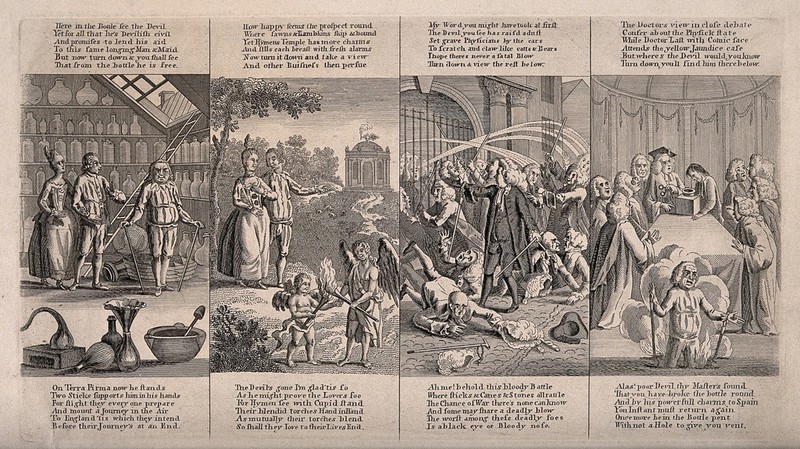
Four scenes from W. Combe's verse Dr. Last or the devil upon two sticks, a parody of the Royal college of physicians and in particular John Fothergill. Engraving after W. Combe., by William Combe
William Combe · Wellcome Collection, London · Wellcome Collection

Four scenes from W. Combe's verse Dr. Last or the devil upon two sticks, a parody of the Royal college of physicians and John Fothergill (in particular). Engraving, 1771, after W. Combe., 21 November 1771, by William Combe
William Combe · Wellcome Collection, London · Wellcome Collection
References
Citations
References
Each reference names the institution holding it, so a reader may go to the document itself.
Institutional database
Wikidata, structured authority record Q4229432: William CombeWikimedia Foundation
Verifiedreference work
Partially resolved
The Encyclopedia exists whether or not anything is for sale. Corrections are recorded rather than overwritten, and every version of this record is kept. Published 18 August 2026.
Elsewhere in Books
38,661 published records in this field, each with its sources named.
- William CohenAuthor
- William ColeAuthor
- William ColepeperAuthor
- William CollinsAuthor
- William CongreveAuthor
- William CooksonAuthor
- William Cosmo MonkhouseAuthor
- William CowperAuthor
Best supported in this field
For owners
Own a work by William Combe?
A specialist will read what you send and tell you what the house can establish, what it cannot, and whether the object is suited to sale. There is no charge and no obligation. The object stays with you throughout; nothing is shipped to us unless it is arranged in writing beforehand.