
waterbed
A waterbed, water mattress, or flotation mattress is a bed or mattress filled with water. Waterbeds intended for medical therapies appear in various reports through the 19th century. The modern version, invented in San Francisco and patented in 1971, became a popular consumer item in the United States through the 1980s with up to 20% of the market in 1986 and 22% in 1987.
Also recorded as flotation mattress · flotation mattresses · waterbeds · water beds
waterbed
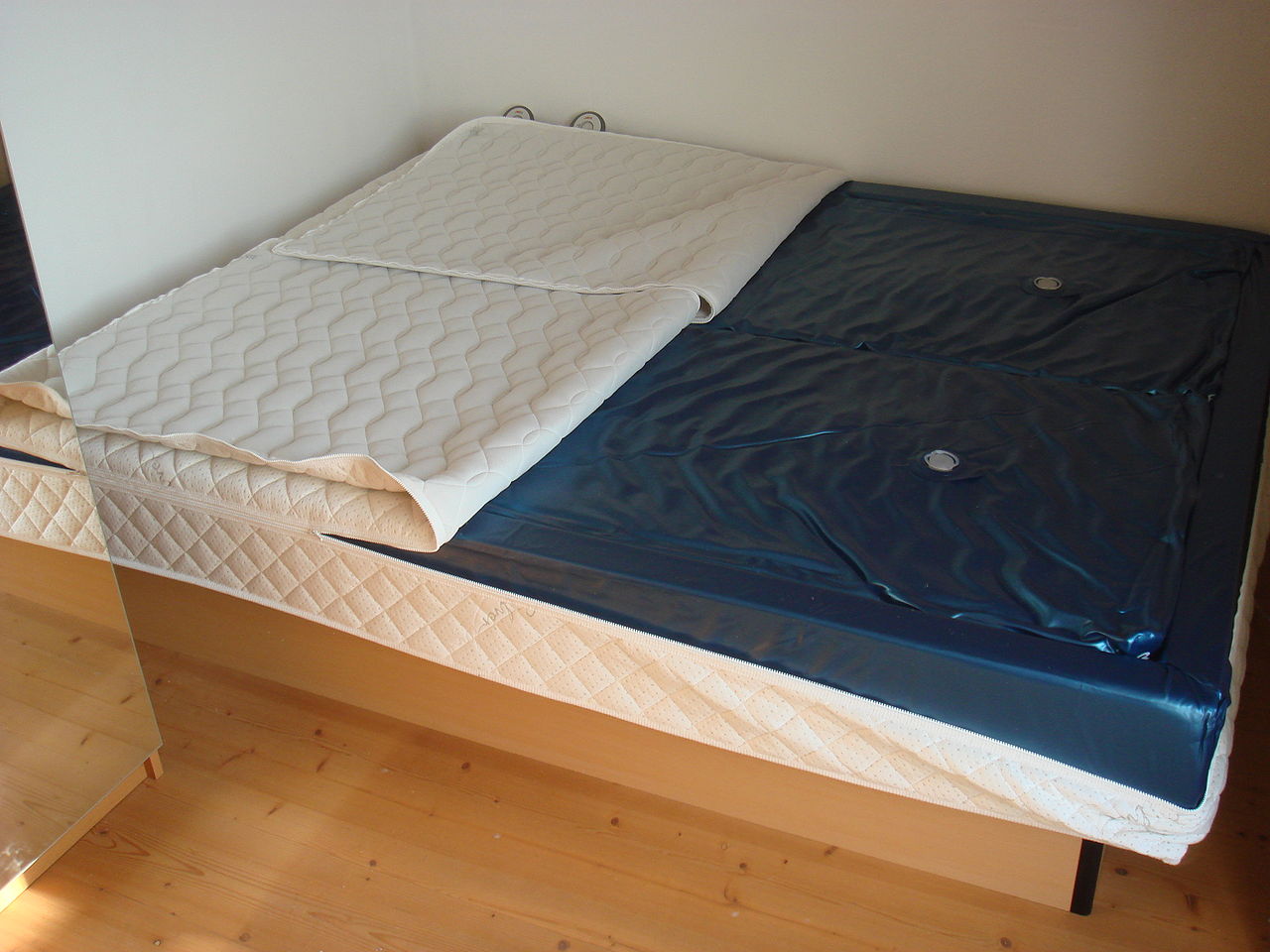
Photographed by Robert Paprstein · Public domain
- Field
- bed · mattress · inflatable
VALÉORINE Encyclopedia
VALÉORINE documentary reading
Documentary summary
A waterbed, water mattress, or flotation mattress is a bed or mattress filled with water. Waterbeds intended for medical therapies appear in various reports through the 19th century. The modern version, invented in San Francisco and patented in 1971, became a popular consumer item in the United States through the 1980s with up to 20% of the market in 1986 and 22% in 1987.
Admitted source layer · organised and presented by VALÉORINE
Note VALÉORINE
No house-authored Note is published until its assertions and sources pass the VALÉORINE evidence contract. The documentary article remains available in full while that enrichment is being consolidated.
Documentary enrichment in progress · no unsupported statement published
Reference Check
Propose documentary evidence for waterbed. A contribution is never written directly as fact: identity, source, rights and evidence gates still decide.
Sign in to contribute
World of VALÉORINE
Documentary connections
Only confirmed graph relationships appear here. Images are shown only when their identity and reuse rights both pass the documentary gate.

Documentary evidence
Evidence Panel
original value insufficient · checked 25 September 2026
- Identity
- resolved
- Independent source families
- 0
- Admitted assertions
- 0
- Open conflicts
- 0
Authority files
wikidata · Q649066 · wikipedia · Waterbed
In this article
Frames
Frames
Waterbeds are typically supported by a specialized frame designed to hold the weight and shape of the water mattress. Hardside waterbeds use a rigid wooden frame that defines the mattress's boundaries and prevents the bladder from expanding outward under pressure. Softside waterbeds use a foam-and-fabric perimeter that forms an internal cavity for the bladder while allowing the bed to resemble a conventional mattress. Both frame types are engineered to distribute the weight of a filled water mattress evenly.
Mattresses
Mattresses
Waterbed mattresses also differ in how much wave motion they allow on the surface: • Free-flow (full-wave) mattresses contain only water without internal baffles or fiber layers, resulting in noticeable wave motion when moving. • Semi-waveless mattresses include some fiber inserts or baffles that reduce wave motion, offering a balance between traditional waterbed feel and motion control. • Waveless mattresses use multiple layers of fiber and baffles to minimize water movement, providing a stable sleeping surface with little to no wave effect. Both hardside and softside mattresses are typically topped with a quilted pad or fitted cover to provide insulation and a traditional sleeping surface.
Safety liners
Safety liners
A safety liner is placed beneath the water mattress to contain leaks and prevent damage to the frame or surrounding furniture. Liners are made from a thick vinyl and are designed to wrap upward around the interior sides of the frame or cavity. In the event of a puncture or seam failure, the liner holds the released water for the mattress to be drained, patched or replaced, reducing the risk of floor damage. Safety liners are required for all hardside and softside waterbeds.
Heaters
Heaters
Waterbeds incorporate an electric heater to regulate the temperature of the water mattress. Heating units are placed beneath the bladder and controlled by an adjustable thermostat that allows precise temperature control, typically between 26 and 32 °C (78–90 °F). A stable temperature is essential for comfort and helps prevent condensation within the mattress. Some waterbeds may use two heaters in dual-chamber systems, allowing each side to maintain a separate temperature. In the event of a power outage, the bed loses its heat source, causing the temperature to drop gradually over time. The rate of cooling depends on factors such as room temperature, insulation, and bedding. Heating a waterbed contributes to household energy consumption, typically using between 300 and 1,500 kWh per year (approximately US$36–180 at 12¢ per kWh), with actual costs varying depending on factors such as climate and bed size. • Illustration — Waterbed heater thermostat control
Water conditioners
Water conditioners
Water conditioners are added to the mattress to prevent the growth of bacteria and algae and to keep the vinyl material supple. These conditioners also help control odor and reduce gas buildup inside the bladder. Most manufacturers recommend adding a conditioner every 6 to 12 months to maintain water quality and extend the life of the mattress. Some conditioner formulas include agents that reduce air bubbles, easing the air removal process after filling. • Illustration — A bottle of waterbed conditioner
Filling and draining
Filling and draining
Waterbeds can be filled or drained using a hose connected to a household tap via a faucet adapter, relying on water pressure to gradually fill the mattress. For draining, a siphoning attachment connected to the faucet allows water to be removed naturally. Alternatively, an electric pump can be used to actively push water in or out of the mattress, speeding up the process and improving efficiency, especially with larger beds. These tools make it possible to adjust the water level, relocate the bed, or perform maintenance. • Illustration — Waterbed fill and drain attachments • Illustration — Waterbed fill and drain pump • Illustration — Hardside waterbed mattress fill valve and padded rails
Features and safety considerations
Features and safety considerations
The waterbed can be comfortable and supportive for many. Its most attractive feature is the form-fitting, pressure-relieving design. This not only adds to overall comfort, but reducing pressure on the spine can provide relief for those with back pain. Additionally, the even weight distribution can help prevent bedsores in individuals who are paralyzed or immobile. Other features include temperature control, letting users keep the bed warm during cold nights or cool in warmer seasons. In addition, they are easy to clean: the surface can be wiped down with a cloth and vinyl cleaner. The mattress cover can be removed and washed regularly. However, The National Institute of Child Health and Human Development warns that the form-fitting nature of a waterbed poses a danger to infants, providing a possibility of asphyxiation.
The Neil Arnott hydrostatic bed
The Neil Arnott hydrostatic bed
A form of waterbed was invented in 1833 by the Scottish physician Neil Arnott. Dr. Arnott's Hydrostatic Bed was devised to prevent bedsores in patients, and comprised a bath of water with a covering of rubber-impregnated canvas, on which lighter bedding was placed. Arnott did not patent it, permitting anyone to construct a bed to this design. The use of a waterbed (for the ailing Mrs. Hale) is mentioned in Elizabeth Gaskell's 1855 novel North and South. On May 18, 1863, a proposal for waterbed supplies was posted to newspapers by the USA Medical and Hospital Department, Medical Purveyor's Office, Washington D.C. The proposal requested a supplier for "water-beds, India Rubber Rubber Cushions, for air or water". In 1871, a waterbed was in use in Elmira, New York, for "invalids". It was briefly mentioned by Mark Twain in his article "A New Beecher Church", which was published in The New York Times on July 23, 1871. Twain wrote: "In the infirmary will be kept one or two water-beds (for invalids whose pains will not allow them to be on a less yielding substance) and half a dozen reclining invalid-chairs on wheels. The water-beds and invalid-chairs at present belonging to the church are always in demand, and never out of service". A newspaper classified want ad in 1877 requested "AN INDIA RUBBER Water-bed. 3 feet by 2 feet, new or second hand. Call immediately at 1,222 Broadway." The protagonist Graham is placed on a waterbed in a glass case during his coma of 203 years in the 1898 H. G. Wells novel "The Sleeper Awakes".
The Charles Hall waterbed
The Charles Hall waterbed
The modern waterbed was created by Charles Prior Hall in 1968, while he was a design student at San Francisco State University in California. Hall originally wanted to make an innovative chair. His first prototype was a vinyl bag chair with 300 pounds (136 kg) of cornstarch. Ultimately, he abandoned working on a chair, and settled on perfecting a bed. Hall was granted a patent (#3,585,356) on his waterbed in 1971, which he originally called "liquid support for human bodies." The same year, he founded Innerspace Environments, a manufacturing and sales company which became the leading retailer of waterbeds in the United States, with 30 owned-and-operated stores. The patent came to trial in 1991 in Intex v. Hall /wbx. The patent was upheld in court, and Hall received a $4.8 million judgment for infringement. Hall /wbx received additional royalties from licensing. Some later lawsuits were dismissed because of laches. In 1987, sales peaked at 22% of the domestic mattress industry. Although the waterbed was initially advertised as offering "undisturbed sleep", Hall admitted that customers "bought it for the sensual or the sexual part of it", and the sexually associated advertising was highly effective in the 1970s and early 1980s. Henry Petroski of Duke University said of the waterbed: "Not only was it the cool new gadget, but it emerged during a time when the culture embraced anything different, especially a product that embodied sexual liberation".
Heinlein descriptions
Science fiction writer Robert A. Heinlein described therapeutic waterbeds in his novels Beyond This Horizon (1942), Double Star (1956), and Stranger in a Strange Land (1961). In 1980, Heinlein recalled in Expanded Universe:Heinlein made no attempt to build his invention, but its first builder, Charles Hall, was denied a patent claim based on Heinlein's "prior works". Apparently, the initial patent application by Charles Hall for the waterbed was denied as being too broad, as the device itself had been described by Heinlein in several of his novels that had been published more than 25 years prior to Hall trying to make one. Hall was later granted a patent when he modified and specified his design.
Notes from the source article
Cited by Wikipedia
Notes from the source article
These works are cited by the source article, in its own numbering. They are recorded as its citations, not as sources VALÉORINE has verified.
- 1.Greenfield, Rebecca. The Rise and Fall of the (Sexy, Icky, Practical) Waterbed. The Atlantic. August 13, 2010.
- 2.What Ever Happened To Waterbeds?. Pocket.
- 3.Williams, Lauren. The Waterbed Doctor: Westminster Retailer Lays Claim to Retro Bed with Nearly 40 Years of Service, Sales. Orange County Register. September 5, 2015.
- 4.Fox, Joanne. Waterbeds no longer a mainstay purchase. Sioux City Journal. March 31, 2013.
- 5.Innomax. Hardside Waterbed Frame Assembly Instructions.
- 6.Innomax. Softside Waterbed Assembly Instructions.
- 7.Tuck Staff. Best Waterbed Mattresses – 2022 Reviews & Buyers Guide. Tuck. 2021.
- 8.Innomax. Waterbed Heater Instructions.
- 9.Are waterbeds good for your back?. Flourish Chiropractic Spa. March 7, 2025.
- 10.Lodder, L. C. H. Prud’homme de. Waterbed conditioners, disinfectants for chemical toilets and rubbish bins. Disinfectant Products Fact Sheet: To assess the risks for the consumer [Internet]. National Institute for Public Health and the Environment. 2006.
- 11.Bioclear. Bioclear Waterbed Conditioner User Instructions.
- 12.Are Waterbeds Good For Your Back?. March 7, 2025.
- 13.Emejulu, Jude-Kennedy C. Does Improvised Waterbed Reduce the Incidence of Pressure Ulcers in Patients with Spinal Injury?. Nigerian Journal of Surgery. 21. 2. 119–123. 2015. 1117-6806.
- 14.https://www.nichd.nih.gov/sites/default/files/2019-04/Safe_to_Sleep_brochure.pdf
- 15.An Encyclopaedia of Domestic Economy, Webster & Parkes, Harper & Brothers, NY, 1855 Google Books
- 16.Dr. Arnott's Hydrostatic Bed, London Medical and Surgical Journal, Volume II, 1833
- 17.Bodenheimer, Rosemarie. North and South: A Permanent State of Change. Nineteenth-Century Fiction. 34. 3. 293. 1979. 10.2307/2933329.
- 18.Humanities, National Endowment for the. Daily national Republican. [volume] (Washington, D.C.) 1862–1866, May 30, 1863, SECOND EDITION, Image 1. Daily national Republican. 1. May 30, 1863. 13879073.
- 19.Humanities, National Endowment for the. The New York herald. [volume] (New York [N.Y.]) 1840–1920, September 14, 1877, Image 18. The New York herald. 16. September 14, 1877. 9467138.
- 20.Garmon, Jay. Geek Trivia: Strange (water)bedfellows. TechRepublic. August 1, 2006.
- 21.Abrams, Carl. Apparently the initial patent application by Charles Hall for the waterbed was denied as being too…. February 25, 2018.
- 22.Modern Living: The Waves of Morpheus. Time. September 7, 1970.
- 23.Kennedy, Pagan. Who Made That Water Bed?. The New York Times Magazine. August 16, 2013.
- 24.United States Court of Appeals for the Federal Circuit. Charles Prior Hall and WBX Partners, Plaintiffs-appellants, v. Aqua Queen Manufacturing, Inc., and Water & Wood Corp., and Vinyl Products Manufacturing, Inc., and Atlanta Vinyl, Inc., and Classic Corporation, d/b/a/ Classic Flotation Sleeping Systems, Inc., and Land & Sky, Ltd., and United States Watermattress Corporation, and Easy Rest, Inc., d/b/a/ Strobel Manufacturing, Defendants-Appellees. July 11, 1996.
- 25.Allen Salkin. For Water Bed Holdout, California Dreaming. The New York Times. August 14, 2003.
- 26.Greenfield, Rebecca. The Rise and Fall of the (Sexy, Icky, Practical) Waterbed. The Atlantic. August 13, 2010.
References
Citations
References
Each reference names the institution holding it, so a reader may go to the document itself.
reference work
Partially resolvedreference work
Partially resolved
Connections
Knowledge graph
Connections
Each connection was recorded deliberately, with the basis for it kept on the internal record.
Broader subject
1- mattressTerminology
Established from a fact already recorded on a verified source.
The Encyclopedia exists whether or not anything is for sale. Corrections are recorded rather than overwritten, and every version of this record is kept. Published 14 August 2026.
Elsewhere in Furniture
924 published records in this field, each with its sources named.
- Wardian caseTerminology
- wardrobeTerminology
- washstandTerminology
- Wassily ChairTerminology
- wax jackTerminology
- weapon mountTerminology
- weapon turretTerminology
- Welsh dresserTerminology
Best supported in this field
For owners
Own an object connected with waterbed?
A specialist will read what you send and tell you what the house can establish, what it cannot, and whether the object is suited to sale. There is no charge and no obligation. The object stays with you throughout; nothing is shipped to us unless it is arranged in writing beforehand.