
Warwick Deeping
Illustration — Portrait of Deeping, published around 1927 George Warwick Deeping (28 May 1877 – 20 April 1950) was an English novelist and short story writer, whose best-known novel was Sorrell and Son (1925).
Warwick Deeping
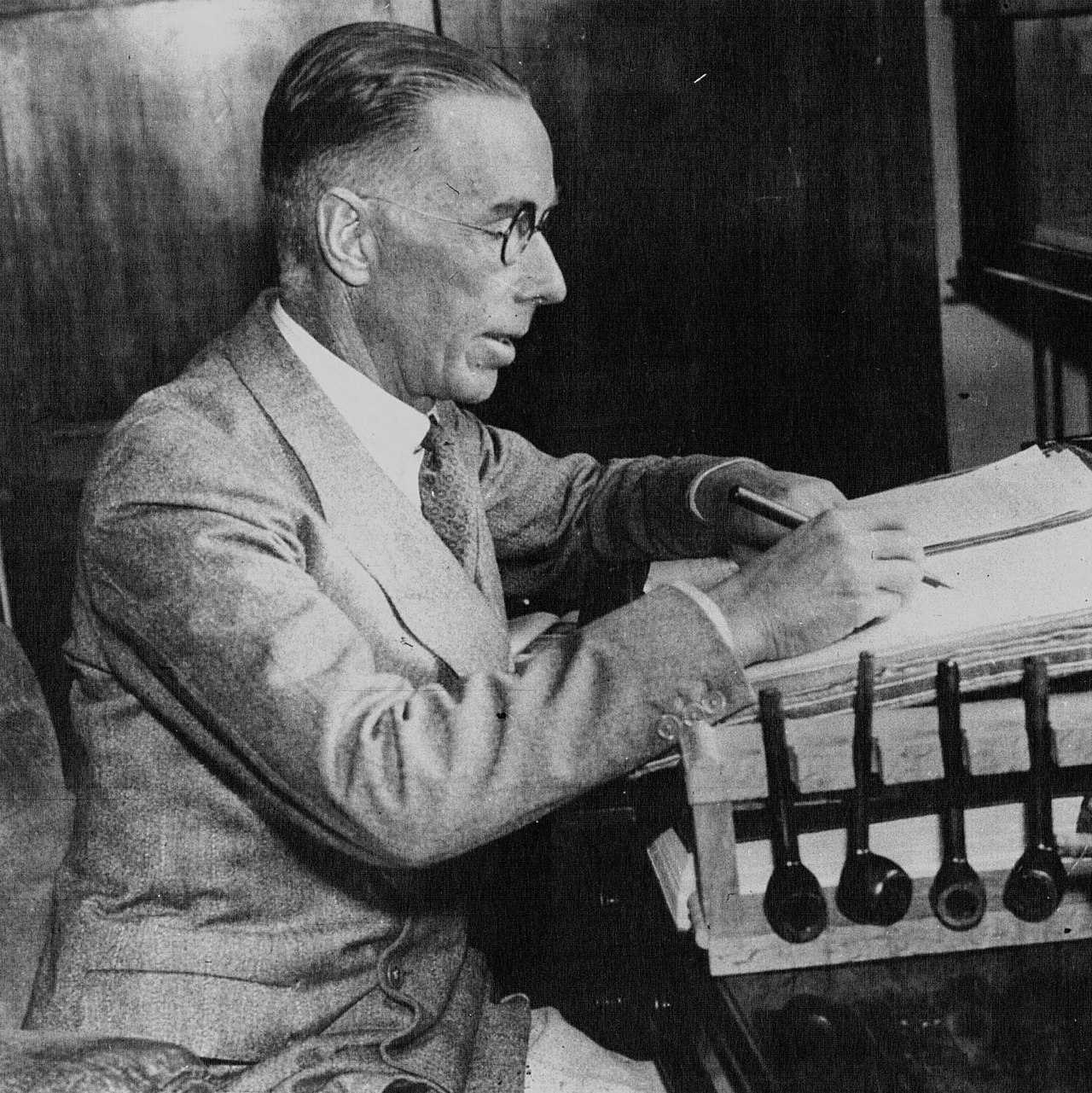
Planet News / Agence Mondial · Bibliothèque nationale de France · Public domain
- Born
- 1877 · Southend-on-Sea.
- Died
- 1950 · Weybridge.
- Nationality
- United Kingdom
- Occupation
- writer
- Education
- Trinity College
- Languages
- English
VALÉORINE Encyclopedia
VALÉORINE documentary reading
Documentary summary
Illustration — Portrait of Deeping, published around 1927 George Warwick Deeping (28 May 1877 – 20 April 1950) was an English novelist and short story writer, whose best-known novel was Sorrell and Son (1925).
Admitted source layer · organised and presented by VALÉORINE
Reference Check
Propose documentary evidence for Warwick Deeping. A contribution is never written directly as fact: identity, source, rights and evidence gates still decide.
Sign in to contribute
World of VALÉORINE
Documentary connections
Only confirmed graph relationships appear here. Images are shown only when their identity and reuse rights both pass the documentary gate.
Documentary evidence
Documentary basis
Authority files
wikidata · Q2550081 · wikipedia · Warwick Deeping
In this article
Life
Life
Born in Southend-on-Sea, Essex, into a family of physicians, Warwick Deeping was educated at Merchant Taylors' School. He proceeded to Trinity College, Cambridge, to study medicine and science (receiving his MA in March 1902), then went to Middlesex Hospital to finish his medical training. During the First World War, he served in the Royal Army Medical Corps. Deeping later gave up his job as a physician to become a full-time writer. He married Phyllis Maude Merrill and lived for the rest of his life in "Eastlands" on Brooklands Road, Weybridge, Surrey. • Illustration — Warwick Deeping in 1932 He was one of the best-selling authors of the 1920s and 1930s, with seven of his novels making the best-seller list. Deeping was a prolific writer of short stories, which appeared in such British magazines as Cassell's, The Story-Teller, and The Strand. He also published fiction in several US magazines, including the Saturday Evening Post and Adventure. All of the short stories and serialised novels in US magazines were reprints of works previously published in Britain. Well over 200 of his original short stories and essays that appeared in various British fiction magazines were never seen in book form during his lifetime.
Themes
Themes
Deeping's early work is dominated by historical romances. His later novels more usually dealt with modern life, and were critical of many tendencies of twentieth-century civilisation. His standpoint was generally that of a passionate individualism, distrustful both of ruling elites and of the lower classes, who were often presented as a threat to his embattled middle-class protagonists. His most celebrated hero is Captain Sorrell M.C., the ex-officer who after the First World War is reduced to a menial occupation in which he is bullied by those of a lower social class and less education. Deeping's novels often deal with controversial issues. In her 2009 study The Ordeal of Warwick Deeping, Mary Grover lists these: • social work and medicine in the slums (Roper's Row, 1929; The Impudence of Youth, 1946; Paradise Place, 1949.) • gender ambiguity (The Return of the Petticoat, 1907) • alcoholism (A Woman's War, 1907; The Woman at the Door, 1937; The Dark House, 1941) • euthanasia (Sorrell and Son (1925); The Dark House, 1941) • wife abuse and justifiable homicide (The Woman at the Door, 1937) • shell shock (The Secret Sanctuary, 1923) • rape (The White Gate, 1913) • pollution of the water supply (Sincerity, 1912)
Places
Named by the record
Places
Only places the record itself states, plotted where the house gazetteer settles their coordinates. Nothing is inferred from a name or a nationality.
Southend-on-Sea.
Birth place
Weybridge.
Death place
Books
Books
• Published posthumously • Time to Heal (1952) • Man in Chains (1953) • The Old World Dies (1954) • Caroline Terrace (1955) • The Serpent's Tooth (1956) • The Sword and the Cross (1957) • The Lost Stories of Warwick Deeping – Volumes I – IX (2013–2024) – A total of over 5000 pages, containing over 250 short stories, novellas, essays and 4 unpublished novels. These works were never published in book form and only appeared in British and American fiction magazines in the 1910s-1930s, such as The Story-Teller, The New Magazine, Cassell's Magazine of Fiction, and The Strand.
Digital editions
Digital editions
* * * * • Works by Warwick Deeping at Project Gutenberg of Australia

Portrait photo of Warwick Deeping
Films
Movies based on Deeping's novels belong, with two exceptions, to the silent era. Unrest was filmed in 1920, Fox Farm in 1922, and Doomsday in 1928. Kitty (1929), directed by Victor Saville, was one of the first British talkies (only the second half of the film had a soundtrack). Sorrell and Son (about an officer who after the First World War finds himself unemployable except in a menial capacity, but who is determined to give his son the best education possible) was filmed three times: It first appeared in 1927 as a silent movie, was remade in 1934 as a sound film, and turned into a TV mini-series in 1984.
Critical reception
Despite his use of controversial themes, Deeping received little recognition as a serious writer. In her influential 1932 book Fiction and the Reading Public, Q. D. Leavis described Warwick Deeping as a "middlebrow" writer. Leavis criticised Deeping and Gilbert Frankau as pretentious writers who worked to "debase the emotional currency by touching grossly on fine issues." Leavis also accused Deeping of anti-intellectualism. Noting several disparaging references to "highbrows" that appeared in Deeping's novels, Leavis wrote that Deeping's writings " exhibit a persistent hostility to the world of letters which is quite unprecedented." Graham Greene also criticized Deeping's work; in his 1936 book Journey Without Maps Greene includes Deeping's novels on a list of books "written without truth, without compulsion, one dull word following another." George Orwell, whose political beliefs were very different from Deeping's, dismissed Deeping in his 1940 essay "Inside the Whale" as being among the 'huge tribe' of writers who 'simply don't notice what is happening'. By contrast, Kingsley Amis gave some guarded praise for Deeping's work. Amis read Deeping's Sorrell and Son and initially disliked the book. However, in a later interview Amis praised Sorrell and Son, saying "Its sensibility was very crude but it delivered". Martin Seymour-Smith argued that the majority of Deeping's novels "have little literary merit." However, Seymour-Smith added "Sorrell and Son, however, does have some force behind its complacency - and is better written than the other sixty-odd books."
Primary material
Documents and archives
reference work
- “Warwick Deeping”, English Wikipedia, consulted as further reading
Reputable secondary · Wikipedia
authority record
- Wikidata, structured authority record Q2550081: Warwick Deeping
General reference · Wikidata
Citations
References
Each reference names the institution holding it, so a reader may go to the document itself.
reference work
Secondary witnessauthority record
General reference
The Encyclopedia exists whether or not anything is for sale. Corrections are recorded rather than overwritten, and every version of this record is kept. Published 20 August 2026.
Elsewhere in Books
39,529 published records in this field, each with its sources named.
- Warren HopeAuthor
- Warren WeaverAuthor
- Warsame Shire AwaleAuthor
- Warsan ShireAuthor
- Wasef BakhtariAuthor
- Washington AllstonAuthor
- Washington CucurtoAuthor
- Wáshington Delgado TresierraAuthor
Best supported in this field
For owners
Own a work by Warwick Deeping?
A specialist will read what you send and tell you what the house can establish, what it cannot, and whether the object is suited to sale. There is no charge and no obligation. The object stays with you throughout; nothing is shipped to us unless it is arranged in writing beforehand.