
viola da braccio
Viola da braccio (from Italian "arm viola", plural viole da braccio) is a term variously applied during the baroque period to instruments of the violin family, in distinction to the viola da gamba ("leg viola") and the viol family to which the latter belongs. At first "da braccio" seems to encompass the entire violin family. Monteverdi's Orfeo (printed 1609) designates an entire six-part string section "viole da brazzo", apparently including bass instruments held between the knees like the cello and bass violin.
viola da braccio
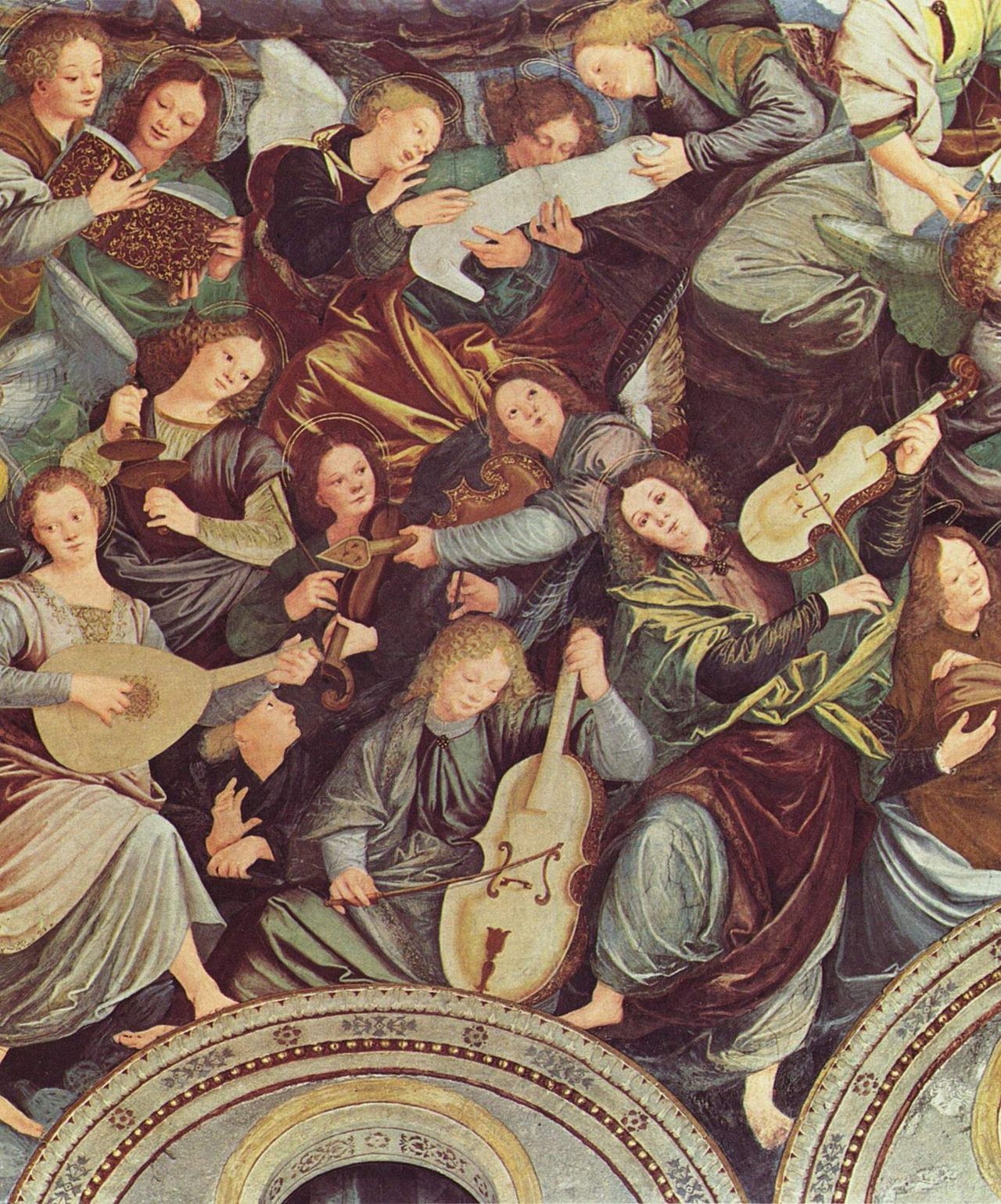
Gaudenzio Ferrari · The Yorck Project (2002) 10.000 Meisterwerke der Malerei (DVD-ROM), distributed by DIRECTMEDIA Publishing GmbH. ISBN: 3936122202. · Public domain
- Field
- viol family.
VALÉORINE Encyclopedia
VALÉORINE documentary reading
Documentary summary
Viola da braccio (from Italian "arm viola", plural viole da braccio) is a term variously applied during the baroque period to instruments of the violin family, in distinction to the viola da gamba ("leg viola") and the viol family to which the latter belongs. At first "da braccio" seems to encompass the entire violin family. Monteverdi's Orfeo (printed 1609) designates an entire six-part string section "viole da brazzo", apparently including bass instruments held between the knees like the cello and bass violin.
Admitted source layer · organised and presented by VALÉORINE
Note VALÉORINE
No house-authored Note is published until its assertions and sources pass the VALÉORINE evidence contract. The documentary article remains available in full while that enrichment is being consolidated.
Documentary enrichment in progress · no unsupported statement published
Reference Check
Propose documentary evidence for viola da braccio. A contribution is never written directly as fact: identity, source, rights and evidence gates still decide.
Sign in to contribute
Documentary evidence
Evidence Panel
wikipedia incomplete · checked 25 September 2026
- Identity
- resolved
- Independent source families
- 0
- Admitted assertions
- 0
- Open conflicts
- 0
Authority files
gnd · 4229884-2 · wikidata · Q570544 · wikipedia · Viola da braccio
In this article
Differences from viola da gamba
Differences from viola da gamba
His Selva morale (1641) contains a piece calling for "due violini & 3 viole da brazzo ouero 3 Tronboni" (2 violins & 3 viole da braccio or trombones), reflecting a general shift in meaning towards the lower instruments. Eventually it came to be reserved for the alto member, the viola. A famous example is Bach's Sixth Brandenburg Concerto (1721), combining two viole da braccio with two viole da gamba. The German word for viola, Bratsche, is a relic of this last use.
The families of the viola da braccio and the viola da gamba differ in size and form, the string tuning (viola da braccio in fifth tuning – viola da gamba in fourth tuning) as well as in the posture (viola da braccio = arm position, exception: bass-viola da braccio – viola da gamba = knee position) as well as in the bow position (viola da braccio = overbow grip – viola da gamba = underbow grip).
History and development
History and development
Over the centuries of history in the violin and viola da gamba families, there had been a constant development into the present form of the modern instruments known to us as violins, violas and cellos. The double bass, however, developed from both the violone and the bass-viola da gamba. The first instruments of the viola da braccio family were built in Italy about 1530. After an early form with three strings, a four-stringed version without string frets was developed with tuning in fifths. In this family, there were also different sizes and tunings, with different names based on pitch. There were soprano, alto, tenor and bass viola da braccio. The alto viola da braccio's tuning is comparable to today's viola. The tuning for this alto viola da braccio was first recorded in the 16th century first (f-c'-g'-d") but was later tuned lower and is now the same tuning as modern violas. The tenor viola da braccio’s tuning was first tuned a minor third higher (B♭-f-c'-g') and later tuned lower (G-d-a-e') and is now comparable to tenor violin’s tuning. The soprano viola's tuning corresponded to today's violin, and the bass viola's tuning is the same as a modern-day cello's tuning.

Bulletin - United States National Museum
United States National Museum · https: Source book page

Portada del manuscrito del Requiem en la de Biber.
Heinrich Biber (1644-1704) · Page de titre manuscrite du "Requiem à 15" de Heinrich Biber (ca. 1687)
Primary material
Documents and archives
authority file
- Gemeinsame Normdatei 4229884-2, Viola da braccio.
Unverified · Deutsche Nationalbibliothek
authority record
- Wikidata, structured authority record Q570544: viola da braccio
Unverified · Wikidata
reference work
- “Viola da braccio”, English Wikipedia, consulted as further reading
Reputable secondary · Wikipedia
Notes from the source article
Cited by Wikipedia
Notes from the source article
These works are cited by the source article, in its own numbering. They are recorded as its citations, not as sources VALÉORINE has verified.
- 1.Holman, Peter. Viola da braccio.
- 2.Geschichte – Vienna Symphonic Library.
- 3.Geschichte – Vienna Symphonic Library.
References
Citations
References
Each reference names the institution holding it, so a reader may go to the document itself.
authority file
Gemeinsame Normdatei 4229884-2, Viola da braccio.Deutsche Nationalbibliothek
Partially resolvedauthority record
Partially resolvedreference work
Partially resolved
The Encyclopedia exists whether or not anything is for sale. Corrections are recorded rather than overwritten, and every version of this record is kept. Published 14 August 2026.
Elsewhere in Collectables
20,755 published records in this field, each with its sources named.
- viola beiroaTerminology
- viola caipiraTerminology
- viola campaniçaTerminology
- viola d'amoreTerminology
- viola da TerceiraTerminology
- Viola da terraTerminology
- Viola de arameTerminology
- viola de buritiTerminology
Best supported in this field
For owners
Own an object connected with viola da braccio?
A specialist will read what you send and tell you what the house can establish, what it cannot, and whether the object is suited to sale. There is no charge and no obligation. The object stays with you throughout; nothing is shipped to us unless it is arranged in writing beforehand.