
Victòria Pujolar Amat
Victòria Pujolar Amat (26 July 1921 – 24 June 2017) was a Spanish Republican activist and member of the Unified Socialist Party of Catalonia. Subject to reprisals by Franco's regime, she suffered torture, imprisonment and exile. She lived in France, Czechoslovakia and Romania.
Also recorded as Victòria Pujolar
Victòria Pujolar Amat

Generalitat de Catalunya · https: dones.gencat.cat/ca/ambits/activitats/commemoracions/-100-anys-del-naixement-de-victoria-pujolar-i-amat/ · CC0
- Born
- 26 July 1921
- Birthplace
- Barcelona
- Died
- 24 June 2017
- Place of death
- Madrid
- Occupation
- Spanish Republican activist, painter, radio broadcaster
- Nationality
- Spain.
- Education
- Mútua Escolar Blanquerna, Instituto-Escuela and Bucharest National University of Arts.
- Languages
- Spanish and Catalan.
VALÉORINE Encyclopedia
VALÉORINE documentary reading
Documentary summary
Victòria Pujolar Amat (26 July 1921 – 24 June 2017) was a Spanish Republican activist and member of the Unified Socialist Party of Catalonia. Subject to reprisals by Franco's regime, she suffered torture, imprisonment and exile. She lived in France, Czechoslovakia and Romania.
Admitted source layer · organised and presented by VALÉORINE
Reference Check
Propose documentary evidence for Victòria Pujolar Amat. A contribution is never written directly as fact: identity, source, rights and evidence gates still decide.
Sign in to contribute
World of VALÉORINE
Documentary connections
Only confirmed graph relationships appear here. Images are shown only when their identity and reuse rights both pass the documentary gate.
Documentary evidence
Documentary basis
Authority files
wikidata · Q61059689 · wikipedia · Victòria Pujolar
In this article
Biography
Biography
She never gave up the political struggle and was the first voice in Catalan on the clandestine Radio España Independiente, popularly known as La Pirenaica, based in Bucharest. She was also a sportswoman and painter.

portrait de Victoria Amat fait en 1947 par Francisco Boix
Jorgeamat
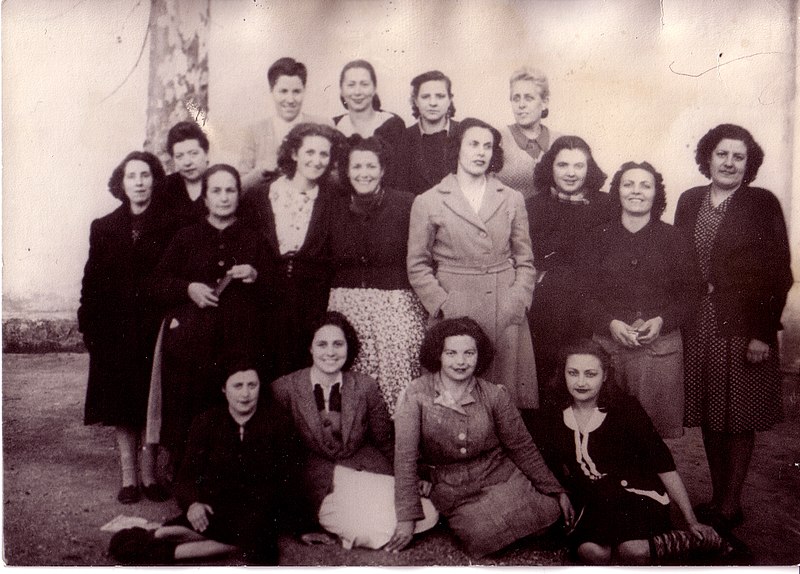
Victoria Amat à la prison del Corts Barcelone en 1945
Jorgeamat
Key facts
Key facts
• Born — 26 July 1921 • Birthplace — Barcelona • Died — 24 June 2017 • Place of death — Madrid • Occupation — Spanish Republican activist, painter, radio broadcaster • Illustration — Heritage interpretation board at Vía Layetana police station in Barcelona.
Early life
Early life
Victòria Pujolar Amat was born in Barcelona on 26 July 1921 into a progressive family. Her father Joan Pujoar Marich was an employee of the Generalidad de Cataluña and her mother Merè Amat Duran worked at the Registro Civil. She was very fond of art and sport as a child. She attended primary school at the Mutua Escolar Blanquerna, and high school at the Instituto Escuela de la La Barceloneta, Barcelona.
Spanish Civil War and Second World War
Spanish Civil War and Second World War
She lived through the Spanish Civil War and the bombing of Barcelona. In 1939, with the defeat of the Republican side in the Spanish Civil War, the teenage Victòria went into exile with her parents in Toulouse, France. During the Second World War, when the area was under German occupation, she was intercepted without papers and interned in the Récébédou concentration camp, south of Toulouse. She managed to escape the camp with her sister and mother. Pujolar joined the Unified Socialist Youth (JSU) of the Unified Socialist Party of Catalonia (PSUC) and in 1944 returned to Barcelona to join the anti-fascist resistance. She found work as editor on the first Vox dictionary and later in the graphic studio of Editorial Bruguera. She was appointed secretary general of the Joventut Socialista Unificada de Catalunya (JSUC). She was given the pseudonym Anna and with her elegant appearance as a Chica del Eixample (young woman from Eixample), she managed to go unnoticed and organised guerrilla contacts in the city. A denunciation led to her arrest and the arrest of several militants, among them the guerrilla Francesc Serrat Pujolar Sisquet, head of the JSU, who was later shot. Taken to the cellars of the Vía Layetana police station, she was interrogated, abused and tortured by the brothers Vicente and Antonio Juan Creix, sinister policemen of the Brigada Político-Social under the orders of Commissioner Eduardo Quintela. Incarcerated in the Les Corts Women's Prison for more than a year while awaiting trial, Pujolar exercised an important leadership role among the inmates, promoting the practice of sport and becoming captain of the prison basketball team. She also painted the sets for some of the theatrical performances organised by the nuns for special occasions. Victoria's time at the prison coincided with the communists Tomasa Cuevas, Isabel Vicente García, Angela Ramis and the Madrid born Adelaida Abarca Izquierdo who had been a teenage member of the Las Trece Rosas group, sentenced to 20 years in prison instead of execution due to her youth. Thanks to her organisational skills, Abarca had become a trustworthy prisoner and took advantage of her sentence to work in the prison office. She manipulated letters, files and records, to facilitate the escape of Victoria Pujolar in conjunction with the contacts they maintained with Party members inside and outside the prison. Pujolar was able to escape, on the occasion of her transfer to Madrid to be court-martialled. Shortly afterwards, Adelaida Abarca and Ángela Ramis also escaped the prison.
Exile
Exile
• Illustration — Victòria Pujolar Amat in a photograph by Francisco Boix in 1947 With the complicity of friends and family, Pujolar managed to cross the French border and reach her parents' home in Toulouse. In 1947, she met the journalist and communist leader Federico Melchor Fernández, who had just returned from exile in Mexico, and they married and had four children. The couple had settled in Paris when, in response to the Cold War, the French government expelled all foreign communist leaders from the country. They decided to emigrate to Prague, where they met Teresa Pàmies. Later, Federico Melchor was called to Bucharest in Romania to direct Radio España Independiente (REI) and there they coincided with the Catalan collective, including Josep Bonifaci i Mora and later Jordi Solé Tura. Emili Vilaseca, the person in charge of REI broadcasting in Catalan, suggested to Pujolar that she take a voice test, and so she becoming the first female announcer. She addressed the listeners of the clandestine Radio Pirenaica in Catalan, under the nickname Montserrat Canigó, a job she alternated for years with her study of painting and fine arts at the Nicolae Grigorescu Fine Arts Institute.
Return to Spain
Return to Spain
In 1966 the family returned to Paris and Pujolar collaborated with Dolores Ibarruri and Irene Falcón in Mujeres Españolas Antifascistas and worked as a layout artist and illustrator on the editorial staff of Mundo Obrero until 1974. The death of the Spanish dictator Francisco Franco opened the way for the Spanish transition to democracy. The legalisation of the Communist Party of Spain (PCE) allowed the couple to move to Madrid. Federico Melchor continued to manage the Mundo Obrero publication and was a member of the executive committee of the Communist Party of Spain until his death in 1985. Pujolar devoted herself fully to painting and held three retrospective exhibitions, in Paris in 1992, in the Sala Blanquerna in Madrid in 2002 and in the Francesca Bonnemaison library in Barcelona in 2005. Victòria Pujolar Amat died in Madrid on 24 June 2017, age 95.
Recognition and commemoration
Recognition and commemoration
In 2016, Pujolar's son Jorge Amat, a French filmmaker, dedicated the documentary La memoria rota (Broken Memory) to her. In 2021 the Catalan Women's Institute promoted the commemoration of the centenary of Pujolar's birth, supported by the Government of the Generalitat de Catalunya, including the publication of a biographical book and various exhibitions. In January 2022 the exhibition of her artistic work ‘Victòria Pujolar Amat. Diari Íntim’ was opened at the Felícia Fuster Foundation in Barcelona, curated by the art historian Esther Rodríguez Biosca. The journalist Elvira Altés curated the exhibition "Qui és Victòria Pujolar Amat?".
Identity and origins
Identity and origins
She also worked under the name Montserrat Canigó. The authorities additionally record the heading Victòria Pujolar. Her recorded languages were Spanish and Catalan. She married Federico Melchor. One child is recorded: Jorge Amat.
Life and career
Dated record
Life and career
The full dated record · 2 entries
1921
Victòria Pujolar Amat born at Barcelona.
2017
Victòria Pujolar Amat died at Madrid.
Places
Named by the record
Places
Only places the record itself states, plotted where the house gazetteer settles their coordinates. Nothing is inferred from a name or a nationality.
Barcelona.
Birth place
Madrid.
Death place
Primary material
Documents and archives
reference work
- “Victòria Pujolar”, English Wikipedia, consulted as further reading
Reputable secondary · Wikipedia
authority record
- Wikidata, structured authority record Q61059689: Victòria Pujolar Amat
General reference · Wikidata
Literature
Scholarly footprint
A count of publications is evidence of attention, not of standing, and is given here only as a measure.
Notes from the source article
Cited by Wikipedia
Notes from the source article
These works are cited by the source article, in its own numbering. They are recorded as its citations, not as sources VALÉORINE has verified.
- 1.100 anys del naixement de Victòria Pujolar Amat (2021). Orígens. 2021.
- 2.Salabert, Juana. Hijas de la ira - Vidas rotas por la guerra civil- (Capítol dedicat a Victòria Pujolar Amat, pàginas 131-168). Random House Mondadori, S.A. 232. 2005. 84-01-37913-X.
- 3.Martí Garcia Ripoll-Duran i Cinto Niqui Espinosa. La ràdio en català a l'estranger (Victòria Pujolar- pag. 89). Universitat Autònoma de Barcelona. 109. 2007. 978-84-490-2499-3.
- 4.4.1.2 La ràdio en català a l'exili dones i noves tecnologies codi lela.
- 5.Victoria Pujolar Amat: Los colores de la resistencia. 9 April 2018.
- 6.Mundo Obrero despide a Victoria Pujolar Amat, una de las camaradas que hicieron posible este periódico. Mundo Obrero.
- 7.Qui és Victòria Pujolar Amat?.
- 8.Jofre Padullers, Manuel Delgado Ruiz i Gerard Horta. Lluites secretes - Testimonis de la clandestinitat antifranquista pàg. 27. Publicacions i edicions Universitat de Barcelona. 2012. 978-84-475-3559-0.
- 9.Borràs, Xavier. Olot recordarà el maquisard Francesc Serrat amb una placa al carrer on va néixer. Diari Digital Garrotxa.cat. 22 October 2018.
- 10.Theros, Xavier. La casa de los horrores. El País. 2012-08-14. 1134-6582.
- 11.2016-01-21.
- 12.Cuevas, Tomasa. Presas (Mujeres en las carceles Franquistas) Capítol XX: Victòria Pujolar - Breve historia de una detención interrumpida. Pàgines 155 a 160. Icaria. 176. 2005. 9788474268300.
- 13.Cronologia Presó de les Corts.
- 14.Cuevas, Tomasa. Presas (Mujeres en las carceles Franquistas) Capítol XXI La fuga - testimoni d'Adelaida Abarca. Icaria editorial, S, A. 176. 2005. 9788474268300.
- 15.Melchor, Federico. Federico Melchor:Testimonio de una vida (El viejo topo). Intervención Cultural - Colección memorias. 320. 2010. 9788492616701.
- 16.Casademont Comas, Emili. En Solé Tura, el de la Pirenaica. Diari de Girona. 13 December 2009.
- 17.Pàmies, Teresa. Ràdio Pirenaica- Emissions en llengua catalana de Radio España Independiente. Capítol dedicat a Victòria Pujolar pàg. 48 a 54. Cossetània. 2007.
- 18.La Resistencia - La Memoria rota- (Cineteca) Documental de Jorge Amat - Cerca amb Google.
- 19.100 anys del naixement de Victòria Pujolar Amat (2021). Materialsː Dossier. 2021.
- 20.Una exposició mostra el llegat artístic de la lluitadora antifeixista Victòria Pujolar Amat.
- 21.El Any Victòria Pujolar Amat contará con una biografía y una exposición itinerante. 2021-07-26.
- 22.Qui és Victòria Pujolar Amat?. Institut Català de les Dones.
References
Citations
References
Each reference names the institution holding it, so a reader may go to the document itself.
reference work
Secondary witnessauthority record
General reference
Further particulars
Held on the record
Further particulars
Open the remaining particulars
Victòria Pujolar Amat studied at Mútua Escolar Blanquerna, Instituto-Escuela and Bucharest National University of Arts.
The Encyclopedia exists whether or not anything is for sale. Corrections are recorded rather than overwritten, and every version of this record is kept. Published 16 August 2026.
Elsewhere in Illustration
5,224 published records in this field, each with its sources named.
- Victor LagyeIllustrator
- Victor PalmovIllustrator
- Victor ReinganumIllustrator
- Victor ServranckxIllustrator
- Victoria ScalisiIllustrator
- Viktor GrebennikovIllustrator
- Viktor KovalIllustrator
- Viktor OlivaIllustrator
Best supported in this field
For owners
Own a work by Victòria Pujolar Amat?
A specialist will read what you send and tell you what the house can establish, what it cannot, and whether the object is suited to sale. There is no charge and no obligation. The object stays with you throughout; nothing is shipped to us unless it is arranged in writing beforehand.