
VB-6 Felix
The VB-6 Felix was a precision-guided munition developed by the United States during World War II. It used an infrared seeker to attack targets like blast furnaces or the metal roofs of large factories. The war ended before it could be used operationally.
VB-6 Felix
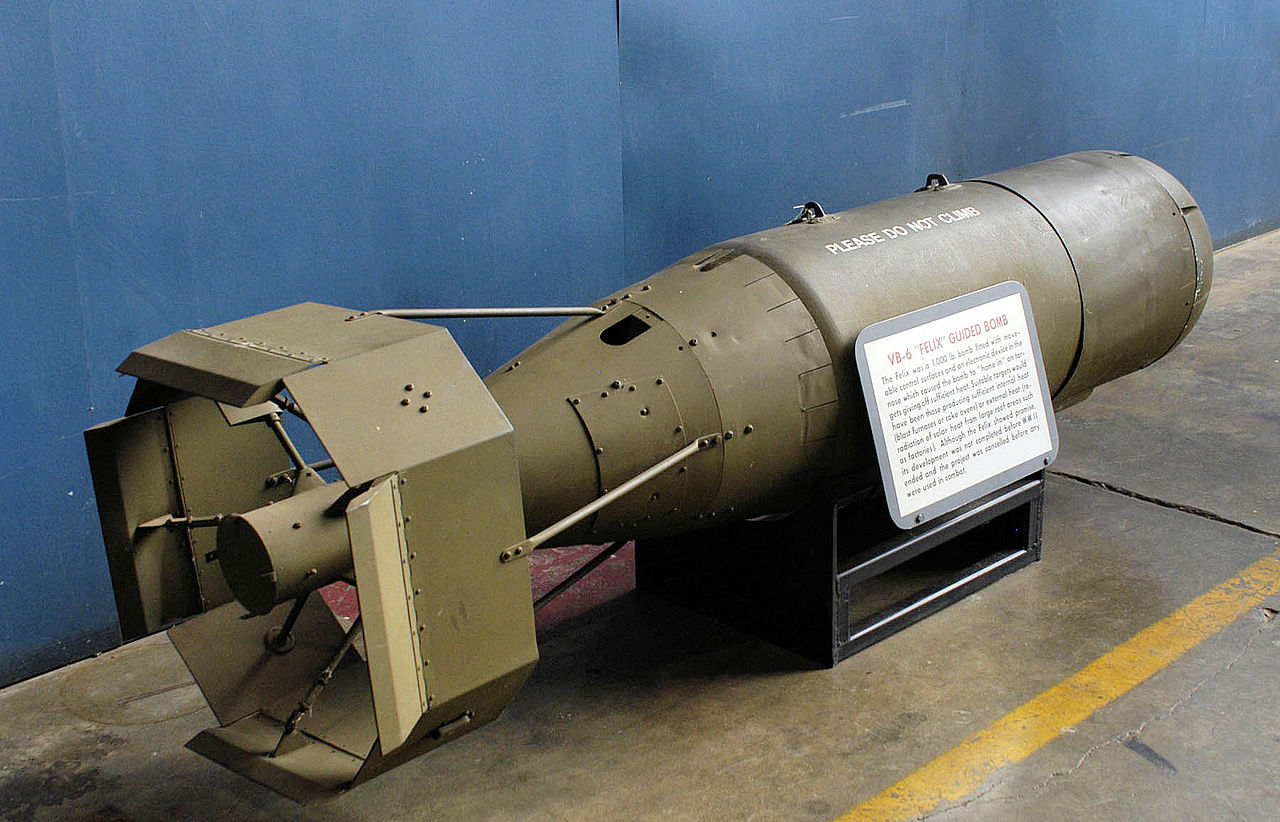
United States Air Force · Public domain
- Name
- VB-6 Felix
- Field
- guided bomb · anti-ship weapon
- Region
- United States
VALÉORINE Encyclopedia
VALÉORINE documentary reading
Documentary summary
The VB-6 Felix was a precision-guided munition developed by the United States during World War II. It used an infrared seeker to attack targets like blast furnaces or the metal roofs of large factories. The war ended before it could be used operationally.
Admitted source layer · organised and presented by VALÉORINE
Note VALÉORINE
No house-authored Note is published until its assertions and sources pass the VALÉORINE evidence contract. The documentary article remains available in full while that enrichment is being consolidated.
Documentary enrichment in progress · no unsupported statement published
Reference Check
Propose documentary evidence for VB-6 Felix. A contribution is never written directly as fact: identity, source, rights and evidence gates still decide.
Sign in to contribute
World of VALÉORINE
Documentary connections
Only confirmed graph relationships appear here. Images are shown only when their identity and reuse rights both pass the documentary gate.

Documentary evidence
Evidence Panel
not yet certified
- Identity
- resolved
- Independent source families
- 0
- Admitted assertions
- 0
- Open conflicts
- 0
Authority files
wikidata · Q7906578 · wikipedia · VB-6 Felix
In this article
Key facts
Key facts
• Name — VB-6 Felix • Origin — United States • Type — anti-ship missile / guided bomb • Is Explosive — yes • Is Missile — yes • Service — never used operationally • Wars — World War II • Designer — National Defense Research Committee • Production Date — 1945 • Weight — 1202 lb (545 kg) • Length — 91.2 in (231.6 cm) • Diameter — 18.6 in (47.2 cm) • Filling — amatol explosive • Filling Weight — 1000 pounds (454 kg) • Engine — none • Payload Capacity — 1000 pounds (454 kg) • Guidance — Infrared homing
History
History
Created by the National Defense Research Committee, Felix relied on infrared to detect and home on heat-emitting targets in clear weather; blast furnaces were considered a particularly practical target for such a weapon, as were the reflective metal roofs of factory buildings. It was this property which earned the weapon its name, after the ability of cats to see in the dark; Felix the Cat was an extremely popular cartoon character at the time. Felix was a 1000-pound (454 kg) general purpose (GP) bomb with an infrared seeker in the nose and octagonal guidance fins in the tail. Unlike other weapons, such as the German Fritz X, Felix was autonomous once launched, although there was a flare in the tail for tracking. In tests, Felix demonstrated a circular error probable of 85 ft. Successful trials led to Felix being put in production in 1945, but the Pacific War ended before it entered combat.
Dove
Dove
• Illustration — Remnant of a Dove bomb excavated at the former Camp Wellfleet in the late 1990s, where a bombing practice target was located in the 1940s. A naval version of the Felix, the ASM-N-4 Dove, was approved in 1944; in 1946 the project was transferred to Eastman Kodak, and in 1949 a contract for 20 prototype weapons was issued. Dove's infrared seeker was expected to be capable of correcting 400 m aiming errors; trials took place through 1952, but no production was undertaken.
Weapons of comparable role, performance and era
Weapons of comparable role, performance and era
• Bomb MK 57 Bat (U.S. Navy radar-guided glide bomb) • PC 1400 X (Fritz X) • LBD Gargoyle • Azon • GB-4 • GB-6 • Bat • Mitsubishi Ki-147 (I-Gо̄ Model 1 Kо̄) • Kawasaki Ki-148 (I-Gо̄ Model 1 Otsu) • Ke-Go • Nikitin PSN-1 • Nikitin PSN-2 • SNAB-3000 *
Places
Named by the record
Places
Only places the record itself states, plotted where the house gazetteer settles their coordinates. Nothing is inferred from a name or a nationality.
- United States
Notes from the source article
Cited by Wikipedia
Notes from the source article
These works are cited by the source article, in its own numbering. They are recorded as its citations, not as sources VALÉORINE has verified.
- 1.Ordway and Wakeford 1960, p.124.
- 2.VB-6 Felix Guided Bomb. National Museum of the United States Air Force. 8 June 2015.
- 3.Gunston 1988, p.30.
- 4.Parsch 2003a
- 5.Final Former Camp Wellfleet Engineering Evaluation/Cost Analysis. Prepared by Foster Wheeler Environmental Corporation, May 2000, for U.S Army Engineering and Support Center, Huntsville, Alabama.
- 6.Parsch 2003b
References
Citations
References
Each reference names the institution holding it, so a reader may go to the document itself.
reference work
Partially resolvedreference work
Partially resolved
The Encyclopedia exists whether or not anything is for sale. Corrections are recorded rather than overwritten, and every version of this record is kept. Published 14 August 2026.
Elsewhere in Militaria
6,095 published records in this field, each with its sources named.
- varmint rifleTerminology
- VarunastraTerminology
- VB Berapi LP06Terminology
- VB rifle grenadeTerminology
- VCM-01Terminology
- VE 10 AigleTerminology
- Vektor CP1Terminology
- Vektor CR-21Terminology
Best supported in this field
For owners
Own an object connected with VB-6 Felix?
A specialist will read what you send and tell you what the house can establish, what it cannot, and whether the object is suited to sale. There is no charge and no obligation. The object stays with you throughout; nothing is shipped to us unless it is arranged in writing beforehand.