
useless machine
Illustration — A modern "useless machine" about to turn itself off A useless machine or useless box is a device whose only function is to turn itself off. The best-known useless machines are those inspired by Marvin Minsky's design, in which the device's sole function is to switch itself off by operating its own "off" switch. Such machines were popularized commercially in the 1960s and sold as an amusing engineering hack or as a joke.
Also recorded as ultimate machine
useless machine
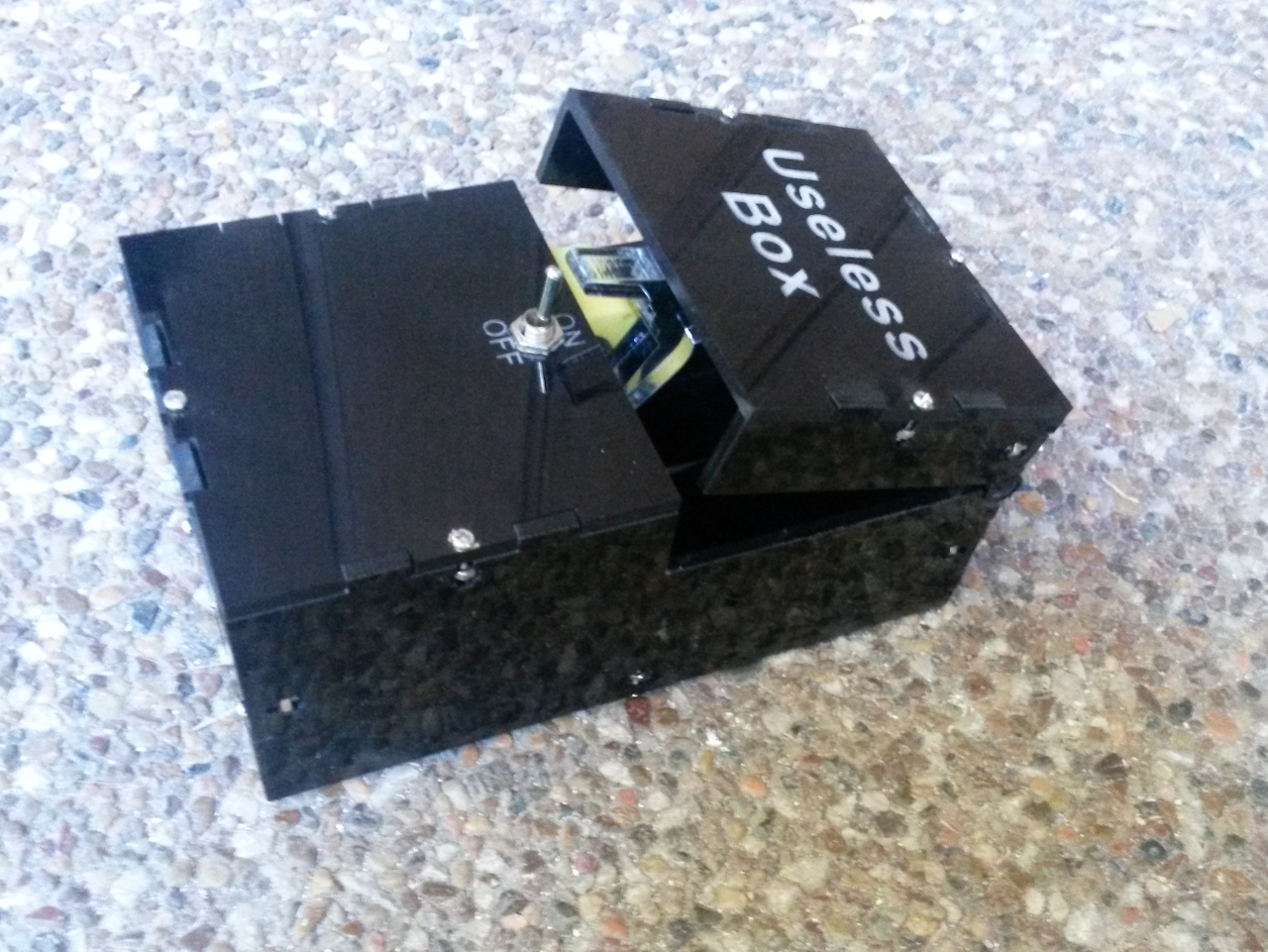
Drpixie · CC BY-SA 4.0
- Field
- machine · office toy
VALÉORINE Encyclopedia
VALÉORINE documentary reading
Documentary summary
Illustration — A modern "useless machine" about to turn itself off A useless machine or useless box is a device whose only function is to turn itself off. The best-known useless machines are those inspired by Marvin Minsky's design, in which the device's sole function is to switch itself off by operating its own "off" switch. Such machines were popularized commercially in the 1960s and sold as an amusing engineering hack or as a joke.
Admitted source layer · organised and presented by VALÉORINE
Note VALÉORINE
No house-authored Note is published until its assertions and sources pass the VALÉORINE evidence contract. The documentary article remains available in full while that enrichment is being consolidated.
Documentary enrichment in progress · no unsupported statement published
Reference Check
Propose documentary evidence for useless machine. A contribution is never written directly as fact: identity, source, rights and evidence gates still decide.
Sign in to contribute
World of VALÉORINE
Documentary connections
Only confirmed graph relationships appear here. Images are shown only when their identity and reuse rights both pass the documentary gate.
Documentary evidence
Evidence Panel
not yet certified
- Identity
- resolved
- Independent source families
- 0
- Admitted assertions
- 0
- Open conflicts
- 0
Authority files
wikidata · Q17113285 · wikipedia · Useless machine
In this article
History
History
More elaborate devices and some novelty toys, which have an obvious entertainment function, have been based on these simple useless machines.
The Italian artist Bruno Munari began building "useless machines" (macchine inutili) in the 1930s. He was a "third generation" Futurist and did not share the first generation's boundless enthusiasm for technology but sought to counter the threats of a world under machine rule by building machines that were artistic and unproductive. • Illustration — A wooden "useless box" The version of the useless machine that became famous in information theory (basically a box with a simple switch which, when turned "on", causes a hand or lever to appear from inside the box that switches the machine "off" before disappearing inside the box again) appears to have been invented by MIT professor and artificial intelligence pioneer Marvin Minsky, while he was a graduate student at Bell Labs in 1952. Minsky dubbed his invention the "ultimate machine", but this nomenclature did not catch on. The device has also been called the "Leave Me Alone Box". Minsky's mentor at Bell Labs, information theory pioneer Claude Shannon (who later became an MIT professor himself), made his own versions of the machine. He kept one on his desk, where science fiction author Arthur C. Clarke saw it. Clarke later wrote, "There is something unspeakably sinister about a machine that does nothing—absolutely nothing—except switch itself off", and he was fascinated by the concept. Minsky also invented a "gravity machine" that would ring a bell if the gravitational constant were to change, a theoretical possibility that is not expected to occur in the foreseeable future.
Commercial products
Commercial products
In the 1960s, a novelty toy maker called "Captain Co." sold a "Monster Inside the Black Box", featuring a mechanical hand that emerged from a featureless plastic black box and flipped a toggle switch, turning itself off. This version may have been inspired in part by "Thing", the disembodied hand featured in the television sitcom The Addams Family. Other versions have been produced. In their conceptually purest form, these machines do nothing except switch themselves off. It is claimed that Don Poynter, who graduated from the University of Cincinnati in 1949 and founded Poynter Products, Inc., first produced and sold the "Little Black Box", which simply switched itself off. He then added the coin snatching feature, dubbed his invention "The Thing", arranged licensing with the producers of the television show, The Addams Family, and later sold "Uncle Fester's Mystery Light Bulb" as another show spinoff product. Robert J. Whiteman, owner and president of Liberty Library Corporation, also claims credit for developing "The Thing". (Both companies were later to be co-defendants in landmark litigation initiated by Theodor Geisel ("Dr. Seuss") over copyright issues related to figurines.) Do-it-yourself versions of the useless machine (often modernized with microprocessor controls) have been featured in a number of web videos and inspired more complex machines that are able to move or which use more than one switch. As of 2015, there are several completed or kit form devices being offered for sale.
Cultural references
Cultural references
In 2009, the artist David Moises exhibited his reconstruction of The Ultimate Machine aka Shannon's Hand, and explained the interactions of Claude Shannon, Marvin Minsky, and Arthur C. Clarke regarding the device. Episode 3 of the third season of the FX show Fargo, "The Law of Non-Contradiction", features a useless machine (and, in a story within the story, an android named MNSKY after Marvin Minsky).
Notes from the source article
Cited by Wikipedia
Notes from the source article
These works are cited by the source article, in its own numbering. They are recorded as its citations, not as sources VALÉORINE has verified.
- 1.Munari, Bruno. official website, "Useless Machines". 15 September 2015.
- 2.Moises, David. "The Ultimate Machine nach Claude E. Shannon" (video). 15 September 2015.
- 3.Pesta, Abigail. Looking for Something Useful to Do With Your Time? Don't Try This. Wall Street Journal. 1. 12 March 2013.
- 4.Seedman, Michael. (Homepage). Leave Me Alone Box. LeaveMeAloneBox.
- 5.Little Black Box. Grand Illusions.
- 6.Reiselman, Deborah. Alum Don Poynter gains novelty reputation on campus and off. UC Magazine. University of Cincinnati. 2012.
- 7.Cancilla, Sam. Little Black Box. Sam's Toybox. Sam Cancilla.
- 8.Liberty Library Corporation. About. Liberty: The Stories Never Die!. 2012.
- 9.Whitehill, Bruce. Bettye-B. The Big Game Hunter. 21 July 2011.
- 10.Nel, Philip. The Disneyfication of Dr Seuss: faithful to profit, one hundred percent?. Cultural Studies. Taylor and Francis, Ltd. 17. 5. 579–614. 2003. 9780203643815.
- 11.Seedman, Michael. What Others Have Done. Leave Me Alone Box. LeaveMeAloneBox.
- 12.Fiessler, Andreas. Useless Machine Advanced Edition.
- 13.Amazon.com. [search results: "useless machine kit"]. Amazon.
- 14.Krausse, Joachim. David Moises: Stuff Works. Verlag für moderne Kunst. 30–31. 2011. 978-3-86984-229-5.
- 15.Travers, Ben. 'Fargo' Review: Carrie Coon Heads to La La Land in Bananas Episode That Upends Expectations For Year 3. Indiewire. 3 May 2017.
- 16.Grubbs, Jefferson. Is The Planet Wyh a Real Book? Fargo Features an Pulp Sci-Fi Hit. Bustle. 3 May 2017.
References
Citations
References
Each reference names the institution holding it, so a reader may go to the document itself.
reference work
Partially resolvedreference work
Partially resolved
The Encyclopedia exists whether or not anything is for sale. Corrections are recorded rather than overwritten, and every version of this record is kept. Published 14 August 2026.
Elsewhere in Collectables
20,755 published records in this field, each with its sources named.
- Us and Them − Cold WarWork
- USAAF MustangWork
- Usagi ShimaWork
- Use Your WordsWork
- Uta no Prince-samaWork
- UtatchiWork
- UtawarerumonoWork
- utility ballTerminology
Best supported in this field
For owners
Own an object connected with useless machine?
A specialist will read what you send and tell you what the house can establish, what it cannot, and whether the object is suited to sale. There is no charge and no obligation. The object stays with you throughout; nothing is shipped to us unless it is arranged in writing beforehand.