
unguided bomb
An unguided bomb, also known as a free-fall bomb, gravity bomb, dumb bomb, or iron bomb, is an aircraft-dropped bomb (conventional or nuclear) that does not contain a guidance system and hence simply follows a ballistic trajectory. It includes all aircraft bombs in general service until the latter half of World War II, and the vast majority until the late 1980s, which were known simply as "bombs". • Illustration — An unguided 500 lb Mark 82 bomb with no retarder Then, with the dramatically increased use of precision-guided munitions, a retronym was needed to separate "smart bombs" from free-fall bombs. "Dumb bomb" was used for a time, but many military circles felt it sounded trite, and eventually "gravity bomb" gained popularity.
Also recorded as free-fall bomb · gravity bomb · dumb bomb · iron bomb
unguided bomb
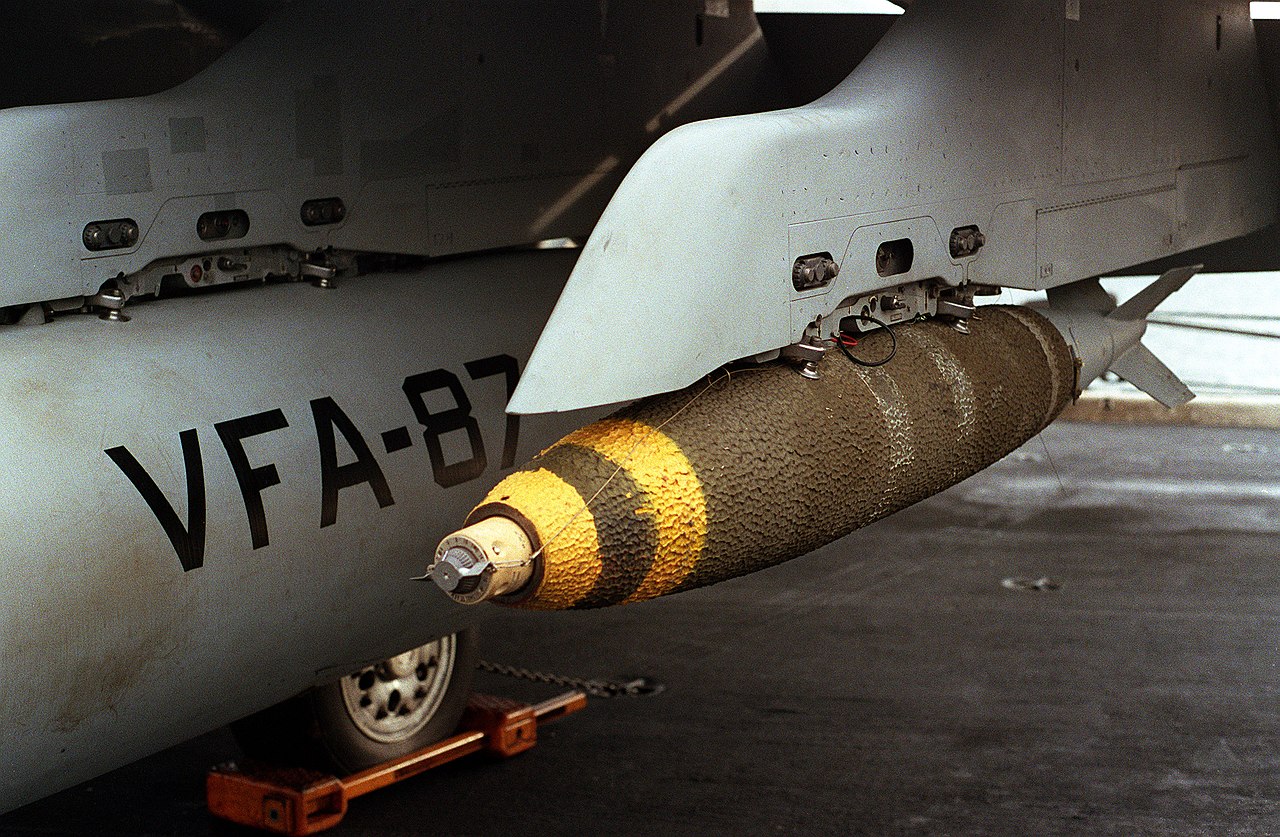
Lt. Parsons, USN · U.S. DefenseImagery [1] photo VIRIN: DN-SC-92-04279 [2] · Public domain
- Field
- aerial bomb
Reference Check
Propose documentary evidence for unguided bomb. A contribution is never written directly as fact: identity, source, rights and evidence gates still decide.
Sign in to contribute
World of VALÉORINE
Documentary connections
Only confirmed graph relationships appear here. Images are shown only when their identity and reuse rights both pass the documentary gate.

Broader Term · outgoing
aerial bomb
Term
Own work

Broader Term · incoming
B83 nuclear bomb
Term
http://www.dodmedia.osd.mil

Broader Term · incoming
barrel bomb
Term
Own work

Broader Term · incoming
Mark 118 bomb
Term
Own work
Broader Term · incoming
Mark 27
Term

Broader Term · incoming
Mark 77 bomb
Term
This tag does not indicate the copyright status of the attached work. A normal copyright tag is still required. See Commons:Licensing .
Documentary evidence
Documentary basis
Authority files
wikidata · Q1454201 · wikipedia · Unguided bomb
In this article
Retarded bomb
Bomb casings for unguided bombs are typically aerodynamic in shape, often with fins at the tail section, which reduce drag and increase stability after release, both of which serve to improve accuracy and consistency of trajectory. Unguided bombs typically use a contact fuze for detonation upon impact, or some milliseconds after if a penetration effect is required. Alternatives include a fuze with an altimeter to cause an air burst at the desired altitude, and a proximity fuze to cause an air burst at a specific distance from the ground or other target.
• Illustration — An F-111 dropping Mark 82 bombs with ballute-type retardation systems (Mk82AIR / BSU49B) • Illustration — Mk. 82 bomb with a Snake Eye tail retarding device – this photograph shows an unfuzed, museum display Mk 82 with its usual combat paint scheme. For display purposes, the optional high-drag Snake Eye tailfin set used for low-altitude release is shown. The retarded bomb uses a mechanical method of creating increased aerodynamic drag, such as a parachute, ballute, or drag-inducing petals. These deploy after the ordnance is released, slowing its fall and abbreviating its forward trajectory, giving the aircraft time to get clear of the blast zone when bombing from low altitudes or with nuclear ordnance. However, these bombs are less accurate than conventional free-fall bombs. Generally the high-drag tail replaces the low-drag so that the same bomb can be configured for either mode of attack during weapons preparation. High-drag bombs can also be dropped in low-drag mode if the pilot selects this option in the aircraft's weapon system, and will function exactly like a low-drag weapon.
Text attribution
Licensing
Text attribution
Part of the biographical narrative on this page reuses licensed material. Its origin, revision and licence are recorded here.
The biographical narrative on this page is based on the Wikipedia article Unguided bomb, revision 1356319090 (EN edition), by its contributors. VALÉORINE has edited that text and built its own documentary record around it. The reused material is available under CC BY-SA 4.0, and this page's reuse of it is offered under the same licence. Everything else on this page — the chronology, the holdings, the evidence, the plates and the connections — is VALÉORINE's own record. Sources and licences.
References
Citations
References
Each reference names the institution holding it, so a reader may go to the document itself.
reference work
Secondary witnessreference work
Secondary witness
Connections
Knowledge graph
Connections
Each connection was recorded deliberately, with the basis for it kept on the internal record.
Broader subject
5- aerial bombTerminology
Established from a fact already recorded on a verified source.
- B83 nuclear bombTerminology
Established from a fact already recorded on a verified source.
- barrel bombTerminology
Established from a fact already recorded on a verified source.
- Mark 118 bombTerminology
Established from a fact already recorded on a verified source.
- Mark 77 bombTerminology
Established from a fact already recorded on a verified source.
The Encyclopedia exists whether or not anything is for sale. Corrections are recorded rather than overwritten, and every version of this record is kept. Published 14 August 2026.
Elsewhere in Militaria
6,095 published records in this field, each with its sources named.
- UMPB D-30Terminology
- UMTASTerminology
- underwater firearmTerminology
- unexploded ordnanceTerminology
- Union Automatic RevolverTerminology
- United Defense M42Terminology
- United States Army Squad Designated Marksman RifleTerminology
- United States Marine Corps Designated Marksman RifleTerminology
Best supported in this field
For owners
Own an object connected with unguided bomb?
A specialist will read what you send and tell you what the house can establish, what it cannot, and whether the object is suited to sale. There is no charge and no obligation. The object stays with you throughout; nothing is shipped to us unless it is arranged in writing beforehand.