
Type 4 Ho-Ro
The Imperial Japanese Army Type 4 15cm self-propelled gun Ho-Ro was based on an already existing reinforced Type 97 Chi-Ha medium tank chassis developed by the Imperial Japanese Army in World War II.
Also recorded as Type 4 15 cm self-propelled gun · 150 mm howitzer on Type 97 · Ho Ro self-propelled howitzer · Type 4 SPA
Type 4 Ho-Ro

Imperial Japanese Army · Jiro Sayama "Kiko nyumon: kikaika butai tettei kenkyu" p286, Kojinsha, 2002. · Public domain
- Name
- Type 4 Ho-Ro
- Field
- self-propelled artillery
- Region
- Empire of Japan
VALÉORINE Encyclopedia
VALÉORINE documentary reading
Documentary summary
The Imperial Japanese Army Type 4 15cm self-propelled gun Ho-Ro was based on an already existing reinforced Type 97 Chi-Ha medium tank chassis developed by the Imperial Japanese Army in World War II.
Admitted source layer · organised and presented by VALÉORINE
Note VALÉORINE
No house-authored Note is published until its assertions and sources pass the VALÉORINE evidence contract. The documentary article remains available in full while that enrichment is being consolidated.
Documentary enrichment in progress · no unsupported statement published
Reference Check
Propose documentary evidence for Type 4 Ho-Ro. A contribution is never written directly as fact: identity, source, rights and evidence gates still decide.
Sign in to contribute
World of VALÉORINE
Documentary connections
Only confirmed graph relationships appear here. Images are shown only when their identity and reuse rights both pass the documentary gate.

Documentary evidence
Evidence Panel
not yet certified
- Identity
- resolved
- Independent source families
- 0
- Admitted assertions
- 0
- Open conflicts
- 0
Authority files
wikidata · Q2301167 · wikipedia · Type 4 Ho-Ro
In this article
Key facts
Key facts
• Type — Self-propelled artillery • Name — Type 4 Ho-Ro • Is Vehicle — yes • Origin — Empire of Japan • Production Date — 1944 • Number — 12 • Length — 5.52 meters (18.1 ft) • Width — 2.33 meters (7.64 ft) • Height — 2.36 meters (7.74 ft) • Weight — 16.3 tons • Suspension — bellcrank • Speed — 38 km/h (23.6 mph) • Vehicle Range — 200 kilometers (125 miles) • Primary Armament — 150 mm Type 38 howitzer • Secondary Armament — None • Armour — 12–25mm (0.98in) • Engine — Mitsubishi Type 100 air-cooled V-12 diesel • Engine Power — 170 Hp (126.8 kW) • Pw Ratio — 12.8 hp/ton • Crew — 6
Development
Development
Inspired by the Grille series of self-propelled artillery vehicles developed by Nazi Germany during World War II, wherein a 15 cm sIG 33 infantry support gun was mounted on a tracked chassis, engineers at the Army Technical Bureau resolved to do the same. Just like the German Grille, the Ho-Ro was based on an already existing chassis. Production was assigned to Mitsubishi Heavy Industries. According to one estimate, 12 units were completed in 1944.
Design
Design
• Illustration — Type 4 15cm self-propelled gun Ho-Ro, side view The hull selected was a modified Type 97 Chi-Ha medium tank chassis. On to this platform, a Type 38 150 mm howitzer based on a design by the German arms-manufacturer Krupp was mounted, but dated from 1905 and had been withdrawn from service as being obsolete in 1942. The main gun could fire Type 88 APHE rounds and HEAT rounds, if necessary. Given its breech loader, the maximum rate of fire was only 5 rounds per minute. The gun's elevation was restricted to 30 degrees by the construction of the chassis. The restricted elevation meant it was capable of firing a 35 kilogram shell 6,000 meters (6,600 yards). Other design issues included the fact that although the gun crew was protected by a gun shield with armor thickness of 25 mm at the front, the shield with armor thickness of 12 mm only extended a very short distance on the sides; leaving the rest of the sides and back exposed. In addition, the Ho-Ro did not have any secondary armament, such as a machine-gun, making it vulnerable to close combat. • Illustration — Top-angle view of Type 4 Ho-Ro
Combat history
Combat history
The Type 4 Ho-Ro was rushed into service, deployed and saw combat as part of the 2nd Tank Division with the Japanese Fourteenth Area Army during the Philippines Campaign in the last year of World War II. Remaining units were deployed to Okinawa in ones and twos for island defense during the Battle of Okinawa, but were severely outnumbered by American artillery.
Surviving example
Surviving example
• Illustration — Type 4 Ho-Ro at the American Heritage Museum The only known surviving example of a Type 4 Ho-Ro is located at the American Heritage Museum in Stow, Massachusetts. It is currently on loan from the National Museum of the Marine Corps and was captured on the island of Luzon in the Philippines.
Identity
Identity
Type 4 Ho-Ro is classified as a self-propelled artillery. Associated with Empire of Japan.
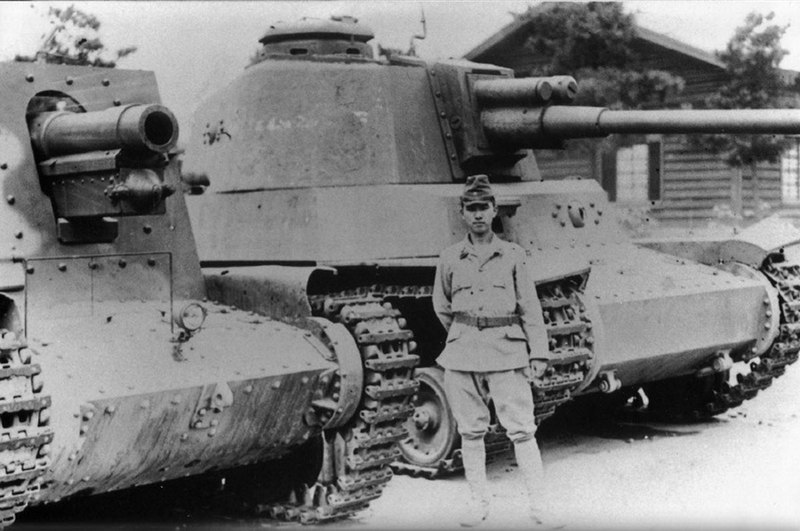
Front angle view of a Type 4 Ho-Ro and Type 4 Chi-To
Imperial Japanese Army

Top-angle, side view of Type 4 Ho-Ro self-propelled gun
Imperial Japanese Army
Places
Named by the record
Places
Only places the record itself states, plotted where the house gazetteer settles their coordinates. Nothing is inferred from a name or a nationality.
Empire of Japan
Country
Type 4 Ho-Ro is associated with Empire of Japan.
Country
References
Citations
References
Each reference names the institution holding it, so a reader may go to the document itself.
reference work
Partially resolvedreference work
Partially resolved
Further particulars
Held on the record
Further particulars
Open the remaining particulars
Type 4 Ho-Ro is connected to 1 other published record in the VALÉORINE Encyclopedia.
The Encyclopedia exists whether or not anything is for sale. Corrections are recorded rather than overwritten, and every version of this record is kept. Published 14 August 2026.
Elsewhere in Militaria
6,095 published records in this field, each with its sources named.
- Type 38 rifleTerminology
- Type 4 40 cm Rocket LauncherTerminology
- Type 4 75 mm AA GunTerminology
- Type 4 grenadeTerminology
- Type 4 rifleTerminology
- Type 4 rocket launcherTerminology
- Type 41 75 mm Mountain GunTerminology
- Type 44 carbineTerminology
Best supported in this field
For owners
Own an object connected with Type 4 Ho-Ro?
A specialist will read what you send and tell you what the house can establish, what it cannot, and whether the object is suited to sale. There is no charge and no obligation. The object stays with you throughout; nothing is shipped to us unless it is arranged in writing beforehand.