
Type 14 105 mm cannon
The Type 14 10 cm cannon (十四式十糎加農砲, Jyūyon-shiki Kanōhō) was the first medium caliber cannon totally of Japanese design and the first with a split trail carriage. The Type 14 designation was given to this gun as it was accepted in the 14th year of Emperor Taishō's reign (1925). It was used by the Imperial Japanese Army but was not considered successful and was replaced by the Type 92 10 cm cannon.
Also recorded as Type 14 10 cm Cannon
Type 14 105 mm cannon

Flickr user · Flickr · CC BY 2.0
- Field
- field gun.
- Region
- Japan.
VALÉORINE Encyclopedia
VALÉORINE documentary reading
Documentary summary
The Type 14 10 cm cannon (十四式十糎加農砲, Jyūyon-shiki Kanōhō) was the first medium caliber cannon totally of Japanese design and the first with a split trail carriage. The Type 14 designation was given to this gun as it was accepted in the 14th year of Emperor Taishō's reign (1925). It was used by the Imperial Japanese Army but was not considered successful and was replaced by the Type 92 10 cm cannon.
Admitted source layer · organised and presented by VALÉORINE
Note VALÉORINE
No house-authored Note is published until its assertions and sources pass the VALÉORINE evidence contract. The documentary article remains available in full while that enrichment is being consolidated.
Documentary enrichment in progress · no unsupported statement published
Reference Check
Propose documentary evidence for Type 14 105 mm cannon. A contribution is never written directly as fact: identity, source, rights and evidence gates still decide.
Sign in to contribute
World of VALÉORINE
Documentary connections
Only confirmed graph relationships appear here. Images are shown only when their identity and reuse rights both pass the documentary gate.

Documentary evidence
Evidence Panel
not yet certified
- Identity
- resolved
- Independent source families
- 0
- Admitted assertions
- 0
- Open conflicts
- 0
Authority files
wikidata · Q3297818 · wikipedia · Type 14 10 cm cannon
In this article
History and development
History and development
Following reports based on first-hand observation of European artillery tactics in World War I by Japanese military observers, the Imperial Japanese Army General Staff instructed the Army Technical Bureau to begin work on new designs to modernize Japan's largely antiquated artillery. One priority was the development of a medium caliber artillery piece that would be able to provide greater firepower than the standard 75mm artillery currently in front line service. However, Japan lacked much of the technical expertise or industrial infrastructure to develop such as weapon, and initial prototypes issued as the "Type 7 10cm cannon" and the "Type 12 10cm cannon" were rejected as unsatisfactory. However, with the incorporation of advancement in design taken from contemporary Schneider designs, the Type 14 10 cm cannon was finally accepted into service in 1925. However, due to technical and budgetary issues, only a total of 60 units were produced.
Design
Design
The Type 14 10 cm cannon was similar in design to the earlier Type 38 10 cm cannon, which was in turn based on a 1905 Krupp design, but is notable in that it was the first design done independently in Japan. It had an interrupted screw breechblock, a hydro-pneumatic recoil mechanism, heavy wooden wheels, and a split trail. Ammunition was semifixed, with high-explosive, armor-piercing, shrapnel, and gas shells, and time fuzes for smoke and incendiary projectiles. It was designed to be transportable by a team of eight draft horses. However, in 1931, a tractor was designed for use with the Type 14, with a 50-horsepower diesel engine, which greatly increased its transportability, albeit at a top speed of eight miles per hour.
Combat record
Combat record
The Type 14 10 cm cannon proved disappointing in terms of range and accuracy, and was not regarded as a successful design. The completed cannons were assigned to reserve and training units in the Japanese home islands, and were not deployed overseas in World War II.

Artillery pieces (mainly Japanese) in the Military Museum of the Chinese People's Revolution
Ryo Chijiiwa · Flickr: artillery
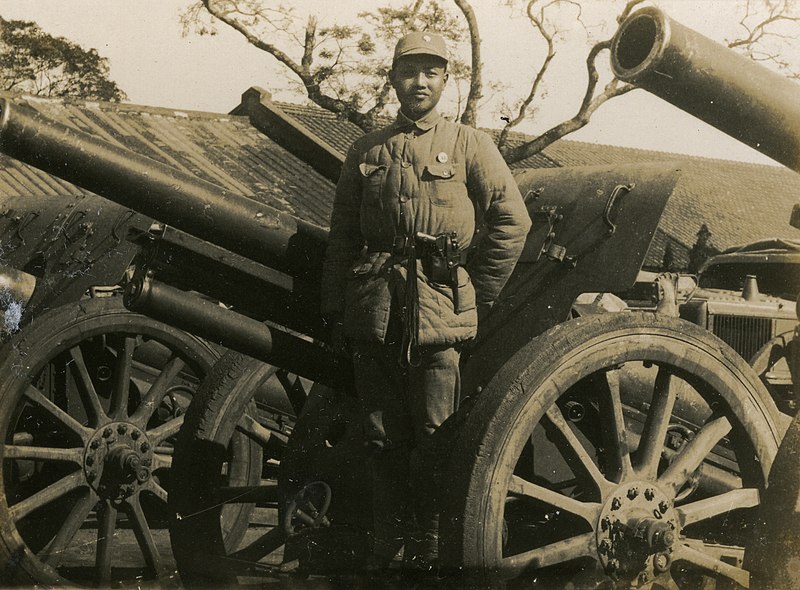
一位國民革命軍士兵與火砲合影,桃園。
吳金淼 · 意象.台灣影像資料庫
Notes from the source article
Cited by Wikipedia
Notes from the source article
These works are cited by the source article, in its own numbering. They are recorded as its citations, not as sources VALÉORINE has verified.
- 1.101. www.quarryhs.co.uk.
- 2.War Department Special Series No 25 Japanese Field Artillery October 1944
- 3.Taki's Imperial Japanese Army: Type 14 10cm Cannon
- 4.US Department of War, TM 30-480, Handbook on Japanese Military Forces
- 5.US Department of War, TM 30-480, Handbook on Japanese Military Forces
Bibliography printed in the source article · 7
- Bishop, Chris (eds) The Encyclopedia of Weapons of World War II. Barnes & Nobel. 1998.
- Chamberlain, Peter and Gander, Terry. Light and Medium Field Artillery. Macdonald and Jane's (1975).
- Chant, Chris. Artillery of World War II, Zenith Press, 2001,
- McLean, Donald B. Japanese Artillery; Weapons and Tactics. Wickenburg, Ariz.: Normount Technical Publications 1973. .
- Mayer, S.L. The Rise and Fall of Imperial Japan. The Military Press (1984)
- War Department Special Series No 25 Japanese Field Artillery October 1944
- US Department of War, TM 30-480, Handbook on Japanese Military Forces, Louisiana State University Press, 1994.
References
Citations
References
Each reference names the institution holding it, so a reader may go to the document itself.
reference work
Partially resolvedreference work
Partially resolved
Connections
Knowledge graph
Connections
Each connection was recorded deliberately, with the basis for it kept on the internal record.
Broader subject
1- field gunTerminology
Established from a fact already recorded on a verified source.
The Encyclopedia exists whether or not anything is for sale. Corrections are recorded rather than overwritten, and every version of this record is kept. Published 14 August 2026.
Elsewhere in Militaria
6,095 published records in this field, each with its sources named.
- Type 11 Surface-to-Air MissileTerminology
- Type 12 surface-to-ship missileTerminology
- Type 12 torpedoTerminology
- Type 14 10 cm AA GunTerminology
- Type 16 maneuver combat vehicleTerminology
- Type 19 155 mm Wheeled Self-propelled HowitzerTerminology
- Type 2Terminology
- Type 2 20 mm AA Machine CannonTerminology
Best supported in this field
For owners
Own an object connected with Type 14 105 mm cannon?
A specialist will read what you send and tell you what the house can establish, what it cannot, and whether the object is suited to sale. There is no charge and no obligation. The object stays with you throughout; nothing is shipped to us unless it is arranged in writing beforehand.