
Type 11 light machine gun
The Type 11 light machine gun is a light machine gun used by the Imperial Japanese Army in the interwar period and during World War II. Adopted as the Imperial Japanese Army's first light machine gun, the Type 11 was designed by Kijirō Nambu and had certain similarities to the Hotchkiss series of machine guns. It had an unusual feed system which required five round clips to be dropped into a hopper, this held up to a total of six clips (30 rounds) and each round was oiled as it was fed into the chamber. Despite good overall performance, this feed system was prone to collect dirt and grit which would jam the weapon while in use.
Type 11 light machine gun
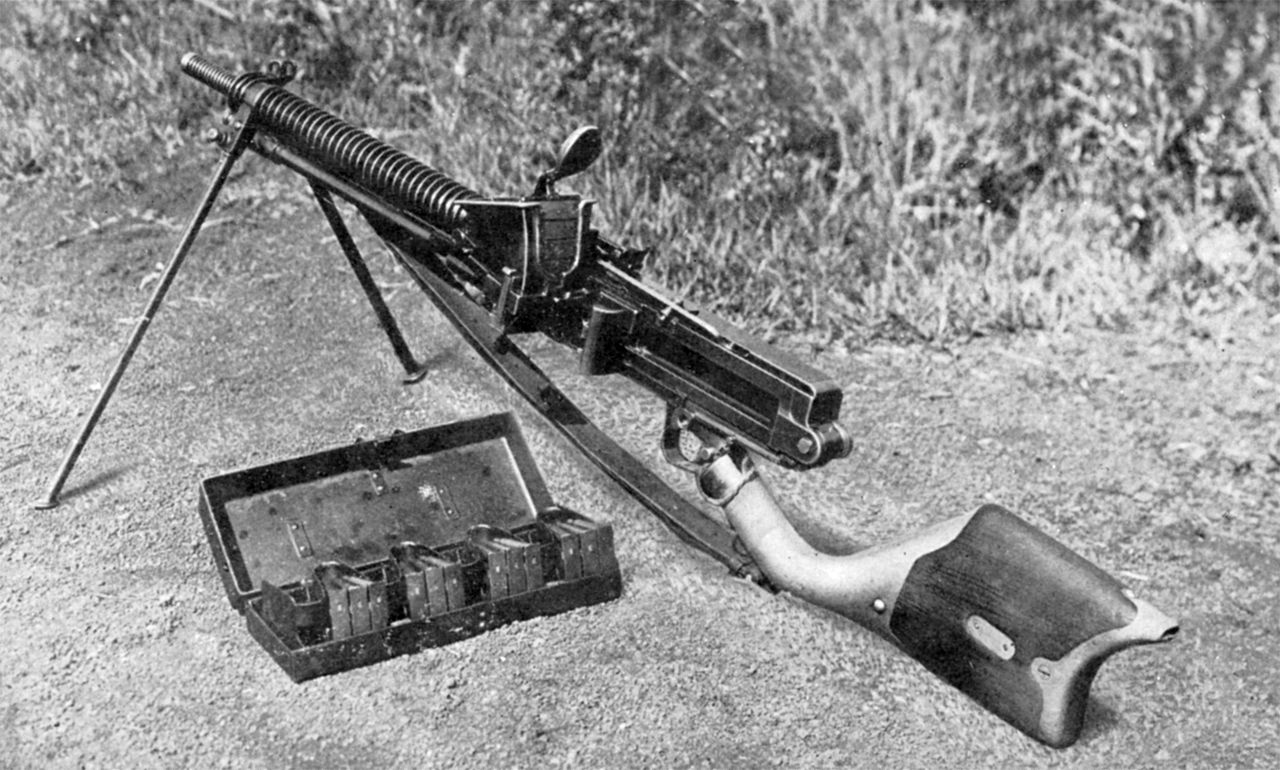
Unknown - possibly Japanese military photographer · 1933 Japanese language book "Glorious army picture book" · Public domain
- Name
- Type 11 light machine gun
- Field
- light machine gun
- Period
- 1922
- Region
- Japan · Empire of Japan
VALÉORINE Encyclopedia
VALÉORINE documentary reading
Documentary summary
The Type 11 light machine gun is a light machine gun used by the Imperial Japanese Army in the interwar period and during World War II. Adopted as the Imperial Japanese Army's first light machine gun, the Type 11 was designed by Kijirō Nambu and had certain similarities to the Hotchkiss series of machine guns. It had an unusual feed system which required five round clips to be dropped into a hopper, this held up to a total of six clips (30 rounds) and each round was oiled as it was fed into the chamber. Despite good overall performance, this feed system was prone to collect dirt and grit which would jam the weapon while in use.
Admitted source layer · organised and presented by VALÉORINE
Note VALÉORINE
No house-authored Note is published until its assertions and sources pass the VALÉORINE evidence contract. The documentary article remains available in full while that enrichment is being consolidated.
Documentary enrichment in progress · no unsupported statement published
Reference Check
Propose documentary evidence for Type 11 light machine gun. A contribution is never written directly as fact: identity, source, rights and evidence gates still decide.
Sign in to contribute
World of VALÉORINE
Documentary connections
Only confirmed graph relationships appear here. Images are shown only when their identity and reuse rights both pass the documentary gate.

Documentary evidence
Evidence Panel
not yet certified
- Identity
- resolved
- Independent source families
- 0
- Admitted assertions
- 0
- Open conflicts
- 0
Authority files
wikidata · Q1151334 · wikipedia · Type 11 light machine gun
In this article
Overview
Overview
It was issued to troops in 1922 and saw extensive service as a squad weapon until 1945.
Key facts
Key facts
• Name — Type 11 light machine gun • Origin — Empire of Japan • Type — Light machine gun • Is Ranged — yes • Service — 1922–1945 • Used By — See Users • Wars — Second Sino-Japanese War Soviet-Japanese Border Wars World War II Chinese Civil War Indonesian National Revolution First Indochina War Darul Islam Rebellion Hukbalahap Rebellion Malayan Emergency Korean War Vietnam War • Designer — Kijiro Nambu • Design Date — 1922 • Unit Cost — 585 yen ($157 USD) in August 1939 • Production Date — 1922–1941 • Number — 29,000 • Weight — 10.2 kg • Length — 1100 mm • Part Length — 443 mm • Cartridge — 6.5×50mm Arisaka • Action — Gas-operated • Rate — 500 rounds/min • Velocity — 736 m/s • Range — 800 m • Max Range — 3700 m (6.5×50mm Arisaka) • Feed — 30-round, hopper system using 6x 5-round stripper clips • Sights — Iron
History
History
Combat experience in the Russo-Japanese War of 1904–1905 had convinced the Japanese of the utility of machine guns in providing covering fire for advancing infantry. This was reinforced by first-hand observations of European combat tactics by Japanese military attachés during the First World War, and the Army Technical Bureau was tasked with the development of a lightweight machine gun which could be easily transported by an infantry squad. The resultant "Type 11 light machine gun" (named after the 11th year of the reign of Emperor Taishō, or 1922) was the first light machine gun to be mass-produced in Japan and the oldest Japanese light machine gun design to see service in the Pacific War. It was superseded by the Type 96 light machine gun in 1936.
Design details
Design details
• Illustration — A Type 11 with accessories • Illustration — A Chinese copy of the Type 11 light machine gun (Type 17) in the Military Museum of the Chinese People's Revolution, Beijing The Type 11 light machine gun was a design by famed arms designer Kijirō Nambu, based on a modification of the French Hotchkiss M1909 Benét–Mercié machine gun. It was an air-cooled, gas-operated design, using the same 6.5×50mm Arisaka cartridges as the Type 38 infantry rifle. A feature of the Type 11 machine gun is its detachable hopper; it can be refilled while attached and does not require removal during operation. Instead of a belt or box magazine, the Type 11 was designed to hold up to six of the same cartridge clips used on the Type 38 rifle. The five-round clips were stacked lying flat above the receiver, secured by a spring arm, and the rounds were stripped from the lowest clip one at a time, with the empty clip dropped out the bottom and the next clip automatically falling into place as the gun was fired. The system had the advantage that any squad member could supply ammunition and that the hopper could be replenished at any time. The relatively short barrel (17.5 inches) produced excessive flash with standard ammunition (initially intended for Type 38 rifles with barrels more than a foot longer). A new load was introduced which burned much more completely in the Type 11's short barrel and produced much less flash as a result. This new round was called the 6.5×50mm Arisaka genso round and the ammunition cartons were identified by a circled "G". The inherent disadvantage of the hopper was that the open feeder box allowed dust and grit to enter the gun, which was liable to jam in muddy or dirty conditions due to issues with poor dimensional tolerances, which gave the weapon a bad reputation with Japanese troops. Another issue was that the weight of the rifle cartridges in the side-mounted hopper unbalanced the weapon when fully loaded. To compensate, the buttstock was designed in a way that it bent to the right, leading to the Chinese nickname for the weapon as the "bent buttstock". Reloading the weapon during an assault charge proved impossible due to the clip feeding system.
Variants
Variants
Type 89 "flexible" – Two Type 11 actions mounted on a flexible mounting for anti-aircraft use and as a rear-defense aerial gun. The machine gun was chambered for the 7.7x58mmSR Type 89 cartridge. It was equipped with a metallic Y-shaped stock and two spade grips, the barrels had no cooling fins. It was fed from two 45-round quadrant-shaped pan magazines (each magazine had a place for nine five-round stripper clips). The double-barrelled machine gun weighted about 28 kg and had a rate of fire of around 1,400 rpm. • Illustration — Type 91 tank machine gun Type 91 – was a modified Type 11 for use on tanks and armoured vehicles. The machine gun was equipped with an angled pistol grip, the stock and bipod were removed, and the hopper was extended to hold three extra clips for a total of 45 rounds. Additionally, the machine gun was equipped with two brackets (on the right side) for mounting a 1.5x30 scope manufactured by Tomioka Kogaku. Te-4 – A modified Type 11 which was designed to replace the Type 89 "flexible" due to the excessive weight of the latter. It used a different flexible mounting, had a shorter wooden stock and a straight pistol grip with an enlarged trigger guard, the barrel had no cooling fins. It was chambered for the 7.7x58mmSR Type 89 cartridge and fed from 70-round pan magazines. It is uncertain whether the Te-4 was made by splitting the Type 89 "flexible" or was a direct derivative of Type 11. Liao Type 17 - A Chinese copy of the Type 11 design manufactured in small numbers at the Mukden Arsenal. Around 400 were produced between 1928 and 1931, production was halted due to the Japanese invasion of Manchuria. One surviving example is displayed at the Military Museum of the Chinese People's Revolution in Beijing.
Combat record
Combat record
• Illustration — IJN Special Naval Landing Forces armed with the Type 11 during the Battle of Shanghai • Illustration — A Type 11 light machine gun captured by the Chinese Army and used against IJA soldiers • Illustration — The Type 91 Tank Machine Gun is being used by the IJA soldier during Battle of Shanghai (1937) • Illustration — A Type 11 (background) used by Indonesian irregulars during training, 1946 The Type 11 came into active service in 1922, and some 29,000 were produced by the time production stopped in 1941. It was the primary Japanese light machine gun through the Manchurian Incident and in the early stages of the Second Sino-Japanese War. Although superseded by the Type 96 light machine gun in production in 1936, it remained in service with front-line combat through the end of World War II. Many were captured by the Chinese and were used against the Japanese. The Manchukuo Imperial Army replaced its ex-Chinese ZB vz. 30s with Type 11s in 1936. Both sides also used Type 11 machine guns during the Chinese Civil War and North Korea used Type 11 and Type 91 during the Korean War. Indonesian nationalist forces used the Type 11 during the Indonesian National Revolution. The Viet Minh also used the Type 11 during the First Indochina War, as did the Viet Cong during the Vietnam War.
Users
Users
• Republic of China: Purchased a small number before war with Japan began. Later captured Japanese examples were used by all Chinese armies including Nationalist, Warlord, Collaborationist and Communist. • Indonesia • Japanese Empire • Flag of the Malayan National Liberation Army.svg Malayan National Liberation Army • Manchukuo • North Korea • People's Liberation Army • Philippines: Captured from Japanese army • South Korea • Republic of South Vietnam Viet Cong • Viet Minh
Chronology
Dated record
Chronology
The full dated record · 2 entries
1922
Type 11 light machine gun first recorded.
1922
Type 11 light machine gun is recorded from 1922.
Main sources
Main sources
* * * * * *
Secondary sources
Secondary sources
* * *
Notes from the source article
Cited by Wikipedia
Notes from the source article
These works are cited by the source article, in its own numbering. They are recorded as its citations, not as sources VALÉORINE has verified.
- 1.Banking and Monetary Statistics, 1914-1941, Part I, p. 673
- 2.TYPE 11 MACHINE GUN - Quartermaster Section.
- 3.Hogg, I. V. (1984). Weapons of the Japanese Army. In S. L. Mayer (Ed.), The Rise and Fall of Imperial Japan, 1894-1945 (pp. 46-51). The Military Press.
- 4.MG. Taki's Japanese Imperial Army website.
- 5.TM-E 30–480 (1945)
- 6.Rottman, Gordon L. Japanese Army in World War II - Conquest of the Pacific 1941-42. Osprey Publishing. 46. 2005. 1841767891.
- 7.Type 11 Nambu LMG. 30 March 2012.
- 8.Segel, Robert G. (2015)
- 9.Meyer, The Rise and Fall of Imperial Japan. pg.55
- 10.Mikesh, Robert C. Japanese Aircraft Equipment 1940 – 1945. Shiffer Publishing. 115–116. 2004. 978-0-7643-2097-2.
- 11.1220195091.1027914646.jpg.
- 12.Japanese Weapons.net. Machine Gun Equipment.
- 13.Shih, Bin. China's Small Arms of the 2nd Sino-Japanese War (1937-1945). 161. 979-8473557848.
- 14.徐, 平. 没有枪,没有炮,敌人给我们造. www.81.cn (An official news portal of the Chinese People's Liberation Army).
- 15.Jowett, Philip S. Rays of the rising sun : armed forces of Japan's Asian allies, 1931-45. Helion. 1, China & Manchukuo. 15. 2004. 9781906033781.
- 16.Mukden Arsenal after WWII. wwiiafterwwii.wordpress.com. April 3, 2017.
- 17.Kinard, Jeff. The Encyclopedia of the Korean War: A Political, Social, and Military History. ABC-CLIO. 1. A-L. 535. 9 April 2010. 978-1-85109-849-1.
- 18.Lohnstein, Marc. The Dutch–Indonesian War 1945–49: Armies of the Indonesian War of Independence. Osprey Publishing Ltd. 33. 2023. 978-1472-8547-42.
- 19.Ezell, Edward Clinton. Personal firepower. Bantam Books. 47-48. 1988. 9780553345490.
- 20.Australian War Memorial. Type 11 Light Machine Gun. awm.gov.au.
- 21.Shih, Bin. China's Small Arms of the 2nd Sino-Japanese War (1937-1945). 161. 979-8473557848.
References
Citations
References
Each reference names the institution holding it, so a reader may go to the document itself.
reference work
Partially resolvedreference work
Partially resolved
The Encyclopedia exists whether or not anything is for sale. Corrections are recorded rather than overwritten, and every version of this record is kept. Published 14 August 2026.
Elsewhere in Militaria
6,095 published records in this field, each with its sources named.
- Type 10 grenade dischargerTerminology
- Type 100 submachine gunTerminology
- Type 11 37 mm Infantry GunTerminology
- Type 11 75 mm AA GunTerminology
- Type 11 Surface-to-Air MissileTerminology
- Type 12 surface-to-ship missileTerminology
- Type 12 torpedoTerminology
- Type 14 10 cm AA GunTerminology
Best supported in this field
For owners
Own an object connected with Type 11 light machine gun?
A specialist will read what you send and tell you what the house can establish, what it cannot, and whether the object is suited to sale. There is no charge and no obligation. The object stays with you throughout; nothing is shipped to us unless it is arranged in writing beforehand.