
Transparente
The Transparente (Transparent) is a Baroque altarpiece located in the ambulatory of the Cathedral of Toledo, in Spain. Its name refers to the unique illumination provided by a large oculus opened high up into the thick wall across the ambulatory, and another hole cut into the back of the altarpiece itself to allow shafts of sunlight to strike the tabernacle. This lower hole also allows persons in the ambulatory to see through the altarpiece to the tabernacle, as if it were "transparent".
Transparente
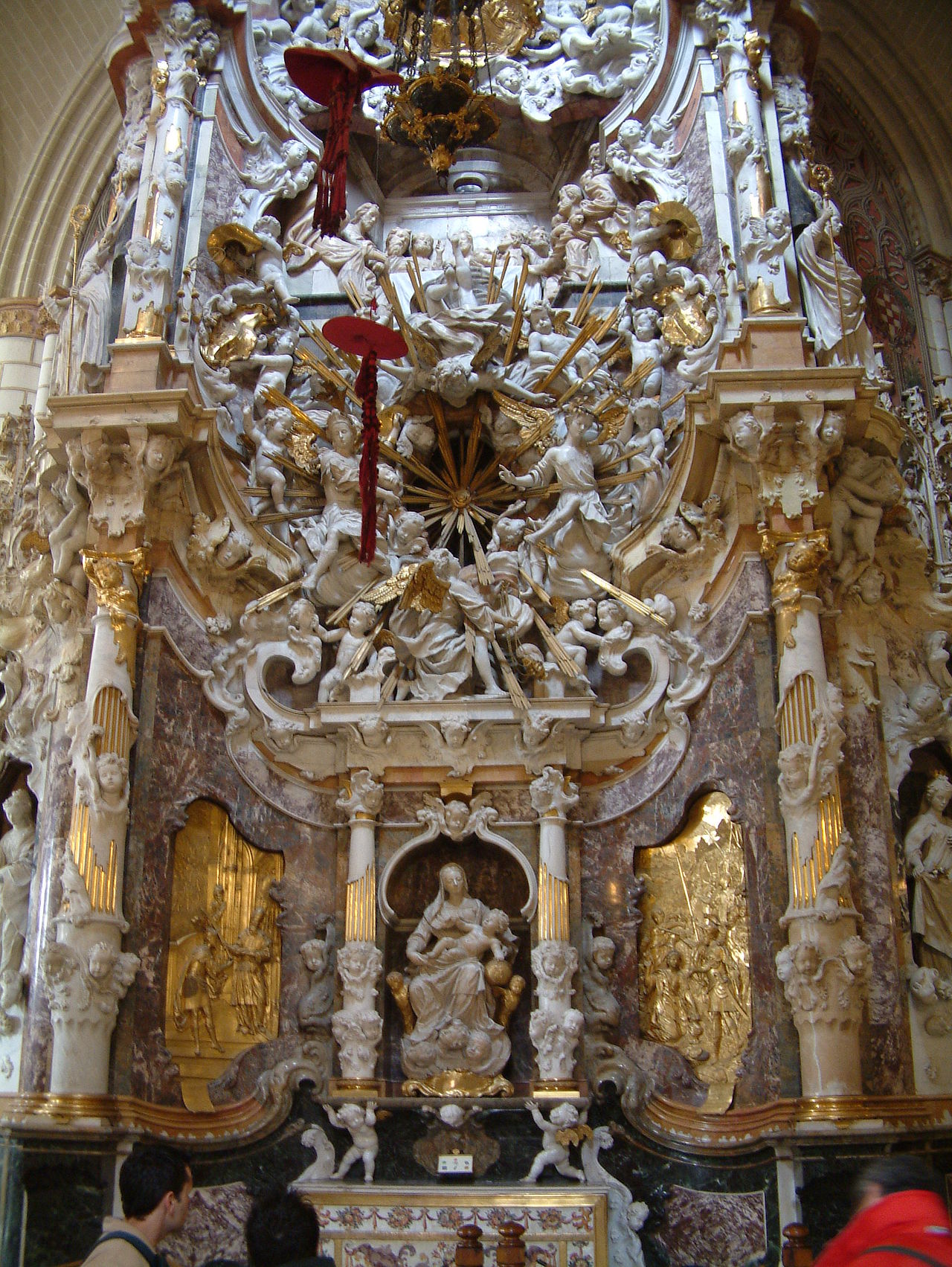
Tim giddings · Tim giddings at the English-language Wikipedia · Own work (Original text: self-made) · CC BY-SA 3.0
- Movement
- Baroque, Churrigueresque
- Region
- Spain.
VALÉORINE Encyclopedia
VALÉORINE documentary reading
Documentary summary
The Transparente (Transparent) is a Baroque altarpiece located in the ambulatory of the Cathedral of Toledo, in Spain. Its name refers to the unique illumination provided by a large oculus opened high up into the thick wall across the ambulatory, and another hole cut into the back of the altarpiece itself to allow shafts of sunlight to strike the tabernacle. This lower hole also allows persons in the ambulatory to see through the altarpiece to the tabernacle, as if it were "transparent".
Admitted source layer · organised and presented by VALÉORINE
Reference Check
Propose documentary evidence for Transparente. A contribution is never written directly as fact: identity, source, rights and evidence gates still decide.
Sign in to contribute
World of VALÉORINE
Documentary connections
Only confirmed graph relationships appear here. Images are shown only when their identity and reuse rights both pass the documentary gate.
Documentary evidence
Documentary basis
Authority files
wikidata · Q5352277
In this article
Overview
Overview
It was created between 1729-1732 by Narciso Tomé and his four sons (two architects, one painter, and one sculptor). The use of light and mixed materials (marble, bronze, paint, stucco) may reflect the influence of Bernini's Cathedra Petri in St Peter's Basilica, Rome. Its execution was ordered by Diego de Astorga y Céspedes, Archbishop of Toledo. The Archbishop wished to mark the presence of the Holy Sacrament with a glorious monument. The monument cost 200,000 ducats and aroused great enthusiasm, even a celebratory poem wherein the monument was acclaimed 'the Eighth Wonder of the World'. Cardinal Astorga y Céspedes is buried at the feet of the Transparente. According to American writer James Michener's book Iberia (1968), the Transparente was installed to allow light to pass from the ambulatory behind the high altar (or 'reredos' as he calls it), onto the tabernacle (the container for the Blessed Sacrament) which stayed in constant shadow because of the tall reredos. After the two holes were cut, Tomé and his sons designed a way to visually connect them by sculpting a fantastic company of angels, saints, prophets, and cardinals. Abstract designs suggesting flowing robes and foliage hang over corners to mask the details of the architectural piercings. Along the edges of the skylight, they arranged an array of Biblical figures who seem to tumble into the cathedral. At the outer edge of the opening sits Christ on a bank of clouds, surrounded by angels. The back side of the altarpiece was converted into a tower of marble which reaches from the floor to the ceiling. Intricate groups of figures were assembled so that the opening to the tabernacle could be hidden yet permit light to pass through.
Key facts
Key facts
• Title — Transparente • Artist — Narciso Tomé • Completion Date — 1732 • Medium — Marble, jasper, bronze • Movement — Baroque, Churrigueresque • Subject — Madonna and Child • Metric Unit — cm • Imperial Unit — in • Museum — Cathedral of Saint Mary • City — Toledo
Gallery
Gallery
• Illustration — 1842 engraving • Illustration — Ambulatory and side view • Illustration — Oculus from below • Illustration — Oculus • Illustration — Detail • Illustration — Madonna detail
Places
Named by the record
Places
Only places the record itself states, plotted where the house gazetteer settles their coordinates. Nothing is inferred from a name or a nationality.
Spain.
Country
Transparente is associated with Spain.
Country
Literature
Scholarly footprint
A count of publications is evidence of attention, not of standing, and is given here only as a measure.
Notes from the source article
Cited by Wikipedia
Notes from the source article
These works are cited by the source article, in its own numbering. They are recorded as its citations, not as sources VALÉORINE has verified.
References
Citations
References
Each reference names the institution holding it, so a reader may go to the document itself.
authority record
Secondary witness
Further particulars
Held on the record
Further particulars
Open the remaining particulars
In public collections
The Encyclopedia exists whether or not anything is for sale. Corrections are recorded rather than overwritten, and every version of this record is kept. Published 16 August 2026.
Elsewhere in Furniture
924 published records in this field, each with its sources named.
- Trà Kiệu altarTerminology
- Traditional Ghanaian stoolTerminology
- train seatTerminology
- Tramp chairTerminology
- trapezeTerminology
- travel cotTerminology
- Třeboň AltarpieceTerminology
- Treetrunk coffinTerminology
Best supported in this field
For owners
Own an object connected with Transparente?
A specialist will read what you send and tell you what the house can establish, what it cannot, and whether the object is suited to sale. There is no charge and no obligation. The object stays with you throughout; nothing is shipped to us unless it is arranged in writing beforehand.