
Étienne-Jules Marey
Étienne-Jules Marey (lang; 5 March 1830, Beaune, Côte-d'Or – 15 May 1904, Paris) was a French scientist, physiologist, and chronophotographer. • Illustration — Étienne Jules Marey around 1880, by Félix Nadar. His work was significant in the development of cardiology, physical instrumentation, aviation, cinematography, and the science of laboratory photography. He is widely considered to be a pioneer of photography and an influential pioneer of the history of cinema.
Also recorded as Etienne-Jules Marey · Étienne Jules Marey · Etienne Jules Marey · Chronophotographic gun
Étienne-Jules Marey
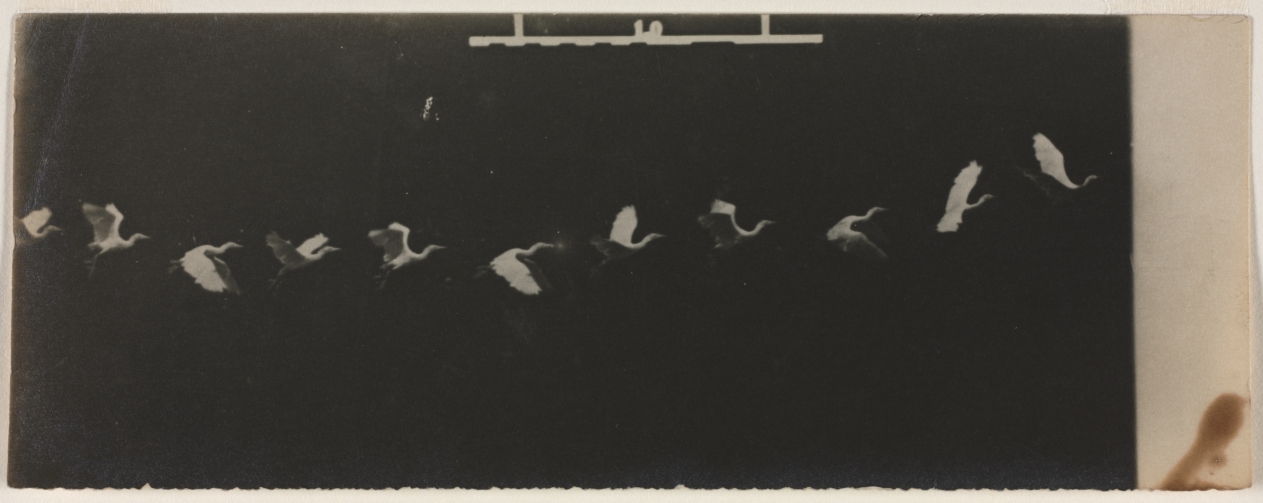
Étienne-Jules Marey · The Cleveland Museum of Art · Dudley P. Allen Fund · CC0
- Born
- 1830 · Beaune.
- Died
- 1904 · Paris.
- Nationality
- France
- Occupation
- inventor · photographer · physician · film director · physiologist · scientist
- Fields
- physiology · medicine · photography · photo equipment
- Honours
- Commander of the Legion of Honour
- Languages
- French
VALÉORINE Encyclopedia
VALÉORINE documentary reading
Documentary summary
Étienne-Jules Marey (lang; 5 March 1830, Beaune, Côte-d'Or – 15 May 1904, Paris) was a French scientist, physiologist, and chronophotographer. • Illustration — Étienne Jules Marey around 1880, by Félix Nadar. His work was significant in the development of cardiology, physical instrumentation, aviation, cinematography, and the science of laboratory photography. He is widely considered to be a pioneer of photography and an influential pioneer of the history of cinema.
Admitted source layer · organised and presented by VALÉORINE
Reference Check
Propose documentary evidence for Étienne-Jules Marey. A contribution is never written directly as fact: identity, source, rights and evidence gates still decide.
Sign in to contribute
World of VALÉORINE
Documentary connections
Only confirmed graph relationships appear here. Images are shown only when their identity and reuse rights both pass the documentary gate.

Documentary evidence
Documentary basis
Authority files
gnd · 3015199-5 · wikidata · Q289217 · wikipedia · Étienne-Jules Marey
In this article
Biography
Biography
He was also a pioneer in establishing a variety of graphical techniques for the display and interpretation of quantitative data from physiological measurement.
The recorded working language is French. The field of work recorded is physiology, medicine and photography. Employment is recorded with Collège de France. Positions recorded include president of the French Academy of Sciences and president. Work by Étienne-Jules Marey is recorded in the collections of The Nelson-Atkins Museum of Art, National Gallery of Canada, Museum of Modern Art, Photography Collection and San Francisco Museum of Modern Art. Distinctions recorded are Commander of the Legion of Honour.
• Illustration — Flying pelican captured by Marey around 1882. He created a method of recording several phases of movement superimposed into one photograph • Illustration — A galloping horse Marey started by studying blood circulation in the human body. He then shifted to analyzing heart beats, respiration, muscles (myography), and movement of the body. To aid his studies, he developed many instruments for precise measurements. For example, in 1859, in collaboration with the physiologist Auguste Chauveau and the watch manufacturer Breguet, he developed a wearable Sphygmograph to measure the pulse. This sphygmograph was an improvement on an earlier and more cumbersome design by the German physiologist Karl von Vierordt. In 1869, Marey constructed a very delicate artificial insect to show how an insect flies and to demonstrate the figure-8 shape it produced during movement of its wings. He fixed a gold foil to an insect wing and shone light on it to study the flapping of the wing. He also used a soot covered glass-fibre introduced along the path of the insect wing to determine if it crossed with the wing in the upper stroke or lower stroke by examining the side on which the soot was cleared. Then, he became fascinated by movements of air and started to study bigger flying animals, like birds. He adopted and further developed animated photography into a separate field of chronophotography in the 1880s. His revolutionary idea was to record several phases of movement on one photographic surface. In 1890, he published a substantial volume entitled Le Vol des Oiseaux (The Flight of Birds), which was illustrated with photographs, drawings, and diagrams. He also created precise sculptures of various flying birds. Marey studied other animals too. He published La Machine animale in 1873 (translated as "Animal Mechanism"). The English photographer Eadweard Muybridge carried out his "Photographic Investigation" in Palo Alto, California, to prove that Marey was right when he wrote that a galloping horse for a brief moment had all four hooves off the ground. Muybridge published his photos in 1879 and received some public attention. Marey hoped to merge anatomy and physiology. To better understand his chronophotographic images, he compared them with images of the anatomy, skeleton, joints, and muscles of the same species. Marey produced a series of drawings showing a horse trotting and galloping, first in the flesh and then as a skeleton. The presence and activity of Marey in Naples is well documented, in particular thanks to the documentation preserved in the historical archive of the Stazione Zoologica Anton Dohrn. Marey began to travel to Naples presumably because of his relation with madame Vilbort, wife of Joseph Vilbort, the director of the French journal Le Globe. Madame Vilbort moved to Naples to cure her illness, thanks to the warm climate, and Marey followed her. Marey and madame Vilbort bought villa Maria in Posillipo in 1880. Marey accomplished in Naples part of his studies aimed at the realization of his pre-cinematographic tools and in the Dohrn zoological station studied the movement of fishes hosted in the aquarium's tanks. In a letter dated 1 November 1876, Marey requested the Stazione Zoologica to provide live ray fishes for his studies. Among the documentation that notes the collaboration of Marey with Anton Dohrn is the archive at the zoological station which preserves photos where the two appear together during an excursion and show Marey on board Dohrn's boat. The usage of the chronophotographic gun, which Marey used to aim at birds, but without shooting, appeared unusual to local people who referred to Marey sometimes as the "silly from Posillipo" ("lo scemo di Posillipo"). He proposed "Marey's Law", a law that stated that an increase in blood pressure caused a lowering of the heart rate and vice versa. He also invented "Marey's tambour" for physiological experiments.
Life and career
Dated record
Life and career
Explore 1830–1904
The full dated record · 4 entries
1830
Étienne-Jules Marey was born in 1830 at Beaune.
1882
Chronophotographic gun-CnAM 16955, dated 1882, held by Conservatoire national des Arts et Métiers.
1882
Chronophotographic gun-CnAM 16955 (Conservatoire national des Arts et Métiers).
1904
Étienne-Jules Marey died in 1904 at Paris.
Places
Named by the record
Places
Only places the record itself states, plotted where the house gazetteer settles their coordinates. Nothing is inferred from a name or a nationality.
Beaune.
Birth place
Paris.
Death place
Chronophotography
Marey's chronophotographic gun was first made in 1882. This instrument was capable of taking 12 consecutive frames a second, with all the frames recorded on the same picture. Using these pictures, he studied horses, birds, dogs, sheep, donkeys, elephants, fish, microscopic creatures, molluscs, insects, reptiles, etc. Some call it Marey's "animated zoo". Marey also conducted the famous study about cats always landing on their feet. He conducted very similar studies with a chicken and a dog and found that they could do almost the same. Marey also studied human locomotion. He published another book, Le Mouvement, in 1894. • Illustration — A moving image from 1900 demonstrating shot put technique In 1885, Marey mentioned how he could playback the animation from his gun using the phenakistiscope. In 1889, he developed the chronophotographe camera, which took images on film at even spacing. He however did not manage to play it back as he was unable to move between the frames in an even manner. Edison visited Marey in 1889 and was able to solve the problem using a sprocketed film advance mechanism along with W.L. Dickison, who was developing something using the cylindrical model of the phonograph. Towards the end of his life, he returned to studying the movement of quite abstract forms, like a falling ball. His last great work was the observation and photography of smoke trails. This research was partially funded by Samuel Pierpont Langley under the auspices of the Smithsonian Institution, after the two met in Paris at the Exposition Universelle (1900). In 1901, he was able to build a smoke machine with 58 smoke trails. It became one of the first aerodynamic wind tunnels.
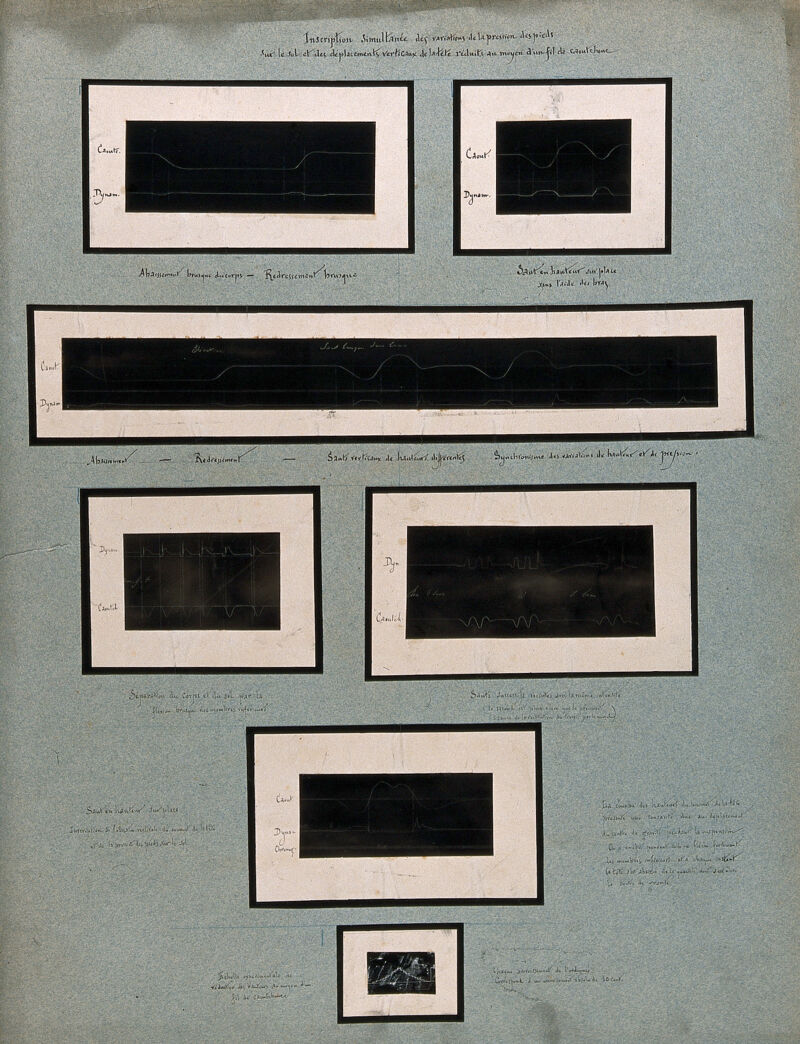
Variations of the pressure of feet on the ground and movements of the head, whilst running (?). Chart by Etienne-Jules Marey., 1800-1899, by Étienne-Jules Marey
Étienne-Jules Marey · Wellcome Collection, London · Wellcome Collection
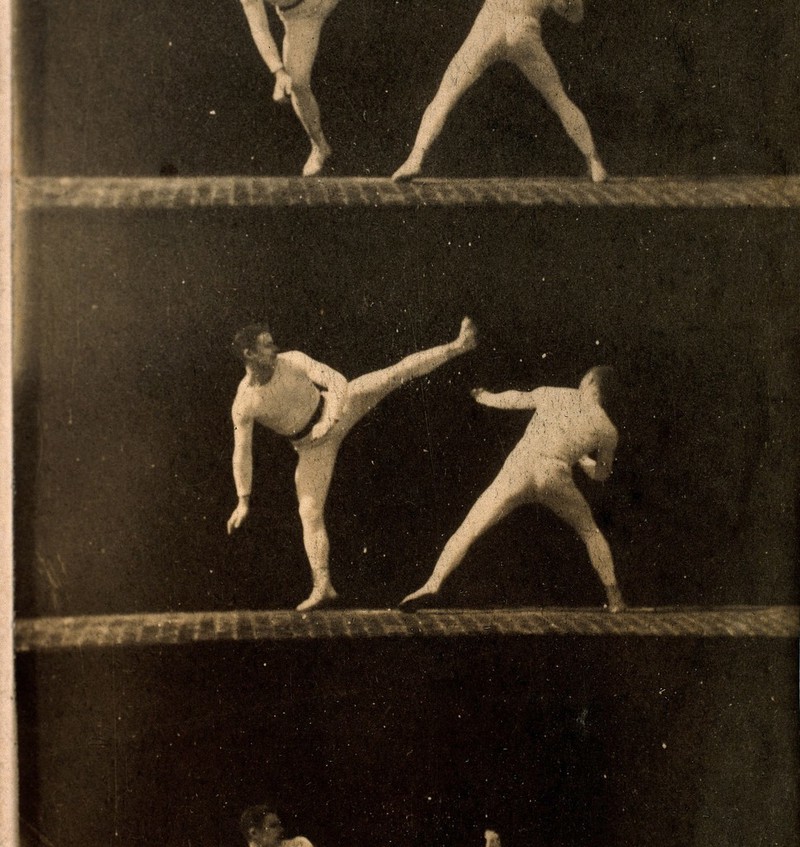
Two men dressed in white, wrestling, sequences. Photograph., by Étienne-Jules Marey
Étienne-Jules Marey · Wellcome Collection, London · Wellcome Collection
Primary material
Documents and archives
reference work
- Wikidata, structured authority record Q289217: Étienne-Jules Marey
Reputable secondary · Wikimedia Foundation
- “Étienne-Jules Marey”, English Wikipedia, consulted as further reading
Reputable secondary · Wikipedia
authority file
- Gemeinsame Normdatei 3015199-5, Musée Étienne-Jules Marey (Beaune).
General reference · Deutsche Nationalbibliothek
References
Citations
References
Each reference names the institution holding it, so a reader may go to the document itself.
authority file
Gemeinsame Normdatei 3015199-5, Musée Étienne-Jules Marey (Beaune).Deutsche Nationalbibliothek
Secondary witnessreference work
Wikidata, structured authority record Q289217: Étienne-Jules MareyWikimedia Foundation
Secondary witnessreference work
Secondary witness
People, houses and institutions
Knowledge graph
People, houses and institutions
Teachers, collaborators, publishers and institutions recorded against this person, each on a stated basis.
Died at
1- ParisPlace
Established from a fact already recorded on a verified source.
The Encyclopedia exists whether or not anything is for sale. Corrections are recorded rather than overwritten, and every version of this record is kept. Published 14 August 2026.
Elsewhere in Photography
11,392 published records in this field, each with its sources named.
- Etheldreda LaingPhotographer
- Etienne Bertrand WeillPhotographer
- Étienne ClémentelPhotographer
- Étienne SvedPhotographer
- Ettore Roesler FranzPhotographer
- Euan DuffPhotographer
- Euclide SicottePhotographer
- Eugen FreundPhotographer
Best supported in this field
For owners
Own a work by Étienne-Jules Marey?
A specialist will read what you send and tell you what the house can establish, what it cannot, and whether the object is suited to sale. There is no charge and no obligation. The object stays with you throughout; nothing is shipped to us unless it is arranged in writing beforehand.